
Teaching high school English learners is not the same as teaching younger students. Teenagers are older, more self-aware, and often much quicker to notice when a lesson feels childish or disconnected from their real lives. Because of that, finding the right ESL teaching strategies for teens matters.
When you are teaching ESL to teenagers, you are not just teaching vocabulary, grammar, reading, writing, speaking, and listening. You are also helping students build confidence, adjust to a new school system, participate with peers, and use English in academic situations.
Over time, I have learned that high school ESL strategies need to be practical, respectful, structured, and flexible. English learners need support, but they also need to feel like the work is age-appropriate. They need scaffolds, but the class should not feel watered down.
These 15 ESL teaching strategies for teens are the ones I come back to again and again in my secondary ESL classroom.
1. Use ESL Teaching Strategies for Teens to Build Predictable Routines
One of the most important parts of secondary ESL instruction is creating routines students can understand quickly.
Many English learners are already using a lot of mental energy just to follow classroom language. When every day feels completely different, students may shut down or wait for someone else to take the lead. However, predictable routines help students understand what to do without needing every direction repeated several times.
A routine does not mean every class period has to look exactly the same. Instead, it means students recognize the structure of the lesson.
For example, you might use:
- A daily bell ringer
- A short vocabulary preview
- Partner practice
- Reading or listening time
- A written response
- An exit ticket
In my classroom, routines lower the pressure. Once students know what is coming, they are usually more willing to participate.
If you are trying to build stronger routines in your own classroom, my post on ESL bell ringers and daily warm-ups gives more ideas for starting class in a consistent way.
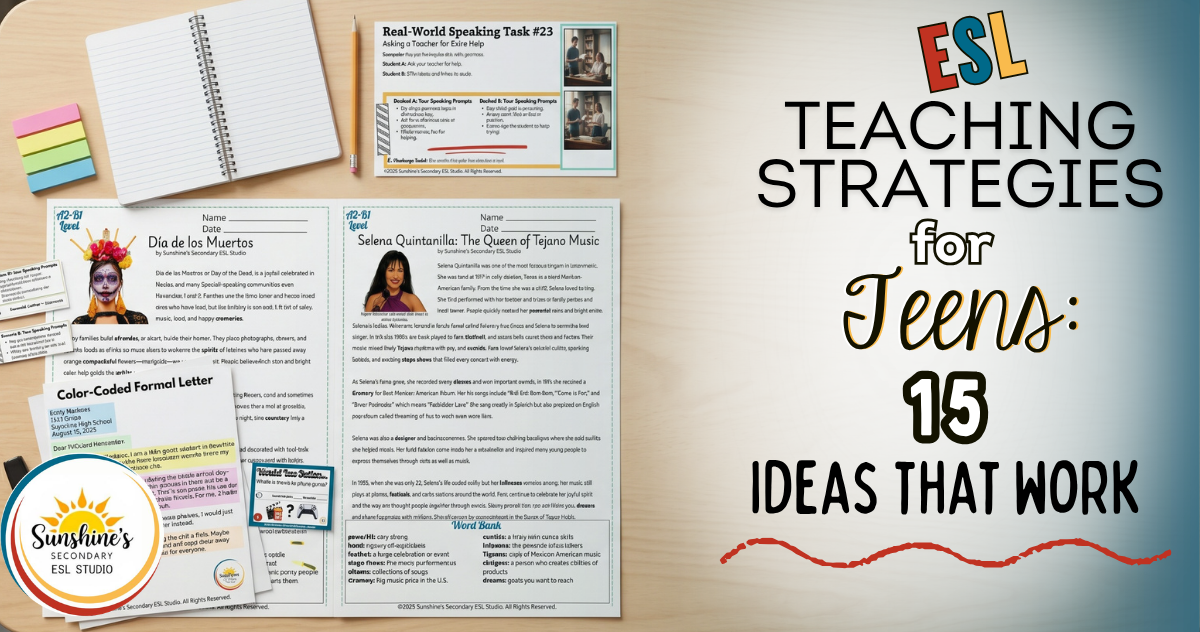
For speaking practice, I like using structured conversation cards, role plays, and speaking prompts because they give students something specific to say and do. I have several ESL speaking resources for teens in my TPT store that are designed for partner practice, small groups, and low-pressure classroom routines.
2. Choose Age-Appropriate ESL Teaching Strategies for Teens
This is one of my biggest beliefs about teaching ESL to teenagers: the materials matter.
High school students know when something looks like it was made for little kids. Even beginner English learners deserve resources that feel appropriate for their age. As a result, teen-friendly materials can make a major difference in participation.
That does not mean the language has to be too difficult. Instead, it means the topics, visuals, fonts, examples, and activities should respect students as teenagers.
Teen-friendly ESL activities often include:
- Real-life situations
- School and friendship topics
- Identity and culture
- Current issues
- High-interest images
- Practical communication tasks
- Short readings that still feel meaningful
This is especially important for beginner ESL high school students. They may need simple language, but they do not need babyish content.
I wrote more about this in my post on beginner ESL in high school, especially because beginner students are often the ones most likely to be handed materials that feel too young for them.
3. Teach Vocabulary Before Students Need It
Vocabulary is one of the biggest barriers for English learners in high school.
If students do not understand the key words in a reading, video, discussion, or writing prompt, they may not even get started. For that reason, one of the most useful high school ESL strategies is previewing vocabulary before the main lesson.
This does not have to take forever. A quick vocabulary preview can make the rest of the lesson much smoother.
You can have students:
- Match words to pictures
- Sort words by category
- Predict meanings
- Use words in simple sentences
- Connect new vocabulary to home language words
- Act out verbs or emotions
- Find examples in a short text
The goal is not for students to master every word before the lesson begins. Instead, the goal is to give them enough access to participate.
For more ideas, my post on ESL vocabulary activities for high school shares ways to make vocabulary practice more active and meaningful for teens.
4. Give Students Sentence Starters Without Making Them Dependent
Sentence starters are one of the most helpful ESL teaching strategies for teens, especially when students are expected to speak or write academically.
A strong sentence starter gives students a way into the task. It helps them begin when they are not sure how to phrase their ideas in English. However, sentence frames should support students without locking them into one exact answer.
For example:
- I agree with ___ because ___.
- One important detail is ___.
- The character feels ___ because ___.
- In my opinion, ___.
- The text shows ___.
The key is to use sentence starters as a bridge, not a permanent crutch. Over time, students should be able to choose, adapt, or move beyond them.
Instead of requiring everyone to use the same frame, I like giving students several options. This helps students at different proficiency levels participate without all sounding identical.
If you want a deeper look at this, I have a post on free ESL sentence starters for teens that explains how I use them to support speaking and writing.
5. Use ESL Teaching Strategies for Teens That Make Speaking Feel Safe
Many ESL teens are nervous about speaking English in front of others. Some are afraid of making mistakes, while others are worried their classmates will laugh. In some cases, students understand much more English than they can produce.
That is why speaking activities need structure.
Instead of asking an open-ended question to the whole class, give students time to think, write, rehearse, and practice with a partner first.
A safer speaking routine might look like this:
- Students read or listen to a prompt.
- They write a short answer.
- Partners practice together.
- Volunteers share with the class.
This gives students multiple chances to prepare before speaking publicly.
You can also use conversation cards, role plays, picture prompts, and short partner interviews to make speaking more manageable.
I wrote more about this in my post on ESL speaking confidence activities and also in my post about ESL teen speaking activities.
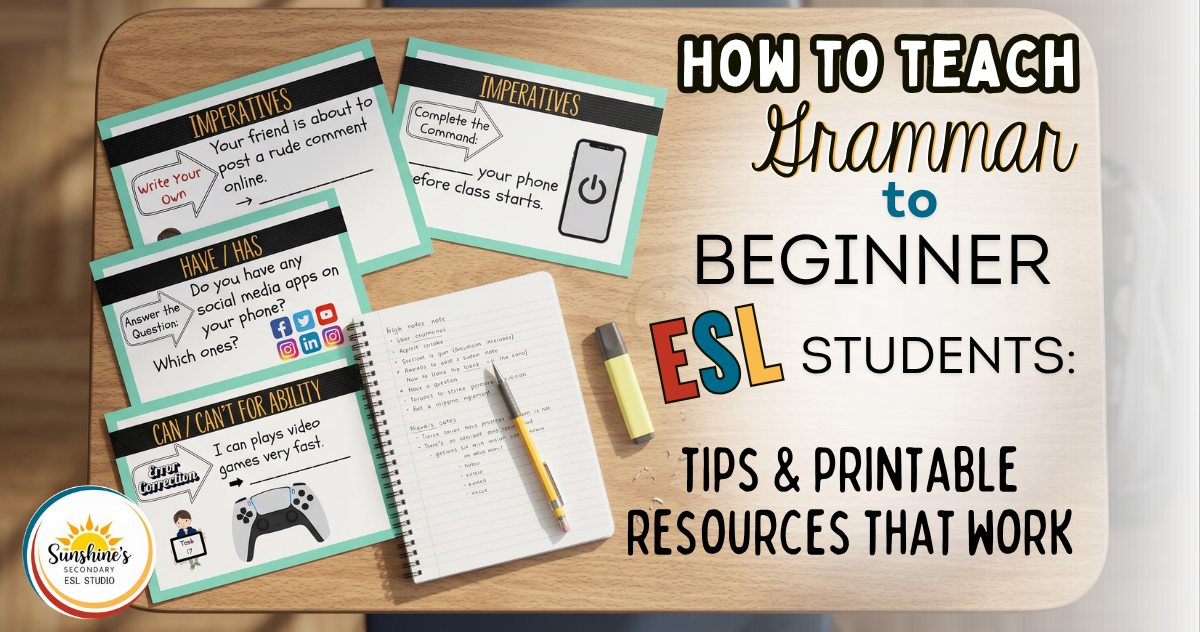
I also create ESL grammar task cards and support materials for teens because grammar practice works better when students can use it in short, manageable routines. These resources are especially helpful when you want students practicing grammar without turning the entire class period into a worksheet.
6. Use Wait Time on Purpose
Silence can feel uncomfortable, but it is not always a bad thing.
When students are learning English, they often need more time to process the question, translate mentally, organize their thoughts, and prepare a response. If we jump in too quickly, we may accidentally train students to wait us out.
Purposeful wait time is one of the simplest ESL teaching strategies for teens, but it can make a big difference.
Instead of asking a question and immediately calling on someone, try:
- Giving students 30 seconds to think
- Letting students write first
- Asking students to discuss with a partner before sharing
- Repeating or rephrasing the question
- Providing two answer choices to get them started
This kind of wait time tells students, “I actually expect you to think. I am not rushing you.”
I wrote more about this in my post on wait time strategies for the ESL classroom.
7. Secondary ESL Instruction Works Best With Clear Scaffolds
In high school ESL classes, students are often grouped together even when their English levels are completely different.
You may have newcomers, intermediate students, long-term English learners, and advanced multilingual students in the same room. Because of that, one-size-fits-all instruction rarely works.
Differentiation does not always mean creating four totally different lessons. Often, it means adjusting:
- The reading level
- The sentence frames
- The amount of vocabulary support
- The writing expectations
- The partner roles
- The length of the response
- The type of graphic organizer
A1 students may need visuals and word banks. B1 students may need sentence frames and paragraph structure. Meanwhile, B2 students may need more academic vocabulary and opportunities to expand their answers.
The goal is for everyone to work toward the same skill with the right level of support.
For more on this, I have posts on differentiating ESL instruction from A1 to B2 and how to differentiate ESL instruction in high school.
8. Use Students’ Home Languages as a Resource
For a long time, many classrooms treated students’ home languages as something to avoid. In secondary ESL instruction, however, students’ full language knowledge can be a powerful support.
Students can use their home language to:
- Preview difficult concepts
- Discuss ideas before writing in English
- Compare vocabulary
- Build background knowledge
- Clarify directions
- Process complex texts
- Support a partner
This does not mean students never use English. Rather, it means we recognize that language learning does not happen in a vacuum.
When students connect new English learning to what they already know in another language, they often understand more deeply.
I wrote about this more fully in my posts on translanguaging in the secondary ESL classroom and native language use in the ESL classroom.
9. Use Reading Supports Without Removing the Thinking
Reading in high school can be especially challenging for English learners because the texts are often written far above their current English proficiency level.
Supporting ESL students during reading does not mean removing all challenge. Instead, it means giving students a pathway into the text.
Helpful reading supports include:
- Vocabulary previews
- Chunked texts
- Guiding questions
- Graphic organizers
- Summaries
- Audio support
- Partner reading
- Adapted texts when appropriate
The goal is access. Students still need to think, infer, analyze, and respond. However, they need language support to show what they understand.
This is especially important during short stories, novels, poems, and informational texts. Many multilingual learners are capable of deep thinking, but they need support with the language demands of the task.
I wrote more about this in my posts on ESL reading comprehension in high school, supporting ESL students during novel studies, and ESL students reading below grade level.
10. Try ESL Teaching Strategies for Teens That Make Writing Less Overwhelming
Writing can feel intimidating for ESL teens, especially when they are expected to write paragraphs, short constructed responses, essays, or test-style answers.
One of the best ESL teaching strategies for teens is to break writing into smaller steps.
Instead of saying, “Write a paragraph,” you can guide students through:
- Understanding the question
- Finding evidence or examples
- Choosing sentence starters
- Writing one clear sentence
- Expanding with details
- Revising for clarity
For many students, the hardest part is starting. Graphic organizers, word banks, sentence frames, model responses, and color-coded examples can make writing feel possible.
This kind of support is not cheating. It is instruction.
I wrote more about this in my posts on ESL writing support strategies, argumentative writing for ESL students, and TELPAS writing practice for grades 9–12.
11. Make Grammar Practical
Grammar instruction works best when students see how it helps them communicate.
For teens, grammar should not feel like random worksheets with no connection to speaking, reading, or writing. Instead, grammar should help students say what they mean more clearly.
For example, instead of teaching verb tense only through isolated sentences, you can connect it to:
- Talking about routines
- Describing past experiences
- Explaining future plans
- Writing summaries
- Comparing characters
- Giving opinions
Grammar becomes more meaningful when students immediately use it in context.
This is why I like grammar task cards, desk mats, and short practice routines. They give students repeated exposure without turning the entire class period into a grammar lecture.
If you teach beginner or intermediate students, you may also like my posts on how to teach grammar to beginner ESL students, ESL grammar task cards, and pronouns ESL grammar cards.
12. Include Listening Practice Regularly
Listening is often overlooked, but it is one of the most important skills for English learners in high school.
Students need to understand teachers, classmates, announcements, videos, directions, conversations, and academic content. That kind of listening takes practice.
Listening activities do not have to be complicated. You can use:
- Short audio clips
- Teacher-read passages
- QR code listening worksheets
- Cloze activities
- Partner dictation
- Video clips with guiding questions
- Repeated listening
I like giving students a reason to listen. Instead of just playing audio and hoping they understand, I give them a task. They might listen for key words, complete missing information, choose the correct answer, or summarize the main idea.
As a result, listening becomes active instead of passive.
For more ideas, you can read my posts on ESL listening activities for high school, ESL listening worksheets with QR codes, and cloze listening activities for ESL.
13. Use Games, But Keep Them Purposeful
ESL activities for teens can absolutely include games. In fact, games can be one of the best ways to increase participation.
The key is choosing games that still support language growth.
Good ESL games for teens usually include:
- Vocabulary review
- Speaking practice
- Listening practice
- Categorizing words
- Describing ideas
- Asking and answering questions
- Reading clues
- Using academic or conversational language
Games should feel fun, but they should not feel like filler.
Some of my favorite teen-friendly options include vocabulary races, charades, logic puzzles, task cards, conversation games, and category games like ¡Basta!
If you want more game ideas, I have posts on ESL logic puzzles for teens, charades for ESL high school students, and the ¡Basta! ESL vocabulary game.
14. Connect Lessons to Culture, Identity, and Real Life
High school students engage more when lessons feel connected to who they are and what they are experiencing.
This does not mean every lesson has to be deeply personal. It simply means students should see real people, real topics, and meaningful themes in the classroom.
You can build connection through:
- Biography readings
- Identity poems
- Cultural comparisons
- Student choice
- Real-world scenarios
- Community topics
- Literature from diverse voices
- Discussions about school, family, goals, and challenges
Culturally responsive ESL teaching helps students feel seen without putting them on the spot or asking them to represent an entire culture.
This can be especially powerful in high school because teens are developing their identities while also navigating language, school expectations, and social pressures.
I wrote more about this in my posts on culturally responsive teaching for ESL teens, social emotional learning for ESL teens, ESL biography reading passages, and ESL identity poem writing activities.
15. Use ESL Teaching Strategies for Teens to Keep Expectations High
One mistake people sometimes make is assuming that ESL support means lowering expectations.
I do not believe that.
English learners can think deeply, analyze texts, discuss important topics, and write meaningful responses. However, they may need scaffolds to access the task and show what they know.
High expectations with no support can lead to frustration. On the other hand, too much simplification can lead to boredom and low growth.
The balance is giving students challenging work with clear supports.
That might look like:
- A rigorous question with sentence frames
- A grade-level theme with an adapted text
- A literary analysis task with a graphic organizer
- A discussion with vocabulary support
- A writing task broken into steps
- A test-prep skill practiced with accessible examples
This is what rigor often looks like in ESL classrooms. It may look different from a mainstream English class, but different does not mean less.English class, but different does not mean less.
I wrote more about this in my post on why rigor in ESL looks different, and it is one of the ideas I wish more people understood about teaching English learners in high school.
Final Thoughts on ESL Teaching Strategies for Teens
The best ESL teaching strategies for teens are not flashy. They are consistent, respectful, and realistic.
High school English learners need lessons that help them build language while still feeling like teenagers. They need structure, but they also need choice. At the same time, they need scaffolds, challenge, speaking practice, writing support, reading access, vocabulary development, and classroom routines that help them feel confident enough to try.
When I plan for my ESL students, I always come back to the same question:
Will this help students participate, understand, and grow without making them feel embarrassed or underestimated?
If the answer is yes, then the strategy is probably worth using.
Whether you are teaching beginner newcomers, intermediate multilingual students, or advanced English learners who still need academic support, these high school ESL strategies can help create a classroom where students feel supported and challenged at the same time.
If you are looking for ready-to-use ESL activities for teens, I also create secondary ESL resources with teen-friendly visuals, scaffolded language support, and classroom routines in mind. Many of my resources are designed for high school ESL students who need meaningful practice without materials that feel too young for them.