
Teaching pronouns to ESL beginners can feel like chaos.
One day your students understand he and she… and the next, they’re mixing me, mine, and us in ways that don’t quite make sense.
It’s not a lack of effort—it’s that pronouns require students to understand how words change depending on their role in a sentence. That’s a big leap for beginner English learners.
When it comes to teaching pronouns to ESL beginners, I’ve found that more explanation doesn’t help. What does help is structure, visuals, and consistent practice.
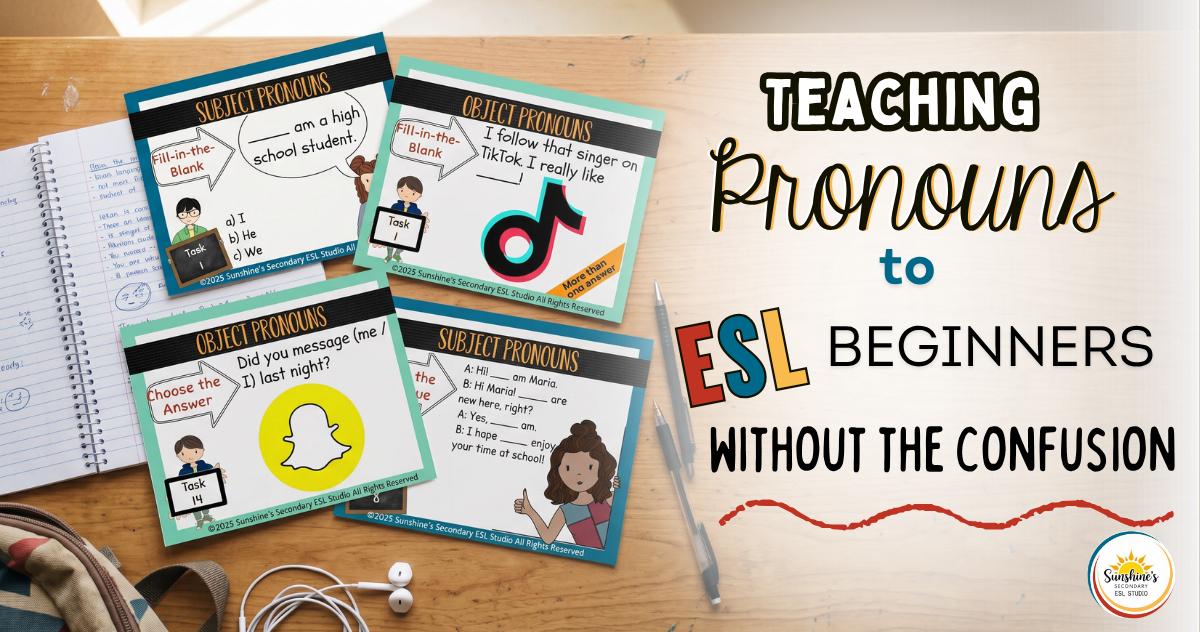
Once I shifted my approach—and started using pronouns ESL grammar cards—everything started to click.
Why Teaching Pronouns to ESL Beginners Is So Challenging
Pronouns seem simple at first, but beginners are actually learning multiple concepts at once:
- Subject pronouns (he, she, they)
- Object pronouns (him, her, us)
- Possessive adjectives (my, your, their)
Without clear structure, students try to use all of them at the same time—and that’s where confusion starts.
If you’re teaching mixed levels, this can feel even more overwhelming. Differentiation becomes key: Differentiating ESL Instruction for A1 to B2
Step 1: Start Teaching Pronouns with Subject Pronouns
Always begin with the easiest win.
Subject pronouns are:
- visual
- repetitive
- easy to model
Examples:
- He is a student.
- They are my friends.
Using images and pointing makes a huge difference here. Students quickly connect the pronoun to a person or group.
If your students struggle to form sentences, pairing this with sentence frames helps a lot: Free ESL Sentence Starters for Teens
Step 2: Introduce Object Pronouns Through Real Language
Object pronouns are where many beginners start to struggle.
Instead of focusing on rules, use real phrases they already hear and use:
- Can you help me?
- She gave it to him.
- He sent us a message.
This keeps learning grounded in communication—not memorization.
You can reinforce this through listening activities like these: Cloze Listening Activities for ESL
Step 3: Teach Possessive Adjectives Through Personalization
This is where engagement really increases.
Let students talk about:
- their phone
- their friends
- their lives
Examples:
- My phone is new.
- Their project is amazing.
When students connect grammar to their real lives, they remember it.
This approach also aligns with culturally responsive teaching: Culturally Responsive Teaching for ESL Teens
Step 4: Use Repetition and Visual Supports
Here’s the part that makes everything stick:
Repetition + visuals
Students need to:
- see it
- hear it
- use it
multiple times.
In my classroom, I rotate between:
- partner speaking
- quick-response activities
- sentence building
- short writing
This is also where pronouns ESL grammar cards become incredibly effective.
Why Pronouns ESL Grammar Cards Make a Difference
Grammar cards take something abstract and make it concrete.
They:
- break concepts into small steps
- provide visual support
- create predictable patterns
- allow repeated practice
For beginner students, that structure is everything.
If you’re already using grammar routines, these pair well with: ESL Grammar Task Cards
And if your students hesitate to speak, combining this with speaking routines helps: How to Build ESL Speaking Routines
Want Ready-to-Use Pronouns ESL Grammar Cards?
If you’re looking for something structured and beginner-friendly, I created a set of:
✔ subject pronoun cards
✔ object pronoun cards
✔ possessive adjective cards
✔ teen-friendly visuals and examples
👉 You can check them out here:
Pronouns ESL Grammar Cards
They’re designed to support exactly what this post is about—teaching pronouns to ESL beginners without confusion.
Final Thoughts
Teaching pronouns doesn’t have to feel overwhelming.
When you:
- simplify the structure
- use visuals
- repeat patterns
- and give students something they can actually use
…you start to see real progress.
Your students don’t need more grammar explanations.
They need clear, consistent support.
And once they have that, everything starts to click.