
When you’re teaching secondary ESL students, finding reading materials that feel meaningful, age-appropriate, and accessible can be a challenge. Teens do not want babyish passages, but many of them still need language support, vocabulary scaffolds, audio, and clear comprehension practice.
That is one reason I love using ESL biography reading passages in the classroom.
Biographies give students real people to learn about. They introduce historical figures, musicians, athletes, writers, activists, and cultural icons in a way that builds both language and background knowledge. Instead of reading isolated practice passages that feel disconnected from the real world, students get to learn about people who made choices, faced challenges, influenced others, and left a mark.
Whether you are teaching A2 newcomers, B1 developing readers, or more confident B2 students, biography passages can support reading comprehension, vocabulary, listening, writing, and classroom discussion. They are also flexible enough to use as full lessons, bell ringers, sub plans, literacy stations, or test-prep practice.
If you teach multiple proficiency levels in the same room, biography passages also pair well with differentiating ESL instruction for A1–B2 students because students can often study the same person and big idea while working with language that matches their current level.
Why ESL Biography Reading Passages Build Background Knowledge
Many multilingual learners come into secondary classrooms with different levels of exposure to historical figures, U.S. history, cultural references, literary figures, and public icons. That does not mean they lack intelligence or curiosity. It means they may not have had the same access to the background knowledge that many grade-level texts assume they already have.
That missing background knowledge can make English I, English II, U.S. history, and other core classes feel overwhelming.
Biography passages help close that gap because they introduce students to real people connected to:
- historical eras
- cultural movements
- important contributions
- major challenges
- public achievements
- personal perseverance
- the human experience behind big ideas
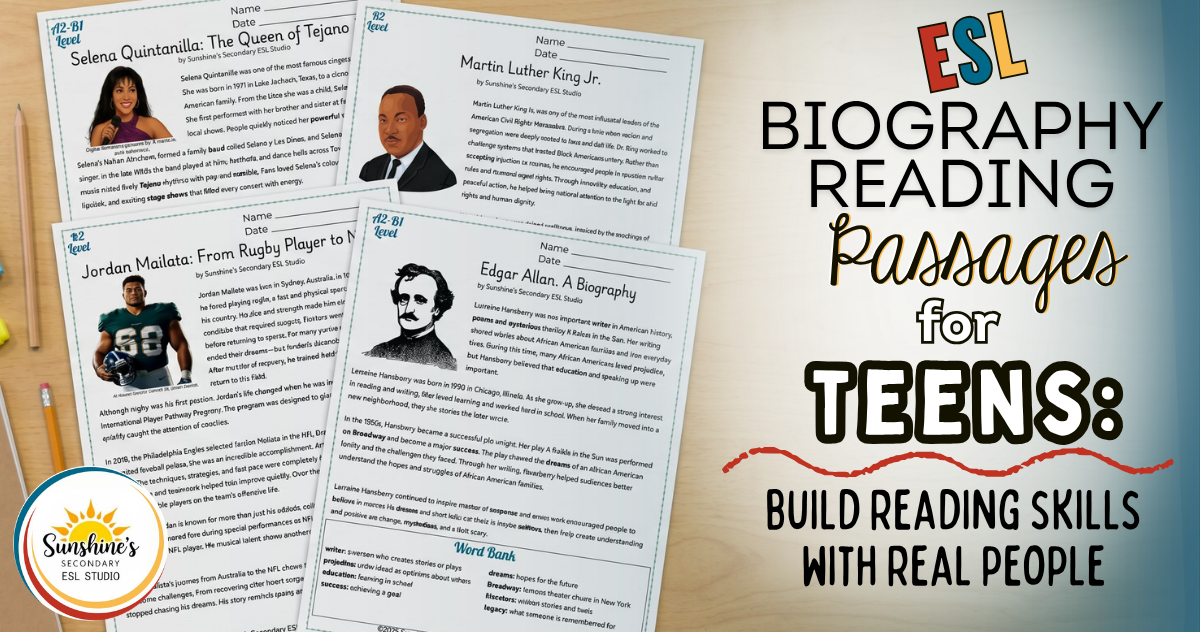
When students read about people like Celia Cruz, Selena Quintanilla, Jordan Mailata, Edgar Allan Poe, or other high-interest figures, they are not only practicing English. They are building the knowledge they need to understand future texts, class discussions, and writing prompts.
This is especially important in high school ESL classrooms because students are often expected to analyze texts before they have enough context to fully understand them. If this is something you see in your own classroom, you may also find my post on supporting ESL students who are reading below grade level helpful.
Why Biographies Work So Well for Secondary ESL Students
Biographies are powerful because they combine story and informational text.
Students get the structure of a real person’s life, but they also practice the academic reading skills they need for informational texts. This makes biographies especially useful for secondary ESL students who need reading practice that feels purposeful instead of random.
With biography reading passages, students can practice:
- identifying main ideas and supporting details
- following chronological text structure
- recognizing problem-and-solution patterns
- analyzing cause and effect
- using context clues
- building academic vocabulary
- making inferences from details
- explaining a person’s impact
- writing short constructed responses with text evidence
These skills transfer directly into ELA, history, science, and state testing. Biography passages are not just “fun extras.” They can become a consistent way to strengthen informational reading skills in a format students usually understand and enjoy.
If you are working on reading comprehension more broadly, you may also want to read my post about ESL reading comprehension strategies for high school.
How to Use ESL Biography Reading Passages Without Overwhelming Students
One mistake teachers sometimes make is handing ESL students a full informational passage and expecting them to work through it independently right away. Some students can do that, but many need more support before they are ready.
Biography passages work best when students have a clear routine.
Before reading, you can preview key vocabulary, introduce the person with a photo or short discussion question, and ask students what they already know. Even a simple KWL chart can help students activate background knowledge before they begin. If you use this kind of pre-reading structure, my post on KWL charts for ESL students gives more ideas for making that routine work with multilingual learners.
During reading, students may benefit from listening to the audio first, following along as they read, annotating important details, or stopping after each section to answer a quick question. For newer English learners, the audio can be especially powerful because it gives them pronunciation support and helps them hear the rhythm of academic English.
After reading, students can complete comprehension questions, discuss the person’s challenges or contributions, and write a short response using sentence frames or evidence from the passage.
A simple lesson flow could look like this:
- Start with a quick question about the person or topic.
- Preview the academic word bank.
- Listen to the passage once with students following along.
- Read the passage again in pairs, small groups, or independently.
- Answer comprehension questions.
- Practice context clues.
- Write a short constructed response using evidence.
This kind of structure gives students repeated exposure to the same language without making the lesson feel repetitive.
Biography Passages Are Great for Mixed-Level ESL Classes
One of the hardest parts of teaching secondary ESL is that students are rarely all at the same level. In one class, you might have a newcomer who is still building sentence-level comprehension sitting next to a student who is ready for more advanced analysis.
That is where leveled biography passages are especially helpful.
When students read about the same person at different levels, everyone can participate in the same general lesson. The A2 student is not left behind, and the B2 student is not stuck with something too simple. Students can still discuss the same person, answer similar questions, and build shared background knowledge, but the language demands are adjusted.
This matters because differentiation should not mean giving one student a completely different lesson while everyone else does something more advanced. When done well, differentiation gives students access to the same meaningful content with the right amount of language support.
If you are trying to make this work in a high school classroom, you may also like my post on how to differentiate ESL instruction in high school.
ESL Biography Reading Passages Support Writing, Too
Biography passages are not only useful for reading. They also give students something clear and concrete to write about.
Instead of asking students to respond to an abstract prompt with limited background knowledge, biographies give them a person, a challenge, a decision, and evidence from the text. Students can write about how someone showed perseverance, influenced others, overcame obstacles, changed history, or used their talents in meaningful ways.
This makes biographies a natural fit for short constructed response practice.
Students can practice:
- restating the question
- making a claim
- using text evidence
- explaining why the evidence matters
- connecting a person’s actions to a larger idea
- using academic sentence frames
This is especially helpful for students preparing for STAAR, TELPAS, and other writing expectations. If your students need more support with written responses, you may also like my post on ESL writing support strategies or my post about TELPAS writing practice for grades 9–12.
For teachers who specifically want biography passages that connect reading and test-prep skills, my STAAR ESL Biography Reading Bundle includes informational text passages with audio and activities designed to support evidence-based responses.
Biography Passages Can Build Cultural Awareness
Another reason biographies are so valuable in ESL classrooms is that they help students learn about people from different backgrounds, time periods, and communities.
When students read about musicians, writers, athletes, inventors, leaders, and historical figures, they begin to see how people’s stories connect to culture, history, identity, perseverance, and change. This can lead to meaningful conversations without forcing students to share personal experiences before they are ready.
For example, a biography about a musician might lead to a conversation about language, culture, and family influence. A biography about a historical figure might help students understand a larger movement. A biography about an athlete might open discussion about discipline, opportunity, and resilience.
This connects naturally to culturally responsive teaching for ESL teens because students need materials that respect their age, intelligence, and lived experiences.
Biography passages can also support seasonal and cultural units. If you teach heritage months or history-based lessons, you may want to connect biography passages with posts like teaching Black History Month in ESL classrooms or teaching U.S. history to high school ESL students.
Easy Ways to Use Biography Passages All Year
One of the best things about ESL biography reading passages is that they do not have to be saved for a huge unit. You can use them throughout the year in small, manageable ways.
They work well as:
- weekly informational text practice
- bell ringers
- Friday reading lessons
- listening practice
- sub plans
- literacy stations
- early finisher work
- test-prep review
- short constructed response practice
- background knowledge builders before a larger unit
If you already use ESL bell ringers and daily warm-ups, a short biography passage can become a meaningful reading warm-up. Students can read a section, answer one comprehension question, define a word from context, or write one sentence about the person’s impact.
Biography passages also work well for easy ESL sub plans for secondary students because students can complete a focused reading task without needing the substitute to teach a brand-new skill from scratch.
What Makes My ESL Biography Reading Passages Different?
I started creating my own biography passages because it can be really difficult to find high-school-appropriate biographies that are actually written for ESL learners.
A lot of biography passages are either too childish, too difficult, too short, or missing the supports multilingual learners need. Secondary ESL students need texts that feel mature but still accessible.
My ESL biography resources are designed with that exact problem in mind.
Each biography includes A2, B1, and B2 leveled reading versions so students can work with language that fits their proficiency level while still learning about the same person and big ideas.
The passages also include embedded audio, which supports listening comprehension, pronunciation, fluency, and students who benefit from hearing the passage before or during reading.
Students also get an academic word bank, comprehension questions, context clues practice, and short constructed response tasks. These pieces work together so students are not just reading and answering surface-level questions. They are building vocabulary, comprehension, writing, and confidence.
If you want a general set of high-interest biographies for teens, you can explore my ESL Biography Reading Bundle for Teens. It includes biography reading passages with audio that are designed specifically for secondary English learners.
Try a Free ESL Biography Reading Passage First
If you want to try this type of lesson before committing to a larger resource, I recommend starting with the free Celia Cruz biography sample.
It gives you a chance to see how the leveled text, audio, vocabulary support, comprehension questions, context clues, and writing task work together. You can use it as a one-day reading lesson, a listening activity, a literacy station, or a quick way to introduce students to biography reading.
Trying a sample first also helps you see whether the format fits your students and your classroom routines.
Student-Friendly Biography Topics
The best biography passages for ESL teens are not just about “famous people.” They should be about people with stories students can understand, discuss, and connect to.
Some student-friendly biography topics include:
- musicians and performers
- athletes
- authors and poets
- civil rights leaders
- historical figures
- inventors
- artists
- cultural icons
- people who overcame major challenges
Teens often respond well when the person feels relevant, surprising, inspiring, or connected to something they have heard about before. For example, students may be interested in Selena Quintanilla because of her music and cultural impact, Jordan Mailata because of his unusual path to the NFL, or Edgar Allan Poe because his life connects to literature they may study later.
That mix of real-world interest and academic reading practice is what makes biography passages so useful.
Build a Full Year of ESL Biography Reading Lessons
If you want biography passages to become a regular part of your ESL reading routine, the ESL Biography Bundle with Audio is the best long-term option.
This Mega Growing Bundle is designed for secondary ESL reading instruction in grades 6–12. As new biographies are added, the bundle grows, and teachers who already purchased it receive the new additions without having to buy each one separately.
This is helpful if you want a consistent reading format your students can get used to over time. Once students understand the routine, they can focus more energy on comprehension, vocabulary, discussion, and writing instead of trying to figure out a new activity format every week.
The growing bundle can help you build a full year of:
- leveled informational reading practice
- listening activities with audio
- academic vocabulary instruction
- context clues practice
- short constructed response writing
- background knowledge lessons
- sub plans and literacy stations
If you are not ready for the full bundle, you can also browse my ESL Reading Activities category for more reading resources for secondary English learners.
Final Thoughts
ESL biography reading passages are powerful because they do more than fill time. They help students build background knowledge, strengthen informational text skills, practice academic vocabulary, listen to fluent reading, and write about real people using text evidence.
For secondary ESL students, that combination matters.
Biographies give students access to meaningful stories while still supporting the reading, writing, listening, and language skills they need in school. They can be used in full lessons, quick warm-ups, sub plans, literacy stations, test-prep practice, or cultural units.
Most importantly, they remind students that reading in English is not only about answering questions. It is also about learning about the world and the people who have shaped it.