
One of the hardest moments in an ESL classroom is asking a question and hearing absolutely nothing back.
You repeat the question.
You point to visuals.
You simplify your language.
Still… silence.
If you teach newcomers or beginner multilingual learners, you already know this feeling. It can make even experienced teachers wonder whether students understand anything at all.
But over the years, I’ve learned something important:
Silence does not always mean students are disengaged.
Some students are translating vocabulary in their heads.
Others are still processing the question.
Many are quietly rehearsing an answer because they are afraid of making a mistake out loud.
That realization completely changed how I approach speaking activities in my high school ESL classroom.
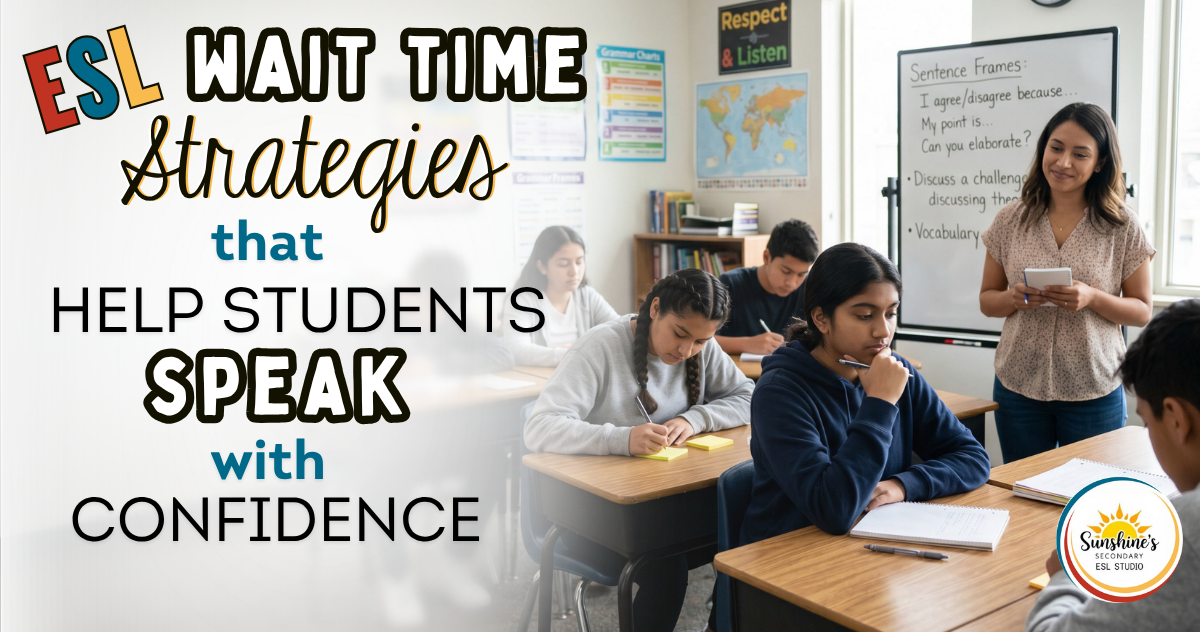
Instead of rushing to fill the silence, I started building intentional supports and ESL wait time strategies that gave students more time, structure, and confidence to participate.
If you also work with hesitant speakers, you may enjoy these related posts:
- ESL Speaking Confidence Activities
- How to Build ESL Speaking Routines
- Beginner ESL Speaking Activities
Why ESL Students Need Wait Time
Many multilingual learners experience what educators often call the “silent period.” During this stage, students absorb huge amounts of language before they feel comfortable producing it.
Unfortunately, classrooms often move faster than language processing does.
When teachers ask questions, English learners may be:
- translating vocabulary
- organizing thoughts
- remembering grammar structures
- worrying about pronunciation
- trying not to feel embarrassed in front of peers
That takes time.
When we answer for students too quickly or rely only on the strongest English speaker in the room, we unintentionally remove opportunities for language growth.
I’ve found that combining intentional wait time with scaffolding creates a much safer environment for speaking practice.
This is especially important for newcomers and students reading below grade level.
You might also find these helpful:
ESL Wait Time Strategies That Actually Work
1. Small Group Question Dissection
This is one of the most effective speaking supports I use.
I project the discussion question and have students echo-read it together. Then we break it apart as a class.
We:
- clarify difficult vocabulary
- identify what the question is really asking
- model possible sentence starters
- connect visuals when needed
After that, students discuss the question in small groups before answering publicly.
And honestly? I allow native language discussion during this stage.
Strategic translanguaging often helps students process ideas more deeply before responding in English.
I talk more about that here:
After just a few minutes of collaborative discussion, students are usually much more willing to participate.
2. The Sticky Note “Parking Lot” Strategy
Some students freeze the moment they are expected to speak out loud.
For those students, writing first can dramatically reduce anxiety.
I place questions around the room or on the board and give students sticky notes to write responses before speaking.
Then when called on, students can:
- read directly from the sticky note
- paraphrase their response
- or simply use the note as a confidence boost
This tiny layer of support changes everything for some learners.
It also pairs really well with:
3. Sentence Frames and Word Banks
One of the biggest mistakes teachers make is assuming students know how to begin speaking.
Even students with strong ideas may not yet have the language structures needed to express them.
Sentence frames lower the pressure while still encouraging language production.
Some examples:
- “I agree with ___ because…”
- “One example is…”
- “I think the character felt…”
Word banks and visuals also reduce cognitive overload, especially for beginners.
These supports help speaking feel possible instead of overwhelming.
You may also like:
4. Low-Stakes Conversation Practice
Students become more confident speakers when speaking happens regularly — not only during formal presentations.
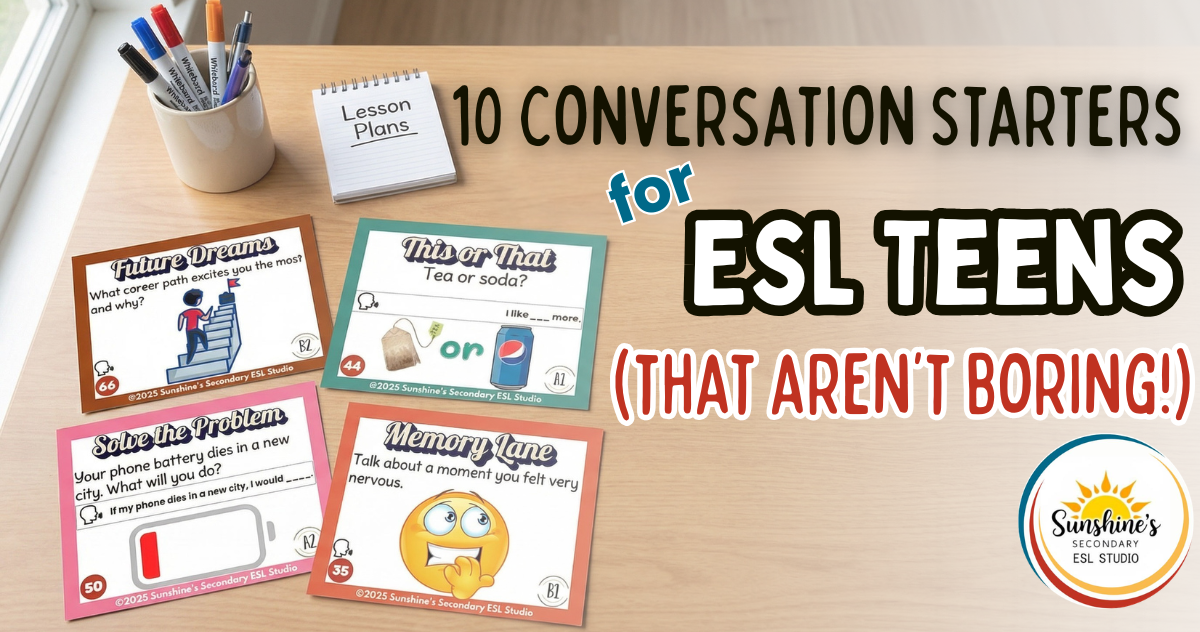
That’s why I love structured conversation routines and speaking cards.
Activities like:
- partner discussions
- would-you-rather questions
- role-plays
- emotion prompts
- conversation cards
allow students to practice English in a lower-pressure environment.
Some related classroom ideas include:
- Conversation Starters for ESL Teens
- ESL Teen Speaking Activities
- A2 ESL Speaking Prompts for Teens
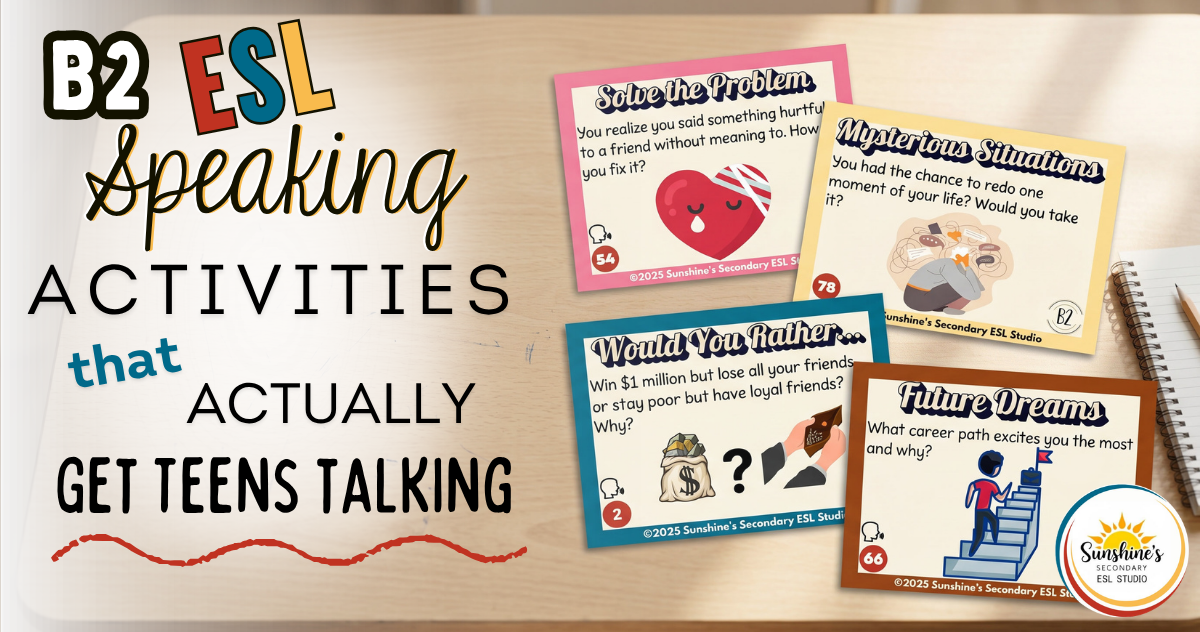
- B2 ESL Speaking Activities for Teens
- ESL Emotion Speaking Prompts
Over time, students begin realizing that speaking English is not about perfection.
It’s about participation.
The Teacher Mindset Shift
The hardest part of wait time is often our own discomfort.
Silence can feel awkward, especially when a lesson already feels slow.
As teachers, we may wonder if students understand the question.
At the same time, we may feel pressure to keep the lesson moving.
In those moments, it is easy to call on the strongest English speaker or answer the question ourselves.
However, many English learners need extra processing time before they can respond confidently.
Once I stopped seeing silence as failure and started seeing it as language processing, my classroom changed.
More students began participating.
Speaking felt less intimidating.
Classroom discussions became more balanced.
Over time, I became more patient too.
Final Thoughts
Effective ESL wait time strategies are not about lowering expectations.
They are about building the supports students need in order to participate successfully.
When multilingual learners are given:
- processing time
- visuals
- sentence supports
- collaborative discussion
- and low-pressure speaking opportunities
they slowly begin finding their voices.
And for many students, that confidence becomes the foundation for future language growth.
ESL Speaking Resources for Teens
If you want ready-to-use speaking supports for middle school or high school ESL students, these resources may help:
- Teen Talk ESL Conversation Cards Bundle
- ESL Speaking Role-Plays for Teens
- ESL Charades for Teens Bundle
- Free Teen Talk Conversation Cards Sample
You can explore more speaking activities and classroom supports in my Sunshine’s Secondary ESL Studio TPT Store