
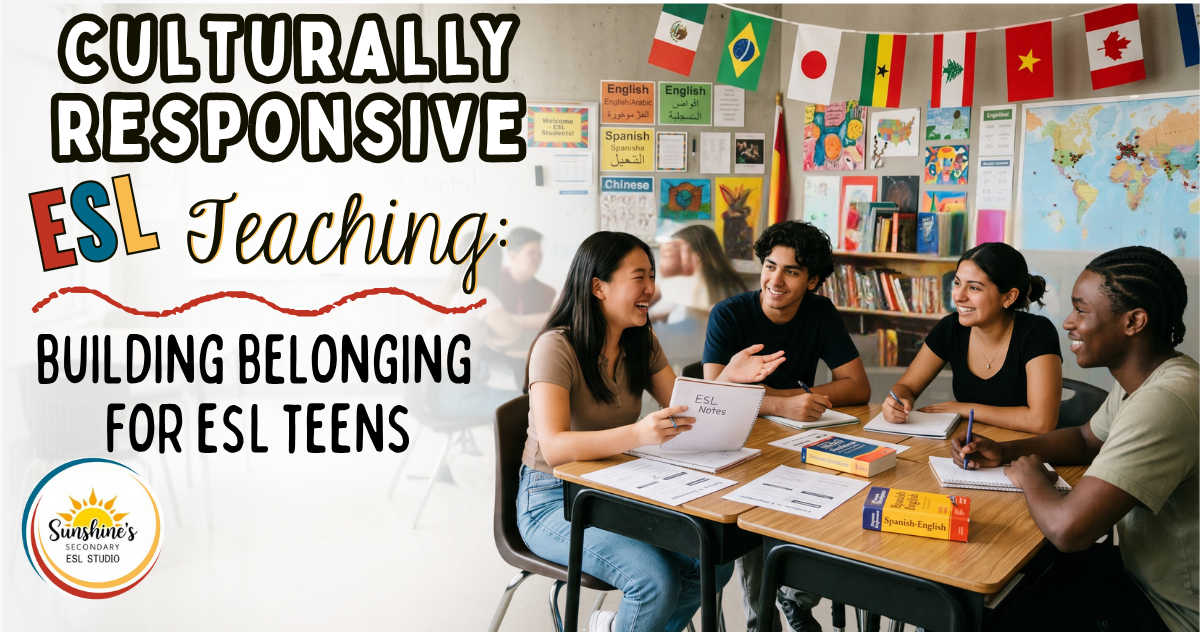
Culturally responsive ESL teaching helps students feel seen, valued, and connected in the classroom. But honestly, this wasn’t always something I fully understood as a teacher.
When I first started teaching high school ESL, my lessons were very curriculum-based. I focused heavily on pacing guides, standards, and making sure I was teaching everything required by the state of Texas. And while those things absolutely matter, I eventually realized something was missing.
Even though I had the flexibility to move beyond the curriculum as long as I was teaching the standards, I wasn’t always bringing enough of my students into the lessons themselves.
Over time, I started noticing something important: the topics my students connected with most were the ones that reflected pieces of their own lives. When students could talk about their cultures, traditions, families, languages, struggles, or experiences moving to a new country, the energy in the room completely changed.
Some of my quietest students suddenly started participating more during discussions. Writing assignments became more meaningful because students actually had something personal they wanted to say. Even reluctant speakers became more willing to take risks when the classroom felt personal instead of scripted.
That’s when I realized culturally responsive teaching isn’t an “extra.” It’s part of what helps multilingual students feel safe enough to participate and confident enough to grow.
Now, I intentionally look for ways to bring students’ backgrounds and lived experiences into reading, writing, speaking, and listening activities whenever I can. And honestly, those small shifts have made some of the biggest differences in my classroom.
If you’re new to culturally responsive ESL teaching, start small. One meaningful connection to students’ real lives can completely transform a lesson.
You can also find more ideas in my post about social emotional learning for ESL teens, where I share ways to build trust and classroom community with multilingual learners.
Why Culturally Responsive ESL Teaching Matters
ESL students walk into our classrooms with rich cultural backgrounds, personal stories, and multilingual experiences. When instruction ignores those experiences, students often disconnect from the content.
But when we intentionally create culturally responsive lessons, we communicate something powerful:
“You belong here.”
That sense of belonging impacts everything:
- speaking confidence
- classroom participation
- reading engagement
- willingness to take risks
- academic growth
This is especially important for newcomers and beginner learners. In my post about beginner ESL students in high school, I talk about how emotional safety and language support go hand in hand.
Reading Activities That Build Cultural Connections
One of the easiest ways to practice culturally responsive ESL teaching is through pre-reading connections.
Before reading a text, I ask students to connect the theme to their own experiences. For example, before reading By Any Other Name by Santha Rama Rau, students reflect on:
Literature discussions become even more powerful when students can connect themes of identity and belonging to their own experiences. My adapted literature resources for ESL teens are designed to support those deeper conversations while still providing language scaffolds.
- the meaning of their names
- nicknames in their culture
- moments when they felt misunderstood
- experiences adapting to a new environment
Suddenly, the text becomes personal.
Students who may normally stay quiet start participating because they already have background knowledge connected to the topic.
This strategy works especially well alongside:
- visuals
- sentence stems
- collaborative discussion
- graphic organizers
I also use many of the scaffolding strategies I discuss in my post about ESL reading comprehension in high school to make complex texts more accessible without lowering rigor.
You can also pair culturally responsive reading with informational text activities like the ones in my post about Hispanic and Latino informational texts for ESL students.
Identity Writing Helps ESL Students Feel Seen
One of the most meaningful culturally responsive writing projects I use is a “Where I’m From” poem activity inspired by George Ella Lyon.
Students write about:
- family traditions
- foods and smells from home
- important sayings
- memories
- cultural celebrations
- places that shaped them
The emotional investment is incredible.
Students who struggle to write complete paragraphs will suddenly write with detail and passion because the topic matters to them.
If you want ready-to-use scaffolds for identity writing, my Where I’m From Poetry Activity for ESL Teens includes sentence starters, brainstorming pages, examples, reflection tools, and differentiated supports designed specifically for secondary multilingual learners.
To support language development, I provide:
- sentence starters
- brainstorming pages
- vocabulary supports
- visual examples
- optional bilingual drafting
If you want to try this activity, my ESL identity poem writing activity includes scaffolds, examples, templates, and reflection pages designed specifically for secondary ESL students.
This type of writing also pairs beautifully with the supports I share in my post about writing support strategies for ESL students.
Listening Activities That Honor Students’ Cultures
Listening practice becomes much more engaging when students feel personally connected to the content.
During identity or culture units, I invite students to share:
- music from their culture
- short videos
- celebrations
- traditions
- interviews
- popular sayings or expressions
One year, a student shared a video of a Vietnamese New Year celebration. Students practiced describing what they noticed in English:
- the sounds
- the emotions
- the visuals
- the traditions
Instead of feeling like a worksheet exercise, listening practice became genuine cultural exchange.
You can find additional ideas in my post about ESL listening activities for high school students.
Speaking Activities That Build Belonging
Speaking can feel intimidating for ESL teens, especially when they are nervous about pronunciation or making mistakes.
Culturally responsive speaking activities give students a real reason to communicate.
Some of my favorite prompts include:
- “A tradition in my family is…”
- “One thing people misunderstand about my culture is…”
- “A food that reminds me of home is…”
- “When I first came to the United States, I felt…”
These conversations build empathy while strengthening speaking skills.
I also love using collaborative speaking games that connect to students’ cultural backgrounds. One of my students’ favorites is Word Dash!, my ESL-friendly version of the Mexican game ¡Basta!. I also use my Teen Talk ESL Conversation Cards to help students practice speaking in low-pressure, culturally meaningful ways. Many of the prompts encourage students to talk about traditions, opinions, personal experiences, and identity while building speaking confidence.
You can read more about it here:
For even more structured conversation support, I often use:
- sentence frames
- partner discussions
- timed speaking rounds
- conversation cards
My posts about building ESL speaking routines and ESL speaking confidence activities also pair naturally with culturally responsive instruction.
Final Thoughts on Culturally Responsive ESL Teaching
Students should never feel like they need to leave their identity at the classroom door in order to learn English.
When we create opportunities for students to share their cultures, stories, and experiences, language learning becomes more meaningful. Students feel safer taking risks, participating in discussions, and expressing themselves in English.
Culturally responsive ESL teaching is not about creating perfect lessons. It’s about creating human connection.
Start with one discussion.
One story.
One meaningful question.
That small shift can completely change the atmosphere of your classroom.