
Walking into a classroom of beginner ESL high school students can feel like stepping into the unknown—especially when your newcomers arrive with little to no English. You’re not just teaching content. You’re building language, confidence, and a sense of belonging all at the same time.
And if you’ve ever stood there thinking, Where do I even start?—you’re not alone.
The good news? You don’t need to overcomplicate it. Teaching newcomer students at the high school level comes down to a few core strategies that work every single time when done consistently. If you’re in that early stage of figuring things out, I actually wrote about what those first days can look like in my post on first week tips for new ESL teachers, and it pairs really well with what we’re about to get into here.
Let’s break it down.
Start with Survival Language First
Before diving into academic content, your beginner students need language they can use right now.
Think:
- Bathroom requests
- Asking for help
- Understanding directions
- Basic classroom vocabulary
This is the foundation of your beginner ESL high school classroom. Without it, everything else feels overwhelming for students.
Instead of long vocabulary lists, focus on repetition, visuals, gestures, and real-life context.
This is exactly why I always start the year with structured supports like survival phrases and visual references. In my classroom, I rely heavily on beginner-friendly tools like survival language mats and simple speaking supports so students aren’t stuck wondering what to say—they already have it in front of them.
Build Routines That Lower Anxiety
Newcomer students are often navigating more than just language—they’re adjusting to a new country, school system, and culture.
Predictability helps.
In a classroom with newcomer ESL students, routines become your anchor. Same warm-up, clear transitions, familiar activity structures—it all matters more than we sometimes realize.
When students know what to expect, they can focus on understanding English instead of trying to figure out what’s happening next. That’s something I go deeper into when I talk about ESL classroom management in high school, because routines and management really go hand in hand.
I also like to build routines around repeatable activities—things like structured speaking cards or simple daily prompts—so students aren’t learning a new system every day, just new language within a familiar structure.
You Don’t Have to Speak Their Language to Support Them
One of the biggest myths in a beginner ESL high school classroom is that you need to speak your students’ native language to teach them effectively.
It sounds logical—but it’s not necessary.
I say this as someone who is bilingual in English and Spanish. Yes, that has helped at times. But I’ve also had newcomer ESL students from all over the world—students whose languages I don’t speak at all.
And they still learned.
Is it challenging sometimes? Of course. There are moments where you wish you could just translate everything quickly and move on. But those moments are also where real language learning happens.
Instead of relying on translation, you lean into visuals, modeling, gestures, repetition, and peer support. If you’ve ever questioned how much translation is too much, I shared some honest thoughts about that in using Google Translate in the ESL classroom.
And honestly, having students from all over the world is one of the most rewarding parts of teaching. It naturally connects to what I wrote about in culturally responsive teaching for ESL teens—you really do start to see the world through your students’ perspectives.
Use Speaking (Even When They’re Beginners)
It might feel counterintuitive, but beginner students need to speak from day one.
The key is structured speaking.
Instead of putting students on the spot, give them support:
- Sentence frames
- Partner practice
- Choral responses
Simple things like:
- “I see a ___.”
- “I like ___ because ___.”
This is where having ready-to-go speaking activities makes your life so much easier. I use structured speaking cards and beginner-friendly discussion prompts constantly because they remove the pressure while still getting students talking.
If you want something free to start with, I’ve shared sentence starters for teens, and they work perfectly alongside more structured speaking activities.
Make Everything Visual
If you remember one thing, let it be this: visuals are everything.
In a beginner ESL high school classroom, visuals reduce confusion, support comprehension, and help students make connections faster.
Use pictures, icons, anchor charts, and color coding whenever possible.
This is why I rely so heavily on visual supports around the room and on student desks. When students can see the language, they’re much more likely to use it independently instead of waiting for help every time.
Focus on Comprehension Over Perfection
Beginner students do not need perfect grammar.
They need to understand, communicate, and feel successful.
If a student says, “He go store yesterday,” they’re communicating—and that matters.
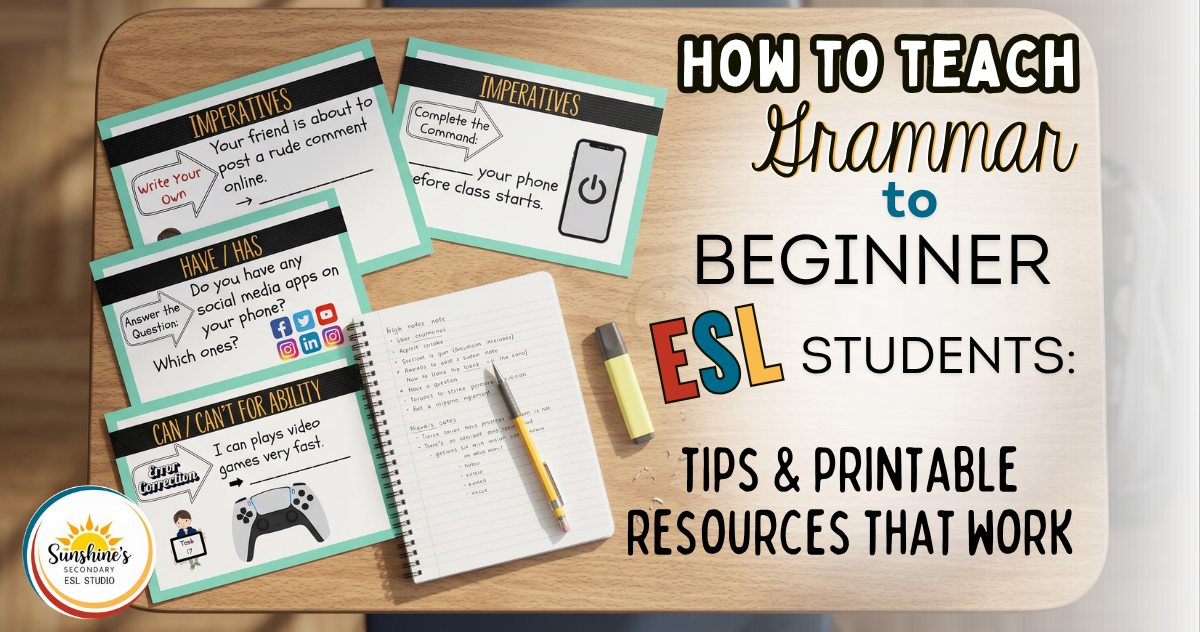
Later, you can build accuracy through structured practice. This is where I start layering in simple grammar-focused activities like task cards or guided practice that keep things repetitive but not boring.
If you want a deeper breakdown, I talk more about that in how to teach grammar to beginner ESL students.
Beginner ESL High School Strategy: Keep Tasks Simple but Meaningful
Simple doesn’t mean easy—it means accessible.
For newcomer students, tasks should have clear steps, models, and visual support.
Instead of jumping straight into full writing tasks, start with:
- Matching
- Sentence completion
- Sorting
And if you’re working with mixed levels, this is where differentiation really matters. I break that down more in differentiating ESL instruction from A1 to B2.
Create Opportunities for Success Every Day
Your students might not understand everything yet—but they should feel successful every day.
That might look small:
- Using one sentence correctly
- Participating in a partner activity
- Recognizing key vocabulary
But those moments build confidence, and confidence drives everything.
If that’s something you’re trying to grow in your classroom, I shared some ideas in ESL speaking confidence activities that really help students open up.
Don’t Do It All Alone
You don’t have to create everything from scratch.
In fact, you shouldn’t.
Lean into routines, reuse what works, and bring in simple, engaging activities when you need them. Even something low-prep and interactive—like the idea I shared in my charades game for ESL high school students post—can completely shift the energy in your room.
Final Thoughts
Teaching beginner ESL high school students—especially newcomers—can feel overwhelming at first. But when you focus on survival language, routines, visuals, structured speaking, and meaningful support, everything starts to fall into place.
And honestly? It becomes one of the most rewarding parts of teaching.
Because when those students who started with zero English begin forming sentences, participating, and gaining confidence… you get to witness growth in real time.
And that’s something special.
Want Ready-to-Use Support for Beginner ESL?
If you’re building out your newcomer classroom and want ready-to-use support, I’ve created a collection of beginner-friendly ESL activities, speaking supports, and grammar resources designed specifically for secondary students. You can take a look at everything in my TPT store and find what fits your students best.
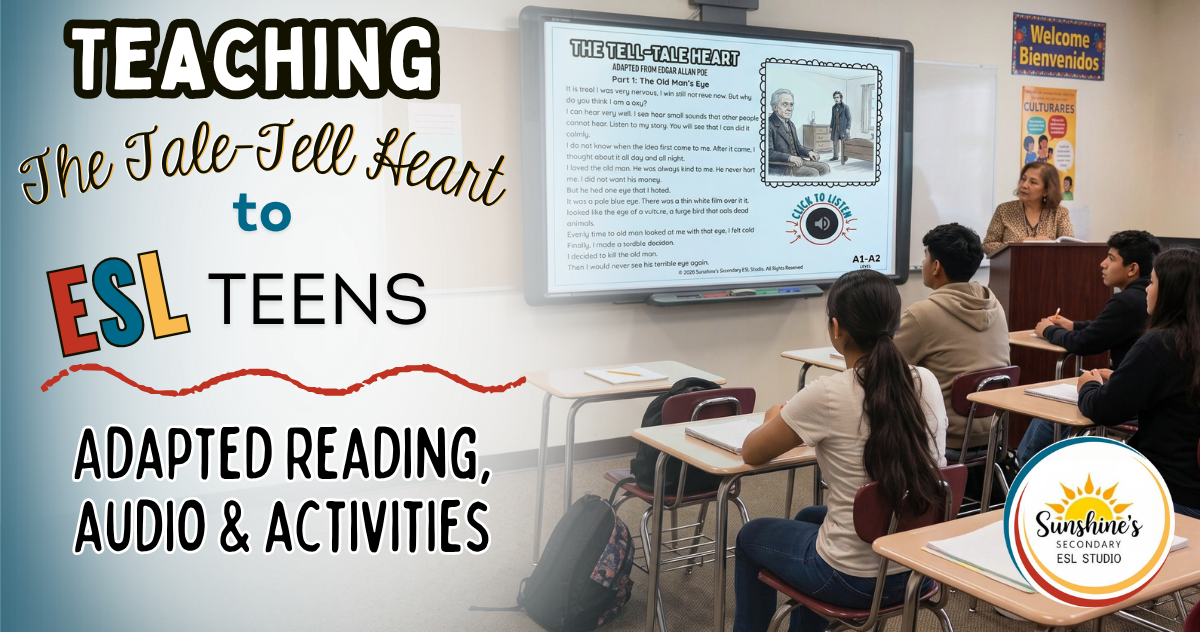
Teaching The Tell-Tale Heart to ESL Teens: Adapted Reading, Audio & Activities
The Monkey’s Paw ESL: How to Teach the Classic Short Story to English Learners
Beginning-of-Year ESL Assessments for High School Students