
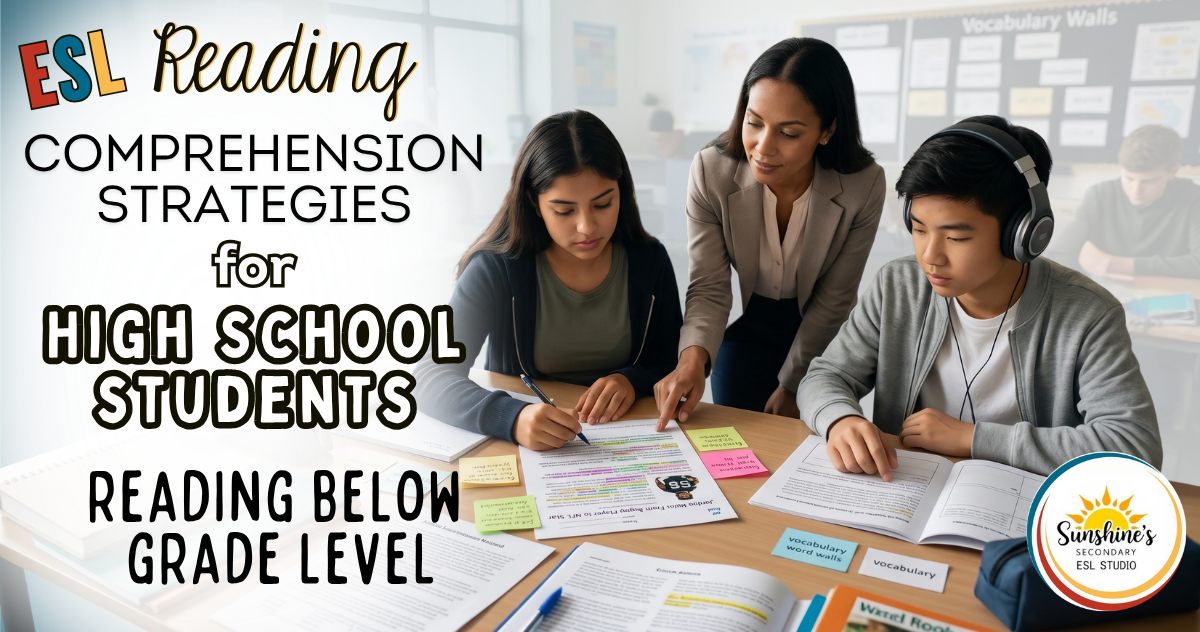
ESL reading comprehension strategies for high school are essential when teaching English learners who are reading below grade level in English. Many secondary ESL students need leveled texts, vocabulary support, audio support, and reading comprehension worksheets ESL teachers can actually use with teens. The challenge is helping students access meaningful content without lowering expectations or giving them materials that feel too young.
Working with high school multilingual learners is one of the most rewarding experiences we can have as teachers, but it also brings a very real challenge. Many ESL students arrive in ninth or tenth grade still building English reading fluency, vocabulary, and comprehension.
That can feel overwhelming when you are expected to teach rigorous academic content.
But here is the truth:
Reading below grade level in English does not mean a student lacks ability, intelligence, or potential.
It means the student needs strategic support.
In high school ESL, rigor does not always mean handing every student the same grade-level text and expecting them to figure it out alone. Rigor means helping students access complex ideas through scaffolds, vocabulary support, audio, background knowledge, and age-appropriate reading materials.
Why ESL Reading Comprehension Strategies for High School Matter
Many secondary teachers feel unprepared to support ESL students reading below grade level, especially when students are also expected to read literature, informational texts, test passages, and academic content.
This is why strong ELL strategies for teachers matter.
A student may struggle to decode English words but still understand complex ideas. Another student may have strong literacy skills in Spanish, Arabic, Vietnamese, or another language, but still need support transferring those skills into English.
That difference matters.
When we understand the student’s full reading profile, we can stop seeing only the deficit and start building from the student’s strengths.
This connects closely with differentiating ESL instruction from A1–B2 because students may need different types of support depending on their English proficiency, native-language literacy, and classroom confidence.
Check Native-Language Literacy When Possible
One of the biggest misunderstandings in secondary education is assuming that a student’s English reading level reflects their overall literacy ability.
This is not always true.
A high school student who reads at a first-grade level in English may read at a much higher level in their native language.
When we do not check native-language literacy, we may miss important information:
- what the student already knows
- what reading skills can transfer
- how much academic vocabulary the student understands
- how quickly the student may progress in English
- where the student truly needs support
A few years ago, my district gave us access to Achieve3000 in Spanish. This completely changed how I understood my students’ reading profiles.
Some students who appeared very low in English were actually much stronger readers in Spanish. One student who read around a first-grade level in English scored several grade levels higher in Spanish.
That information changed everything.
It told me the student already had literacy skills. His brain knew how to process text. He did not need babyish materials. He needed English language support, vocabulary development, audio support, and structured reading practice.
That is a very different instructional plan.
Native-Language Support Can Strengthen English Reading
Students often grow faster in English when their native-language literacy continues to develop.
Language strengthens language.
Even small supports can make a difference:
- letting students preview a topic in their first language
- allowing students to discuss ideas in their native language before answering in English
- using bilingual vocabulary support when appropriate
- connecting new English words to words students already know
- letting students write or brainstorm in their first language before translating ideas into English
This does not mean students avoid English. It means they use everything they know to make English more meaningful.
This connects with native language use in the ESL classroom and translanguaging in the secondary ESL classroom. When students are allowed to use their full language background strategically, they often understand more and participate with more confidence.
7 ESL Reading Comprehension Strategies for High School Students
Here are practical ESL reading comprehension strategies for high school students who are reading below grade level in English.
1. Use Age-Appropriate Leveled Texts
High school ESL students do not want materials that feel babyish.
They need texts that are readable but still respectful of their age, interests, and maturity.
The best reading materials for secondary ESL students are:
- age-appropriate
- visually supported
- leveled by language proficiency
- short enough to finish
- rich in useful vocabulary
- connected to real topics
- supported with comprehension questions
- available with audio when possible
This is why leveled reading passages work so well in high school ESL. Students can read about meaningful topics while still getting the support they need.
If your students need teen-friendly leveled readings, you may want to explore my A2–B2 Leveled ESL Informational Texts with Audio in my TPT store.
You can also read more about ESL reading comprehension in high school.
2. Pre-Teach Key Vocabulary Before Reading
Vocabulary is one of the biggest barriers for English learners.
Even strong readers can shut down when every sentence has too many unfamiliar words.
Before reading, choose a small number of must-know words. I usually focus on words students need in order to understand the main idea.
You can pre-teach vocabulary with:
- pictures
- simple definitions
- examples
- gestures
- sentence frames
- quick partner practice
- vocabulary games for ESL students
The goal is not to teach every word before reading. The goal is to remove the biggest obstacles so students can actually focus on meaning.
This also connects with ESL vocabulary activities for high school and Basta vocabulary games for ESL.
3. Chunk the Text Into Smaller Sections
Long texts can overwhelm ESL students, especially when they are still building English stamina.
Instead of giving students an entire passage at once, break the reading into smaller chunks.
A simple routine might look like this:
- Preview the title and image.
- Read the first section.
- Answer one guiding question.
- Discuss with a partner.
- Continue to the next section.
This keeps students from getting lost and gives you more chances to check comprehension.
Chunking is also helpful during literature units. If you teach novels, short stories, or poetry, you can use graphic organizers to help students track characters, conflict, setting, and important events.
You can find more ideas in ESL graphic organizers for literature and how to support ESL students during novel studies.
4. Use Audio Support to Build Fluency
Audio support is one of my favorite ESL reading comprehension strategies for high school.
When students hear fluent reading while following the text, they can focus on meaning instead of spending all their energy decoding.
Audio support helps students:
- hear pronunciation
- build fluency
- improve comprehension
- connect spoken and written English
- feel more confident with difficult texts
This is especially helpful for ESL students reading below grade level because audio reduces the cognitive load.
Students are not “cheating” when they listen while reading. They are building language.
If you want to use audio in a simple way, try this routine:
- Students preview the vocabulary.
- Students listen once without writing.
- Students listen again while following the text.
- Students answer comprehension questions.
- Students discuss or summarize the section.
You can also connect audio support with cloze listening activities for ESL or ESL listening activities for high school.
5. Activate Background Knowledge Before Reading
Students understand more when they already know something about the topic.
Before reading, give students a reason to care.
You can build background knowledge with:
- images
- short videos
- maps
- real-world questions
- quick discussions
- KWL charts
- short native-language previews
For example, before reading a biography, students might discuss what makes someone influential. Before reading a short story, they might preview the setting or conflict. Before reading an informational text, they might connect the topic to their own lives.
Background knowledge makes the text less intimidating.
You can use KWL charts for ESL students to help students organize what they already know, what they want to know, and what they learned.
6. Use Reading Comprehension Worksheets ESL Students Can Actually Understand
Reading comprehension worksheets ESL teachers use in high school should not just be long pages of questions.
They should guide students through the text.
Helpful reading comprehension worksheets may include:
- vocabulary previews
- picture support
- chunked questions
- multiple-choice questions
- short written responses
- sentence frames
- text evidence practice
- summary support
The goal is not to make the assignment easier. The goal is to make the thinking visible.
For example, a student may understand the main idea but not yet have the English to explain it independently. A sentence frame gives that student a way to show comprehension while still practicing academic English.
This is also why differentiated reading passages can be so powerful. Students can work with the same topic or story at different language levels while still participating in the same class discussion.
For this type of support, you may want to explore:
These resources are designed for secondary ESL students, so the content stays age-appropriate while the language is scaffolded.
- The Necklace ESL Reading Passages A1–B2
- The Night Face Up Reading Bundle
- ESL Biography Reading Passages
- To Kill a Mockingbird ESL Bundle
- A2–B2 Leveled ESL Informational Texts with Audio
7. Create a Consistent Weekly Reading Routine
High school ESL students often do better when the reading routine is predictable.
A consistent routine lowers stress because students know what to expect.
Here is a simple weekly ESL reading routine:
Day 1: Preview vocabulary and background knowledge
Day 2: Listen and read the first section
Day 3: Answer guided comprehension questions
Day 4: Discuss the text with sentence frames
Day 5: Write a short response or summary
You can adjust this routine for short stories, biographies, informational texts, poetry, or novel excerpts.
The routine matters because students are not only learning one text. They are learning how to approach reading in English.
You can also pair reading with structured speaking so students have a chance to process what they read. For ideas, visit ESL speaking activities for teens or conversation starters for ESL teens.
What Kind of Reading Materials Work Best for ESL Students Reading Below Grade Level?
The best materials for ESL students reading below grade level are not elementary worksheets.
High school students need materials that respect their age while supporting their language level.
Look for reading materials that include:
- teen-friendly topics
- clear vocabulary support
- visuals
- short sections
- comprehension questions
- audio when possible
- sentence frames
- discussion questions
- writing extensions
This is why biographies, cultural readings, short stories, informational texts, and adapted literature can work so well in high school ESL.
They allow students to build vocabulary, comprehension, fluency, and confidence without feeling like the work was made for little kids.
Celebrating Growth in ESL Reading Comprehension
High school ESL students often know they are behind in English. Many feel embarrassed when they cannot read as quickly as their classmates.
That is why we have to show them their growth.
Celebrate when students:
- understand more vocabulary
- read for longer periods
- answer more questions independently
- use text evidence
- summarize more clearly
- participate in discussions
- listen and follow along with more confidence
Progress matters.
A student who moves from avoiding reading to finishing a short leveled passage has grown. A student who listens to audio and follows along with the text is building fluency. A student who uses a sentence frame to explain the main idea is developing academic language.
Those moments deserve recognition.
Ready-to-Use ESL Reading Support for High School
If your students need extra support with fluency, vocabulary, and reading comprehension, I have several leveled ESL reading resources in my TPT store designed specifically for middle and high school English learners.
These resources include supports such as:
- A1–B2 leveled texts
- audio support
- vocabulary practice
- comprehension questions
- graphic organizers
- sentence frames
- teen-friendly topics
You can explore my A2–B2 Leveled ESL Informational Texts with Audio or browse my ESL Reading Activities for more secondary ESL reading support.
No babyish content. No overwhelm. Just structured, age-appropriate support for English learners.
Keep Exploring ESL Reading and Language Support
If this post was helpful, you may also like:
- ESL Reading Comprehension in High School
- Differentiating ESL Instruction from A1–B2
- Native Language Use in the ESL Classroom
- Translanguaging in the Secondary ESL Classroom
- How to Support ESL Students During Novel Studies
- ESL Graphic Organizers for Literature
Final Thought
Supporting ESL students reading below grade level is not about lowering expectations.
It is about giving students the right scaffolds, the right texts, and the right reading comprehension strategies.
When we use strong ESL reading comprehension strategies for high school, we help students access meaningful content while they continue building English.
You are not just teaching them to read in English.
You are helping them realize they are already capable readers who are learning to show what they know in a new language.