
Finding the right first week ESL writing activity can completely change the tone of your classroom.
During the first week, many ESL teens walk into school nervous about speaking or writing in English. Some students are new to the school, while others are new to the country. In many cases, they are also quietly wondering if they will be able to succeed in an English-speaking classroom at all.
That’s why I love using identity-based writing activities during the first week of school.
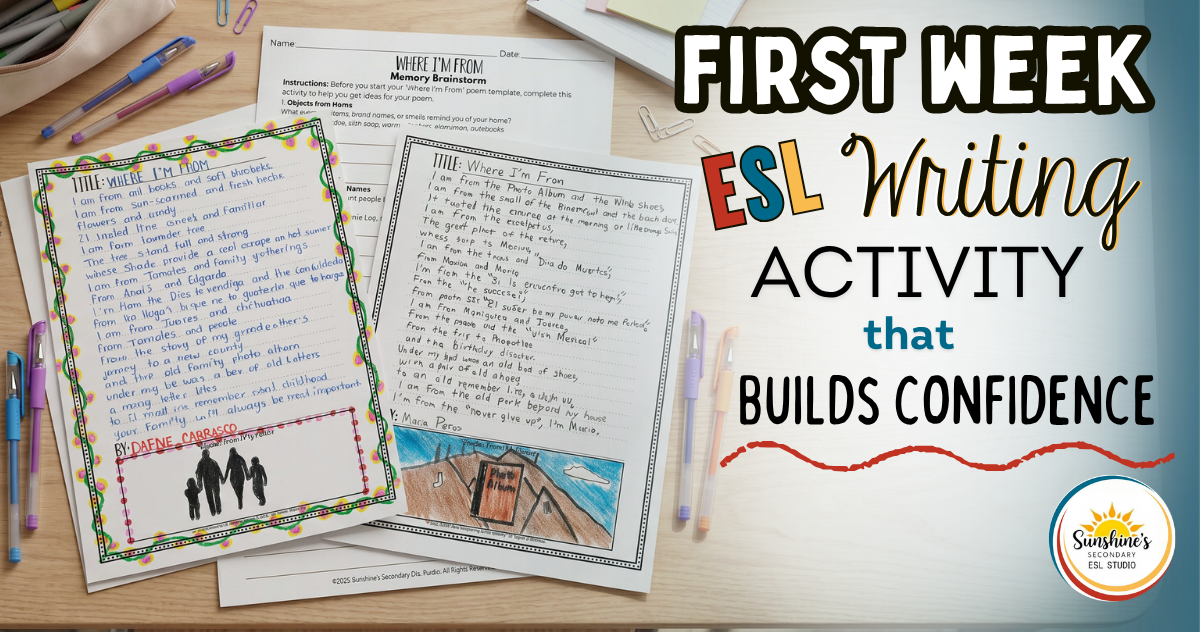
One of my favorite back-to-school ESL activities is the “Where I’m From” Identity Poem. It is more than just a writing assignment. Instead, it becomes a confidence builder, a conversation starter, and a classroom community activity all in one.
If you are looking for a meaningful first week ESL writing activity for high school students, this has become one of the most powerful lessons in my classroom.
If you are still planning your first week, this also pairs well with my First Week Tips for New ESL Teachers.
Why Identity Writing Matters for ESL Teens
During the first week of school, I want my ESL students to feel safe, seen, and proud of who they are.
Many English learners spend so much time worrying about grammar mistakes or pronunciation that they rarely get opportunities to share their stories. However, identity writing changes that.
Instead of focusing on perfect English, students focus on memories, family traditions, food, music, places, and experiences that matter to them. As a result, the writing becomes personal, which naturally increases engagement.
Over the years, I have noticed that even shy students are more willing to write and share when the topic connects to their own lives.
For secondary ESL students, activities like this help build:
- classroom community
- student confidence
- speaking and listening skills
- cultural pride
- low-stress writing practice
This kind of relationship-building is especially important during the first week of school. If you want more ideas for creating a supportive classroom environment, you may also like my post about social emotional learning for ESL teens.
What Is the “Where I’m From” Identity Poem?
This activity is inspired by the poem “Where I’m From” by George Ella Lyon.
Students create their own identity poem using sensory details, memories, family traditions, and personal experiences.
Their poems often include:
- foods they grew up eating
- sayings from family members
- music and celebrations
- childhood memories
- important places
- cultural traditions
The final poems are always meaningful, emotional, and personal.
Best of all, students begin to realize that their backgrounds and experiences belong in the classroom.
Why This First Week ESL Writing Activity Works
One reason this first week ESL writing activity works so well is because students are never staring at a blank page.
Everything is scaffolded.
The resource includes:
- a student-friendly brainstorm worksheet
- sensory language support
- sentence frames and guided prompts
- peer feedback forms
- English and Spanish revision checklists
- final draft publishing pages
- student examples for modeling success
For many ESL students, sentence frames make a huge difference. They reduce writing anxiety and help students get started.
If you use writing scaffolds regularly, you may also like these free ESL sentence starters for teens.
I also keep this activity printable and handwriting-based.
Students stay engaged in the writing process instead of rushing to copy and paste responses online. The writing feels more authentic, personal, and reflective.
Why This Activity Works Even With Shy Students
I have used this activity with everyone from confident intermediate speakers to newcomers with very limited English.
Every year, it leads to meaningful moments.
Students discover shared hometowns, talk about favorite foods, and connect through shared traditions. At times, they laugh while sharing memories. Other times, the writing brings up emotional moments. Either way, students almost always leave feeling more connected to the classroom.
I think the activity works so well because students are writing about something they already know deeply: themselves.
That instantly lowers the pressure.
Even students who do not usually participate are often willing to share:
- one line from their poem
- a favorite memory
- a meaningful object
- a family tradition
Those small moments build confidence quickly during the first week.
How I Differentiate This Writing Activity for Different ESL Levels
One of the biggest challenges in a secondary ESL classroom is teaching students with different language levels at the same time.
I usually modify this activity depending on my students’ proficiency levels.
A1 Newcomers
- Students sketch and label ideas first
- Bilingual brainstorming is encouraged
- Sentence frames stay very simple
- Partner discussions happen before writing
A2 Students
- Students expand ideas using sensory details
- Sentence starters provide extra support
- Peer conversations help generate ideas
B1 Students
- Students write longer descriptive lines
- Figurative language can be introduced
- Students revise for stronger word choice
Differentiation matters so much in secondary ESL. If you teach mixed proficiency levels, you may also enjoy my posts about differentiating ESL instruction in high school and beginner ESL high school strategies.
Yes, There’s Spanish Support
If you teach Spanish-speaking ESL students, the bilingual supports are very helpful during the first week.
The sentence frames and revision checklists are translated into Spanish so students fully understand the expectations of the assignment.
The goal is not to make the activity easier. Instead, the goal is to make it accessible.
When students understand the task clearly, they can focus more energy on expressing themselves in English.
How I Use This During the First Week of School
Here is my typical classroom flow for this first week ESL writing activity.
Start with the Mentor Poem
On the first day, I introduce the mentor poem and give students time to listen through the QR code audio link. After that, students complete the brainstorm activity so they can start collecting memories, places, foods, traditions, and sensory details.
Move Into Descriptive Writing
Next, we highlight examples of sensory language together. Then I model what strong descriptive writing can look like before students begin drafting with sentence stems.
Add Feedback and Revision
Once students have a draft, we move into peer feedback and teacher conferencing. Students also use the revision checklist in English or Spanish so they know exactly what to improve before they continue writing.
Publish and Share
Finally, students complete their final draft. Some students also record an optional Vocaroo reading, while others prepare their poems for a classroom or hallway display.
By the end of the week, students have created something personal and meaningful that they are genuinely proud of.
And honestly? The hallway displays always end up beautiful.
Build a Stronger First Week ESL System
A meaningful writing activity is powerful on its own. However, it works even better when students also have routines, visuals, and daily supports in place.
If you are planning your back-to-school ESL activities, these resources can help create a calmer and more predictable start to the year.
Newcomer supports help brand-new English learners understand the classroom from the beginning.
👉 Secondary ESL Newcomer Launch Bundle
Classroom routines, procedures, and community-building activities help you set expectations from day one.
👉 Back to School ESL Bundle
Daily warm-ups give students a predictable way to begin class and practice language consistently.
👉 ESL Bell Ringers Mega Bundle
Together, these supports work well alongside first-week writing because students need more than one good activity. They need a classroom system that helps them feel safe, prepared, and ready to participate.
More First Week ESL Resources
If you are planning your back-to-school ESL activities right now, these resources may also help:
- First Week ESL Slides
- ESL Desk Mats for Back to School
- ESL Routines Posters
- ESL Back to School Bundle
These types of structured supports can make the first few weeks feel calmer and more predictable for English learners.
Want to Try This ESL Writing Activity?
You can grab the full “Where I’m From” Identity Poem resource here:
👉 ESL Identity Poem for Back to School | “Where I’m From” with Spanish Support
The activity is designed for CEFR A2–B1 ESL students. It includes everything you need to guide students through brainstorming, drafting, revising, and publishing their poems.
Final Thoughts
This is not just another back-to-school ESL activity.
It is a way to help students feel like they belong.
During the first week of school, many English learners are carrying anxiety, uncertainty, and fear of making mistakes. Because of that, giving them the opportunity to share their identities in a supportive, scaffolded way can completely change the atmosphere of your classroom.
If you are looking for a first week ESL writing activity that builds confidence, encourages authentic expression, and creates meaningful classroom connections, this has easily become one of my favorite lessons of the year.