
Finding ESL vocabulary games for teens that actually work with high school students can feel impossible sometimes. Teenagers know immediately when an activity feels too childish, too repetitive, or too disconnected from real language use.
That’s why one of my favorite classroom vocabulary activities is inspired by a game many of my students already know and love: ¡Basta!
This fast-paced category game brings energy, competition, and meaningful language practice into the ESL classroom without requiring complicated prep. Even better, it connects naturally to many students’ cultural backgrounds, which instantly increases engagement.
Over the years, Word Dash! has become one of those rare ESL vocabulary games for teens that students ask to play again and again.
Affiliate disclosure: This post contains affiliate links. As an Amazon Associate I earn from qualifying purchases at no additional cost to you.
What Is ¡Basta!?
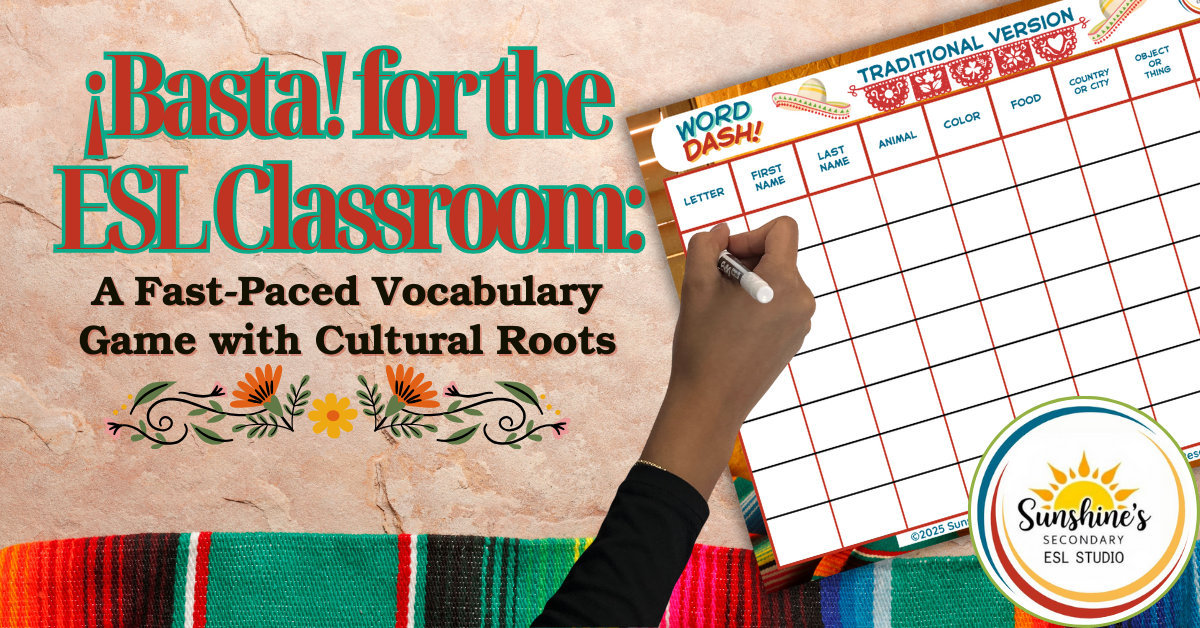
¡Basta! (which means “Stop!” in Spanish) is a simple paper-and-pencil game that’s popular across Mexico and many parts of Latin America. Players choose a random letter and race to fill category boxes with words that begin with that letter.
Typical categories might include:
- Name
- Animal
- Food
- Color
- Country or City
The first player to finish shouts “¡Basta!” and the round ends. Students then compare answers and score points based on accuracy and originality.
At its core, it’s a vocabulary race that encourages quick thinking, spelling, category fluency, and speaking opportunities—all things that work beautifully in a secondary ESL classroom.
Activities like this pair naturally with other speaking activities for ESL teens that encourage students to produce language in a low-pressure environment.
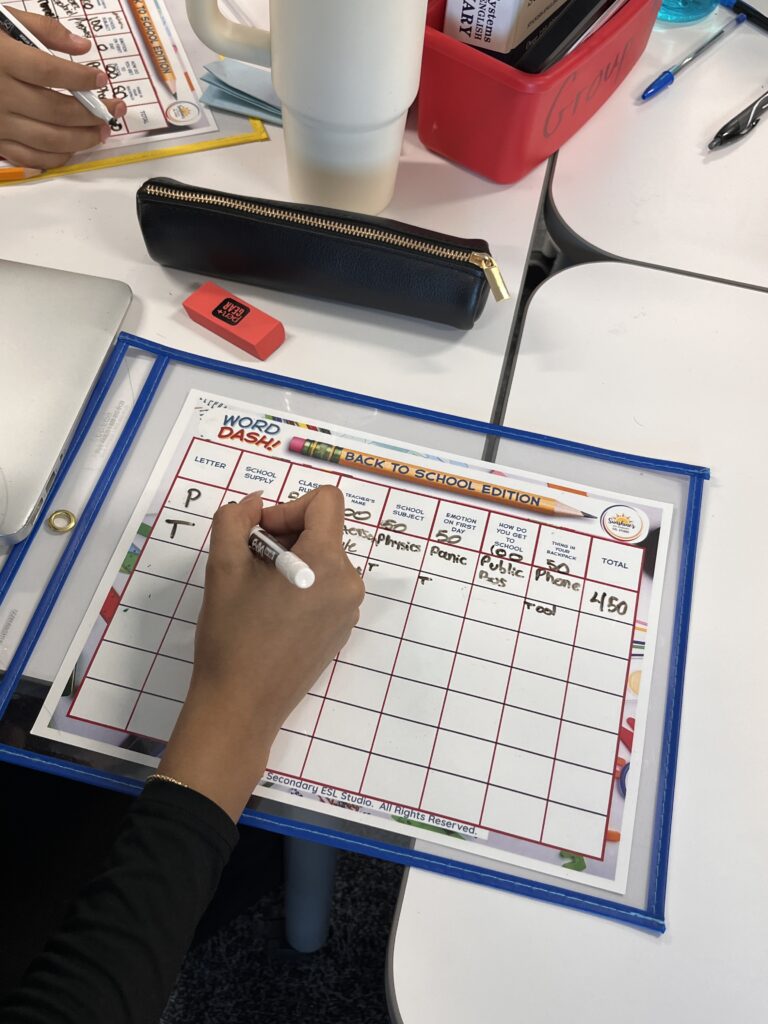
Classroom tool I use: I place the ¡Basta! game sheets in reusable dry-erase sleeves so students can play multiple rounds without needing a new copy each time.
See the reusable dry-erase sleeves I use on Amazon
I also use fine-tip dry-erase markers so students have enough room to write inside the categories.
See the dry-erase markers on Amazon
How I Adapted ¡Basta! Into One of My Favorite ESL Vocabulary Games for Teens
I loved the structure of the original game, but I wanted categories that better supported English language development and common classroom themes.
So I created Word Dash!—an ESL-friendly version inspired by ¡Basta! but designed specifically for secondary English learners.
One of the first versions I created was a Back-to-School edition with categories like:
- School Supply
- Class Rule
- School Subject
- Emotion on the First Day
- How You Get to School
Instead of disconnected vocabulary practice, students were using high-frequency words tied directly to school life and real communication.
We played in teams, laughed at funny answers, and debated whether certain words “counted.” Most importantly, students were using academic and social vocabulary without the activity feeling forced.
Games like this also help build the kind of classroom participation and risk-taking I talk about in my post on ESL speaking confidence activities.
Why High School ESL Students Actually Enjoy This Game
One reason this activity works so well with teenagers is that it doesn’t feel overly academic or elementary.
Students are moving quickly, competing with classmates, and relying on vocabulary they already partially know instead of staring at a memorization list. Even students who are normally quiet tend to participate because the focus shifts from “perfect English” to contributing to the team.
That balance matters a lot in secondary ESL classrooms.
Teen learners want activities that feel social, fast-paced, and age appropriate. Word Dash! gives them structure while still feeling fun and interactive.
It also works across multiple proficiency levels because students can participate using the vocabulary they already have available. Beginners can contribute simple words while more advanced students stretch themselves with more complex vocabulary.
If you teach mixed proficiency levels, you may also enjoy reading about differentiating ESL instruction from A1 to B2 in the secondary classroom.
The Free Traditional Version Inspired by ¡Basta!
Because this game has such deep cultural roots for many of my students, I also wanted to create a more traditional version—and offer it completely free for teachers.
This FREE Traditional Word Dash! includes classic categories inspired directly by the original game:
- First Name
- Last Name
- Animal
- Color
- Food
- Country or City
- Object
I kept the format simple and classroom-friendly with:
- printable color and black-and-white versions
- student instructions
- scoring directions
- easy prep for teachers
Experiences like this are one reason I care so much about culturally responsive teaching for ESL teens. When students recognize pieces of their own culture inside classroom activities, engagement changes completely.
In many ways, games like this also naturally support translanguaging in the secondary ESL classroom because students often draw from both languages while building vocabulary connections.
I wanted teachers to be able to try the activity immediately, so I created a completely free Traditional Word Dash! version inspired by classic ¡Basta! categories.
FREE Word Dash! Traditional Vocabulary Game for ESL | Inspired by the Game Basta
Why ESL Vocabulary Games for Teens Work So Well
Many ESL vocabulary games for teens focus mainly on memorization. Word Dash! encourages students to actually use language quickly and flexibly.
Whether you teach newcomers or advanced multilingual learners, this game supports several language development goals at once:
- builds vocabulary fluency across multiple topics
- encourages category thinking and spelling awareness
- supports speaking and writing extensions
- increases collaboration and participation
- connects to students’ cultural knowledge
- lowers anxiety during language production
I’ve used it with:
- small groups
- whole-class competitions
- stations
- substitute lesson plans
- fast-finisher folders
- back-to-school activities
- end-of-year review days
Its flexibility is part of what makes it so effective.
If your students enjoy fast-paced classroom games, they may also enjoy:
You may also enjoy my collection of ESL vocabulary activities for high school students if you are looking for additional ways to build vocabulary practice into your classroom routines.
A Back-to-School Version of This ESL Vocabulary Game for Teens
If you want a more classroom-ready version with themed categories, editable slides, and reusable formats, I also created a Back-to-School Word Dash! edition for ESL teens.
This version includes:
- school-themed vocabulary categories
- printable formats
- editable Google Slides
- reusable laminated versions
- teen-friendly design
- easy implementation during the first weeks of school
It pairs especially well with:
Word Dash ESL Vocabulary Games Bundle | Basta-Inspired Games for Teens
Looking for More ESL Games for Teens?
If your students enjoy ESL vocabulary games for teens like Word Dash!, you can explore more activities designed specifically for middle and high school English learners in my Teachers Pay Teachers store.
Many of these resources focus on:
- vocabulary development
- speaking confidence
- collaboration
- listening skills
- critical thinking
- age-appropriate engagement for teens
I’ve found that secondary ESL students respond best when activities feel interactive, respectful of their age group, and connected to real communication instead of isolated drills.
Wrap-Up
I’ve seen firsthand how games like this bring language to life for ESL teens. When students recognize something familiar from their own experiences or cultures, participation changes completely.
Whether you use the free traditional version or the themed classroom editions, Word Dash! is one of those ESL vocabulary games for teens that combines vocabulary practice, speaking, collaboration, and genuine student engagement.
And honestly, those are the activities students remember.
Happy Teaching,
Sunshine Castro, M.Ed.