
Teaching argumentative writing for ESL students isn’t just about writing essays. It’s about helping students develop confidence, academic vocabulary, sentence structure, and the ability to express opinions clearly. When multilingual learners are asked to write an argument, they’re often juggling language development and critical thinking at the same time.
That’s why argumentative writing for ESL students requires intentional scaffolding. In secondary classrooms especially, the concept of rigor often looks different for multilingual learners, which I talk about more in my post on why rigor in ESL classrooms looks different.
Over the years, I’ve experimented with many strategies. Some worked. Some didn’t. But eventually I developed a system that helps ESL teens understand the purpose behind argumentative writing while giving them the language tools they need to succeed.
Below is the step-by-step approach I use in my own classroom.
And if you’d like to use the same scaffolds I use, you’ll find a free argumentative essay graphic organizer and bilingual English-Spanish essay blueprint later in this post.
Step 1: Start with Speaking Before Writing
One of the most important foundations of argumentative writing for ESL students is speaking first.
Before we look at a writing prompt or begin drafting, students practice sharing their opinions out loud. This approach mirrors the same strategies I use when building speaking confidence with ESL students, because language production becomes much easier when students rehearse ideas verbally first.
I’ll start with a simple question like:
Should students have to wear school uniforms?
Then I model opinion sentence frames such as:
“I believe ___ because ___.”
“In my opinion, ___ is better because ___.”
“Some people think ___, but I disagree because ___.”
Students practice responding in pairs or small groups. For students who need additional language support, using structured sentence starters for ESL teens can make a huge difference in helping them express opinions clearly before writing begins.
Once students feel comfortable discussing their ideas, transitioning to written arguments becomes much easier.
Step 2: Choose High-Interest Topics for Argumentative Writing for ESL Students
Engagement is everything.
Argumentative writing for ESL students becomes far more meaningful when students care about the topic they’re discussing. I usually choose prompts connected to real issues teens understand, such as school policies, social media, or freedom of expression.
Some topics that always generate strong discussion include:
• Should phones be allowed in class?
• Should schools enforce dress codes?
• Should certain media be censored?
In fact, the topic of whether cellphones should be banned in schools almost always sparks passionate debate in my classroom.
These types of real-world issues also appear in several of the argumentative reading passages I use with students, including topics like cellphone bans, school dress codes, and censorship in media. When students read and respond to authentic debates like these, their argumentative writing becomes much more thoughtful and detailed.
You can explore these argumentative readings with audio and ECR writing tasks in my store:
Step 3: Use Visual and Bilingual Scaffolds
Once students understand the topic, I introduce the structure of an argumentative essay.
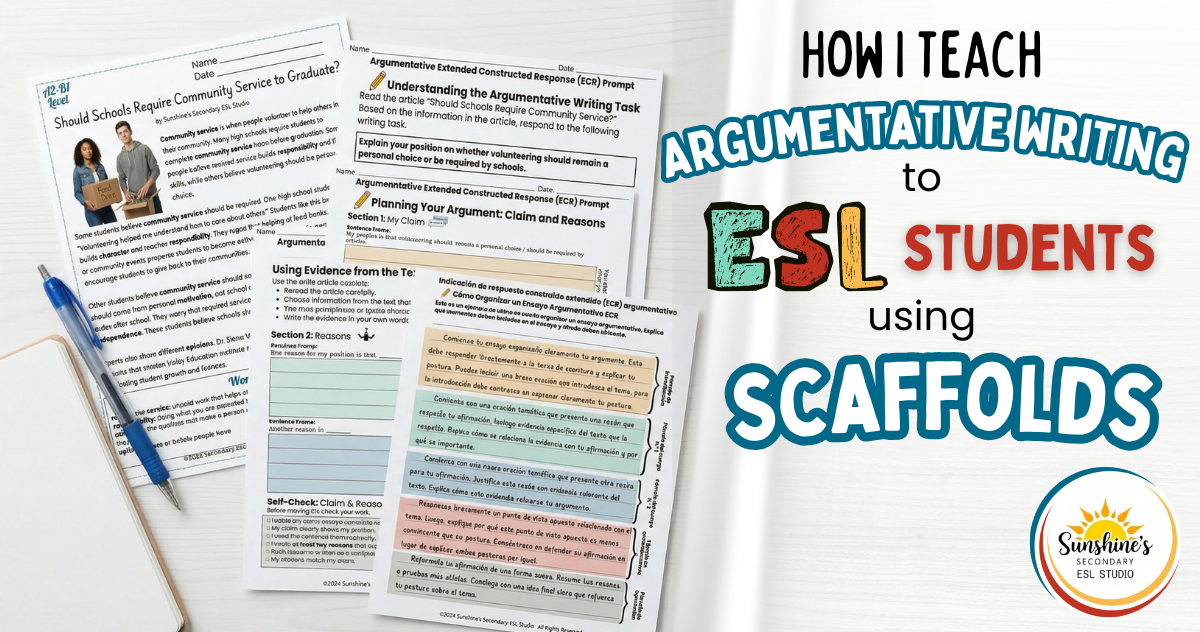
One of the most helpful tools I use when teaching argumentative writing for ESL students is a bilingual essay blueprint. This visual guide shows students exactly what belongs in each paragraph of an argumentative essay, and it’s written in both English and Spanish to support multilingual learners.
Next, students complete a graphic organizer that walks them through:
• writing a clear claim
• listing reasons
• finding evidence
• explaining their evidence
• addressing a counterclaim
• writing a conclusion
Each section includes sentence stems and guiding prompts so students always know what to write next.
This type of scaffolded support is especially helpful for multilingual learners who may still be reading below grade level in English, since it breaks complex writing tasks into manageable steps.
If you’d like to try the same scaffold with your students, you can download my free Argumentative Essay Graphic Organizer and English-Spanish Essay Blueprint below.
👉 Download the free Argumentative Essay Graphic Organizer + English-Spanish Essay Blueprint
Step 4: Teach Evidence Like a Detective
Another challenge in argumentative writing for ESL students is helping learners understand how to use evidence effectively.
Instead of jumping straight into writing essays, we practice identifying evidence inside short mentor texts first.
Students highlight:
• the claim in one color
• the evidence in another
• the explanation in a third
This color-coding strategy helps students visually see how arguments are built. Once they understand the structure, they begin applying the same pattern to their own writing.
Step 5: Practice Counterclaims Through Conversation
Counterclaims can feel abstract for many students, so I teach them through conversation first.
Students pair up and take opposite sides of an issue. One student argues their point, and the other student responds with a counterargument.
These mini-debates are low-stakes and often surprisingly fun. They help students understand that strong arguments acknowledge other viewpoints while defending their own position.
After the discussion, students add their counterclaim and rebuttal to their graphic organizer.
Step 6: Write in Layers Instead of All at Once
Writing a full essay in one sitting can feel overwhelming for language learners.
Breaking the writing process into smaller sections makes the task much more manageable and is one of the most effective ways of differentiating ESL instruction across A1–B2 proficiency levels.
Each day we focus on one section of the essay:
• the claim
• the first reason
• evidence and explanation
• the counterclaim
• the conclusion
By the time students finish, they’ve built their essay step by step and actually understand the purpose of each paragraph.
Final Thoughts on Argumentative Writing for ESL Students
Teaching argumentative writing for ESL students doesn’t have to feel overwhelming.
With the right scaffolds, pacing, and visual supports, multilingual learners can do far more than simply complete an assignment. They can develop real arguments, support their opinions with evidence, and build confidence in their academic writing.
If you’d like to try the same tools I use in my classroom, download the free bilingual argumentative essay organizer and essay blueprint above.
You can also explore more argumentative reading passages and ECR writing prompts designed for secondary ESL students in my Teachers Pay Teachers store. These resources focus on high-interest topics like cellphone bans, school dress codes, and censorship in media, helping students practice real argumentative writing skills with built-in scaffolds.