
Teaching grammar to beginners can feel frustrating—especially when students seem to understand in the moment but struggle to apply it later.
When thinking about how to teach grammar to beginner ESL students, it becomes clear that grammar cannot be taught in isolation. Instead, students need to see, hear, practice, and interact with language in meaningful ways. At the same time, high school learners need materials that feel respectful and age-appropriate.
Understanding Beginner ESL Learners
One of the biggest challenges in teaching grammar to beginner ESL students is language interference. In many cases, students rely on patterns from their first language, which can lead to repeated errors.
For example, English places adjectives before nouns (a red car), while Spanish places them after (un carro rojo). Because of this difference, students need consistent exposure, modeling, and guided practice over time.
In addition, beginners often struggle with limited vocabulary and low confidence. As a result, they may hesitate to participate or take risks. For this reason, visuals and context play a critical role. When students can connect grammar to something they can see or relate to, comprehension improves significantly.
This connects closely to culturally responsive teaching for ESL teens because meeting students where they are makes grammar more accessible.
You’ll also see this in action when working with newcomers in Beginner ESL in High School, where support and scaffolding are essential from day one.
Why Traditional Grammar Methods Don’t Work
Traditional grammar instruction often relies too heavily on worksheets and isolated drills. However, beginner ESL students need more than definitions and fill-in-the-blank exercises.
Instead, grammar should be taught across all four domains:
- reading
- writing
- speaking
- listening
If you’re looking to strengthen multiple domains at once, strategies from ESL Vocabulary Activities for High School pair really well with grammar instruction.
For instance, when introducing prepositions, it helps to physically demonstrate meaning. You might place an object on a desk, move it under a chair, or stand in front of the class. As a result, students begin to associate language with real actions, making the concept easier to remember.
A Lesson I Learned Early On
At the beginning of my career, I relied heavily on workbooks. After explaining a concept and modeling a few examples, I would ask, “Do you understand?” Students would nod, and I assumed everything was fine.
However, when I graded their work, the results told a different story.
From that experience, I realized that understanding requires more than exposure. Since then, I have focused on building lessons that include multiple opportunities for practice, interaction, and feedback.
Building these kinds of routines is much easier when you have a strong start to the year. You can see how this connects in First Week Tips for New ESL Teachers.
Go-To Strategies for Teaching Grammar to Beginners
When grammar feels overwhelming, these strategies consistently help:
- First, use sentence starters to reduce cognitive load – (Grab ideas here: Free ESL Sentence Starters for Teens)
- Next, teach one target at a time to maintain clarity
- Additionally, incorporate real-life teen contexts like social media or school situations
- At the same time, support learning with visuals and examples – (These help a lot: Survival English Desk Mats for ESL)
- Whenever possible, include movement or interactive activities – (Try this: Charades Game for ESL High School Students)
- Most importantly, focus on progress rather than perfection
Ultimately, the goal is not flawless grammar—it is confident communication.
Why Task Cards Work So Well for Beginners
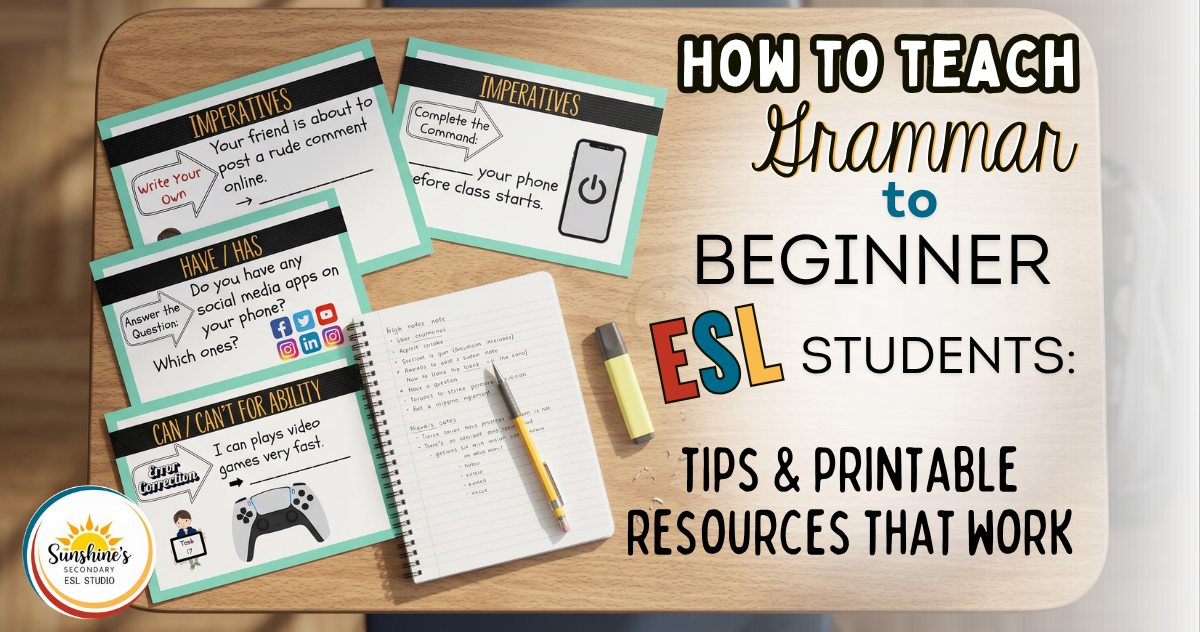
One tool that has made a huge difference in my classroom is task cards.
Although they are simple, they are incredibly effective. For one thing, they break grammar into manageable pieces. In addition, they feel less intimidating than full worksheets.
Here’s why they work so well:
- They are bite-sized and approachable
- They reduce overwhelm for beginners
- They work well in stations, small groups, or warm-ups
- They are flexible and reusable
If you want to see how I structure these, you can check out ESL Grammar Task Cards for more ideas and classroom examples.
In my classroom, I use them in multiple ways. Sometimes students work independently, while other times I project them for whole-class instruction. As a result, students at different levels can participate more comfortably.
Interestingly, my A1–A2 students often take more risks when sentence stems are included. With that support in place, they begin to build confidence and engage more actively.
Try It in Your Classroom (Free Resource)
If you’re working on how to teach grammar to beginner ESL students, starting with the right tools can make a big difference.
👉 You can start here: A1 Grammar Task Card Freebie
This resource works especially well for:
- warm-ups
- small group practice
- guided instruction
Want More Grammar Support?
If the free set works well, you can easily expand your resources:
Each option is designed specifically for teens, requires minimal prep, and targets beginner-level grammar skills.
Final Thoughts
Teaching grammar to beginner ESL students becomes much more effective when instruction is intentional, structured, and engaging.
If you’re also thinking about differentiation across levels, this pairs well with Differentiating ESL Instruction A1–B2.
By focusing on clear modeling, meaningful practice, and supportive tools, students begin to build both confidence and competence.