
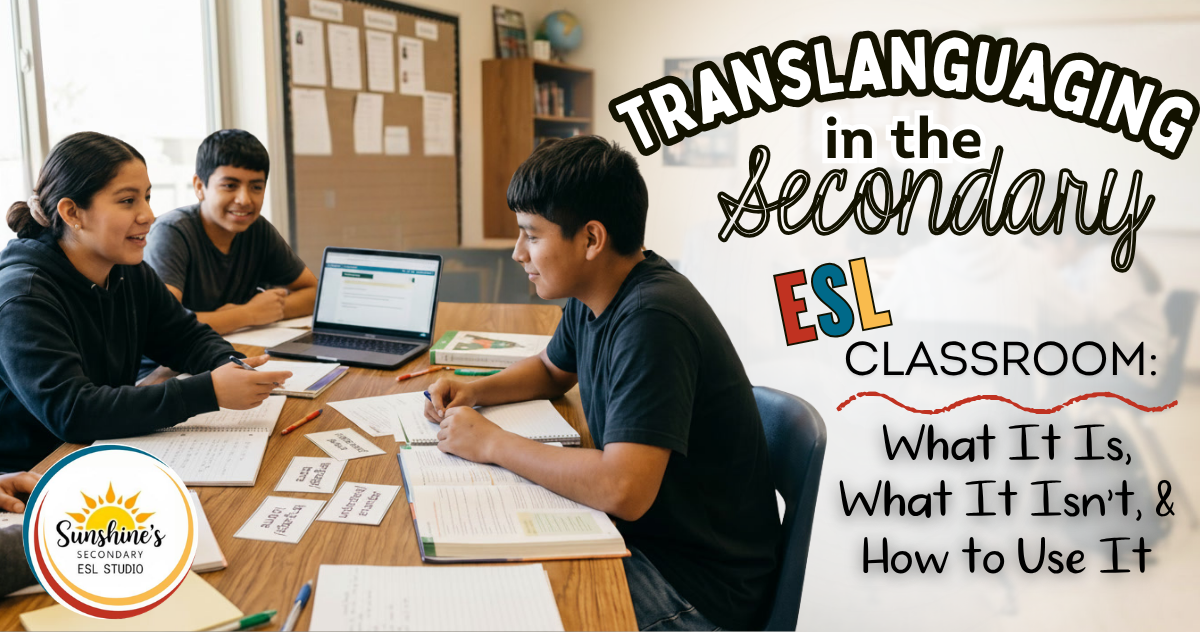
Translanguaging in the secondary ESL classroom gives multilingual learners permission to use the languages they already know as purposeful tools for understanding difficult content, organizing ideas, and preparing to communicate in English. For example, a student might discuss a reading in Spanish, annotate it with notes in both languages, and then write an English response using academic vocabulary from the lesson.
That student is not avoiding English. Instead, the student is using an existing language resource to reach the English task.
This distinction matters in middle and high school classrooms. Secondary multilingual learners are often expected to analyze literature, explain scientific processes, defend arguments, and understand grade-level content before they have developed all the English needed to express what they know.
Thoughtful translanguaging gives students another way into that learning without lowering expectations or replacing English instruction.
What Is Translanguaging in the Secondary ESL Classroom?
Translanguaging is the intentional use of a multilingual learner’s complete linguistic repertoire during learning.
In practical classroom terms, students may use their home language to:
- Activate background knowledge
- Understand an unfamiliar concept
- Discuss a difficult question
- Organize ideas before writing
- Clarify academic vocabulary
- Research a topic
- Rehearse an English response
- Demonstrate what they understand
For example, a newcomer might read a short English paragraph about ecosystems, discuss its meaning with a Spanish-speaking classmate, label a diagram in both languages, and then complete an English sentence frame explaining how plants and animals depend on one another.
The Spanish discussion is not the final objective. Rather, it is the bridge that helps the student reach the English objective.
This approach reflects an asset-based view of multilingual students. Instead of treating a student’s home language as a problem or interference, translanguaging recognizes it as a valuable resource for learning.
That same mindset is central to culturally responsive teaching for ESL teens. Students are often more willing to participate when their language, experiences, and cultural knowledge are treated as strengths.
What Translanguaging Is—and What It Is Not
Translanguaging is sometimes misunderstood as allowing students to speak any language they want without clear expectations.
However, that is not the goal.
Translanguaging in the secondary ESL classroom is:
- Using a home language to build background knowledge
- Discussing a complex idea before explaining it in English
- Brainstorming or outlining before completing an English writing task
- Creating bilingual vocabulary supports
- Comparing words, expressions, and concepts across languages
- Researching in one language and presenting in another
- Using translation tools strategically
- Allowing students to demonstrate understanding while their English develops
Translanguaging in the secondary ESL classroom is not:
- Translating every sentence of every lesson
- Replacing English-language instruction
- Allowing students to avoid English practice
- Giving students unlimited social time in a home language
- Lowering the rigor of academic content
- Assuming every multilingual student reads and writes fluently in a home language
- Expecting the teacher to speak every language in the classroom
Ultimately, the difference is instructional purpose.
Students should know why they are using another language, how long they will use it, and what English-language outcome they are expected to produce afterward.
My Experience With an “English Only” Rule
When I was hired as a brand-new ESL teacher, a seasoned ESL teacher told me that I needed to establish an “English only at all times” rule.
At first, I followed that advice because I assumed constant English use would help students learn faster. Before long, though, I began to see a different result.
Some students became quieter. Others appeared more hesitant to ask questions or share ideas. Most importantly, several students seemed less willing to take risks in a language they were still learning.
As I gained experience, I abandoned the English-only rule. Once students were allowed to use their home language purposefully to clarify ideas, ask questions, and prepare responses, many became more willing to participate in English.
That experience changed the way I viewed language use in the ESL classroom. Encouraging English growth does not require treating students’ other languages as though they do not belong.
In fact, a rigid English-only approach can sometimes create the opposite of what we want. Instead of encouraging more English, it may increase anxiety and reduce participation.
For me, that was one of the clearest lessons in why translanguaging matters.
Translanguaging vs. Code-Switching and Translation
Translanguaging, code-switching, and translation are related concepts, but they are not identical.
How is translanguaging different from code-switching?
Code-switching generally refers to moving between languages during communication.
A bilingual student might say:
“I finished the first question, pero no entiendo la segunda.”
That shift may happen naturally and without planning.
Translanguaging is broader. It includes the different ways multilingual people draw from all their language knowledge to understand, think, learn, and communicate.
In the classroom, teachers may also design opportunities for translanguaging on purpose.
For instance, you might tell students:
“Discuss the question in the language that helps you think. Then prepare one answer in English.”
Here, the language use is connected to a clear academic goal.
How is translanguaging different from translation?
Translation involves expressing information from one language in another. Although translation can be part of translanguaging, it is not the entire process.
Giving students a fully translated worksheet does not automatically require them to make connections between languages or develop English.
A more purposeful routine might ask students to:
- Use a bilingual dictionary or translation tool to clarify an unfamiliar word.
- Compare the translation with the English term.
- Discuss the concept through an example.
- Apply the English word in a sentence or explanation.
Translation opens the door. Afterward, discussion, application, and English production build lasting language.
Students often need guidance in using translation tools effectively. I discuss that balance further in using Google Translate in the ESL classroom.
Why Translanguaging in the Secondary ESL Classroom Matters
Secondary multilingual learners are doing two demanding things at the same time: learning English and mastering grade-level academic content.
A high school newcomer may be learning basic classroom language while also being asked to understand biology, algebra, world history, and literature.
Without meaningful scaffolds, the language demand can hide the student’s actual knowledge and reasoning.
Translanguaging improves access to complex content
A student may understand photosynthesis, migration, symbolism, or proportional relationships in a home language but lack the English vocabulary needed to explain the concept.
By allowing the student to process the idea in a stronger language, the teacher gives the student access to the content while English develops.
This support is especially important when ESL students are reading below grade level. Simplifying every idea is not the only solution. Sometimes students need a language bridge rather than easier thinking.
Translanguaging can increase participation
Some students remain silent because they are still forming their answers in English. Others understand the lesson but do not know how to begin expressing their ideas.
A short home-language discussion can help students organize their thinking before speaking.
Additionally, this approach works well alongside strategic wait time in the ESL classroom. Students need time to process the question, formulate an idea, locate the English, and decide how they want to respond.
Translanguaging affirms linguistic identity
Adolescents are highly aware of whether their language and culture are respected.
When students are repeatedly told not to use the language they know best, they may receive a larger message: an important part of who they are does not belong at school.
Translanguaging does not require every lesson to become a cultural celebration. Instead, it simply recognizes that students do not stop being multilingual when they enter an English classroom.
Translanguaging supports academic rigor
Rigor does not mean forcing students to complete every cognitive step in English without support.
A student can analyze a difficult theme, compare historical perspectives, or explain a scientific process even if the English required to communicate that thinking is still developing.
As a result, translanguaging allows teachers to maintain challenging content while providing access. This is one reason rigor in ESL often looks different.
Who Benefits From Translanguaging in the Secondary ESL Classroom?
Translanguaging can support students at many proficiency levels, but it should not look identical for everyone.
Translanguaging strategies for newcomers and A1 students
Newcomers may need home-language support to understand basic directions, routines, schedules, and expectations.
They might:
- Match English classroom commands with home-language meanings
- Discuss directions with a same-language peer
- Label a picture in both languages
- Use a bilingual glossary
- Respond to a comprehension question in a home language before learning the English sentence
- Listen to a short explanation in a familiar language before returning to the English lesson
Teachers working with true beginners may also find these strategies for beginner ESL students in high school helpful.
During the first weeks of school, visual and linguistic supports can reduce confusion while students learn essential routines. My Secondary ESL Newcomer Launch Bundle provides structured first-weeks materials that can be combined with purposeful home-language support.
Translanguaging strategies for A2 students
A2 students can often communicate about familiar topics, yet academic explanations may still be difficult.
They may benefit from:
- Discussing a text before answering in English
- Brainstorming in a home language
- Comparing cognates
- Using bilingual word banks
- Rehearsing an English answer with a partner
- Completing an English sentence frame after organizing the idea in another language
Translanguaging strategies for B1 and B2 students
Intermediate students may not need frequent translation, but they can still use translanguaging during demanding academic tasks.
They might:
- Research a difficult topic using sources in multiple languages
- Compare how a concept is explained in different languages
- Annotate an English text with multilingual notes
- Discuss a complex question before writing an English argument
- Analyze differences in tone, word choice, or cultural meaning
- Verify their understanding of specialized academic vocabulary
Rather than disappearing entirely, the support becomes more selective and intellectually sophisticated as students develop proficiency.
Translanguaging in mixed-level secondary ESL classes
Translanguaging can also help teachers manage classes that include students from A1 through B2.
The same task might require:
- Home-language discussion and a sentence frame for an A1 student
- A bilingual word bank and short English paragraph for an A2 student
- English discussion supported by multilingual research for a B1 student
- An extended English response comparing sources or perspectives for a B2 student
For more ways to adapt one lesson across proficiency levels, see differentiating ESL instruction from A1 to B2.
Practical Translanguaging Strategies for the Secondary ESL Classroom
Translanguaging does not need to become a separate unit or complicated program. Instead, it can be built into classroom routines you already use.
Use translanguaging to activate background knowledge
Before introducing a new text or topic, allow students to access what they already know.
You might ask:
- What do you already know about this topic?
- Have you studied this before?
- What words do you associate with it?
- How would you explain it to someone in your family?
- Does this idea remind you of something from your country or community?
Students can discuss or record ideas in any language. Afterward, the class can build an English word bank together.
A KWL chart works well for this routine. Students might complete the “Know” section in a home language, add English vocabulary during instruction, and complete the “Learned” section with English sentence frames.
You can find more suggestions for using KWL charts with ESL students.
Use bilingual vocabulary and cognate supports
Academic vocabulary is often where content comprehension breaks down.
Students can create a vocabulary chart with:
- The English word
- A student-friendly English definition
- A home-language equivalent
- A picture or symbol
- An example sentence
- A cognate, when appropriate
For example:
| English term | Home-language connection | English example |
|---|---|---|
| migration | migración | Migration can happen for economic or political reasons. |
| evidence | evidencia | The author uses evidence to support the claim. |
| consequence | consecuencia | One consequence of the law was increased protest. |
Still, students should not stop at the translated word. Translation provides initial access, while the visual, example, discussion, and English application develop usable academic language.
Use translanguaging before English writing
One of the simplest ways to use translanguaging in the secondary ESL classroom is to separate idea development from English production.
Ask students to:
- Read or listen to the question.
- Discuss the idea in a language that supports their thinking.
- Record important words or points.
- Identify the English vocabulary they will need.
- Use an English sentence frame to produce the final response.
For example:
“Discuss why the character made this decision. You may discuss it in your home language. Then write: ‘The character decided to ___ because ___.’”
Students are still completing the English task. However, they are not being forced to generate the idea and construct the English at exactly the same time.
This routine also supports building consistent ESL speaking routines because students often become more willing to speak after preparing their ideas.
Use home-language brainstorming for essays
Writing requires students to manage several demands at once:
- Generating ideas
- Organizing information
- Choosing vocabulary
- Constructing sentences
- Applying grammar
- Revising and editing
For multilingual learners, those demands can become overwhelming.
Allowing students to brainstorm in a home language separates the quality of their thinking from their current English proficiency.
A student might:
- List ideas in Spanish
- Organize them in an English graphic organizer
- Add important English vocabulary
- Draft with sentence frames
- Revise the final paragraph in English
This approach pairs naturally with other ESL writing support strategies, including models, structured organizers, word banks, collaborative planning, and oral rehearsal.
Allow multilingual annotation during reading
Students do not need to annotate an English text only in English.
They might:
- Translate one essential word
- Summarize a paragraph in a home language
- Write a question in either language
- Connect the text to prior knowledge
- Mark cognates
- Draw a visual representation
- Write an English main-idea statement after processing
In a literature lesson, for instance, a student might annotate a difficult passage in Spanish and then use those notes to explain the theme in English.
For additional secondary reading scaffolds, see these ESL reading comprehension strategies for high school.
Use translanguaging in speaking activities
Speaking activities should not become tests of how quickly students can produce English without preparation.
Try this progression:
- Students think independently.
- Next, students discuss the prompt in any language.
- Then, students identify the English vocabulary they need.
- After that, they rehearse the English response.
- Finally, students share with a partner, group, or class.
For a question such as “What makes someone a good friend?” an A1 student may need a visual, a translated keyword, and a sentence frame. Meanwhile, a B2 student may discuss the concept first and then give a more detailed English explanation.
Structured prompts make this process easier. The Teen Talk ESL Conversation Starters Bundle can be used by allowing students to clarify or rehearse ideas in their home languages before responding in English.
You can also find more conversation starters for ESL teens.
Use translanguaging with listening activities
Listening can be especially demanding because students must process language in real time.
Before listening, students can:
- Preview essential vocabulary in both languages
- Discuss the topic in a home language
- Predict what they may hear
- Review a visual or short summary
During listening, they might take multilingual notes or label a diagram.
After listening, students can compare notes in any language before completing an English response.
The goal is not to translate the entire audio. Instead, the goal is to reduce the number of unfamiliar demands students must manage at once.
Use translanguaging in grammar instruction
Translanguaging can also help students understand how English works.
Students might compare:
- English and home-language word order
- How each language forms questions
- Whether adjectives come before or after nouns
- How verb tense is expressed
- How pronouns function
- Which grammar patterns transfer and which do not
For example, Spanish-speaking students may compare:
The interesting book
El libro interesante
Through this comparison, students can see why English adjective placement may feel unfamiliar.
The teacher does not need to know every grammar rule in every language. Students can be language experts who explain patterns they notice while the teacher guides the English application.
Using Multiple Languages in Secondary Content-Area Classes
This approach is not limited to an ESL language-development class. It can also help multilingual learners access grade-level content in science, math, social studies, and English language arts.
Supporting Science Learning With Home-Language Resources
Before a lab, students can review key vocabulary in English and a home language. They may discuss the procedure with a partner, label a diagram bilingually, perform the experiment, and write the conclusion in English.
For example:
- Home-language discussion: What are we measuring?
- Bilingual notes: height/altura, temperature/temperatura
- English output: “The plant grew more because it received more sunlight.”
Translanguaging in math
Students can solve a word problem together using the language that helps them understand the process. Then, they explain the reasoning in English using a frame such as:
“First, we ___. Next, we ___. Therefore, the answer is ___.”
In this case, the purpose is to prevent limited English from blocking mathematical reasoning.
Translanguaging in social studies
Students can research a historical event using English and home-language sources. After comparing information, they might build an English timeline and present their conclusions in English.
This process also creates an opportunity to discuss whether sources from different countries or languages present the event differently.
Translanguaging in English language arts
Students can discuss a character’s motivation in a home language, locate textual evidence in English, and write an English analysis.
Similarly, they might compare a translated text with the English version and discuss differences in word choice, tone, or cultural meaning.
In every example, translanguaging supports the cognitive work while the lesson preserves a clear English-language outcome.
A Three-Step Routine for Translanguaging in the Secondary ESL Classroom
Teachers do not need to redesign an entire lesson. Start with one question or task.
Step 1: Process ideas in the strongest available language
Give students time to think, annotate, discuss, or research using the language resources that help them understand.
Teacher language:
“Talk through the idea in the language that helps you think.”
Step 2: Build a bridge to English
Next, help students connect their understanding to the English they need.
Provide:
- English keywords
- Sentence frames
- Visuals
- Word banks
- Model responses
- Bilingual glossaries
- Peer support
Teacher language:
“Which English words will you need to explain your idea?”
Step 3: Produce a meaningful English response
Finally, ask students to complete an English task appropriate for their proficiency level.
They might:
- Write one sentence
- Give an oral summary
- Complete an exit ticket
- Label a diagram
- Present a conclusion
- Write a paragraph
- Defend an answer with evidence
Teacher language:
“Now use your notes and discussion to explain the idea in English.”
This routine keeps translanguaging structured. Students know when home-language use is encouraged, what purpose it serves, and what English outcome is expected.
How to Keep Translanguaging Structured
Concerns about classroom management are understandable. Even so, students can use multiple languages without the lesson becoming disorganized.
Before the activity, explain:
- Why students may use another language
- How long they have
- What they must accomplish
- What English product they will complete
- How each person will participate
For example:
“You have three minutes to discuss the main idea in the language that helps your group. Then each person will write one English sentence explaining it.”
That direction is very different from saying:
“You can speak Spanish whenever you want.”
The first direction creates a structured instructional routine. By contrast, the second leaves the purpose unclear.
Do Teachers Need to Speak Every Student’s Language?
Teachers do not need to speak all their students’ languages to use translanguaging effectively.
You can:
- Let students annotate in a home language
- Pair students who share a language when appropriate
- Allow multilingual research
- Ask students to develop bilingual glossaries
- Use visuals and models
- Use translation tools selectively
- Require an English summary afterward
- Check understanding through diagrams, examples, and student products
You do not need to understand every word students say. Instead, you need to create a task that produces visible evidence of learning.
At the same time, avoid making one bilingual student responsible for constantly translating for everyone. Peer support is useful, but a student should not become an unpaid classroom interpreter or lose access to personal learning time.
What If Students Have Different Home-Language Literacy Levels?
Not every multilingual student reads and writes confidently in a home language.
Some students speak a language fluently but have attended school primarily in English. Others have experienced interrupted schooling or have limited literacy in every language they use.
Therefore, translanguaging should provide options rather than require written home-language work.
Students may:
- Discuss orally
- Draw
- Use gestures
- Label pictures
- Listen to an explanation
- Watch a short video
- Use voice typing
- Record an audio response
- Work with a peer
The goal is to use the linguistic resources students actually possess, not to make assumptions based only on the language spoken at home.
Does Translanguaging Lower English Expectations?
Translanguaging should not lower English expectations.
Strong translanguaging lessons still contain clear language objectives.
For example:
Content objective: Students will explain two causes of the American Revolution.
Language objective: Students will use because, led to, and as a result to explain cause and effect orally and in writing.
Students may discuss historical causes in a home language, but they still practice the targeted English structures.
Clear language objectives for high school ESL help teachers maintain that balance. The home language supports access to the concept, while the language objective protects continued English development.
How to Explain Translanguaging to Administrators and Parents
Some administrators or parents may worry that allowing home-language use reduces English exposure.
In response, explain that translanguaging is not replacing English instruction. It is a temporary and intentional scaffold that helps students access grade-level content and prepare for English communication.
You can show:
- The English-language objective
- The time limit for home-language processing
- The expected English product
- The sentence frames students are practicing
- The academic vocabulary students must use
- Student work that demonstrates movement from multilingual processing to English production
A lesson plan might state:
“Students may discuss prior knowledge in a home language for three minutes. Students will then complete an English cause-and-effect response using the assigned academic vocabulary.”
That wording makes the purpose visible and keeps English development central.
Common Mistakes With Translanguaging in the Secondary ESL Classroom
Translating everything
Students still need meaningful English exposure and appropriate productive struggle. Therefore, translate strategically rather than automatically.
Requiring every student to use a home language
Some students may prefer English. Others may not share a language with anyone in the class. Translanguaging should expand students’ options, not create another restriction.
Allowing home-language use without a learning goal
Tell students why they are using the language and what they must accomplish afterward.
Assuming translation equals comprehension
Knowing a translated word does not guarantee that a student understands the concept. Follow translation with examples, visuals, discussion, or application.
Making the final English task inaccessible
If the English output is far above the student’s proficiency level, translanguaging alone will not solve the problem. Differentiate the final task with sentence frames, word banks, oral rehearsal, shorter responses, or models.
Treating every multilingual student the same
Students differ in English proficiency, home-language literacy, educational history, confidence, and access to same-language peers. Consequently, the support should reflect the actual learner.
Frequently Asked Questions About Translanguaging
What does translanguaging look like in the secondary ESL classroom?
Students may discuss a concept in a home language, annotate with multilingual notes, use bilingual vocabulary supports, research in multiple languages, or brainstorm before completing an English speaking or writing task.
Is translanguaging just allowing students to speak their home language?
No. Purposeful translanguaging has a learning goal. The teacher identifies when home-language use will support learning and connects it to a specific content or English-language outcome.
Will translanguaging slow English development?
Purposeful home-language support does not have to reduce English learning. On the contrary, it can help students understand difficult concepts and prepare stronger English responses. The key is maintaining meaningful English instruction and output.
Is translanguaging the same as bilingual education?
No. Bilingual education is generally a program model in which students receive instruction in two languages. Translanguaging, however, is a flexible classroom practice that can be used within different instructional models.
How can I assess students when translanguaging is allowed?
First, determine what you are assessing. If the goal is content understanding, students may be able to use diagrams, multilingual notes, or limited home-language support. If the goal is English proficiency, the final product should allow you to evaluate the targeted English skill.
Should every translanguaging activity end in English?
Not every informal check must end in extended English. Nevertheless, students need regular opportunities to transfer their understanding into English. When English development is the objective, the lesson should include an appropriate English outcome.
Final Thoughts on Translanguaging in the Secondary ESL Classroom
Translanguaging in the secondary ESL classroom is not about choosing a student’s home language instead of English. Rather, it is about using what students already know to help them reach what they are still learning.
A student who discusses an idea in Spanish before writing in English is still learning English. Likewise, a newcomer who uses a bilingual glossary during science is still engaging with science. A student who researches a historical topic in Arabic before presenting in English is also developing academic English.
The most important question is not:
“Did the student use another language?”
More useful questions are:
“Did that language use help the student understand the content?”
“Did it increase participation?”
“Did it help the student move toward an appropriate English outcome?”
When the answer is yes, translanguaging is not a shortcut around learning. Instead, it is a thoughtfully designed path into it.