
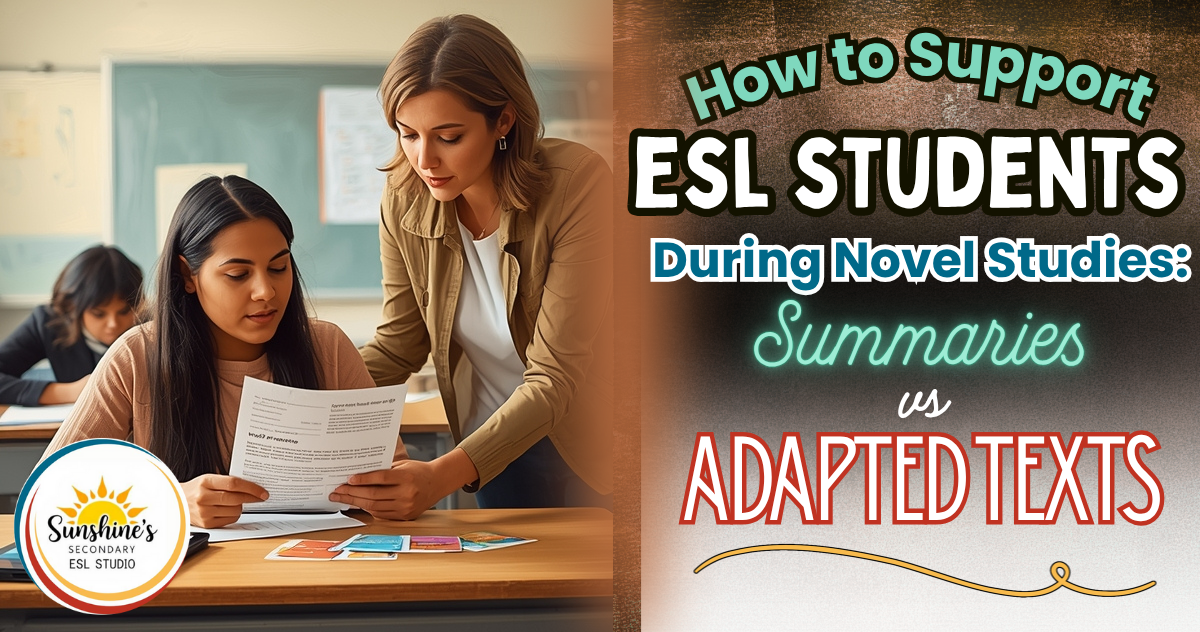
Knowing how to support ESL students during novel studies can feel complicated, especially when the class is reading a text that was not written with multilingual learners in mind. Many ESL students are expected to read the same novels as their monolingual peers, but they may still be building the vocabulary, background knowledge, grammar, and reading stamina needed to access those texts independently. That does not mean they are not capable of deep thinking. It means they need the right scaffolds.
Early in my career, I thought supporting ESL students during novel studies meant choosing easier books or simplifying everything as much as possible. Over time, I realized that approach could unintentionally limit students. Our multilingual learners deserve access to rich literature, complex themes, and meaningful classroom discussions.
The real question is not, “How do I make the book easy?”
The better question is, how do I make the book possible?
That is where summaries, adapted texts, visuals, and audio support can make a huge difference.
Why It Is Hard to Support ESL Students During Novel Studies
Novel studies are difficult because students are not just reading words on a page. They are trying to understand character development, plot structure, figurative language, cultural references, symbolism, tone, and theme—all in a language they are still learning.
For students reading below grade level, this can quickly become overwhelming. I talk more about that challenge in my post on ESL students reading below grade level, because many of our students are capable of strong thinking even when the original text is not yet independently accessible.
Some novels are especially challenging because they include older language, idioms, historical references, long descriptive passages, complex sentence structures, multiple characters, or sensitive topics that require background knowledge.
This is why simply handing students the original novel and telling them to “try their best” usually is not enough.
Students need access points before, during, and after reading. They need vocabulary support, visuals, audio, sentence frames, summaries, discussion routines, and sometimes adapted text.
How Adapted Texts Support ESL Students During Novel Studies
An adapted text is a rewritten version of the original text that uses more accessible language while still following the same plot, structure, and emotional tone.
A strong adapted text should not feel like a random summary. It should still feel like a reading experience.
That is what I try to do with my Julius Caesar ESL Adapted Play with Audio. Because Shakespeare’s works are in the public domain, I can legally create a full adapted version of the play for A2–B1 learners. The goal is to preserve the drama, conflict, and major ideas while making the language more accessible.
I also wrote more about this teaching process in my post on how to teach Julius Caesar to ESL students, especially for teachers who want students to experience Shakespeare without feeling completely lost.
For public domain texts, adapted versions can be powerful because they allow students to move through the entire story with more confidence. They can follow the plot, understand the characters, and participate in discussions without spending all of their energy decoding every sentence.
A good adapted text can help students read more independently, understand the full storyline, build confidence with literary texts, and engage with theme, conflict, and character development.
For ESL students, this matters. They do not need babyish texts. They need accessible texts that still respect their age, intelligence, and ability to think deeply.
But Not Every Novel Can Be Adapted
This is where things get complicated.
In my own classroom, I can create adaptations for instructional use with my students. But when it comes to sharing or selling resources publicly, copyright matters.
Public domain texts, like Shakespeare’s plays, can be adapted and shared legally. Modern copyrighted novels are different. A rewritten version of a copyrighted novel usually cannot be sold or distributed without permission from the publisher.
That means I cannot legally create and sell a full adapted version of a copyrighted novel like To Kill a Mockingbird.
This is why teachers need to understand the difference between adapted texts and summaries.
Summaries vs. Adapted Texts: What Is the Difference?
An adapted text rewrites the original text in more accessible language while still following the structure, plot, and pacing of the original.
A summary condenses a chapter, scene, or section into the most important events, ideas, characters, and conflicts.
Both can support ESL students during novel studies, but they serve different purposes.
| Teaching Situation | Best Support | Why It Works |
|---|---|---|
| Public domain text, like Shakespeare | Adapted text | You can legally rewrite the text while preserving the full reading experience. |
| Copyrighted modern novel | Summaries | Students get key plot and theme support without replacing the original novel. |
| Limited prep time | Summaries | Students can quickly build background before reading or discussing. |
| Deep literary analysis unit | Adapted text, summaries, or both | Students need access to the story before they can analyze it. |
| Mixed-proficiency ESL class | Summaries + visuals + audio | Students at different levels can enter the text with more confidence. |
Summaries are not a shortcut. Used well, they are a bridge.
They help students understand what is happening before they engage with the original language. This is especially helpful when the class is reading a copyrighted novel and a full adapted version is not an option.
How Summaries Support ESL Students During Novel Studies
Summaries give students the big picture.
Before students read a difficult chapter, a summary can help them understand who is involved, what is happening, where the scene takes place, and why the moment matters. That background knowledge makes the original text less intimidating.
This is especially helpful for novels with complex historical or cultural settings. For example, when teaching books connected to difficult historical topics, students need support with both language and context. I shared a similar challenge in my post on teaching Holocaust topics to ESL teens, because students need enough background knowledge to understand the seriousness of the content without becoming overwhelmed by language barriers.
Summaries can also support students who are still developing academic reading skills. In my post on ESL reading comprehension in high school, I talk about how comprehension improves when students are given structured ways to preview, process, and revisit information.
That is exactly what summaries can do during a novel study.
They help students preview the chapter, identify important characters, understand major events, build vocabulary in context, follow the plot across chapters, and prepare for discussion or writing.
When summaries are paired with visuals and audio, they become even stronger.
Why Visuals and Audio Support ESL Students During Novel Studies
For many ESL students, text alone is not enough.
A short chapter summary may help, but a summary with visuals and audio gives students multiple ways to access meaning. They can listen while reading, connect images to key events, and hear the rhythm of English as they follow along.
This is one reason I created my To Kill a Mockingbird ESL Bundle. Since I cannot legally provide a full adapted version of Harper Lee’s novel, I created A2-level chapter summaries with visuals and MP3 audio to help students preview and understand each chapter before working with the original text.
The goal is not to replace the novel. The goal is to help students enter the novel with more confidence.
I use the same approach with The Boy in the Striped Pajamas ESL Chapter Summaries & Visual Supports. The summaries help students follow the story, understand key events, and prepare for meaningful discussion without requiring me to rewrite the copyrighted text.
Audio support is also important because many students understand more when they can hear the language. I talk more about this in my post on ESL listening activities for high school, especially because listening can help students build confidence before they are asked to speak or write.
Why Scaffolds Support Rigor Instead of Removing It
One misconception about summaries is that they lower expectations.
I do not see it that way.
For ESL students, summaries often make rigorous work possible. If students cannot follow the plot, they cannot analyze character motivation, theme, symbolism, or conflict. They need basic comprehension before they can do higher-level thinking.
This connects closely to my post on why rigor in ESL looks different. Scaffolding does not remove rigor. It creates a path toward it.
For example, if students read a short summary before a chapter, they can enter the original text with a stronger sense of what to expect. Instead of using all their energy just trying to figure out what is happening, they can notice important details, make inferences, and participate in class conversations.
That is not lowering the bar.
That is helping students reach it.
When I Use Summaries in My Own Classroom
I use summaries when the original text is important, but the language is too demanding for students to access independently.
Sometimes I use a summary before reading. Sometimes I use it after reading to help students check their understanding. Sometimes I use it in place of a section when time is limited or when the class needs to focus on a specific theme or discussion question.
Summaries are especially helpful when students are new to English, the novel has difficult historical context, the class is moving quickly, or students need support before discussion.
I also like summaries because they help students feel less lost. Once students understand the basic events, they are more willing to participate. They can answer questions, make predictions, and talk about the characters without feeling embarrassed.
This is also where graphic organizers can help. In my post on ESL graphic organizers for literature, I share how visual structure can help students organize characters, conflicts, themes, and evidence during reading.
Summaries and graphic organizers work well together because one gives students the story foundation, and the other helps them organize their thinking.
When I Use Adapted Texts Instead
I use adapted texts when I want students to experience the full story in a more accessible form.
This works best when the original text is in the public domain or when I am adapting something only for my own classroom use. For example, with Julius Caesar, students can read a modern English adapted version that still follows the full play.
That type of support is different from a summary because students are still moving through the text scene by scene. They are not just getting the highlights. They are experiencing the story in a more complete way.
Adapted texts are especially helpful when the language is too old or complex, the class is studying plot across the whole work, or students need repeated exposure to literary structure.
For Shakespeare, this can be a game changer. Students can still discuss ambition, betrayal, persuasion, power, and loyalty without getting completely blocked by the original language.
A Simple Way to Decide Which Support to Use
When I am deciding between summaries and adapted texts, I ask myself a few questions.
Is the text public domain?
If yes, an adapted text may be possible.
Is the text copyrighted?
If yes, summaries are usually a safer option for shared or published resources.
Do students need the full reading experience?
If yes, an adapted text may be better.
Do students need chapter support before reading the original?
If yes, summaries may be enough.
Are students struggling to follow the plot?
Summaries, visuals, and audio can help immediately.
Are students ready to analyze theme, character, and conflict?
Then summaries or adapted texts can help them get to that deeper thinking faster.
The support should match the purpose of the lesson.
Supporting ESL Students Without Taking Over the Novel
One thing I try to avoid is replacing the entire reading experience with teacher explanation.
It can be tempting to explain everything before students even have a chance to think. But ESL students still need opportunities to wonder, predict, discuss, and respond.
The goal is to give them enough support to enter the text, not so much support that they no longer have to engage with it.
That is why I like using short chapter summaries, key vocabulary previews, visuals, audio, discussion questions, sentence starters, character charts, theme trackers, quick writes, and partner discussions.
For students who need writing support after reading, I also recommend building in sentence frames and structured responses. My post on ESL writing support strategies has ideas for helping students move from comprehension to written analysis.
Novel studies should not stop at “What happened?” Students also need support answering “Why does it matter?”
Legal and Ethical Considerations for Teachers
Teachers are creative. We adapt, modify, scaffold, and rework materials constantly because we want our students to succeed.
But when it comes to sharing or selling materials, copyright matters.
A full rewritten version of a copyrighted novel is usually not something teachers can legally distribute or sell without permission. Even if the purpose is educational, that does not automatically make it okay to publish.
That is why summaries are such a useful alternative. They allow teachers to create original support materials that help students understand the novel without replacing the copyrighted work.
For me, this matters because I want my resources to be both helpful and ethical.
With public domain texts like Julius Caesar, I can create a full adapted version. With copyrighted novels like To Kill a Mockingbird or The Boy in the Striped Pajamas, I create summaries, visuals, and audio supports instead.
Different texts require different solutions.
My Approach: Access, Not Shortcuts
When I create novel study resources, I keep one principle in mind: ESL support should feel like access, not a downgrade.
Students should not feel like they are being handed the “easy” version because they are less capable. They should feel like they are being given the tools they need to understand, participate, and grow.
That is the heart behind my literature resources.
For To Kill a Mockingbird, my chapter summaries with visuals and audio help students preview key events and understand the story before working with the original novel.
For The Boy in the Striped Pajamas, chapter summaries and visual supports help students follow the plot and process difficult topics with more clarity.
For Julius Caesar, the adapted play gives students a fuller reading experience because the original work is public domain and can be legally adapted.
Each resource answers the same question in a different way:
How can we support ESL students during novel studies while keeping the learning meaningful, age-appropriate, and legally responsible?
Final Thoughts
Supporting ESL students during novel studies is not about making literature easy. It is about making literature reachable.
Sometimes that means using an adapted text. Sometimes it means using summaries. Sometimes it means adding visuals, audio, vocabulary support, sentence frames, or graphic organizers.
The right scaffold depends on the text, the students, and the purpose of the lesson.
When students understand what is happening, they can do so much more than answer basic comprehension questions. They can discuss characters, analyze themes, make connections, and build confidence as readers.
That is the real goal.
Not shortcuts.
Access.
Ready-to-Use ESL Novel Study Supports
If you are looking for ready-to-use resources to support ESL students during novel studies, these are a few options from my TPT store:
- To Kill a Mockingbird ESL Bundle | Chapters 1–31 | A2 Summaries, Visuals & Audio
- The Boy in the Striped Pajamas | ESL Chapter Summaries & Visual Supports
- Julius Caesar ESL Adapted Play with Audio | Modern English Complete Bundle
You can also explore more teaching ideas on my ESL teacher blog or visit Sunshine’s Secondary ESL Studio for more secondary ESL resources.