
Teaching ESL in high school comes with a challenge that does not always get talked about enough: our students may need beginner English support, but they are not little kids. If you are wondering how to teach ESL in high school without using babyish materials, the key is learning how to separate language level from maturity level.
High school English learners still need many of the same foundational language skills younger students need. They may need help with basic vocabulary, sentence structure, pronunciation, reading fluency, grammar, listening comprehension, and classroom routines. Some students are still learning how to write a complete sentence in English. Others may need repeated practice with simple present tense, pronouns, question words, or survival phrases.
But needing foundational skills does not mean they need babyish materials.
That is the difference.
High school ESL students can need simple language without needing cutesy images, elementary themes, cartoon-heavy worksheets, or activities that feel like they were designed for much younger children. When the materials feel too young, the lesson can feel demeaning, even if the skill itself is exactly what students need.
If you have ever searched for ESL resources and thought, “The language level is right, but my teenagers would hate this,” you are not alone.
This is one of the reasons I started creating my own materials for secondary ESL students. There just are not enough age-appropriate ESL lessons made specifically for teenagers, especially beginner and intermediate English learners in high school.
Why It Is Hard to Teach ESL in High School With the Right Materials
One of the hardest parts of teaching ESL in high school is that language level and age level do not always match.
A student may be 15 or 16 years old and still learning beginner English. Another student may be able to explain complex ideas in their home language but struggle to express those same ideas in English. Some students may read below grade level in English, but they still have teenage interests, opinions, responsibilities, and life experiences.
That creates a real instructional challenge.
Many beginner ESL resources are made for elementary students because the language is simple. The problem is that the topics, images, fonts, and overall design often feel too young for high school students.
On the other hand, grade-level high school materials can be too difficult without serious scaffolding.
So teachers are left trying to find the middle ground: materials that are simple enough for English learners to access but mature enough for teenagers to use without feeling embarrassed.
That is exactly the gap I see over and over again.
In fact, my own school district has purchased ESL materials that clearly have grade levels like 3rd–5th grade printed on them. And while those materials may target needed foundational skills, it is hard to ignore how that feels in a high school classroom.
A high school student should not have to sit at a desk with materials labeled for elementary grades just because they are still developing English.
That is not the student’s fault. It is a resource gap.
When teachers ask how to teach ESL in high school, they are often really asking how to make lessons accessible without making students feel embarrassed.
Foundational Skills Are Not Babyish
I want to be very clear about this: foundational skills are not babyish.
Sentence frames are not babyish. Vocabulary practice is not babyish. Visuals are not babyish. Word banks are not babyish. Repetition is not babyish. Reading support is not babyish. Pronunciation practice is not babyish.
High school English learners need those supports.
The problem is not the scaffold. The problem is when the scaffold is packaged in a way that feels childish or disrespectful.
For example, a beginner high school student may absolutely need practice with classroom commands, basic grammar, or everyday vocabulary. That does not mean the worksheet needs to look like it was made for a seven-year-old.
This is why I think we have to separate language level from maturity level.
Students can be beginner English learners and still deserve materials that look and feel appropriate for teenagers.
That belief is at the center of how I approach beginner ESL in high school. Students need the basics, but they also need dignity.
How to Teach ESL in High School Without Making Lessons Too Difficult
Sometimes teachers worry that if materials are age-appropriate, they will automatically be too hard for beginner English learners.
But age-appropriate does not mean overly difficult.
An age-appropriate ESL lesson can still include simple sentences, visuals, sentence starters, word banks, examples, partner practice, chunked readings, and repeated exposure. The difference is that the topic, design, and task still feel like they belong in a secondary classroom.
For example, instead of a worksheet about a cartoon animal going to the park, a beginner student might read a short passage about a new student starting high school, a teen preparing for a test, a student balancing school and family responsibilities, or a character making a difficult choice.
The language can be simple. The situation can still be mature.
That is the sweet spot.
This is also why differentiating ESL instruction in high school matters so much. Students may need different levels of language support, but they should not be pushed into materials that feel too young just because their English is still developing.
This is one of the biggest lessons I have learned about how to teach ESL in high school: students can need beginner language support without needing materials that look like they belong in an elementary classroom.
Keep the Support, Change the Look
One of the easiest ways to make ESL materials more appropriate for teenagers is to keep the support but change the look.
A worksheet can have sentence frames without looking elementary. A grammar activity can have visuals without using babyish clipart. A vocabulary lesson can include pictures without feeling like a primary-grade matching page.
Design matters more than people sometimes realize.
High school students notice when materials feel too young. They notice the fonts, the clipart, the examples, the topics, and even the way directions are written. If the page feels childish, some students will shut down before they even begin.
That does not mean everything has to be plain or boring.
Teen-friendly ESL materials can still be colorful, visual, and engaging. They just need to feel clean, organized, and respectful. I usually think in terms of clear headings, readable fonts, strong spacing, real-world topics, purposeful visuals, and layouts that do not overwhelm students.
This is one reason I have been building resources for my own classroom and my Sunshine’s Secondary ESL Studio TPT store. I needed materials that supported my students’ language development without making them feel like they were using elementary school worksheets.
Use Teen-Friendly Topics With Accessible Language
If you want ESL lessons to feel less babyish, start with the topic.
High school English learners care about friendship, identity, school stress, family, jobs, culture, technology, music, sports, fairness, future goals, and real-world situations. Even beginner students can engage with those topics when the language is scaffolded well.
This does not mean every lesson has to be trendy. It just means the content should feel like it belongs in a high school classroom.
For vocabulary, that might mean practicing words connected to emotions, school routines, personal goals, community, conflict, identity, or real-life decision-making. For speaking, that might mean using structured prompts that ask students to choose, explain, agree, disagree, or share an opinion with support.
I have found that students respond much better when the task feels like something a teenager would actually talk about. That is one reason I use structured speaking resources and routines with my students. If you are looking for more ideas in that area, I wrote more about ESL teen speaking activities and how to build ESL speaking routines in a way that feels manageable.
The structure helps students participate. The topic helps them care.
A big part of how to teach ESL in high school is choosing topics that match students’ age while adjusting the language to match their English level.
Give Students Real Tasks, Even With Simple English
Another way to avoid babyish ESL materials is to give students tasks that feel meaningful.
High school English learners can practice simple language while still doing real thinking. They can compare, sort, choose, explain, support an opinion, complete a dialogue, identify evidence, or respond to a short reading.
The English may be scaffolded, but the task should not feel pointless.
For example, instead of only matching vocabulary words to pictures, students might sort words into categories or decide which words describe a character. Instead of copying grammar sentences, they might use sentence frames to describe a routine, retell part of a story, or respond to a class discussion.
This is where rigor in ESL can look different from rigor in a mainstream English class. It may not always look like long essays or full-length grade-level texts. Sometimes rigor looks like a student using new language accurately, making a choice, explaining a reason, or connecting vocabulary to a text.
I wrote more about that in my post on why rigor in ESL looks different, and I still think this is one of the biggest misunderstandings people have about secondary ESL.
Simple language does not have to mean simple thinking.
Choose Readings That Respect Their Age
Reading is one of the areas where high school ESL materials can become especially tricky.
Many beginner readings are technically accessible, but the topics feel too young. At the same time, many high school texts are far too difficult for English learners without support.
The solution is not to avoid challenging ideas. The solution is to build a bridge.
That bridge might include adapted texts, short summaries, vocabulary previews, chunked questions, bilingual support, visuals, sentence frames, and graphic organizers. Students can still work with meaningful themes, literature, history, poetry, and nonfiction. They just need a way into the language.
For example, when students are reading a short story, they may need a story snapshot, character chart, timeline organizer, or guided comprehension questions. When they are reading nonfiction, they may need headings, images, word banks, and shorter sections.
The point is not to make reading “easy.” The point is to make reading possible.
This is the same idea behind my posts on ESL reading comprehension in high school and how to support ESL students during novel studies. High school English learners can engage with serious content, but they need materials designed with their language development in mind.
Make Grammar Practice Feel Mature
Grammar is another area where ESL lessons can accidentally feel too young.
Beginner English learners often need direct grammar practice. They need examples. They need repetition. They need to see patterns clearly. There is nothing wrong with that.
But grammar practice does not have to feel disconnected or childish.
Students can practice pronouns by describing people in realistic situations. They can practice present tense by talking about routines. They can practice past tense by retelling what happened in a short reading. They can practice future tense by discussing goals, plans, or predictions.
The skill stays focused, but the context feels more meaningful.
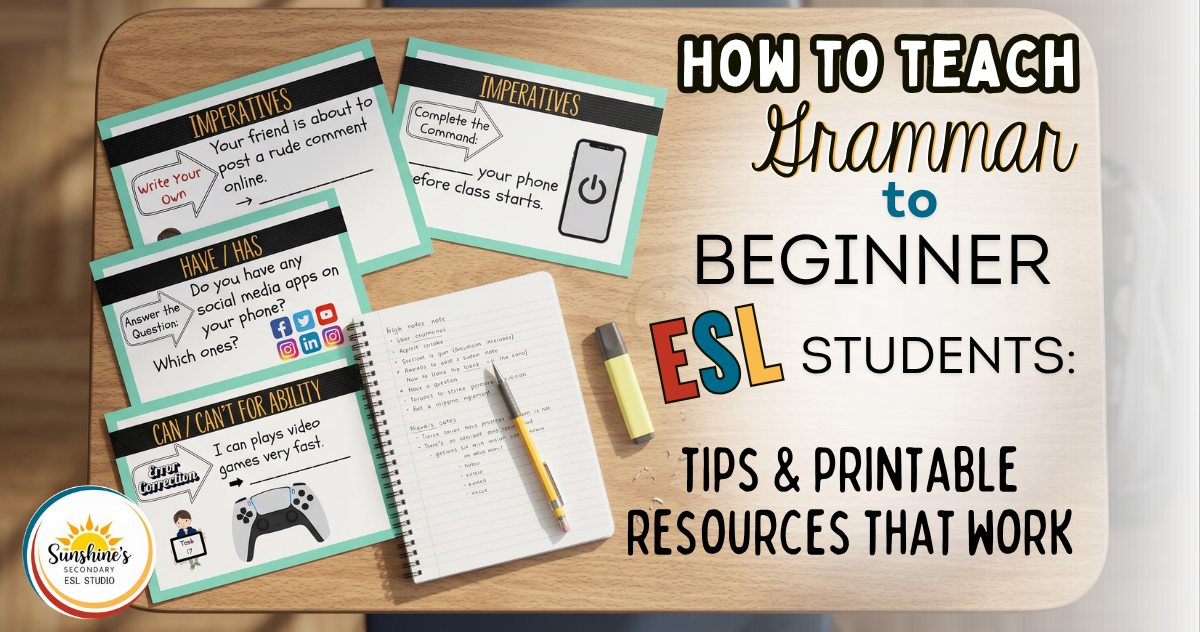
This is the approach I try to use when creating grammar materials for teenagers. I want students to practice the structure, but I also want the activity to feel like it belongs in a high school ESL classroom. I wrote more about this in my post on ESL grammar task cards and in my post about how to teach grammar to beginner ESL students.
High school students still need grammar basics. They just do not need those basics wrapped in babyish packaging.
Build Routines That Help Students Feel Confident
Age-appropriate materials are important, but routines matter too.
When students know what to expect, they are more willing to participate. This is especially true for English learners who are processing language, content, directions, and classroom expectations at the same time.
A routine might be a daily bell ringer, a weekly speaking task, a vocabulary preview, a listening activity, a grammar warm-up, or a short writing response. The format becomes familiar, so students can focus more on the language.
This is one reason I like using ESL bell ringers and daily warm-ups. A predictable routine can make students feel more settled, especially at the beginning of class.
The same is true for classroom expectations. High school English learners may need visual reminders and repeated practice with routines, but those supports should still look appropriate for older students. That is something I also think about with visual ESL expectations posters and ESL routines posters.
Students are not too old for support. They are too old for support that feels demeaning.
Let Students Use What They Already Know
One mistake people sometimes make is assuming that limited English means limited knowledge.
That is not true.
High school English learners bring background knowledge, culture, opinions, academic skills, home languages, and life experiences into the classroom. They may not always have the English words yet, but that does not mean the ideas are not there.
That is why I believe students should be able to use their full language resources when appropriate. Sometimes that means discussing an idea first in their home language. Sometimes it means using bilingual notes, translating a key word, sketching an idea, or talking with a partner before writing in English.
This is not lowering expectations. It is helping students access the lesson.
I wrote more about this in my post on native language use in the ESL classroom and my post on translanguaging in the secondary ESL classroom. For teenagers especially, home language can be a bridge to deeper thinking, not a barrier.
When students feel that their language and experiences are respected, the classroom feels safer and more mature.
What Age-Appropriate ESL Lessons Can Look Like
Age-appropriate ESL lessons do not have to be complicated.
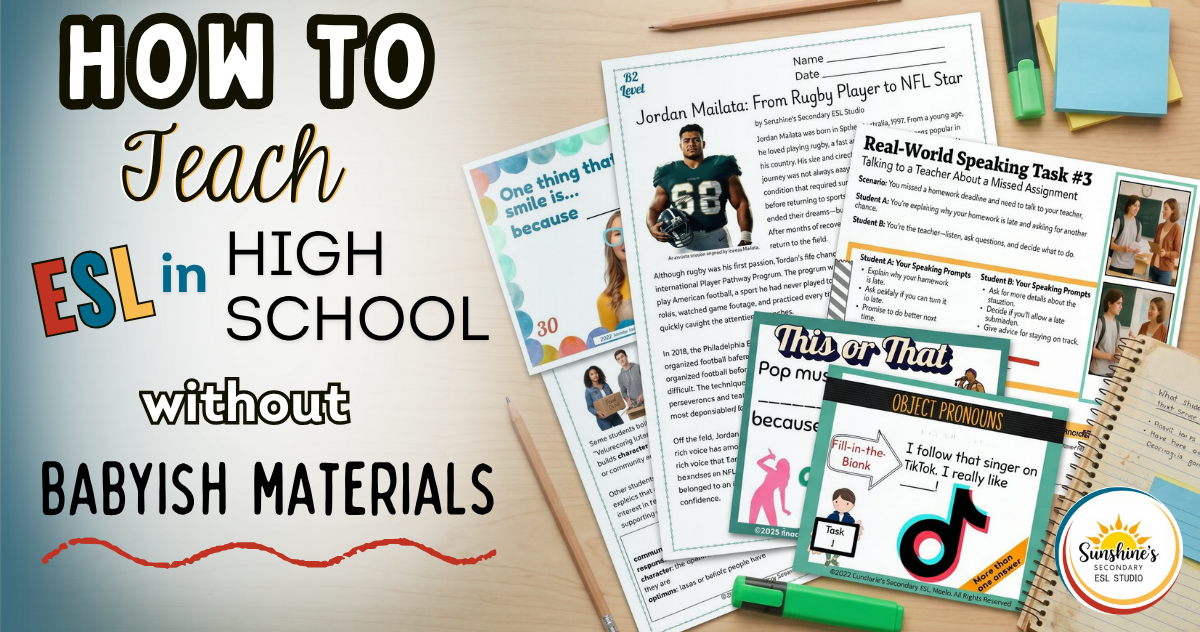
They might include short readings about teen-relevant topics, structured conversation cards, vocabulary sorts, grammar task cards, listening activities, sentence frames, visual supports, or graphic organizers. They might include adapted literature activities, speaking routines, classroom posters, writing frames, or comprehension questions.
The key is that the materials do three things at the same time:
They support the student’s English level.
They respect the student’s age.
They give the student something meaningful to do with language.
That is the balance I am always looking for.
For example, a newcomer student may need survival phrases and visuals, but those visuals can still look clean and mature. A beginner student may need sentence starters, but the question can still invite a real opinion. An intermediate student may need vocabulary support, but the reading can still connect to literature, history, identity, or culture.
This is also why I care so much about culturally responsive teaching for ESL teens. Age-appropriate ESL is not only about avoiding babyish clipart. It is also about choosing topics, texts, and activities that help students feel seen and respected.
The more I create resources for secondary students, the more I realize that how to teach ESL in high school is not about removing scaffolds. It is about making those scaffolds feel age appropriate.
A Simple Test for High School ESL Materials
Before using an ESL activity with teenagers, I like to ask a few questions.
Would my students feel respected using this?
Does the language match what they need?
Does the topic feel appropriate for high school?
Does the design look mature enough for teenagers?
Does the task help students actually use English?
If the answer is yes, the material is probably on the right track.
If the answer is no, the activity may need to be adapted. Sometimes that means changing the visuals. Sometimes it means rewriting the examples. Sometimes it means adding sentence frames, simplifying directions, or connecting the task to a more meaningful situation.
You do not have to throw away every simple activity. But you do need to make sure it feels like it belongs in a high school classroom.
Final Thoughts on Teaching ESL in High School
Learning how to teach ESL in high school without babyish materials takes time because the resource gap is real.
High school English learners still need foundational skills. They still need vocabulary support, grammar practice, reading scaffolds, pronunciation help, listening practice, and speaking routines. But none of that means they should be handed materials that feel like they were made for much younger children.
Students deserve support without embarrassment.
For me, how to teach ESL in high school always comes back to dignity. Students need support, but they also need to feel respected.
They deserve accessible language without childish design.
They deserve foundational practice without feeling talked down to.
That is why I continue creating materials for this age group. Not because high school ESL students need less support, but because they need better support. They need resources that meet them where they are linguistically while still respecting who they are as teenagers.
When we stop confusing beginner English with beginner maturity, our ESL classrooms become stronger.
And our students notice.