
First day activities for ELL students should be simple, visual, and low-pressure, especially when you are welcoming newcomer students who may not understand classroom routines yet.
The first day with a new English learner can feel a little overwhelming for everyone. The student may not know where to sit, what to do, how to ask for help, or even how to explain that they are confused. The teacher may be trying to welcome the student, keep the rest of the class moving, and figure out what the student understands in English.
That is why first day activities for ELL students need to focus on safety, basic communication, and practical classroom language before heavy academic work.
Planning for Back to School ESL? You can also visit my Back to School ESL Resources page for secondary ESL activities, newcomer support, daily routines, and ready-to-use resources for middle school and high school English learners.
The goal is not to find out everything the student knows on day one. The goal is to help the student feel safe, learn a few useful words, and understand that your classroom is a place where they can ask for help.
For newcomer students, especially in middle school and high school, the first day should focus on practical classroom language, feelings, classroom questions, and survival English. They do not need babyish worksheets. They need age-appropriate support that helps them function in a real classroom.
Why First Day Activities for ELL Students Need to Be Simple
When a newcomer student walks into class, it can be tempting to give them a full packet, a long reading passage, or a big “getting to know you” assignment.
But honestly, that can be too much.
Many beginner English learners are trying to process everything at once:
- Where am I supposed to sit?
- What is the teacher saying?
- What do I do with this paper?
- Can I use my phone or translator?
- What if I need the restroom?
- What if I do not understand?
That is why the best first day ESL activities are not complicated. They are short, visual, and useful right away.
A good first day activity should help the student do at least one of these things:
- introduce themselves
- share how they feel
- ask a classroom question
- understand a basic direction
- identify school supplies
- know who can help them
- know where to go in the school
If the activity does one or two of those things well, that is enough.
Start with a Newcomer About Me Activity
One of the easiest newcomer first day activities is a simple About Me page.
But for newcomer ESL students, I would keep it very basic. This is not the time for long paragraphs or personal essays.
Start with sentence frames like:
- My name is ___.
- I am from ___.
- I speak ___.
- I like ___.
- Today, I feel ___.
This gives students a way to share important information without being overwhelmed. It also gives the teacher helpful details right away.
For older students, I like using a clean, teen-friendly layout with visuals and word banks. A high school newcomer does not need a page that looks like it was made for a six-year-old. They need beginner support that still respects their age.
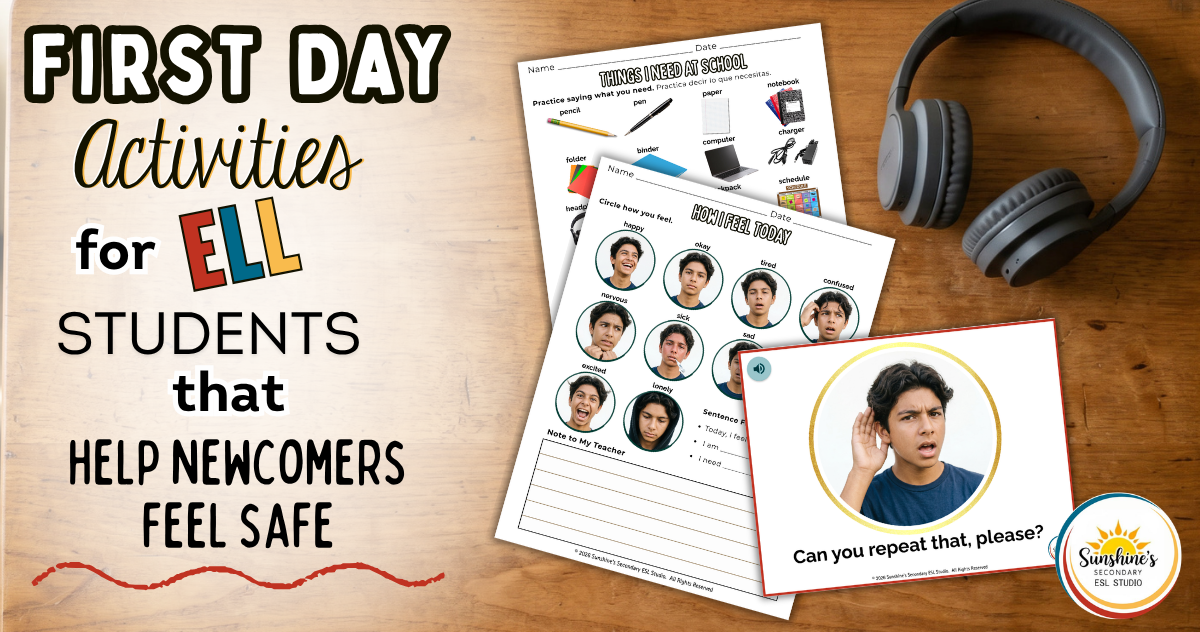
If you want a ready-to-use first day activity, my free ESL Newcomer First Day Mini Kit gives you a simple starting point for welcoming beginner English learners without overwhelming them. It includes a newcomer About Me activity, feelings check-in, classroom questions support, visual word banks, and simple sentence frames designed for middle school and high school newcomers.
You can grab the free ESL Newcomer First Day Mini Kit and use it on the first day of school, during the first week, or anytime a new English learner arrives in your class.
Use a Feelings Check-In as a First Day ELL Activity
Before jumping into content, I like to give newcomer students a way to say how they feel.
A simple ESL feelings check-in can be powerful because students may not yet have the words to explain what is going on internally.
They might feel:
- happy
- okay
- tired
- nervous
- confused
Even if they only circle a word or point to a picture, that gives you information. It also tells the student, “Your feelings matter here.”
This connects really well with social emotional learning, especially for teens who may be adjusting to a new school, new country, new language, or new routine. I wrote more about that in my post on social emotional learning for ESL teens.
For first day newcomer support, I like sentence frames such as:
- Today, I feel ___.
- I need ___.
That second sentence matters. A student might feel tired, nervous, sick, confused, or overwhelmed. Giving them language like “I need help,” “I need water,” or “I need a break” can make the day feel more manageable.
Teach Classroom Questions Students Can Actually Use
One of the most practical Back to School ELL activities is teaching classroom questions.
Newcomer students need to know how to ask for help. They may not be ready for a full conversation, but they can learn short questions they will use every day.
Some of the most useful classroom questions for newcomers include:
- What page?
- What do I write?
- Can you repeat that, please?
- Can you speak slowly, please?
- Can I use a translator?
- Can I go to the restroom?
- Can you help me?
- What should I do next?
These questions give students a little more control. Instead of sitting silently, they have words they can use.
This also builds speaking confidence. If you want more ideas for getting secondary students talking without putting them on the spot, you may also like my post on ESL speaking confidence activities and my post on how to build ESL speaking routines.
For students who need audio support, you can also try my free ESL Audio Slides sample. It gives newcomer students a simple way to hear, repeat, and practice beginner classroom vocabulary before using the full audio slide bundle.
Practice Basic Classroom Directions for Newcomer Students
Newcomers also need to understand what the teacher is asking them to do.
This is a little different from classroom questions.
Classroom questions are what students say.
Classroom directions are what students need to understand.
Some important classroom directions include:
- listen
- read
- write
- circle
- underline
- highlight
- match
- choose
- turn it in
- work with a partner
These words show up constantly in class. If a student does not understand them, even a simple worksheet can become confusing.
That is why beginner ESL activities should include classroom directions practice early. You can model the direction, show a visual, say the word, and have students repeat it.
For more classroom routine support, you may want to read my post on ESL commands and routines task cards or my post on first week tips for new ESL teachers.
Introduce School Supplies, People, and Places
Newcomer students also need basic school vocabulary.
Not fancy vocabulary. Practical vocabulary.
Words like:
- pencil
- paper
- notebook
- backpack
- laptop
- charger
- schedule
- ID
They also need words for people and places at school:
- teacher
- counselor
- nurse
- office
- restroom
- cafeteria
- library
- hallway
These words help students navigate the school day. They also support survival English for newcomers because students can begin to ask for what they need and understand where to go.
For example:
- I need a pencil.
- I need my schedule.
- I need the nurse.
- I need the office.
- Where is the restroom?
This is where visuals and audio can really help. Students need to see the word, hear the word, repeat the word, and connect it to something real.
Need more support for the first week with newcomers?
If you want a more complete first week routine, my ESL Newcomer Student Packet and Audio Slides Bundle gives students practice with the exact language they need at the beginning of the year: feelings, needs, classroom questions, classroom directions, school supplies, school people, and school places.
The packet gives students printable first-week support, while the audio slides help them hear, repeat, and practice survival English in a low-pressure way. This works especially well for middle school and high school newcomers who need beginner language support without materials that feel too young.
My ESL Audio Slides Bundle | Newcomer Vocabulary & Listening Practice includes audio-supported slides for feelings, classroom questions, classroom directions, school supplies, and people and places at school.
What to Avoid with First Day Activities for ELL Students
There are a few things I would avoid on the first day with newcomer ELL students.
First, I would avoid long written assignments unless the student is ready for them. A full paragraph about summer vacation might be fine for an intermediate student, but it can be frustrating for a newcomer.
Second, I would avoid making the student speak in front of the whole class right away. Some students are comfortable doing that, but many are not. Partner practice, pointing, circling, matching, and repeating are much safer starting points.
Third, I would avoid materials that look too young. This matters a lot in secondary ESL. Beginner English does not mean beginner thinking. A high school newcomer may need A1 language, but they still deserve age-appropriate visuals and topics.
I talk more about this in my post on how to teach ESL in high school without babyish materials and my post on beginner ESL in high school.
A Ready-to-Use First Day Activity for ELL Students
If you are looking for first day activities for ELL students that are quick to prep, this freebie gives you a simple starting point without overwhelming the student.
If you need something simple for a newcomer’s first day, I created a free resource for exactly that.
The ESL Newcomer First Day Mini Kit is a free Back to School ELL activity for beginner English learners.
It includes:
- a newcomer About Me page
- a mini feelings check-in
- classroom questions support
- visual word banks
- simple sentence frames
- light Spanish support
- printable pages
It is designed for middle school and high school newcomers, so it gives students beginner support without feeling babyish.
This freebie works well when a student arrives on the first day of school, during the first week, or even in the middle of the year.
More Newcomer ESL Support for the First Week
The first day is important, but newcomer student support does not stop there.
After students have a few basic words and sentence frames, they need repeated practice with the same language. That is why I like using a mix of print, digital, audio, and visual support.
For a more complete first week resource, the ESL Newcomer Student Packet gives students structured practice with school information, feelings, needs, classroom communication, survival English, and first-week reflection.
If you want the student packet plus audio support, the ESL Newcomer Student Packet & Audio Slides Bundle | Back to School ELL includes the packet and the audio slide decks together.
If you only want the audio-supported slides, the ESL Audio Slides Bundle | Newcomer Vocabulary & Listening Practice is a good fit.
And if you want to test the audio format first, you can grab the ESL Audio Slides Freebie | Newcomer Vocabulary & Listening Practice.
Final Thoughts
The best first day activities for ELL students do not have to be complicated.
In fact, simple is usually better.
Newcomer students need to feel safe, understand a few basic routines, and learn language they can use immediately. A strong first day activity might be as simple as an About Me page, a feelings check-in, a few classroom questions, or a short listen-and-repeat vocabulary activity.
The point is not to test everything.
The point is to help students think:
“I can do something in this class.”
That little bit of confidence can make a big difference.
Want the first day and first week planned for you?
Start with the free ESL Newcomer First Day Mini Kit if you need a quick, no-stress activity for a new English learner. Then, when you are ready for more structured first-week support, the ESL Newcomer Student Packet and Audio Slides Bundle gives you printable activities and audio-supported practice for classroom language, feelings, needs, school vocabulary, and survival English.
It is designed for secondary newcomers who need simple, visual, age-appropriate support from the first day of school.