
If you teach high school ESL, you already know the struggle. Finding ESL speaking activities for teens that actually get students talking can be hard, especially when you ask a question, wait expectantly, and suddenly every student is deeply interested in their desk, their pencil, or the wall behind you.
Silence in an ESL classroom does not always mean students are being difficult. Sometimes they are processing. Sometimes they are nervous. Sometimes they know the answer but do not feel confident enough to say it out loud. That is why real-world ESL speaking activities for teens can make such a difference.
Instead of asking students to perform awkward textbook conversations, real-world speaking tasks give them situations they might actually experience: ordering food, asking for help, making plans, giving advice, solving a problem, or handling a misunderstanding with a friend.
When the task feels useful, students are much more willing to try.
If you are trying to build stronger speaking habits in your classroom, you may also like my post on how to build ESL speaking routines. Speaking gets easier when students know what to expect and have repeated opportunities to practice.
The best ESL speaking activities for teens give students a clear reason to talk, enough support to begin, and a topic that feels connected to real life.
Why ESL Speaking Activities for Teens Sometimes Fall Flat
Before we can fix the silence, we need to understand it. High school ESL students are not just learning vocabulary and grammar. They are also navigating confidence, identity, peer pressure, and the fear of sounding “wrong” in front of everyone.
That is a lot.
They are afraid of making mistakes
Teenagers care deeply about how they are perceived. Even confident students may hesitate when they are asked to speak in a new language. A small pronunciation mistake or grammar error can feel embarrassing, especially in front of peers.
For many students, silence feels safer than taking a risk.
This is why I try to make speaking practice low-pressure at first. Students need to know that imperfect English is not failure. It is part of the process. If your students freeze because they are afraid of making mistakes, these ESL speaking confidence activities can help you build more trust before expecting longer conversations.
They need more processing time
Sometimes students are not refusing to answer. They are translating, thinking, rehearsing, and deciding if their answer is “good enough” before they say anything.
That pause can feel uncomfortable as the teacher, but it is often necessary for multilingual learners. Instead of rushing to fill the silence, we can use stronger wait time, sentence starters, partner rehearsal, and visual supports to help students prepare to speak.
I wrote more about this in my post on wait time strategies for ESL classrooms, because silence is not always a problem. Sometimes it is where the language is forming.
They are tired of fake scripts
Many ESL materials still rely on conversations that sound like this:
A: Hello. How are you today?
B: I am fine, thank you. And you?
A: I am fine, too.
There is nothing wrong with basic dialogue practice for beginners, but high school students quickly recognize when a conversation feels robotic. Teenagers are surrounded by real language every day through music, videos, games, social media, jobs, friends, and school. When classroom conversations do not sound anything like real life, students check out.
They do not want to repeat lines just to repeat lines.
They want to talk about something that feels connected to their world.
The topics do not always feel relevant
If a speaking activity has nothing to do with students’ lives, motivation drops. A 16-year-old may not care about practicing a tourist conversation in a train station if they have never taken a train. But they may care about asking a teacher for help, making weekend plans, apologizing to a friend, ordering food, explaining a problem, or deciding what to do in an awkward social situation.
That is where real-world ESL speaking activities for teens work better. They make the language feel useful right now.
What Makes Real-World ESL Speaking Activities for Teens Different?
Real-world speaking tasks are different because they are built around communication, not memorization.
Instead of giving students a full script, you give them a situation, a role, a goal, and the language support they need to participate. Students still have structure, but they are not trapped into reading lines that someone else wrote.
For example, instead of this:
“Practice ordering food with your partner.”
You might give students this scenario:
“You are at a café with a limited budget. You want to order food and a drink, but you also need to ask about prices, ingredients, and recommendations.”
That small shift gives students a reason to speak. They have to ask questions, make choices, respond to their partner, and solve a small communication problem.
That is much closer to real life.
Start with Scenarios, Not Scripts
One of the easiest ways to improve ESL speaking practice is to stop giving students complete dialogues every time.
Instead, give them a situation.
For example:
“You and your friend are planning a surprise birthday party, but you disagree about where to have it.”
Then add support:
Student A wants to have the party at a restaurant.
Student B wants to have the party at someone’s house.
Together, you must agree on a final plan.
Helpful phrases:
“What if we…?”
“That sounds expensive.”
“I think it would be better if…”
“Maybe we could…”
“I understand, but…”
Now students have enough structure to begin, but they still have to think, listen, respond, and create language in the moment.
That is the sweet spot.
If your students need even shorter starting points before they are ready for full role plays, you can also use conversation starters for ESL teens to help them practice responding without the pressure of a long performance.
Scaffold the Speaking Before You Expect Independence
Real-world speaking does not mean throwing students into a conversation and hoping for the best. ESL students still need support, especially if they are beginners or lower-intermediate learners.
The goal is not to remove scaffolds. The goal is to use scaffolds that help students communicate without making the activity feel babyish.
Some of the most helpful speaking supports include:
- sentence starters
- useful phrases
- role cards
- vocabulary previews
- visuals
- partner rehearsal
- audio models
- short planning time
- clear speaking goals
For example, if students are practicing how to ask for help, you might give them phrases like:
“I don’t understand…”
“Can you explain…?”
“Could you show me how to…?”
“I tried, but…”
“What should I do next?”
These supports give students a place to begin. Once they feel more confident, you can slowly remove some of the language frames and let them speak more independently.
For lower-intermediate students, A2 ESL speaking prompts for teens can give them enough structure to participate without overwhelming them. For newcomers or students who need even more support, starting with a beginner ESL speaking activity can help them build confidence before moving into more open-ended role plays.
Use Audio Models to Build Confidence
One thing that can make real-world speaking tasks even stronger is audio.
Many students are not only worried about what to say. They are also worried about how to say it. They may wonder:
How should my voice sound?
Where should I pause?
How do I ask this politely?
What does this phrase sound like in a real conversation?
Audio models help students hear pronunciation, tone, rhythm, and natural phrasing before they speak. This is especially helpful for intermediate students who may understand the language on paper but still feel unsure when speaking out loud.
You can use audio in a few simple ways:
First, let students listen for meaning.
Then, let them listen for useful phrases.
After that, have them practice the conversation with a partner.
Finally, let them create their own version of the scenario.
This keeps the audio from becoming another script to memorize. Instead, it becomes a launch pad for real communication.
If you are interested in using tools like AI voiceovers carefully and responsibly, I also wrote about AI in the ESL secondary classroom and how it can support language learning without replacing student thinking.
Give Students a Real Reason to Speak
Students are more motivated when speaking has a purpose.
A role play becomes more engaging when there is a small problem to solve, a decision to make, or an outcome at the end.
For example:
After a restaurant role play, students choose the best order for a $10 budget.
After a planning task, students vote on the most realistic plan.
After a conflict-resolution task, another pair decides whether the solution was fair.
After an advice task, students choose the most helpful response.
After a school-problem scenario, students explain what they would do next.
The point does not have to be complicated. Students just need to feel like the conversation is going somewhere.
That is one reason teen-friendly speaking tasks work better than random question lists. Students are not just answering to finish the assignment. They are using English to complete a task.
Make Speaking Practice Feel Safe
A speaking activity can be creative, relevant, and beautifully designed, but if the classroom does not feel safe, many students still will not talk.
That does not mean every student needs to feel completely comfortable all the time. Speaking a new language will always involve some risk. But we can lower the emotional pressure so students are more willing to try.
Here are a few ways to build a safer speaking culture:
Start with partners before whole-class sharing.
Let students rehearse before they perform.
Praise communication, not just accuracy.
Give students useful phrases before asking them to respond.
Avoid correcting every mistake in the moment.
Rotate roles so the same students do not dominate every time.
Use humor and relatable scenarios to lower the tension.
I also like to remind students that the goal is not perfect English. The goal is clear communication.
When students understand that their ideas matter more than flawless grammar, they usually take more risks. Over time, those risks lead to stronger fluency.
ESL Speaking Activities for Teens They Can Actually Use
If you want to add more real-life speaking practice, start with situations your students might recognize.
Here are some examples that work well with secondary ESL students:
Ordering food
Students practice reading a menu, asking about prices, making choices, and speaking politely to a server. This is practical, familiar, and easy to scaffold.
Asking for help
Students practice explaining a problem to a teacher, classmate, counselor, or coworker. This is one of the most important real-world speaking skills for multilingual learners.
Making plans
Students practice suggesting ideas, agreeing, disagreeing, and compromising. This works well because teens actually make plans with friends and family.
Giving advice
Students respond to realistic problems, such as friendship issues, school stress, or time management. This allows them to practice opinions, modal verbs, and empathy.
Solving a disagreement
Students practice conflict-resolution language in a safe classroom setting. They can use phrases like “I understand,” “I didn’t mean to,” “That made me feel,” and “Next time, we should…”
Explaining a problem
Students practice describing what happened, asking for support, and clarifying details. This can connect to school, work, technology, transportation, or everyday life.
For higher-level students, you can make the scenarios more complex by adding stronger opinions, unexpected complications, or multiple possible solutions. These B2 ESL speaking activities for teens are a good next step if your students are ready for more detailed discussion.
What This Can Look Like in Class
Imagine it is Friday, last period. Your students are tired, and you know a traditional speaking activity is going to fall flat.
Instead of handing them a scripted dialogue, you give each pair a role-play card.
The scenario says:
“Your friend posted an embarrassing picture of you online. You want them to delete it, but they think you are overreacting.”
Suddenly, the room changes.
Students laugh because the situation feels familiar. They start asking what they are allowed to say. They look at the sentence starters. They rehearse with their partners. Some students add their own details. Others ask how to say a phrase more naturally.
Then you hear it:
“I get why you thought it was funny, but I didn’t like it.”
“You should have asked me first.”
“I’m sorry. I didn’t know you felt that way.”
“Next time, please don’t post it without asking.”
That is real communication.
It may not be perfect. It may not be polished. But students are using English to express opinions, solve a problem, and respond to another person.
That is exactly what speaking practice should help them do.
You Do Not Have to Create Every Speaking Task From Scratch
I love real-world speaking tasks, but I also know how much time it takes to create them well.
A strong speaking task needs a realistic scenario, clear roles, useful language, student-friendly design, and enough support that students do not freeze. If you add audio, printable cards, and digital options, it becomes even more time-consuming.
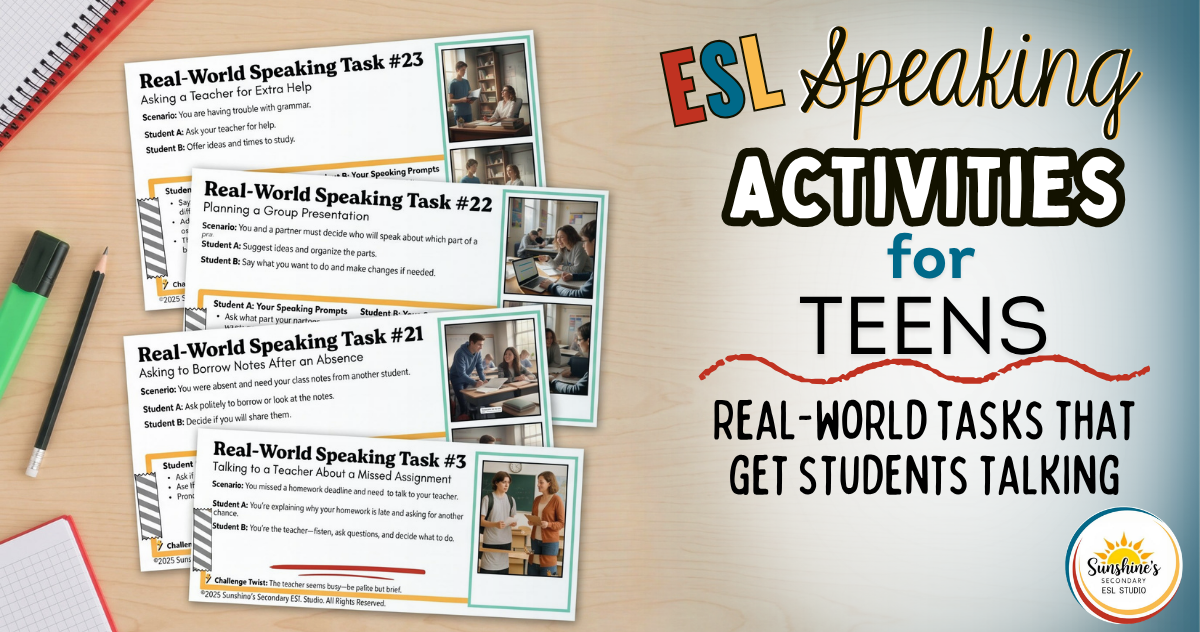
That is why I created my ESL speaking resources for teens.
If you want to try this type of speaking practice without creating everything yourself, start with my FREE ESL Speaking for Teens | Role Play & Conversation Card with Audio. It gives students a real-life café scenario with printable cards, conversation support, and audio, so they can practice speaking in a way that feels structured but still natural.
Once students understand the routine, you can build from there with ESL Speaking for Teens Vol. 1 and ESL Speaking for Teens Vol. 2. Both sets include teen-friendly role plays, conversation cards, and audio support, so students are not just reading lines from a script. They are practicing real communication in realistic situations.
If you want the full collection, the Secondary ESL Conversation Bundle | Role Play Cards for Teens includes both volumes and gives you a larger bank of real-world speaking tasks to use throughout the year.
You can use ESL speaking activities for teens as warm-ups, partner tasks, review practice, confidence builders, or full speaking lessons depending on your students’ levels.
Final Thoughts
Getting ESL teens to speak more does not happen because we tell them to “just talk.”
It happens when we give them a reason to speak, the language to begin, and the classroom culture to take a risk.
Real-world ESL speaking activities for teens work because they connect English to situations students actually understand. They move speaking practice away from memorized lines and toward communication that feels useful, relevant, and human.
When students see that English can help them order food, ask for help, make plans, solve problems, and express themselves, speaking becomes less of a performance and more of a tool.
And that is when students start talking.