
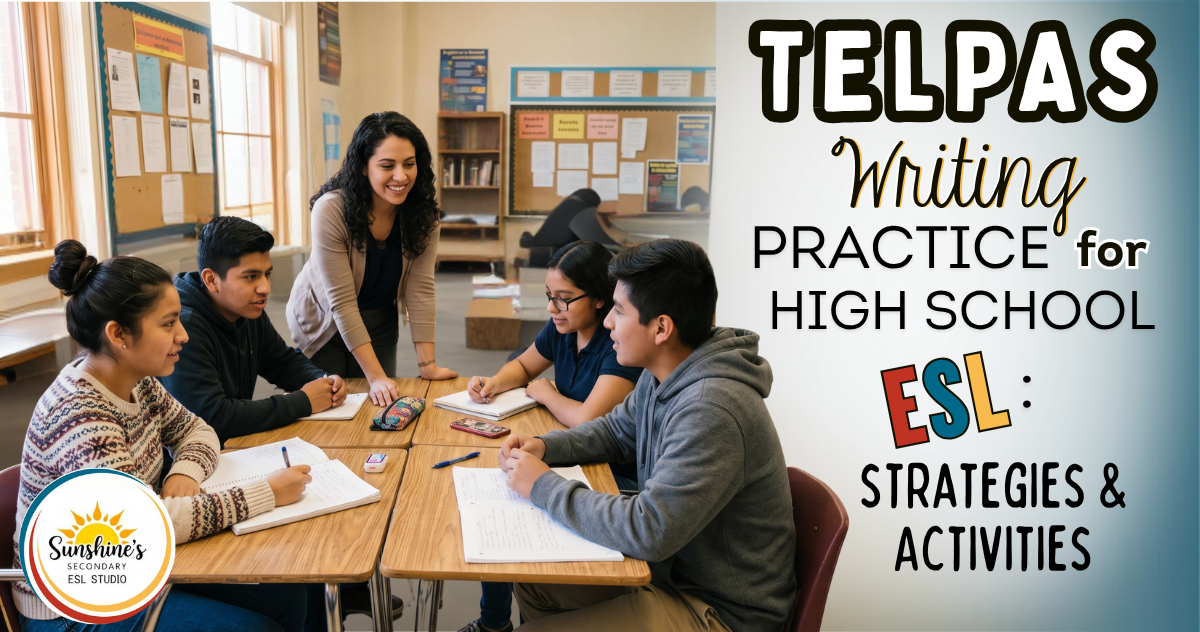
TELPAS writing practice for high school students should help multilingual learners communicate increasingly complex ideas, not simply complete isolated test-prep worksheets. Secondary English learners develop stronger writing when they regularly describe, explain, summarize, compare, and support ideas across the school year.
However, knowing what that practice should look like can be difficult, especially in a mixed-proficiency classroom. One student may still be building basic sentences, while another is ready to organize detailed paragraphs and extended responses.
The goal is not to give every student the same writing expectation. Instead, teachers can provide meaningful, age-appropriate writing opportunities and adjust the support according to each student’s current English proficiency.
This guide includes practical TELPAS writing strategies, differentiated activities, teen-friendly prompts, and classroom routines. These ideas can help secondary ESL teachers strengthen writing instruction without making every lesson feel like test preparation.
What Does TELPAS Writing Assess in High School?
Beginning in spring 2023, TELPAS writing was combined with the online reading assessment for students in grades 2–12. According to the Texas Education Agency, students may encounter text-entry, multistep text-entry, and constructed-response items. Depending on the task, they may respond to pictures, questions, readings, or other stimuli and provide relevant details.
As a result, TELPAS writing practice for high school should not focus only on memorizing an essay formula.
Students need regular opportunities to:
- Communicate a clear idea
- Answer the entire question
- Add relevant details
- Explain reasons and examples
- Use increasingly precise vocabulary
- Connect ideas across sentences
- Organize responses clearly
- Apply grammar while communicating meaning
- Clarify or revise confusing writing
Grammar matters, but it is not the only goal. A grammatically correct sentence that barely answers the question may reveal less language development than a detailed response that communicates a meaningful idea despite a few errors.
TELPAS measures English-language development. Therefore, students should have opportunities to show what they can currently communicate and then build from that starting point.
What Effective TELPAS Writing Practice for High School Should Include
Secondary students need more than a folder of disconnected TELPAS writing prompts that appears a few weeks before testing.
Effective practice should be:
Frequent. Students write regularly instead of completing one lengthy assignment every few weeks.
Meaningful. Prompts connect to school experiences, academic content, texts, images, personal goals, or age-appropriate issues.
Differentiated. Students may respond to the same central prompt with different scaffolds and output expectations.
Integrated. Speaking, listening, reading, vocabulary, and writing reinforce one another.
Progressive. Students move from words and phrases to complete sentences, connected paragraphs, and more sustained responses.
Low-risk. Not every piece of writing needs a major grade or extensive correction.
Clear language objectives for high school ESL can help teachers plan writing more intentionally. For example, a language objective might state:
Students will explain an opinion in writing using one reason and one example.
That objective identifies the language students are practicing rather than simply naming the assignment.
Build TELPAS Writing Practice for High School Into Everyday Lessons
Teachers do not necessarily need a separate TELPAS writing block. In fact, many effective TELPAS writing activities can be incorporated into lessons students are already completing.
Use short written responses after reading
After students read a passage, ask a focused question that requires explanation rather than simple recall.
Instead of asking:
What did the character do?
Try:
Why do you think the character made that decision? Use one detail from the text to explain your answer.
Students at beginning levels might use a sentence frame and a brief word bank. Intermediate students could write several connected sentences. Meanwhile, more advanced students may produce a developed paragraph with evidence and explanation.
This reading-to-writing routine also reflects the integrated nature of TELPAS. My guide to ESL reading comprehension in high school includes additional ways to make secondary texts accessible without removing the thinking.
Turn exit tickets into writing practice
Exit tickets can do more than check whether students remember a fact. They can ask students to summarize, compare, explain, predict, or reflect.
Possible prompts include:
- What was the most important idea in today’s lesson? Explain why.
- What is one difference between the two ideas we studied?
- What problem did the person in the text face, and how was it solved?
- What is one question you still have?
- Which strategy helped you understand today’s lesson?
A beginner may write one supported sentence. An intermediate student may write three or four connected sentences. In contrast, a more advanced student can write a complete paragraph.
Reuse speaking prompts as writing prompts
One of the easiest ways to reduce teacher preparation is to use the same topic for more than one language domain.
Students might first discuss:
Should students be allowed to use cellphones during class?
Afterward, they can write an individual response using ideas and vocabulary generated during the discussion.
These conversation starters for ESL teens provide age-appropriate topics that can move naturally from speaking into writing.
Add writing to warm-ups
A warm-up does not always need to be a grammar correction exercise. Students can respond to:
- A photograph
- A surprising fact
- A quotation
- A school scenario
- A graph
- A short question
- A current classroom topic
For example:
Study the photograph. What do you think happened immediately before this moment? What might happen next?
Students can discuss the image first and then write. Consequently, the activity moves naturally from observation to speaking and from speaking to writing.
For additional ideas, see my guide to ESL bell ringers and daily warm-ups.
TELPAS Writing Strategies for Stronger Responses
Students often need to be explicitly taught what it means to develop an answer. Simply telling them to “write more” does not show them what to add.
Teach students to answer, explain, and provide an example
A manageable response-building routine is:
- Answer the question.
- Explain the answer.
- Add a reason, example, or detail.
Consider this prompt:
Should high school start later?
A student might initially write:
Yes. School should start later.
The teacher could then ask:
- Why?
- Who would benefit?
- What might improve?
- Can you give a specific example?
With those questions, the response could develop into:
School should start later because many teenagers do not get enough sleep. When students are exhausted, it is harder for them to concentrate during their first classes. For example, a student who arrives tired may struggle to follow directions or complete morning work. Therefore, a later start could help students arrive more alert and prepared to learn.
This approach teaches elaboration without requiring every student to produce a long essay.
Model sentence expansion during TELPAS writing practice
Students can learn to develop writing by expanding one idea in stages.
Original idea:
Cellphones are useful.
Explain why the idea is true:
Cellphones are useful because students can quickly find information.
Include a specific example:
Cellphones are useful because students can quickly find information. For example, an English learner can look up an unfamiliar academic word during a lesson.
Introduce another perspective:
Cellphones are useful because students can quickly find information. For example, an English learner can look up an unfamiliar academic word during a lesson. However, students need clear rules so the phones do not become a distraction.
The purpose is not to make every response longer for the sake of length. Instead, students learn how reasons, examples, and contrasting ideas make writing clearer.
Students who need additional language support may benefit from these free ESL sentence starters for teens.
Teach a small set of useful transitions
Students do not need a page containing dozens of transition words. Begin with a manageable group they can use repeatedly:
- because
- but
- so
- first
- next
- finally
- for example
- also
- however
- therefore
- as a result
- in contrast
Initially, ask students to use one or two transitions accurately. Later, introduce additional choices as their writing becomes more complex.
Develop vocabulary before students write
Vocabulary practice becomes more meaningful when students immediately apply the words.
Before students answer a prompt about school rules, develop a short word bank such as:
- responsible
- consequence
- benefit
- distraction
- necessary
- fair
- effective
- improve
First, students can discuss or sort the words. Next, they can use several of them during oral rehearsal. Finally, they can apply the vocabulary in their written responses.
My collection of ESL vocabulary activities for high school includes more ways to develop vocabulary without relying only on memorization.
Teen-Friendly TELPAS Writing Prompts
Teenagers usually respond more thoughtfully when prompts respect their age, experiences, and interests.
School and student-life prompts
- Should high schools begin later in the morning? Explain.
- What is one school rule you would change? Why?
- Should students help create classroom rules?
- What makes a teacher effective?
- Is homework always necessary?
- Should community service be required for graduation?
- What is one change that would improve your school?
- Should students be allowed to use artificial intelligence for schoolwork? Under what conditions?
Personal and reflective prompts
- Describe a goal you are currently working toward.
- Write about a challenge you faced and what you learned.
- Describe a person who has influenced you.
- What is one skill every teenager should learn before adulthood?
- Describe a place that is important to you.
- What does success mean to you?
- Explain something you can do now that was once difficult.
These prompts can connect naturally to goal setting with high school English learners.
Academic and content-based prompts
- Explain the cause of an event studied in history.
- Describe the steps in a scientific process.
- Compare two characters, systems, historical figures, or ideas.
- Summarize the central idea of a text.
- Explain how one piece of evidence supports an author’s claim.
- Describe a problem and propose a reasonable solution.
- Predict what might happen next and explain your reasoning.
Visual and multimedia prompts
Students can also write from:
- A photograph
- An infographic
- A political cartoon
- A short silent video
- A painting
- A school-appropriate advertisement
- A simple graph or chart
For instance:
Study the image. What appears to be happening? Which details support your interpretation?
Beginning students can identify people, objects, and actions. Intermediate students can describe relationships or events. Advanced students can infer, predict, evaluate, or explain.
Differentiating TELPAS Writing Practice for High School Classes
A mixed-proficiency class does not require four entirely different writing lessons.
Instead, teachers can keep the central prompt the same while changing the supports, planning tools, and expected output. For more examples, see my guide to differentiating ESL instruction from A1 to B2.
Consider this prompt:
Should students have homework every night? Explain your opinion.
| Proficiency range | Possible expectation | Possible support |
|---|---|---|
| Beginning/A1 | One or two understandable sentences expressing an opinion | Picture support, bilingual brainstorming, word bank, complete sentence frame |
| High beginner/A2 | Three or four connected sentences with one reason | Sentence starters, model response, transition list |
| Intermediate/B1 | A developed paragraph with an opinion, reason, and example | Planning organizer, guiding questions, partial model |
| Upper intermediate/B2 | Multiple organized paragraphs that address another perspective | Brief planning checklist and targeted vocabulary |
Support beginners without making the task childish
Newcomers may understand the topic but lack the English needed to express their thinking.
Useful supports include:
- Drawing or labeling ideas before writing
- Providing a short bilingual word bank
- Allowing home-language brainstorming
- Offering sentence frames
- Using oral rehearsal
- Modeling one possible response
- Reducing the amount of required writing without reducing the thinking
A high school newcomer should not receive an elementary-looking worksheet simply because the student is beginning to learn English. Mature topics can still be linguistically accessible.
My article about the first 30 days with a high school newcomer provides additional strategies for establishing routines and supports.
Remove scaffolds gradually
Sentence frames should support language production, not permanently replace it.
A possible progression is:
Full frame:
I believe ______ because ______.
Partial frame:
I believe ______. One reason is ______.
Transition bank:
because, for example, however, therefore
Independent response:
Write a paragraph that states and supports your opinion.
Students will not all move through this sequence at the same pace. Nevertheless, each learner should gradually take on more responsibility for organizing and expressing ideas.
Use Speaking Before Writing
Students often have more to say than they initially have the English to write. Speaking before writing gives them time to develop ideas, hear useful vocabulary, and rehearse sentences.
A simple routine is:
- Display the prompt.
- Provide silent thinking time.
- Let students discuss their ideas with a partner.
- Collect useful vocabulary on the board.
- Invite several students to share.
- Ask everyone to write an individual response.
This sequence is especially helpful for students who freeze when they immediately see an empty text box.
Wait time also matters. English learners may need time to understand the question, form an idea, find the English words, and organize a response. My article on wait-time strategies in the ESL classroom explains why an immediate answer is not always the best measure of what a student knows.
For reluctant speakers, these speaking-confidence activities for ESL students can help teachers develop oral-language routines that later support writing.
Analyze Models Without Asking Students to Memorize Them
Students need to see what stronger writing looks like. However, the purpose of a model should be analysis rather than copying.
Display a response and ask:
- Where does the writer answer the question?
- Which sentence gives a reason?
- Where does the writer add an example?
- Which transition connects the ideas?
- What detail makes the response clearer?
- What could the writer add next?
Teachers can also compare two created responses.
Response A:
School uniforms are good. Students wear the same clothes.
Response B:
School uniforms may benefit students because they reduce pressure to wear expensive clothing. When everyone follows the same dress expectations, students may be able to focus more on school than on comparing outfits.
Then ask students what the second response does that the first response does not. This makes instructions such as “add more detail” visible and specific.
For students learning to organize claims and evidence, my free ESL Argumentative Essay Outline & Example provides a bilingual planning structure and model.
Give Focused Feedback on TELPAS Writing Practice
Correcting every error is exhausting for teachers and overwhelming for students.
Instead, choose one or two priorities based on the purpose of the task.
Feedback might focus on:
- Answering the whole question
- Adding a reason
- Including an example
- Organizing ideas
- Using a transition
- Clarifying one confusing sentence
- Applying a recently taught grammar structure
A quick comment might say:
Your opinion is clear, and you gave a strong reason. Next, add one specific example to show what you mean.
Another could say:
I understand your main idea. Try connecting these sentences with because, but, or so.
This kind of feedback gives students a realistic next step.
For additional support before, during, and after drafting, see these ESL writing support strategies.
Afterward, grammar instruction can address patterns that appear across student writing. Rather than marking every verb error on one paper, a teacher might teach a brief lesson on the most important recurring pattern and ask students to revise one or two sentences.
A Weekly TELPAS Writing Practice for High School Routine
TELPAS writing preparation does not need to dominate the week. A predictable routine can provide consistent practice while remaining manageable.
Monday: Personal or visual quick write
Display a photograph or reflective question. Allow oral rehearsal and several minutes of writing.
Possible prompt:
Describe one goal you have for this month and explain why it matters.
Wednesday: Reading-to-writing response
Use a text students are already reading.
Possible prompt:
Which decision made by the main character had the greatest effect on the story? Explain using one detail from the text.
Friday: Developed response
Use a school, community, or academic issue. Discuss it first and then have students write at their proficiency level.
Possible prompt:
Should students be required to complete community service before graduating? Explain your position.
During the following week, include a descriptive, narrative, or explanatory task. That variety prevents students from practicing only opinion writing.
Teachers seeking ready-made warm-ups may also use the ESL Bell Ringers Mega Bundle | 160 Daily Warm-Ups for Teens with Audio. Mystery photographs and fun facts can be extended into written predictions, explanations, and reflections.
For more sustained teen-centered writing, the Freedom of Speech & Expression ESL Argumentative Writing Bundle with Audio moves naturally from listening and discussion into organized writing.
Narrative writing also develops fluency and sentence control. The ESL Future Tense Writing Activity | Finish the Story Writing Prompts for Teens gives students unfinished stories they complete using predictions, future-tense verbs, and original ideas.
Monitor Growth Without Creating More Grading
Students need opportunities to see that their writing is developing.
Keep one sample every few weeks and ask students to compare it with an earlier piece.
They can look for evidence of progress:
- Did I write more?
- Did I answer the full question?
- Did I add reasons or examples?
- Did I use more specific vocabulary?
- Did I connect my ideas?
- Is my writing easier to understand?
- Can I write with less support?
A simple portfolio often provides a clearer view of growth than one isolated assignment.
Moreover, students can use that evidence when setting language-learning goals. Growth becomes concrete when a learner notices that an earlier response contained one incomplete sentence, while a recent response contains four connected sentences and a clear idea.
Common TELPAS Writing Practice Mistakes
Waiting until TELPAS season
A few weeks of intensive prompts cannot replace writing practice across the school year.
Giving everyone identical support
The task can remain the same, but the scaffolding should reflect students’ current language needs.
Correcting every grammar error
Too much correction can hide larger priorities. Focus first on meaning, development, organization, and one manageable language goal.
Using only opinion prompts
Students should also describe, explain, summarize, compare, narrate, and respond to academic content.
Asking students to write before they have ideas
Discussion, visuals, reading, vocabulary development, and oral rehearsal give students something meaningful to write.
Making materials look elementary
Beginning English does not mean beginning thinking. Use mature topics and visuals while simplifying the language demands.
Frequently Asked Questions About TELPAS Writing Practice for High School
How can I help high school students prepare for TELPAS writing?
Include frequent, meaningful writing in regular instruction. Ask students to respond to readings, images, discussions, content lessons, and age-appropriate questions. Then teach them how to answer fully, add details, organize ideas, and revise unclear writing.
What kinds of writing should students practice for TELPAS?
Students should practice descriptions, explanations, summaries, personal narratives, text-based responses, and supported opinions. They also need experience responding to pictures, questions, readings, and other stimuli.
How often should students complete TELPAS writing practice?
Brief writing can occur several times per week, while more developed responses may be completed weekly or every other week. Consistency matters more than assigning a lengthy composition every day.
How do I differentiate writing prompts for newcomers?
Keep the topic mature while reducing the language burden. Use visuals, oral rehearsal, bilingual brainstorming, word banks, sentence frames, and shorter output expectations.
Can speaking activities improve student writing?
Yes. Discussion helps students generate ideas, rehearse vocabulary, and practice sentence structures before writing.
Should TELPAS writing practice be graded?
Much of it can remain formative. Give focused feedback and opportunities to revise rather than assigning a major grade to every response.
Should teachers use TELPAS writing prompts every day?
Students should write regularly, but every activity does not need to be labeled TELPAS practice. Journals, summaries, explanations, exit tickets, and content responses all support the language development students need.
Final Thoughts on TELPAS Writing Practice for High School
Effective TELPAS writing practice for high school students does not require constant test-prep drills. Instead, it requires regular opportunities to think, speak, read, and communicate through writing.
Begin with what each student can currently produce. Then help that learner take the next reasonable step: from a word to a phrase, from a phrase to a sentence, from a sentence to a developed paragraph, or from one paragraph to a sustained response.
Use relevant topics. Allow students to talk before writing. Model how ideas become stronger. Differentiate the support rather than lowering the thinking.
Most importantly, make writing a normal part of instruction throughout the year. That steady language development is more valuable than any last-minute TELPAS trick, and it gives secondary multilingual learners writing skills they can use far beyond one assessment.