
Listening activities are essential for ESL students, but they can be time-consuming to prep—especially at the secondary level. If you’re looking for ESL listening activities for high school students that are simple, engaging, and actually work, this free resource is a great place to start.
In my classroom, I’ve learned that students need exposure to both:
- spoken English they can see (like teacher modeling), and
- audio they can only hear (no visual cues)
That second type is often the most challenging.
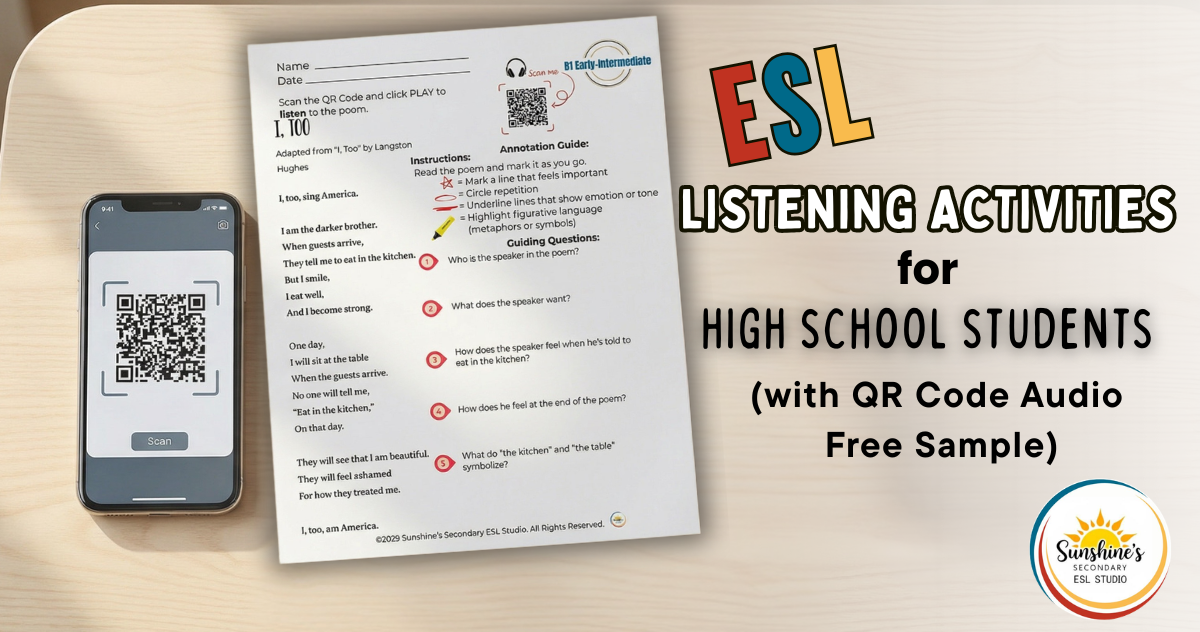
To help bridge that gap, I created a free ESL listening worksheet with QR code audio designed for B1 (early-intermediate) English learners. It’s ready to print and use right away—but I’ll also show you how to use it even if your school has cell phone restrictions.
Why ESL Listening Activities for High School Students Matter
Strong ESL listening activities for high school students build more than just comprehension—they support fluency, pronunciation, and confidence.
In a perfect world, every teacher would:
- speak clearly
- face students
- slow down their speech
But we know that’s not always reality.
Students will hear:
- fast speech
- unclear pronunciation
- teachers talking while writing on the board
That’s why we need to prepare them for real-world listening conditions, not just ideal ones.
One of the most effective ways to do this is through multimodal input—combining audio, text, and visual support. If you’re already using strategies like structured speaking or guided interaction, this pairs really well with routines like 👉 How I Build ESL Speaking Routines
How QR Code Audio Makes Listening Activities Easier
One of the easiest ways to create ESL listening worksheets is by using QR code audio.
Here’s how I create mine using Vocaroo:
- Go to vocaroo.com (no login needed)
- Record or upload your audio
- Click “Save & Share”
- Download the QR code
- Insert it into your worksheet
That’s it.
Now—if your school allows phones, students can scan and listen independently.
If your school has restrictions, you still have great options:
- play the audio from your device
- use listening stations
- assign it as small group rotation work
- project the QR code and control playback yourself
This keeps the focus on accessible ESL listening practice, not the technology.
If you’re exploring how tech tools fit into your classroom, this connects really well with 👉 Google Translate in the ESL Classroom
What’s Included in This ESL Listening Worksheet
This free resource is designed specifically for ESL listening activities for high school students at the B1 level.
It includes:
- Adapted B1 version of “I, Too”
- Annotation guide
- Guiding questions
- QR code with MP3 audio
- Answer key
If you’re already teaching poetry or culturally relevant texts, this pairs beautifully with 👉 I, Too Langston Hughes ESL Lesson Ideas
How to Use This in Your Classroom
This is a print-and-go PDF designed for grades 7–12 ESL students, but it also works well for struggling readers.
You can use it for:
- independent practice
- stations
- sub plans
- homework
- small group instruction
You can also extend the activity by having students:
- record themselves reading
- generate their own QR codes
- respond to each other’s recordings
This works especially well if you’re building confidence through structured speaking tasks like 👉 ESL Speaking Activities for Teens
Want More ESL Listening Activities for High School Students?
If this free sample works well for your students, I also offer a full leveled version in my TPT store:
👉 I, Too Leveled Poetry Pack (A1–B2 with Audio)
This full resource includes:
- 5 leveled versions (A1–B2 + original text)
- MP3 audio for every level
- Google Slides with embedded audio
- PowerPoint version
- printable PDFs
- QR codes for flexible listening access
- answer keys
If you’re differentiating across levels, this also pairs well with 👉 Differentiating ESL Instruction from A1–B2
Final Thoughts
Finding meaningful ESL listening activities for high school students shouldn’t feel overwhelming.
This free worksheet is:
- low prep
- flexible (with or without phones)
- easy to implement
- aligned to real classroom needs
If you’re looking for a quick win, try it out and see how your students respond.
And if it works well, you’ll already have a leveled system ready to go.