
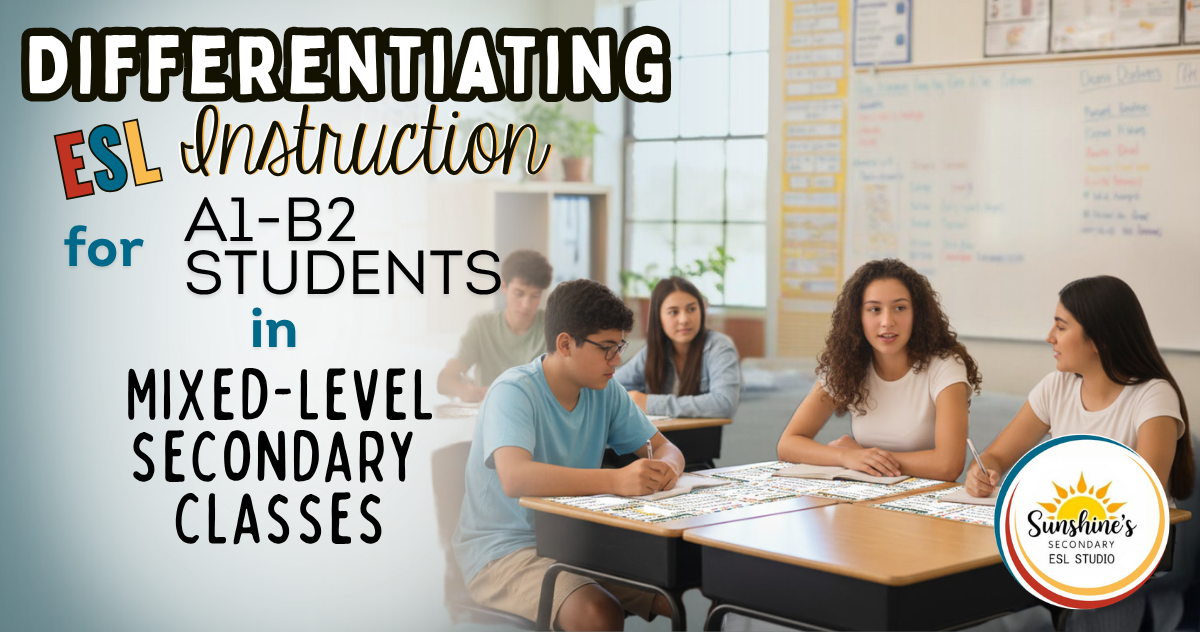
Differentiating ESL instruction in mixed-level classes can feel overwhelming when one classroom includes newcomers, developing English learners, and more confident intermediate students. It may seem as though every proficiency level requires a separate lesson, set of materials, and assessment.
Fortunately, effective differentiation does not require four completely different lesson plans.
The goal is to teach one shared lesson while adjusting the language support, task complexity, and expected output. Students can study the same age-appropriate topic and work toward the same central objective, even when they need different pathways to reach it.
In my own mixed-level ESL classroom, I plan around the same materials and learning goals. My newcomers may need more simplified language, visuals, word banks, and sentence frames. My intermediate English learners may need less support and a challenge slightly above their current comfort level.
I know differentiation is working when the lesson is not too easy for my intermediate students but also not impossible for my newcomers.
That balance is the heart of differentiating ESL instruction in mixed-level classes.
What Differentiating ESL Instruction Means in Mixed-Level Classes
Classroom organization plays an important role in differentiation. If you’d like to see how I arrange group seating and organize language supports for mixed-level classes, visit my guide to secondary ESL classroom setup.
Differentiating ESL instruction means adjusting how students access information, practice skills, and demonstrate learning according to their current English proficiency.
It does not mean lowering the learning goal or replacing meaningful academic work with easy activities.
In a mixed-level secondary ESL classroom, students may share:
- The same topic
- The same essential question
- The same content objective
- The same central concept
- The same whole-class instruction
However, the teacher may adjust:
- Reading complexity
- Vocabulary support
- Sentence frames
- Visual and audio support
- Response length
- Amount of evidence required
- Level of independence
- Depth of analysis
A student’s English proficiency affects how that student communicates an idea. It should not prevent the student from thinking about meaningful, age-appropriate content.
Differentiating ESL Instruction Without Lowering Rigor
One of the biggest misconceptions about differentiation is that it makes the work easier.
Effective differentiation changes the language demand without necessarily changing the thinking demand.
For example, students at several proficiency levels can answer the same essential question:
Was the character’s decision justified?
An A1 newcomer might select an answer and complete a sentence frame:
The decision was right because ______.
An A2 student might write two or three connected sentences using a word bank.
A B1 student might write a paragraph using evidence from the text.
A B2 student might analyze the decision, cite evidence, and address another possible interpretation.
All four students are thinking about the same question. The complexity of their English output changes, but the lesson still requires reasoning.
This is why rigor in ESL classrooms may look different without becoming less meaningful.
Start With One Shared Lesson Objective
The most manageable way to differentiate is to begin with one shared content objective.
For example:
Content objective:
Students will explain how a character’s decision contributes to the conflict.
Next, identify the language students need to complete that task.
Language objective:
Students will use cause-and-effect language to explain how the character’s decision affects the conflict.
Clear language objectives for high school ESL help teachers decide which language supports students need.
The content objective remains connected across proficiency levels, but the expected language changes.
A1 student expectation
Students identify the character’s decision and complete a supported sentence:
The character ______. This causes ______.
A2 student expectation
Students write two or three connected sentences using words such as because, so, or causes.
B1 student expectation
Students write a paragraph explaining the connection between the decision and the conflict, using one piece of evidence.
B2 student expectation
Students analyze how the decision develops the conflict and support their interpretation with relevant evidence.
This approach keeps the class together while still giving each student an appropriate level of support and challenge.
What Stays the Same and What Changes
When differentiating ESL instruction in mixed-level classes, teachers do not need to change every part of the lesson.
| Lesson element | What stays the same | What may change |
|---|---|---|
| Topic | The same age-appropriate topic | Amount of background support |
| Objective | The same central learning goal | Complexity of the language objective |
| Reading | The same central ideas | Length, vocabulary, syntax, and audio support |
| Speaking | The same discussion question | Sentence frames, rehearsal, and response length |
| Writing | The same central prompt | Length, evidence, and sentence complexity |
| Assessment | The same concept | Response method and language expectations |
Students should feel that they are participating in the same class rather than completing unrelated work based on their English level.
Differentiate Content, Process, Product, and Language Support
A practical differentiation plan can focus on four areas:
- Content
- Process
- Product
- Language support
These categories help teachers make purposeful adjustments without redesigning the entire lesson.
Differentiate the content
Content is the information students receive.
Teachers can provide access to the same topic through:
- Leveled or adapted reading passages
- Shorter sections of text
- Visual vocabulary
- Audio recordings
- Highlighted evidence
- Brief summaries
- Original texts for students ready for more independence
Adapted text should still address mature ideas and secondary-level topics.
Students who are reading below grade level do not need childish materials. They need age-appropriate content presented in more accessible language.
For example, The Necklace ESL Reading Passages A1–B2 show how one literary text can be adapted for several proficiency levels while keeping the central story and ideas connected.
Differentiate the process
Process refers to how students work with the content.
Students may benefit from:
- Teacher modeling
- Partner rehearsal
- Think-pair-share
- Chunked directions
- Graphic organizers
- Repeated listening
- Flexible grouping
- Guided practice before independent work
A newcomer may need to rehearse an answer with a partner before speaking. A B1 or B2 student may be ready to respond independently or lead part of a discussion.
The central task can remain the same while the amount of structure changes.
Differentiate the product
Product refers to how students demonstrate learning.
Students may respond through:
- A labeled visual
- An oral response
- A recorded answer
- A sentence frame
- A short paragraph
- A developed written response
- A presentation
- A structured academic discussion
Not every student must produce the same number of sentences to demonstrate understanding.
An A1 student may show the central idea through a supported oral response. A B2 student may be expected to explain, justify, and elaborate.
Differentiate language support
Language supports give students access to the task without completing the thinking for them.
Useful supports include:
- Sentence starters
- Word banks
- Transition words
- Visuals
- Models
- Audio
- Bilingual glossaries
- Response frames
- Academic vocabulary lists
When students know what they want to say but cannot begin, free ESL sentence starters for teens can lower the language barrier without lowering the thinking.
Always-available supports can also help students become more independent. A1–B2 Survival English Desk Mats give students quick access to classroom language and sentence starters without requiring the teacher to repeat the same prompts throughout the lesson.
Differentiating Reading for A1–B2 Students
For the same reading lesson, teachers can vary:
- Text length
- Sentence complexity
- Vocabulary support
- Audio access
- Number of questions
- Question complexity
- Amount of teacher guidance
An A1 student may use a shortened passage with visuals and answer literal comprehension questions.
An A2 student may read a longer adapted version and identify key details.
A B1 student may explain relationships and cite evidence.
A B2 student may analyze tone, author choices, or deeper implications.
These ESL reading comprehension strategies for high school provide additional ways to support students while preserving meaningful reading.
Differentiating Writing for Mixed-Level ESL Classes
Writing assignments can keep the same central prompt while changing the scaffolds.
Consider this prompt:
Explain whether the character made the right decision.
A1 writing task
Choose an opinion and complete a sentence frame:
I think the character was right because ______.
A2 writing task
Write three connected sentences using a word bank and a model.
B1 writing task
Write a paragraph with a clear opinion, reason, and piece of evidence.
B2 writing task
Write a developed response that considers another viewpoint and supports the analysis with evidence.
Students may also benefit from oral rehearsal, models, graphic organizers, and revision checklists.
These ESL writing support strategies can help students organize and express their ideas more confidently.
Differentiating Speaking in Mixed-Level Classes
Mixed-level speaking activities can use the same topic with different response expectations.
Teachers can adjust:
- Preparation time
- Sentence starters
- Partner support
- Response length
- Follow-up questions
- Vocabulary requirements
- Level of independence
An A1 student may point to a visual and complete one sentence.
An A2 student may answer and provide a simple reason.
A B1 student may elaborate and ask a follow-up question.
A B2 student may lead part of the discussion or defend a viewpoint.
Predictable ESL speaking routines make differentiation easier because students already understand how to participate in the activity.
Leveled A1–B2 conversation cards for teens can also provide the same discussion structure with different levels of language demand.
Differentiating Listening for A1–B2 Students
Listening tasks can be differentiated by changing:
- Number of times students listen
- Availability of a transcript
- Vocabulary preview
- Use of visuals
- Note-taking support
- Complexity of the listening question
An A1 student may listen for a key word or match audio to a picture.
An A2 student may identify the main idea and several key details.
A B1 student may take guided notes and summarize the message.
A B2 student may make an inference or evaluate the speaker’s point of view.
Audio support is especially helpful when students need to hear language several times before producing it independently.
Supporting Newcomers Without Holding Back Intermediate Students
Newcomers need substantial language access, but the support should still feel appropriate for teenagers.
Useful newcomer supports include:
- Mature visuals
- Simplified directions
- Survival language
- Sentence frames
- Audio
- Short, meaningful texts
- Strategic native-language support
- Predictable routines
- Partner rehearsal
Avoid assuming that beginning English means beginning thinking.
A newcomer may have strong academic knowledge, life experience, or literacy in another language. The student may simply need a more accessible way to participate in English.
These beginner ESL high school strategies go deeper into providing respectful, age-appropriate support.
At the same time, B1 and B2 students need more than extra questions or additional worksheets.
Useful extensions include:
- Requiring additional evidence
- Comparing two sources
- Addressing a counterargument
- Leading a discussion
- Revising for greater precision
- Explaining reasoning
- Evaluating an author’s choices
- Completing a more independent version of the task
The goal is to stretch students slightly beyond their current comfort level without making the task unreachable.
Flexible Grouping in Mixed-Level ESL Classes
Students should not remain in the same proficiency groups during every lesson.
Group students by proficiency when they need:
- Targeted language instruction
- Leveled reading support
- Vocabulary reteaching
- Grammar practice
- Differentiated writing guidance
Use mixed-proficiency groups when students are:
- Discussing ideas
- Solving a problem
- Comparing viewpoints
- Completing a collaborative project
- Sharing background knowledge
The purpose of the task should determine the grouping.
Avoid making the strongest English speaker responsible for translating or teaching the entire group. More advanced students also deserve opportunities to develop their own language and thinking.
Assessing Students in Mixed-Level ESL Classes
Assessment should help teachers decide what students need next.
Simple formative checks can include:
- Selecting a picture or key word
- Completing one sentence
- Recording an oral response
- Highlighting evidence
- Writing a short exit ticket
- Completing a self-rating checklist
- Participating in a quick conference
Teachers should consider both content understanding and English production.
A student may understand a concept but lack the language to explain it independently. Another student may speak fluently but still need support with academic reasoning.
A beginning-of-year ESL assessment can provide useful starting information, but ongoing classroom observation is equally important.
Grading Students When Language Demands Differ
Fair grading does not always require identical language output.
Teachers can maintain the same content goal while adjusting expectations for:
- Sentence complexity
- Response length
- Use of evidence
- Independence
- Accuracy
- Available supports
A newcomer should not automatically fail a content task because the student cannot yet produce the same amount of English as a B2 student.
At the same time, students should continue moving toward greater independence.
This guide to grading ESL students in high school explores how teachers can balance fairness, language development, and academic expectations.
Common Questions About Differentiating ESL Instruction in Mixed-Level Classes
How do you differentiate instruction for ESL students?
Begin with one shared learning goal. Then adjust the content, process, product, and language support according to students’ current English proficiency.
How do you teach several proficiency levels in one class?
Use the same topic and central objective for the whole class. Provide different levels of vocabulary support, text complexity, sentence frames, response length, and independence.
How can teachers differentiate without creating four separate lessons?
Start with one objective and one shared topic. Adjust the supports and expected output rather than designing unrelated assignments for every level.
What does differentiation look like in a mixed-level ESL classroom?
Students may read versions of the same text, answer the same essential question, and participate in the same discussion. However, their vocabulary support, sentence frames, response length, and depth of analysis may differ.
How do sentence frames support differentiation?
Sentence frames reduce the language required to begin a response. They allow students to focus on the academic idea while continuing to develop English.
How do teachers maintain rigor for newcomers?
Keep the thinking meaningful while reducing unnecessary language barriers. Newcomers can still compare, classify, explain, sequence, and express opinions with appropriate support.
How do teachers challenge B1 and B2 students?
Increase independence, depth, precision, and use of evidence. Do not simply give intermediate students more of the same work.
How do teachers assess students at different proficiency levels?
Assess the shared concept while considering each student’s current language development. Use several response formats, including oral, visual, and written evidence.
How do teachers avoid making newcomer materials look childish?
Use mature topics, respectful visuals, realistic photographs, and age-appropriate designs. Simplify the language—not the student’s age or intelligence.
A Planning Checklist for Differentiating ESL Instruction
Before teaching, ask:
- What is the shared content objective?
- What language must students understand or produce?
- Which vocabulary is essential?
- What support will newcomers need?
- What support can be removed for intermediate students?
- Can students rehearse before writing or speaking?
- Would visuals or audio improve access?
- How will each level demonstrate understanding?
- Does the task remain meaningful for everyone?
- What quick assessment will guide the next lesson?
Final Thoughts
Differentiating ESL instruction in mixed-level classes does not require four completely separate lesson plans.
Students can share one meaningful objective while receiving different levels of language support, text access, rehearsal, and academic challenge.
Newcomers may need visuals, simplified language, and clear sentence frames. Intermediate learners may need greater independence, deeper questions, and tasks slightly above their current comfort level.
When differentiation is working, the lesson is not too easy for students who are ready for more, but it is also not impossible for students who are just beginning.
That is the balance we are trying to create: one classroom, one meaningful learning goal, and several respectful ways for students to reach it.