
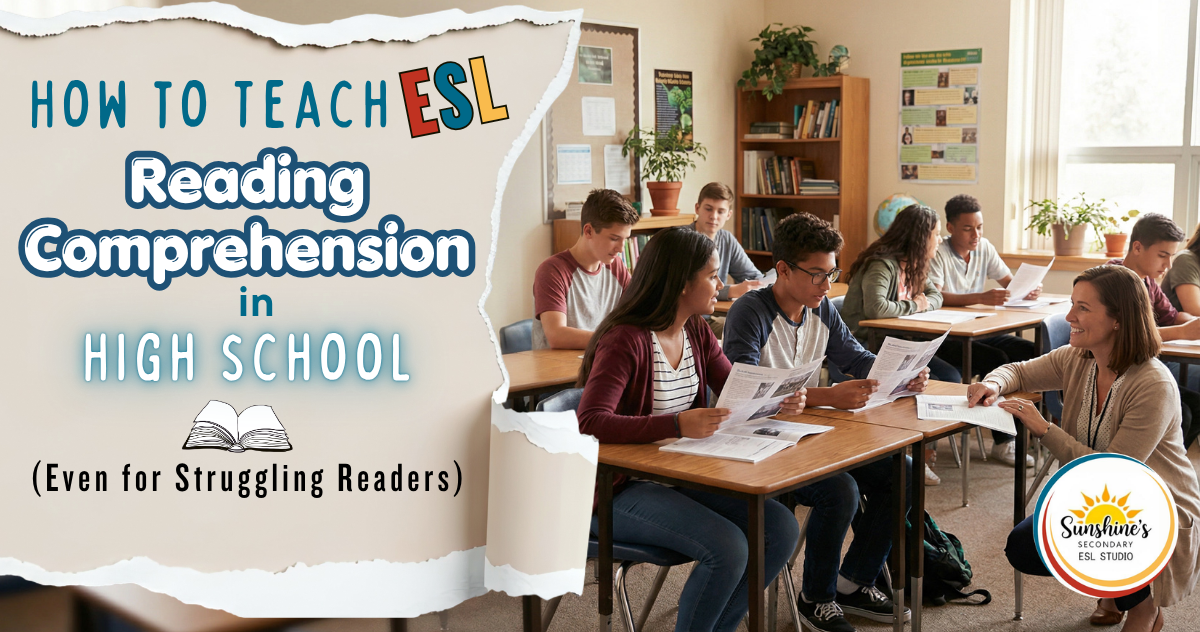
If you teach ESL reading comprehension in high school, you already know the reality: your students are expected to engage with grade-level texts… but many of them are still developing foundational reading skills in English.
That gap can feel overwhelming.
You’ve got students who:
- Can decode but don’t understand
- Understand verbally but struggle to read independently
- Shut down the moment they see a long passage
And meanwhile, the expectation is still rigor, standards, and academic growth.
If you’ve ever worked with students who are reading below grade level, you’ve probably seen how quickly frustration builds—which is something I talk more about in this post on supporting ESL students reading below grade level.
So what actually works?
Let’s talk about what ESL reading comprehension in high school should really look like—and how you can support struggling readers without watering things down.
Rethinking ESL Reading Comprehension in High School
One of the biggest mindset shifts is this:
Reading comprehension is not just about reading.
For multilingual learners, it’s also about:
- Vocabulary development
- Background knowledge
- Sentence structure awareness
- Confidence
If a student doesn’t understand the words, the sentence structure, or the context… comprehension breaks down fast.
That’s why simply assigning a text and asking questions rarely works in an ESL classroom.
Instead, we have to build comprehension before, during, and after reading.
If you’ve ever questioned whether your approach is “rigorous enough,” this connects closely to how rigor actually looks different in ESL classrooms—which I break down more in why rigor in ESL looks different.
Strategy 1: Frontload Just Enough (Not Too Much)
Before students ever read, they need a small entry point into the text.
But here’s the key:
You don’t want to over-explain everything.
Instead, focus on:
- Key vocabulary (5–8 words max)
- Basic context (1–2 sentences)
- A simple prediction question
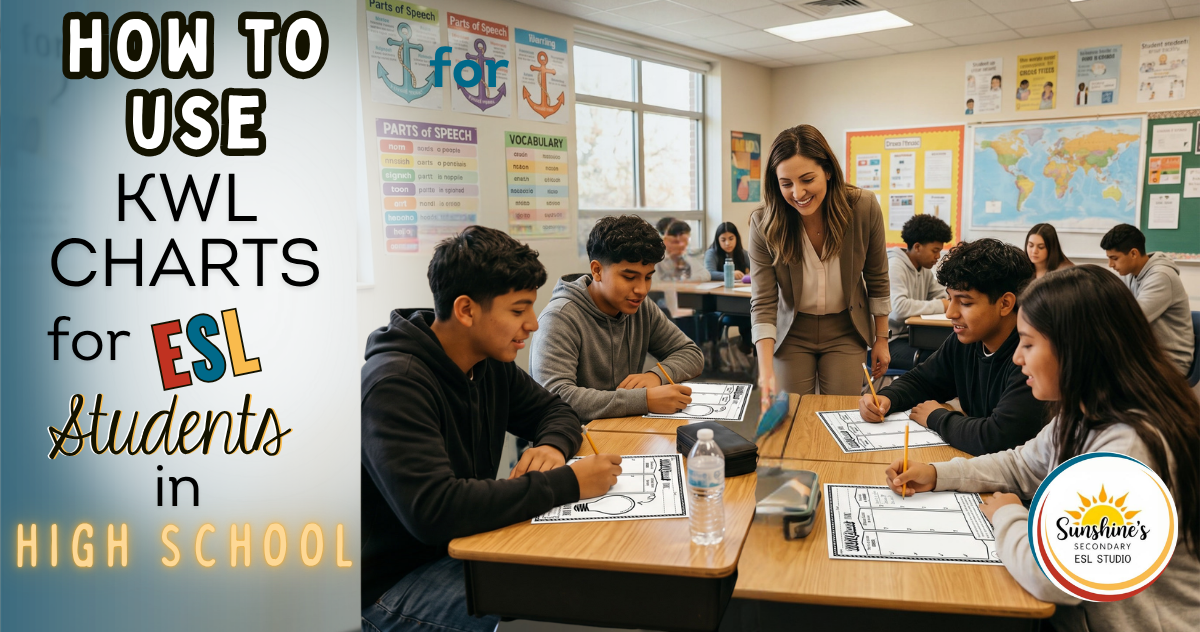
You can even use simple tools like KWL charts to guide this process—something I’ve used consistently and explained more in how to use KWL charts for ESL students.
In my own classroom, I also like pairing this with short, accessible informational texts that already include built-in supports (like vocabulary focus and comprehension checks), so students aren’t walking in cold.
Example:
“This text is about a teenager who has to make a difficult decision. What kinds of decisions do teenagers have to make?”
This gives students something to hold onto without overwhelming them.
Strategy 2: Use Chunking for ESL Reading Comprehension in High School
Long passages are one of the fastest ways to lose ESL readers.
Chunking changes everything.
Instead of:
👉 One full-page text + 10 questions
Try:
👉 1 paragraph → quick check
👉 Next paragraph → quick check
This allows students to:
- Process information in smaller pieces
- Stay engaged
- Build confidence as they go
This is especially important when working with structured texts like short stories or novel excerpts. For example, when I scaffold texts like “The Necklace” for ESL students, chunking is one of the main strategies that keeps students from shutting down.
I design my reading activities this same way—breaking texts into manageable sections with comprehension built into each part—because it keeps students from getting overwhelmed early on.
Even your most reluctant readers are more likely to stick with the text when it feels manageable.
Strategy 3: Make Reading Active (Not Silent and Passive)
A quiet classroom might look productive… but in ESL, it often means students are lost.
Instead, build in structured interaction:
- Partner reading
- Echo reading
- Choral reading
- Stop-and-talk moments
For example:
“Turn to your partner and explain what just happened in your own words.”
This kind of structure pairs really well with speaking routines. If you already use conversation strategies, you can easily blend them into reading—which is something I talk more about in how to build ESL speaking routines.
In fact, I often pull in simple discussion prompts or structured speaking supports right after each chunk of reading so students are processing out loud before they ever write.
Strategy 4: Focus on Meaning, Not Just Correct Answers
A lot of traditional reading comprehension focuses on:
- Multiple choice
- Right vs. wrong
But ESL students need space to build meaning, even if their language isn’t perfect.
Try:
- Sentence frames
- Short constructed responses
- Verbal explanations before writing
Example:
“The main idea is ___ because ___.”
If you’re also supporting writing alongside reading (which you should be), this connects directly to strategies like the ones I use in argumentative writing for ESL students.
Many of my reading resources also include short constructed response (SCR) questions for this exact reason—so students are practicing comprehension and writing at the same time.
You’re not just checking comprehension—you’re helping them develop it.
Strategy 5: Teach Students How to Use Context Clues
This is one of the most powerful (and underused) skills in ESL reading comprehension in high school.
Instead of giving definitions, teach students how to figure out meaning from the text.
Model it explicitly:
- “I don’t know this word, but the sentence says…”
- “This word might mean ___ because ___.”
Then give them practice where they:
- Identify clues
- Make guesses
- Check for understanding
A lot of my informational text resources are built around this exact idea—focusing on clues instead of definitions—because that’s what actually builds independence for ESL learners.
Strategy 6: Use Leveled Texts Without Lowering Expectations
Here’s something important:
Scaffolding is not the same as simplifying the thinking.
You can:
- Use slightly adapted texts
- Provide audio support
- Add visuals
…while still asking grade-level questions.
This is exactly why I create A2–B1 and B2 versions of the same text—so students can access the content at their level while still working toward the same skill.
This is the same idea behind differentiation across proficiency levels, which I go deeper into in differentiating ESL instruction from A1 to B2.
This allows students to:
- Access the content
- Practice real comprehension skills
- Build confidence with academic language
Strategy 7: Build Confidence First (Especially for Struggling Readers)
Many students who struggle with reading have already decided:
👉 “I’m bad at reading.”
That belief is your biggest obstacle.
So we have to create early wins.
Try:
- Short, achievable tasks
- Clear directions
- Immediate feedback
- Celebrating effort, not just accuracy
This is one reason I always keep shorter, scaffolded readings on hand—especially at the beginning of a unit—so students can experience success before moving into more complex texts.
You’ll often see this shift happen quickly when students start experiencing success.
What ESL Reading Comprehension Should Look Like in Your Classroom
At the end of the day, strong ESL reading comprehension in high school classrooms are not:
- Silent
- Worksheet-heavy
- Focused only on correct answers
They are:
- Interactive
- Scaffolded
- Language-rich
- Built on small, intentional steps
Your students don’t need less rigor.
They need more support in reaching it.
Final Thoughts
If you’re teaching ESL reading comprehension in high school, just know this:
You’re not behind.
Your students aren’t incapable.
They just need a different pathway to understanding.
And when you start layering in these strategies—chunking, interaction, scaffolds, and language support—you’ll start to see it:
👉 More participation
👉 Better comprehension
👉 And students who actually believe they can do it
And that’s the goal.
Teaching The Tell-Tale Heart to ESL Teens: Adapted Reading, Audio & Activities
The Monkey’s Paw ESL: How to Teach the Classic Short Story to English Learners
Beginning-of-Year ESL Assessments for High School Students