
If you’ve been an ESL teacher for more than five minutes, you’ve probably heard it before:
“But are your lessons rigorous enough?”
It’s a frustrating question, and honestly, it usually comes from someone who has never actually taught multilingual learners. Conversations like this often reveal a bigger misunderstanding about rigor in ESL classrooms and what meaningful challenge really looks like for students learning a new language.
When people walk into an ESL classroom and see something that looks different from a mainstream English class, they sometimes assume different equals easier.
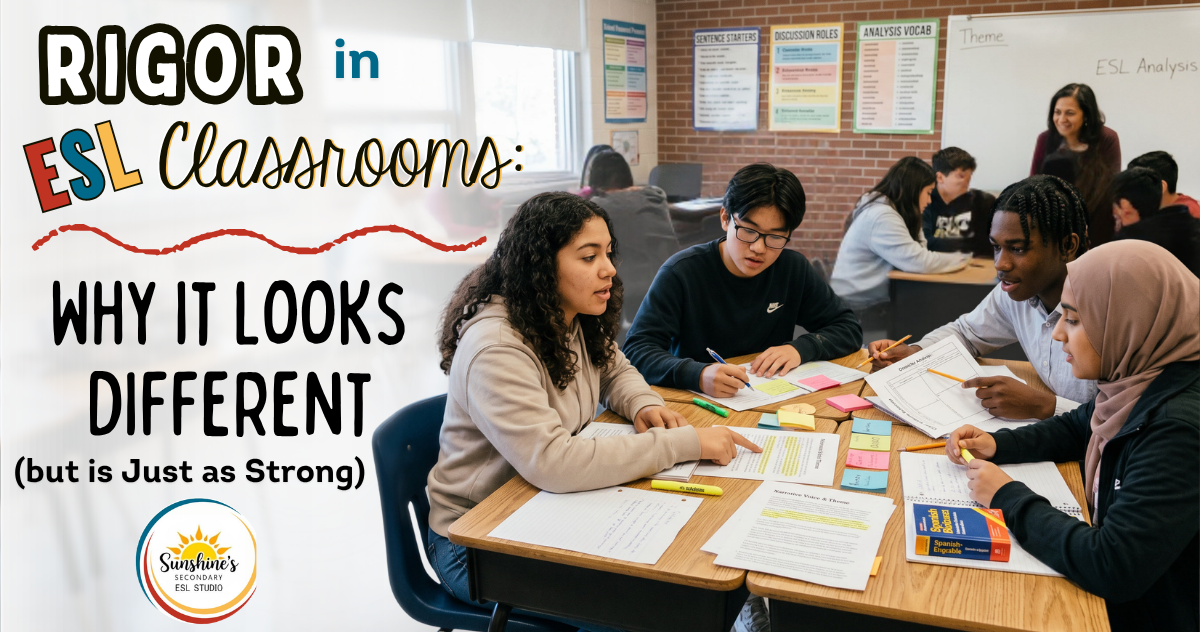
But here’s the truth: rigor in ESL classrooms does not have to look identical to mainstream instruction to be just as strong.
In many cases, multilingual learners are doing even more cognitive work because they are learning academic content and language simultaneously.
What Rigor in ESL Classrooms Actually Looks Like
For our students, rigor is not about piling on difficult texts and hoping they’ll sink or swim. It’s about stretching language skills while building the confidence to engage with complex content.
That means:
- scaffolding complex texts so students can access meaning without drowning in vocabulary
- teaching academic language directly—transition words, tone, sentence structure, and phrasing
- designing tasks that push higher-order thinking like analysis, synthesis, and evaluation
- using gradual release so students move from guided practice to independence
- building structured speaking opportunities where students explain, defend, and justify ideas
If you’re differentiating across proficiency levels, this is exactly where strong scaffolding matters. “Differentiating ESL Instruction from A1–B2”
In other words, rigor in ESL classrooms is about providing multiple pathways to the same high-level thinking.
A beginner student may use sentence stems to analyze a character. An intermediate student may discuss symbolism with a partner. An advanced student may write an evidence-based response independently.
The language support looks different, but the thinking remains rigorous.
That’s something people outside ESL classrooms often miss.
Sometimes Rigor in ESL Classrooms Is Quiet
One of the biggest misconceptions about rigor in ESL classrooms is that rigorous learning always looks loud, fast, and fully independent.
But for multilingual learners, rigorous thinking can look very different.
It can look like:
- a beginner student carefully building a sentence before speaking
- a group using sentence stems to debate an idea
- students rereading a paragraph multiple times to unpack meaning
- a newcomer annotating a text with visuals and translations
- a hesitant student finally volunteering an academic response aloud
These moments may not always resemble traditional mainstream instruction, but they require enormous cognitive effort.
Students are simultaneously processing:
- vocabulary
- grammar
- pronunciation
- listening comprehension
- cultural context
- and academic content
That is rigorous work.
This is one reason why structured speaking routines matter so much in secondary ESL classrooms. “How to Build ESL Speaking Routines”
Confidence-building activities also play a huge role in helping students participate in academically demanding tasks. “ESL Speaking Confidence Activities”
And sometimes the most rigorous thing a multilingual learner can do is simply persist through productive struggle in a new language.
Why Rigor in ESL Classrooms Does Not Mean Using the Same Text
Let’s take poetry as an example.
A mainstream English II class might jump directly into a highly abstract poem with little support. In ESL, we may choose something like Hope is the Thing with Feathers or identity-based poetry that allows students to connect language with personal experience.
On the surface, this can appear simpler.
But what ESL students are doing is anything but easy.
They are:
- unpacking metaphor and symbolism in a new language
- practicing fluency through reading and speaking
- making cultural and personal connections
- building transferable academic vocabulary
- discussing abstract ideas with language limitations
That’s rigor.
If you’ve ever scaffolded poetry successfully for multilingual learners, you know how much thinking is involved. “Scaffolded ESL Poetry Activities”
Identity-based writing and culturally responsive instruction can also create incredibly rigorous opportunities for students to connect language with lived experience. “Culturally Responsive Teaching for ESL Teens” and “ESL Identity Poem Writing Activity”
And when students are reading, discussing, and responding to literature with support, they’re building the exact skills they need for mainstream academic success. “How to Support ESL Students During Novel Studies”
Sometimes ESL Classrooms Look “Too Supported” to Outsiders
This is where misunderstandings about rigor in ESL classrooms often begin.
People see:
- sentence stems
- bilingual glossaries
- visuals
- translated directions
- partner discussions
- graphic organizers
…and assume the work has been watered down.
But support is not the same thing as lowering expectations.
Visual scaffolds help students access grade-level thinking.
Sentence stems help students participate in academic conversations before they fully control the language independently.
Graphic organizers help students organize complex thinking in a manageable way. “ESL Graphic Organizers for Literature”
Even allowing strategic native language use can strengthen comprehension and academic confidence. “Native Language Use in the ESL Classroom” and “Translanguaging in the Secondary ESL Classroom”
The goal is not dependence.
The goal is access.
Over time, strong scaffolding allows students to do more independently while still engaging with challenging material.
That is exactly what effective rigor in ESL classrooms should do.
The Problem with the Word “Rigor”
The word rigor gets thrown around constantly in education.
But when it’s directed at ESL classrooms, it sometimes carries an unspoken message:
“Your students are not being challenged enough.”
That couldn’t be further from the truth.
ESL teachers constantly balance:
- language development
- content mastery
- confidence building
- literacy gaps
- academic vocabulary
- and social-emotional support
We are making sure students are challenged without being overwhelmed.
That balance is incredibly difficult.
In fact, many multilingual learners are expected to analyze literature, write academically, participate in discussions, and pass standardized assessments while still developing foundational English skills.
That is real rigor in ESL classrooms.
This becomes especially important when working with students who are still developing literacy skills in either language. “Supporting ESL Students Reading Below Grade Level”
Writing instruction also requires extensive scaffolding without sacrificing academic expectations. “ESL Writing Support Strategies” and “Argumentative Writing for ESL Students”
Rigor Is Not the Same as Compliance
Sometimes what schools label as “rigor” is actually compliance.
Silent classrooms.
Packets.
Endless worksheets.
Students copying notes without meaningful interaction.
But multilingual learners need opportunities to process language actively.
Real rigor often looks like:
- collaborative discussions
- structured interaction
- speaking practice
- meaningful reading tasks
- academic vocabulary development
- critical thinking with support
Students should be thinking deeply—not just sitting quietly.
That’s one reason I rely heavily on structured discussion, reading supports, and interactive activities in my own classroom. “ESL Reading Comprehension for High School” and “Conversation Starters for ESL Teens”
When students are actively using language, they are doing the cognitive work necessary for growth.
Respect the Expertise of ESL Teachers
The next time someone questions rigor in ESL classrooms, it’s worth remembering:
- ESL teachers differentiate without lowering expectations
- we teach language and content simultaneously
- our students are learning academic material in a new language
- and we constantly adapt instruction to meet diverse proficiency levels
That is not easier.
It’s more complex.
ESL teachers should not have to constantly defend whether their classrooms are rigorous enough. We see the complexity of the work every day.
When multilingual students analyze literature, build confidence speaking publicly, write in a new language, and engage with grade-level concepts, that is real academic rigor—even when the path looks different.
A Word to ESL Teachers
If you’ve ever felt discouraged by the “rigor” conversation, you’re not alone.
Keep doing what works.
You are designing lessons that are:
- accessible
- challenging
- meaningful
- supportive
- and aligned with real student needs
That is what rigor in ESL classrooms truly looks like.
And if you’re looking for ready-to-go resources that balance scaffolding with rigor, you can explore my classroom-tested materials here:
“Secondary ESL Resources on Teachers Pay Teachers”
Many of these include:
- leveled texts (A1–B2)
- structured speaking and writing tasks
- scaffolded reading activities
- built-in language support
- differentiated discussion opportunities
Because rigor is not about making things harder.
It’s about making meaningful learning possible.