
If you’ve ever searched for ESL listening activities high school, you already know the struggle—finding activities that actually work with teens is not always easy. Listening can feel passive, frustrating, or even intimidating for students, especially when they’re still building vocabulary and confidence.
However, listening is one of the most powerful ways to grow language when it’s done right.
Not only does it build comprehension, but it also strengthens vocabulary, improves pronunciation, and helps students feel more confident in real conversations. So the goal isn’t just to “add listening”—it’s to make it active, structured, and student-centered.
Let’s break down what that actually looks like in a high school ESL classroom.
Why ESL Listening Skills Matter More Than We Think
In many classrooms, listening tends to get pushed aside in favor of reading and writing. However, for ESL students, listening is foundational.
Before students can speak confidently, they need to hear the language. Likewise, before they can write effectively, they need exposure to how English sounds in real contexts.
Because of that, strong listening practice helps students:
- Recognize natural speech patterns
- Build vocabulary through context
- Improve pronunciation
- Process language more quickly
- Gain confidence in conversations
Even more importantly, when students feel like they understand what they’re hearing, everything else starts to click.
If you’ve ever struggled with getting students to actually use what they hear, pairing listening with structured speaking routines makes a huge difference. I break that down more in this post on how to build ESL speaking routines where I show how listening and speaking really go hand in hand.
The Problem With Traditional ESL Listening Activities
When you look at many ESL listening activities high school teachers have used in the past, the structure is usually pretty basic:
- Play audio
- Ask comprehension questions
- Check answers
And that’s where it stops.
The problem is that this approach assumes students can already process what they’re hearing. In reality, many high school ESL students:
- Miss key words
- Get stuck on unfamiliar vocabulary
- Lose track after one sentence
- Shut down when they feel overwhelmed
As a result, instead of building skills, these activities often create frustration.
That’s why listening needs scaffolding—just like reading. If this sounds familiar, you’ll also relate to what I talk about in ESL students reading below grade level because the same overwhelm shows up in both reading and listening.
ESL Listening Activities High School Teachers Can Actually Use
So what does effective listening instruction look like? Let’s walk through ESL listening activities high school students actually respond to.
1. Pre-Listening Vocabulary (This Changes Everything)
Before you ever press play, students need access to the language.
That doesn’t mean handing them a list of definitions. Instead, it means giving them a chance to interact with key words in a meaningful way.
For example, you might try:
- Matching words to images
- Quick partner discussions
- Predicting the topic
- Using sentence frames with key vocabulary
As a result, students aren’t hearing everything for the first time—and comprehension improves immediately.
This is also where tools like KWL charts can support listening just as much as reading. If you use them already, you can easily adapt them for audio with KWK charts for ESL students.
2. Give Students One Clear Listening Purpose
Rather than asking students to understand everything, narrow the focus.
For instance:
- “Listen for the main idea.”
- “Listen for three reasons.”
- “Listen for the problem and solution.”
This simple shift reduces overwhelm. At the same time, it builds confidence because students can actually succeed at the task.
And if you’re working toward academic writing or test prep, this kind of focused listening directly supports what students need later. I connect those skills more in ESL test prep in high school.
3. Chunk the Audio (Do Not Skip This)
This step is a game-changer.
Instead of playing the entire audio at once, break it into smaller sections. After each chunk:
- Pause the audio
- Let students process
- Ask a quick question
- Have them compare answers
In other words, you’re giving students time to think—just like we naturally do when processing language.
If you want a ready-made structure for this, cloze-style listening works really well with chunking. You can see how that looks here in Cloze listening activities for ESL.
4. Use Repetition (Without the Guilt)
Students need to hear audio more than once—and that’s completely okay.
A simple structure might look like this:
- First listen → general understanding
- Second listen → specific details
- Third listen → confirm answers
With each round, students notice more. Because of that, repetition builds both comprehension and confidence.
Technology can also make this easier, especially when students can replay audio independently. If you’re using QR codes or digital access, this approach works really well 👉 https://sunshinecastro.com/esl-listening-worksheet-qr-code/
5. Turn Listening Into Speaking
At this point, listening shouldn’t stand alone—it should lead directly into speaking.
This is where everything starts to connect.
After listening, you can have students:
- Turn and talk
- Summarize with a partner
- Role-play based on the audio
- Respond to an opinion question
As a result, students move from input to output, which reinforces learning in a powerful way.
If your students are hesitant to speak, structured supports make all the difference. I share more ideas in ESL Speaking Confidence Activities and Conversation Starters for ESL Teens
Making Audio Work in the ESL Classroom
One of the biggest challenges teachers face is finding the right audio.
So what actually works for high school ESL students?
- Clear, natural speech (slightly slowed if needed)
- Teen-relevant topics
- Short segments (1–3 minutes)
- Opportunities for repetition
Most importantly, audio should feel like support—not a test.
And honestly, tools like AI and translation can support listening when used intentionally—not replace it. If you’re navigating that balance, this might help: Google Translate in the ESL Classroom and AI in the ESL Secondary Classroom
A Simple ESL Listening Routine You Can Use Every Day
If you want something consistent, here’s a routine you can use across levels:
Step 1: Pre-Teach Vocabulary (3–5 minutes)
Give students quick exposure to key words
Step 2: First Listen (Low Pressure)
Students focus on the general idea
Step 3: Second Listen (Focused Task)
Students answer 2–3 specific questions
Step 4: Partner Check
Students compare and discuss answers
Step 5: Third Listen (Optional)
Students confirm or revise responses
Step 6: Speaking Extension
Students respond, summarize, or discuss
Because this routine is predictable, students feel more comfortable—and that leads to better participation.
Building Confidence Through ESL Listening Practice
For many students, listening isn’t just about skill—it’s about confidence.
They often think:
- “I don’t understand anything.”
- “I’m too slow.”
- “Everyone else gets it except me.”
That’s why your role is so important.
You can shift that mindset by:
- Breaking tasks into smaller steps
- Celebrating partial understanding
- Allowing repetition
- Providing structured support
Over time, students begin to realize they can understand—and that changes everything.
This idea connects closely to how rigor actually looks in ESL classrooms, especially when students are building skills step by step 👉 https://sunshinecastro.com/why-rigor-in-esl-looks-different/
🎧 Informational Texts with Audio
These are perfect for building listening comprehension with built-in support. Each resource includes leveled texts, audio, and comprehension activities so students can listen more than once and actually understand what they’re hearing.
📱 QR Code Listening Activities
If you want students to control their own listening pace, these are a game-changer. Students can scan, listen, pause, and replay as needed—making differentiation so much easier.
✍️ Cloze Listening Activities
These help students focus on specific words and details while listening. They’re especially helpful for building vocabulary and improving attention to language.
🗣️ ESL Speaking Activities for Teens
Since listening and speaking go hand in hand, these activities help students take what they hear and actually use it in conversation.
💡 Pro Tip: Start with one structured listening routine and pair it with speaking practice—
Final Thoughts on ESL Listening Activities in High School
Teaching listening doesn’t have to feel frustrating—for you or your students.
When you use ESL listening activities high school students can actually engage with, the entire experience changes.
Instead of feeling passive or overwhelming, listening becomes:
- Interactive
- Supportive
- Effective
And most importantly, students start to feel successful.
From there, that confidence carries over into speaking, reading, and writing—which is exactly what we want. If you want to continue building those connections, this pairs well with ESL Reading Comprehension for High School
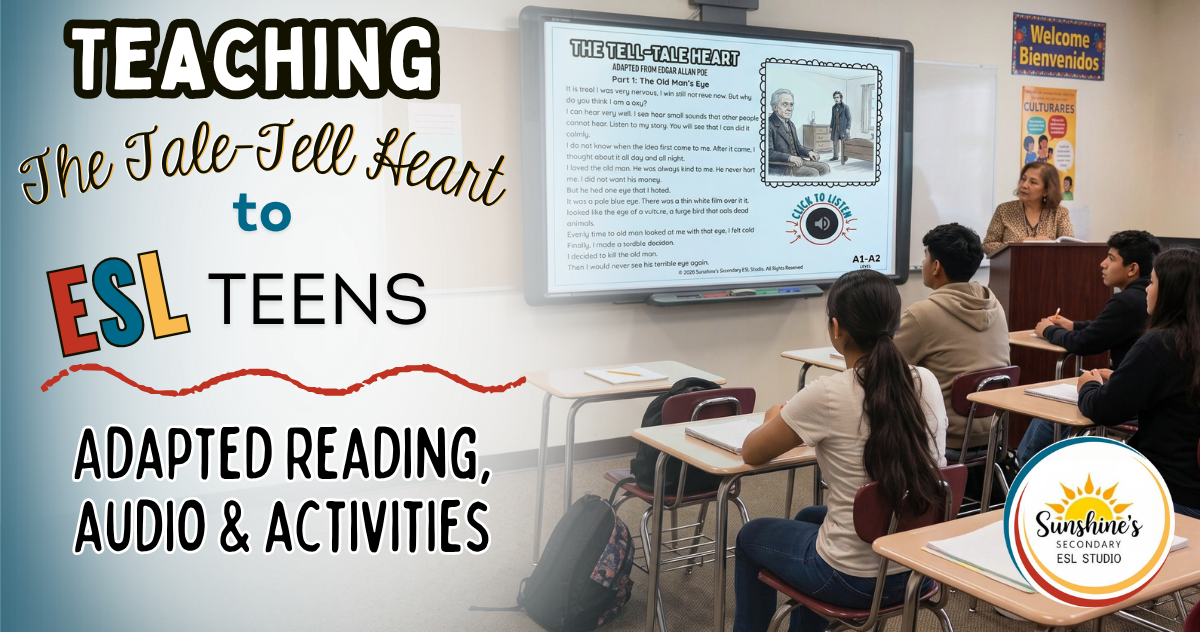
Teaching The Tell-Tale Heart to ESL Teens: Adapted Reading, Audio & Activities
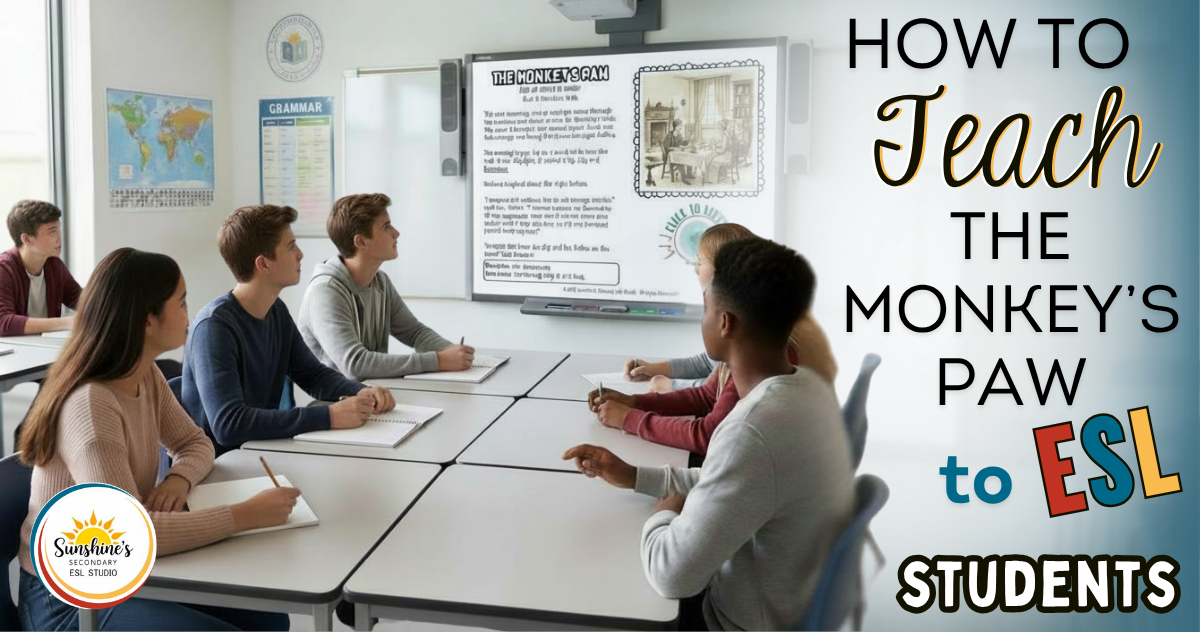
The Monkey’s Paw ESL: How to Teach the Classic Short Story to English Learners
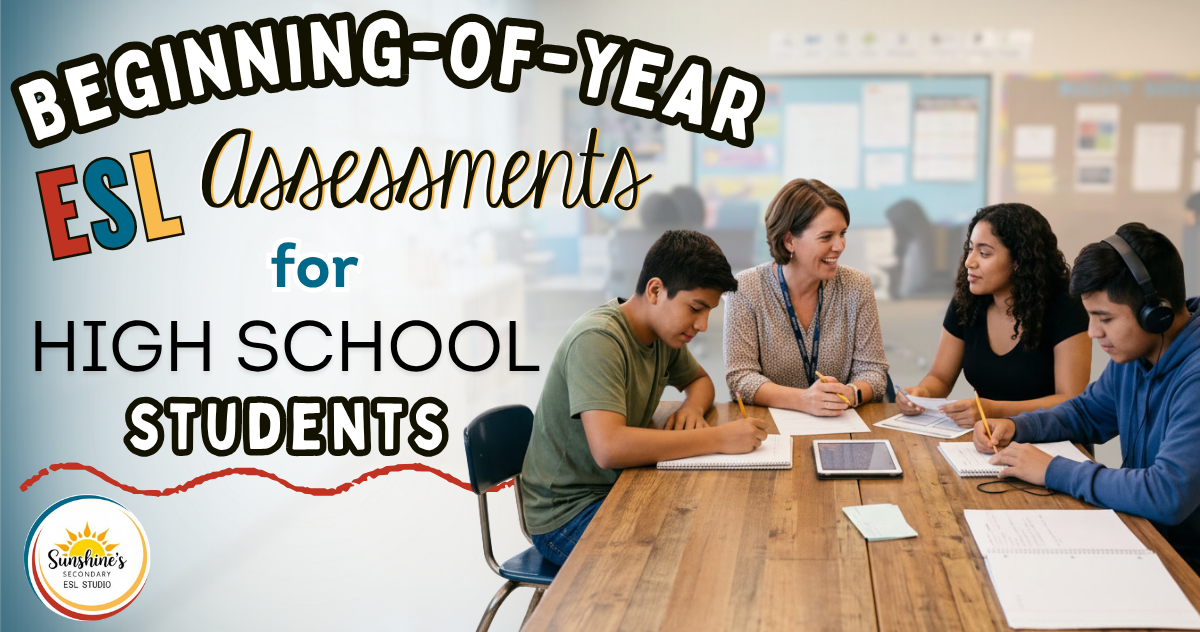
Beginning-of-Year ESL Assessments for High School Students