
ESL bell ringers are the daily warm-up activities that reminded me how much English learners rely on a predictable start to class.
For a long time, I had a bell ringer routine that worked. Each day followed a familiar pattern, even though the topic changed. Monday might be a photo reflection. Tuesday might be a fun fact. Wednesday might be a quote or idiom of the day.
Students came in, looked at the board, and started right away. Instead of waiting for directions, they already knew the first step. Over time, that simple opening routine gave my ESL students a comfortable expectation.
Looking back, I can also see how much it helped with classroom management. A predictable task at the bell cut down on the little issues that can happen when students are unsure what to do. I have written more about routines and expectations in my post on ESL classroom management for high school, and bell ringers are one of the routines I keep coming back to.
Planning your Back to School ESL routines? You can also visit my Back to School ESL Resources page for secondary ESL activities, newcomer support, daily warm-ups, classroom routines, and ready-to-use resources for middle school and high school English learners.
When I Stopped Using ESL Bell Ringers
Last year, I got away from that routine.
Part of the reason was that I listened to advice that sounded reasonable at the time. A district facilitator once suggested that bell ringers should always connect directly to the day’s lesson. For example, if students were studying Julius Caesar, then the bell ringer should connect to Julius Caesar.
In a traditional English classroom, that advice can make sense. Some warm-ups are meant to prepare students for a specific text, skill, or lesson objective. I have absolutely used content-based openers, especially during literature units like the ones I shared in how to support ESL students during novel studies and how to teach Julius Caesar to ESL students.
In an ESL classroom, though, our students need more than content review. They need language development every single day.
Why ESL Warm-Up Activities Do Not Always Have to Match the Lesson
ESL warm-up activities can support the day’s lesson, but they do not always have to match it perfectly to be valuable.
English learners need practice with vocabulary, grammar, speaking, listening, writing, confidence, and real-world language. A warm-up about an idiom, a photo, a fun fact, teen slang, or a music video can still build those skills.
That realization was important for me. Bell ringers for English learners are not just “extra” activities. Used intentionally, they become short language-development routines.
Some prompts work as ESL vocabulary warm-ups because students describe, explain, and make connections with new words. Other prompts can become ESL grammar warm-ups when we look closely at sentence patterns, verb tenses, or how students explain their ideas. Even a simple reflection can help students practice writing complete thoughts in English.
Because of that, I no longer believe every bell ringer has to match the exact assignment for the day. In ESL, language practice is always connected to the bigger goal.
Why I Brought Back Daily ESL Warm-Ups
Another change made me even more certain that I needed to bring my daily ESL warm-ups back.
Our district made several financial cuts, and one of those cuts affected our English Language Development classes. In the past, students had both an ESL English content course and an ELD class. That second class gave us more protected time for language development.
When that class was cut, I felt the loss immediately. My students still needed language practice, even if the schedule no longer gave us the same amount of dedicated ELD time.
For that reason, I wanted a routine that could protect a small piece of language development every day. These ELL bell ringers became one way to do that.
Now, if someone walks into my classroom and wonders why the warm-up is not directly tied to the day’s text, I can confidently explain the purpose. My students need daily opportunities to think, write, speak, listen, and build English. A mystery photo, fun fact, idiom, slang word, or music video reflection can absolutely support that goal.
My Weekly ESL Bell Ringer Routine
For this upcoming school year, I created 160 no-prep ESL bell ringers that follow a predictable weekly pattern.
The categories change by day, but the routine stays familiar. That gives students the best of both worlds: variety and structure. They know what kind of thinking to expect, but they are not doing the exact same task every day.
Want this routine already planned for you?
If you want a ready-to-use daily warm-up routine for secondary ESL, my ESL Bell Ringers Mega Bundle includes 160 no-prep bell ringers designed for middle school and high school English learners.
The bundle includes mystery photo reflections, fun facts, idioms, teen slang, and music video reviews so students get repeated practice with speaking, listening, vocabulary, writing, opinions, and classroom discussion. The format stays predictable, but the topics change throughout the week, which makes it easier to build a consistent Back to School routine without starting from scratch every morning.
Monday: Mystery Photo Reflections
On Mondays, students will respond to a mystery photo. They will observe the image, describe what they notice, make guesses, and explain their thinking.
Photos are powerful because every student can enter the task at some level. Beginning students can name objects or describe colors. More advanced students can make inferences, justify opinions, and write detailed responses.
You can find this category here: ESL Mystery Photos for Teens.
Tuesday: Fun Facts
On Tuesdays, students will respond to a fun fact. These prompts are great for curiosity, discussion, and quick writing.
A fun fact gives students something interesting to think about right away. From there, they can agree, disagree, make a connection, ask a question, or explain their reaction. This type of warm-up is simple, but it often leads to rich conversation.
You can find this category here: ESL Fun Facts for Teens.
Wednesday: Idiom of the Day
On Wednesdays, students will learn an idiom of the day. Idioms are especially important for English learners because the meaning is not always literal.
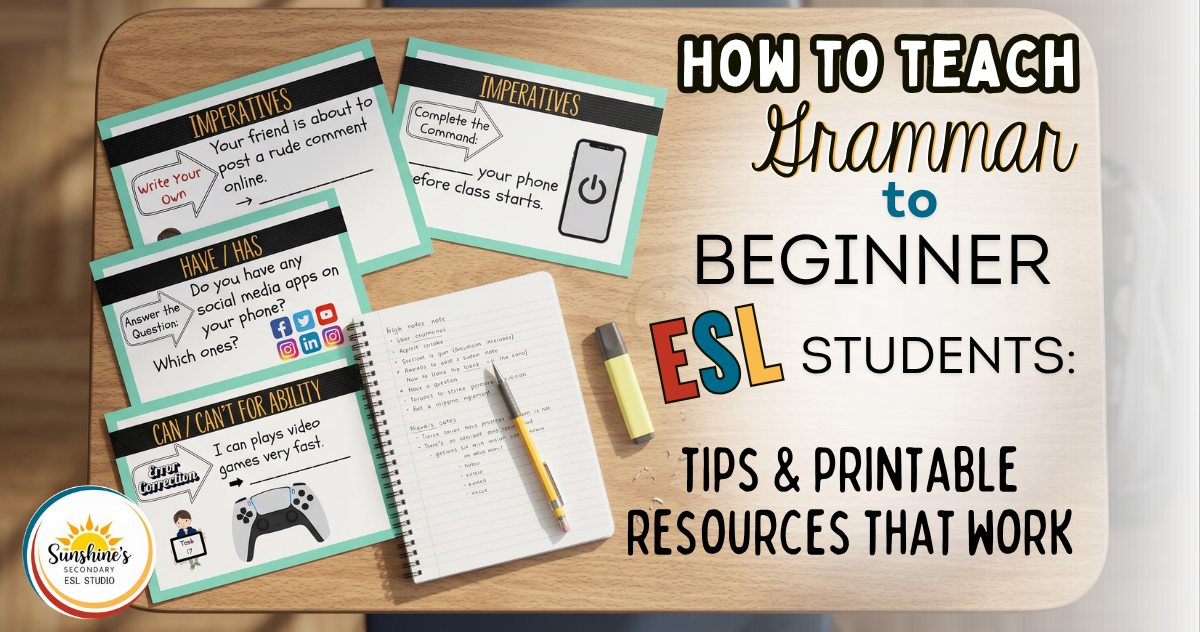
A short idiom routine gives students a low-pressure way to practice figurative language. It also helps them notice how English works beyond textbook vocabulary. This connects naturally with grammar and language practice, like the ideas I shared in how to teach grammar to beginner ESL students.
You can find this category here: ESL Idioms for Teens.
Thursday: Teen Slang
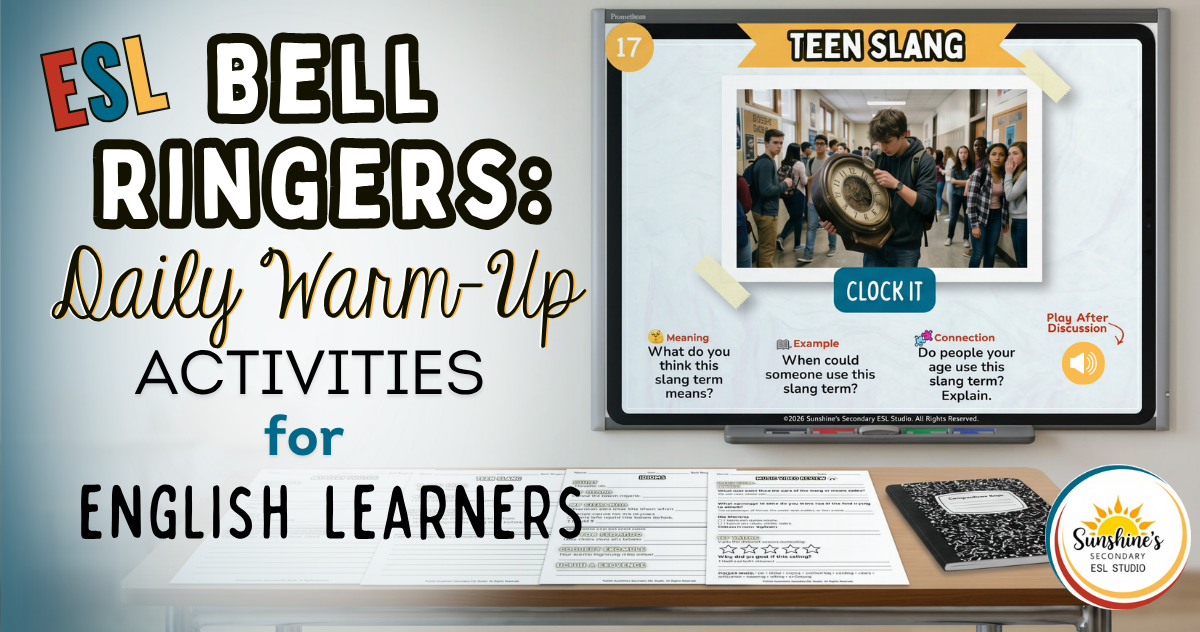
On Thursdays, students will learn a teen slang word. This category matters because students may understand slang in their native languages but still miss the meaning of slang used by their English-speaking peers.
Teen slang helps students navigate informal language, social conversations, and peer interactions. It can also open the door to speaking practice, which pairs well with ESL speaking confidence activities and conversation starters for ESL teens.
You can find this category here: Teen Slang for ESL Teens.
Friday: Music Video Reviews
On Fridays, I wanted something a little different. Students will watch a weird, interesting, creative, or thought-provoking music video and then respond to it.
This routine gives students practice with adjectives, opinions, evidence, creativity, and interpretation. They can describe the visuals, explain the mood, discuss the message, and reflect on what they noticed. It is also a great way to bring listening and media analysis into class.
For more ideas connected to listening practice, you might also like my post on ESL listening activities for high school.
You can find this resource here: Music Video Reviews for Teens.
Try a Free ESL Bell Ringers Sample
Before committing to the full set, you can try a free ESL bell ringers sample with your students.
The free sample gives you a feel for the format, audio support, response style, and types of prompts included in the larger sets. It is a simple way to see how daily ESL warm-ups can help English learners come into class, settle in, and begin using English right away.
Want a ready-to-use daily warm-up routine for secondary ESL? Start with the free ESL Bell Ringers sample, then upgrade to the full ESL Bell Ringers Mega Bundle when you are ready for the complete routine.
What My No-Prep ESL Bell Ringers Include
These no-prep ESL bell ringers include 160 daily warm-ups for secondary English learners.
I created them in four volumes so teachers can use them throughout the school year. You can find ESL Bell Ringers for Teens Volume 1, Volume 2, Volume 3, and Volume 4 separately.
Teachers who want the full routine can grab the ESL Bell Ringers Mega Bundle. The mega bundle includes all four volumes in one place, which makes it easier to plan a consistent start to class during Back to School and continue the routine throughout the year.
These bell ringers can be used as morning work, do-now activities, daily writing prompts, speaking starters, vocabulary practice, or quick language-development routines.
Why Predictable Bell Ringers Help English Learners
Predictability is not the same as boredom.
For many English learners, a predictable opening routine lowers stress. Students do not have to wonder what to do when they walk in. They can look at the board, recognize the type of task, and begin.
That sense of routine can be especially helpful at the beginning of the year. It pairs well with other classroom supports, such as visual ESL expectations posters.
A strong bell ringer routine also helps students understand that class starts right away. The first few minutes are not wasted time. They are a chance to use English, build confidence, and transition into the rest of the lesson.
Final Thoughts on ESL Bell Ringers
After a year without my old routine, I realized how much I missed it.
My students had looked forward to those predictable categories. On the strange days when we could not do them, the classroom environment felt different. Something about the opening rhythm was missing.
This year, ESL bell ringers are coming back with a clearer purpose. Instead of busy work or random fillers, these short routines give English learners intentional language-development practice.
Whether the day starts with a mystery photo, a fun fact, an idiom, a slang word, or a music video reflection, students will know one thing for sure: in our class, we begin using English right away.
That is the kind of routine I want to protect.
Ready to build a daily warm-up routine for secondary ESL?
Start with the free ESL Bell Ringers sample if you want to test the format with your students. Then, when you are ready for the complete routine, the ESL Bell Ringers Mega Bundle gives you 160 no-prep daily warm-ups with audio-supported prompts, discussion starters, writing practice, and teen-friendly topics for English learners.
It is an easy way to make the first few minutes of class more predictable, purposeful, and language-rich from the beginning of the school year.