
Back in 2010, I thought I was going to be a writer. I genuinely believed I could just land a writing job and everything would fall into place. That didn’t happen—and looking back, it’s part of why I started an ESL teaching blog years later.
Instead, life took me in a completely different direction—one that led me into the classroom.
I started subbing in my local school district, and within a year, I was alternatively certified in ELAR and ESL.
And just like that, everything changed.
The moment I stepped into a classroom, I was hooked.
From Wanting to Write… to Teaching ESL
Fast forward to today, and I’ve spent over a decade teaching ESL at the high school level.
Somewhere along the way, I realized something I hadn’t expected:
I still wanted to write—but I didn’t want to leave teaching behind.
That realization is a big part of why I started an ESL teaching blog focused on supporting teachers who work with secondary ESL students.
This space allows me to combine both:
- sharing real classroom strategies
- supporting other ESL teachers
- creating resources that actually work for teens
Why High School ESL Teachers Need More Support
If you teach secondary ESL, you already know this:
A lot of the advice out there doesn’t really apply to us.
We’re not just teaching basic vocabulary or simple conversations. We’re helping students:
- read complex texts
- write paragraphs and essays
- prepare for state testing
- build confidence in a new language
All at the same time.
And often, we’re doing it with students at completely different levels in the same classroom.
That’s why I focus so much on differentiation and scaffolding. If that’s something you’re navigating, you might find helpful ideas in Differentiate ESL Instruction High School.
Why I Created This ESL Teaching Blog
I started this blog because I saw a gap.
Secondary ESL teachers need:
- practical strategies
- realistic classroom ideas
- support that actually fits our students
Not just theory.
Not just elementary-focused resources.
Not just ideas that sound good but don’t work in a real classroom.
This is exactly why I started an ESL teaching blog—to create a space that actually supports high school ESL teachers in meaningful ways.
If you’re working with newcomers or mixed-level classes, you’ll probably connect with what I share in Beginner ESL High School.
Why I Didn’t Start This Blog Sooner
I could have started a blog years ago.
But honestly, I wasn’t ready.
Now, after:
- 13+ years teaching high school ESL
- earning my M.Ed. in Curriculum and Instruction (Bilingual Education)
- working with multilingual learners every day
…I finally feel like I have something meaningful to share.
More importantly, I understand what actually works—and what doesn’t.
What You’ll Find Here
This blog is a place where I share:
- strategies for teaching ESL in high school
- ways to support multilingual learners
- classroom-tested activities and ideas
You’ll also find resources I’ve created for my own students—because sometimes you just need something ready to go.
For example, one of the biggest challenges I see is students not knowing how to start a sentence. That’s why I use structured supports like sentence frames and visual tools. If you want something simple to try, you can start with Free ESL Sentence Starters for Teens.
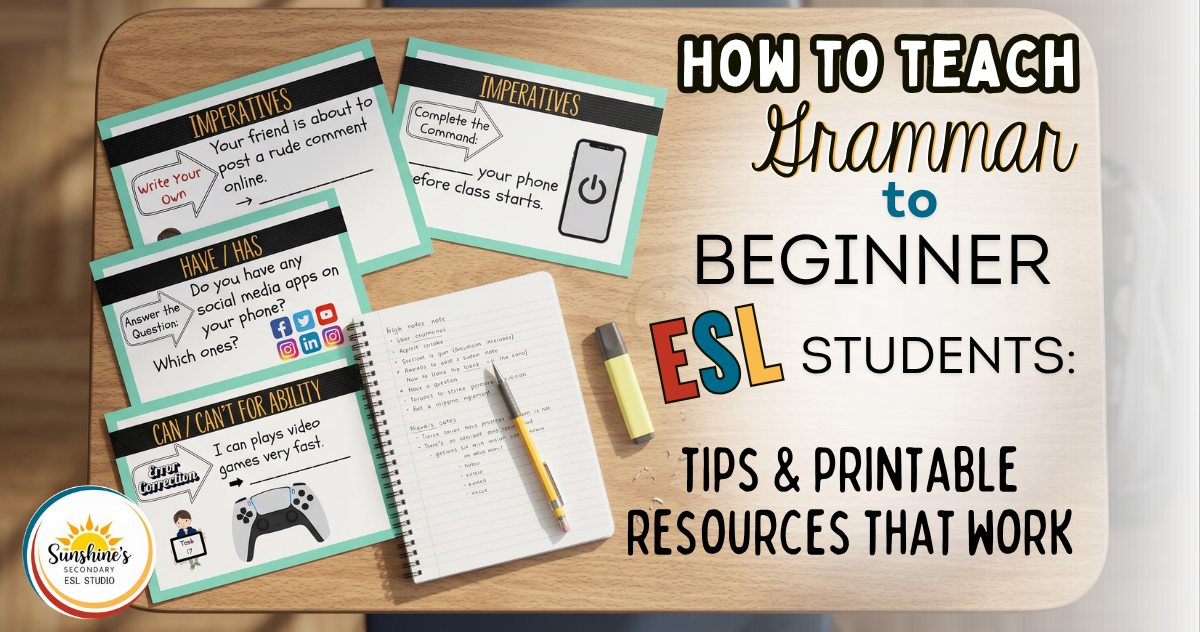
If you want something structured and ready to use, this is also where I use my ESL grammar task cards to give students guided practice with sentence building and grammar in context.
And when students need consistent, visible support during writing or speaking, this is exactly where I use tools like my ESL desk mats to give students consistent language support without slowing down instruction.
The Bigger Goal Behind This Blog
At the end of the day, why I started an ESL teaching blog comes down to one thing:
Supporting teachers who are doing this work every day.
Because teaching ESL at the high school level isn’t easy—but it matters.
And too often, we’re figuring it out on our own.
Final Thoughts
If you’re here, you’re probably doing that work too.
And I’m really glad you found this space.
If you want to explore more strategies, classroom ideas, and resources, you can start here:
👉 ESL Teacher Blog