
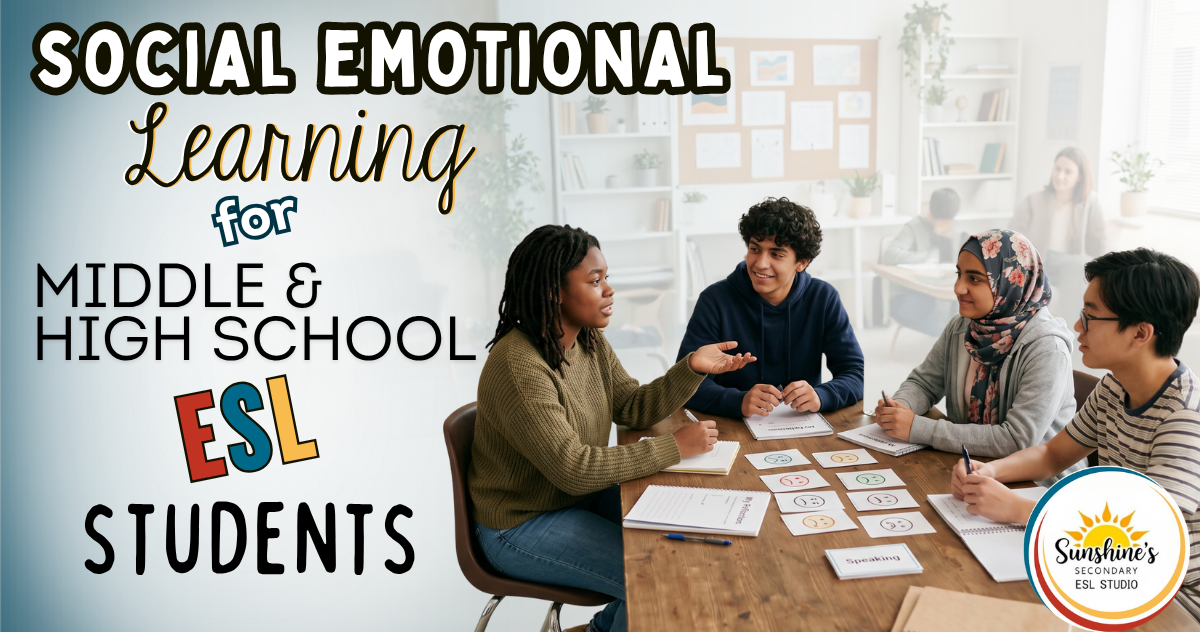
Social Emotional Learning for ESL Teens should be practical, age-appropriate, and supported with clear language. Middle and high school English learners may be building emotional skills while also learning how to express themselves in a new language, adjust to a new school, and develop relationships across cultures.
A student who does not answer an SEL question may not be refusing to participate. The student may need more processing time, may not know the vocabulary, or may not feel comfortable discussing something personal.
Effective SEL in a secondary ESL classroom should include student choice, language scaffolds, cultural awareness, and activities that do not force personal disclosure.
What Is Social Emotional Learning for ESL Teens?
Social-emotional learning helps students develop skills related to self-awareness, self-management, social awareness, relationships, and responsible decision-making.
For English learners, these skills are closely connected to language development. Students may need direct instruction in how to name emotions, ask for help, solve disagreements, and express their needs appropriately.
Useful sentence frames include:
- “I feel ___ because ___.”
- “Could you explain that again?”
- “I need help with ___.”
- “I understand your idea, but ___.”
- “Can we find another solution?”
These are SEL skills, but they are also practical communication skills students can use throughout the school day.
Why Social Emotional Learning for ESL Teens Matters
English learners may face language anxiety, fear of making mistakes, culture shock, isolation, and difficulty understanding unfamiliar school expectations.
SEL can help students:
- Build confidence
- Develop emotional vocabulary
- Ask for help
- Manage frustration
- Strengthen peer relationships
- Participate more comfortably
- Adjust to a new school environment
However, SEL activities must be adapted for students’ language levels and cultural backgrounds.
Language Anxiety
Many English learners understand more than they are ready to say. Students may stay quiet because they are worried about pronunciation, grammar, or being laughed at.
Providing additional wait time gives students time to process the question and prepare a response.
Teachers should also avoid correcting every language error during an SEL discussion. The immediate goal is often communication rather than perfect grammar.
Newcomer Adjustment
Newcomers may be learning a new schedule, school system, language, and social environment at the same time.
Predictable routines can help students feel more secure. Teachers can support students during their first 30 days in high school ESL by teaching routines clearly, providing visual support, and allowing students to participate gradually.
Cultural Differences
Students may come from cultures with different expectations about eye contact, emotional expression, independence, and communication with adults.
Quietness should not automatically be interpreted as disrespect or disengagement. Culturally responsive teaching requires teachers to consider how culture may influence student behavior.
Mixed-Level Classes
An activity that works for a B2 student may be too difficult for an A1 newcomer.
The same principles used when differentiating ESL instruction for A1–B2 students should also be used with SEL activities.
Students can participate by:
- Pointing to a visual
- Choosing from several answers
- Writing one word
- Using a sentence frame
- Discussing with a partner
- Giving a longer explanation
Creating a Safe SEL Classroom for English Learners
SEL begins with the classroom environment.
Teachers can help students feel safe by:
- Learning and correctly pronouncing their names
- Establishing predictable routines
- Teaching expectations clearly
- Allowing private questions
- Addressing accent-based teasing immediately
- Providing different ways to respond
- Allowing students to pass on personal questions
- Treating home languages as strengths
Students should know that mistakes are a normal part of learning English.
They should also know that they will not be forced to share private experiences.
Allowing home-language support can help beginning students express ideas that are more complex than their current English.
Practical Social Emotional Learning for ESL Teens
Social Emotional Learning for ESL Teens works best when activities include language scaffolds, student choice, and age-appropriate topics.
1. Use a Low-Risk Emotion Check-In
Display several emotion words with simple visual cues. Students can point to a word, write it privately, or complete a sentence frame.
Examples include:
- “Today I feel ___.”
- “My energy level is ___.”
- “Right now I need ___.”
Students should not be required to explain their answers.
For A1 students, use familiar words such as happy, tired, nervous, and calm. More advanced students can use words such as frustrated, relieved, or overwhelmed.
2. Let Students Write Before Speaking
Writing before speaking gives students time to organize their thoughts and prepare the English they need.
Try prompts such as:
- “One thing that helped me learn today was ___.”
- “One challenge I handled was ___.”
- “I feel more confident when ___.”
- “One goal I have is ___.”
Students can share with a partner, read directly from their paper, or choose not to share.
This also supports other ESL speaking confidence activities.
3. Use Choice-Based Partner Prompts
Instead of asking every student the same personal question, provide several choices.
For example:
- What helps someone feel welcome in a new class?
- What can a student do when an assignment feels difficult?
- How can classmates solve a disagreement respectfully?
These questions develop SEL skills without requiring personal disclosure.
Conversation starters for ESL teens can also be adapted into low-pressure SEL discussions.
4. Teach Emotion Vocabulary
Many English learners know basic words such as happy, sad, and angry but need more precise vocabulary.
Teach related groups of words:
- Anger: annoyed, frustrated, irritated
- Fear: nervous, worried, anxious
- Happiness: excited, proud, relieved
- Sadness: lonely, disappointed, discouraged
Students can sort the words by intensity or match them to fictional situations.
5. Practice Asking for Help
Asking for help is both a language skill and an SEL skill.
Teach students phrases such as:
- “Can you repeat the directions?”
- “Could you show me an example?”
- “I understand this part, but I need help with ___.”
- “Can I have more time?”
- “May I talk to you privately?”
Students can practice these phrases through short role-plays.
6. Use Fictional Advice Scenarios
Give students a short situation to discuss.
For example:
A student is afraid to answer because classmates laughed at their pronunciation. What advice would you give?
Students can respond with sentence frames:
- “The student could ___.”
- “The teacher should ___.”
- “A classmate could help by ___.”
- “The best solution is ___ because ___.”
Because the situation is fictional, students can practice empathy without sharing personal experiences.
7. Practice Conflict Resolution
English learners may understand that they should solve disagreements respectfully but not know the language to do it.
Teach phrases such as:
- “I felt ___ when ___.”
- “I did not mean to ___.”
- “Can we find another solution?”
- “I understand your point, but ___.”
- “What can we do differently next time?”
Use realistic scenarios involving group projects, borrowed supplies, classroom responsibilities, or misunderstandings.
A structured conflict-resolution reading activity can provide useful background and language practice.
8. Include Identity Writing
Identity activities can help students build self-awareness and classroom belonging.
Students might write about:
- A language they speak
- A place that matters to them
- A personal strength
- A cultural tradition
- A goal for the future
An ESL identity poem writing activity gives students structure while still allowing them to decide what they want to share.
9. Self-Regulation and Social Emotional Learning for ESL Teens
Self-regulation activities do not need to take an entire class period.
Teachers can use:
- Two minutes of quiet breathing
- A short stretch
- A visual timer
- A private break card
- A written plan for handling frustration
Students can also practice reading and listening skills through an Emotional Regulation informational text with audio.
10. Use Private Reflection
Exit tickets can help students reflect without requiring them to speak publicly.
Try prompts such as:
- “One thing I handled well today was ___.”
- “One strategy that helped me was ___.”
- “One question I still have is ___.”
- “Next class, I will try to ___.”
A1 students can choose a picture or write one word. More advanced students can explain their response.
These reflections should not be graded according to whether students appear positive or cheerful.
How to Integrate Social Emotional Learning for ESL Teens into ESL Lessons
SEL does not need to become a separate subject.
It can be included naturally in reading, speaking, listening, and writing.
Reading
Use informational texts or literature to discuss how a person responds to stress, friendship, failure, or conflict.
Students can identify:
- The problem
- The character’s emotions
- The choices the character makes
- A possible solution
Resources such as a growth mindset reading with audio allow students to develop language skills while learning about persistence and mistakes.
Speaking and Listening
Use partner discussions, role-plays, advice scenarios, and structured speaking routines.
Students should receive the vocabulary, sentence frames, and models they need before speaking.
Consistent ESL speaking routines can reduce anxiety because students know what to expect.
Writing
Students can:
- Write advice to a fictional character
- Set a language goal
- Complete a short reflection
- Explain how to solve a disagreement
- Describe how a character feels
These activities support both writing development and SEL.
Culturally Responsive SEL for Multilingual Learners
Culturally responsive SEL does not assume that every student expresses feelings or communicates in the same way.
Teachers should avoid requiring students to:
- Make prolonged eye contact
- Discuss family problems
- Reveal difficult memories
- Share private emotions publicly
- Participate in activities that feel childish
- Agree with one cultural idea of independence or success
Students can still develop SEL skills through fictional situations, private writing, visuals, bilingual discussion, and structured choices.
Using translanguaging in the secondary ESL classroom can also help students connect new English emotion words to ideas they already understand.
Common SEL Mistakes in Secondary ESL Classrooms
Avoid:
- Forcing every student to share aloud
- Asking students to describe trauma
- Assuming quiet students lack confidence
- Using materials that feel too young
- Correcting every grammar mistake
- Grading students’ emotions
- Expecting classroom SEL to replace professional support
- Requiring personal disclosure
Teachers can support students, but they are not therapists. When a student shares a serious safety or mental-health concern, follow school procedures and involve the appropriate counselor or support professional.
Frequently Asked Questions
How can I help shy ESL students participate?
Begin with private writing, visuals, sentence frames, and partner rehearsal. Give students enough processing time and allow them to pass.
Can newcomers participate in SEL activities?
Yes. Newcomers can point to visuals, choose from options, use their home language, repeat a model, or complete a short sentence frame.
Should students be required to share their feelings?
No. Students can develop emotional vocabulary, empathy, self-regulation, and conflict-resolution skills without sharing private information.
How does SEL support English development?
SEL gives students meaningful opportunities to practice asking for help, expressing emotions, solving problems, reflecting, and communicating respectfully.
Final Thoughts on Social Emotional Learning for ESL Teens
Social Emotional Learning for ESL Teens does not require forced sharing, childish activities, or a separate curriculum.
A short check-in, a realistic role-play, a private reflection, or a structured partner discussion can help students build both English and social-emotional skills.
Start with one consistent routine. Provide clear language support, offer different ways to participate, and allow trust to develop gradually.