
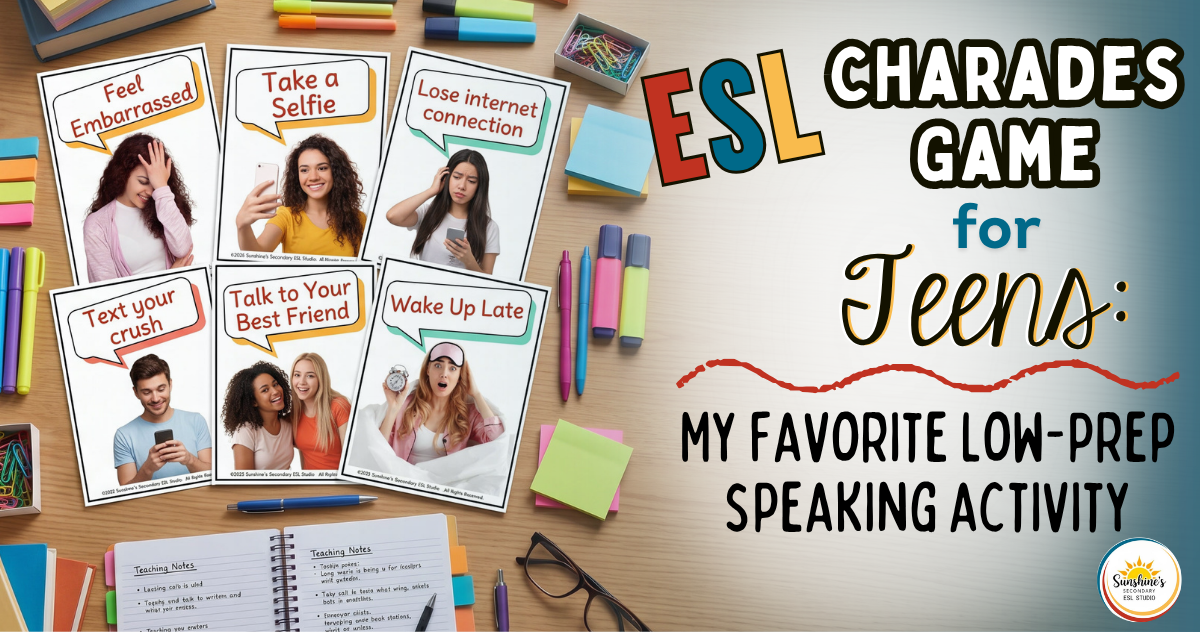
Looking for an engaging ESL speaking game your students will actually enjoy? An ESL charades game for teens is one of my favorite low-prep speaking activities for high school students. During summer school this year, I pulled out a simple set of charades cards, and within minutes my sleepy students were laughing, shouting guesses in English, and fully participating.
For secondary ESL teachers trying to build speaking confidence without putting students on the spot, charades is one of those rare activities that feels fun while still delivering meaningful language practice.
If you’re looking for even more speaking-focused ideas for teens, you might also enjoy these posts on ESL Teen Speaking Activities and How to Build ESL Speaking Routines.
Why I Tried Charades with My ESL Class
If you’ve taught ESL teens for more than a day, you already know that getting students to speak in front of peers can feel intimidating for them. Many students are afraid of making mistakes, using incorrect grammar, or being laughed at.
That’s one reason I’m always looking for activities that lower stress levels while still encouraging authentic language use. Games naturally help lower the affective filter because students focus more on participation and teamwork than perfection.
I noticed this especially during summer school. My students were tired, unmotivated, and completely checked out. I needed something interactive and low-pressure.
So I tried charades.
And honestly? It worked better than I expected.
How I Set Up the Game (With Beginner-Friendly Tweaks)
I kept the structure simple, but I added several scaffolds to support English learners.
First, each acting student received a card written in English. Before the timer started, I gave them time to quietly figure out the meaning. Some asked classmates for help, some used gestures, and others checked a Spanish-English dictionary.
I didn’t rush this part because it became an important language-learning opportunity on its own.
Once students felt ready, the timer started. Their team had three minutes to guess the answer in English. I accepted close approximations like “She’s cleaning!” for a card that actually said “Clean the floor.” The goal wasn’t perfect grammar. The goal was communication.
Of course, students occasionally shouted answers in Spanish first. Instead of shutting that down, I would pause and ask:
“How do you say that in English?”
Those moments turned into quick vocabulary mini-lessons that students actually remembered later.
I’ve talked more about this idea in my posts about Translanguaging in the Secondary ESL Classroom and Native Language Use in the the ESL Classroom. Strategic use of students’ native languages can support comprehension and confidence instead of hurting learning.
Why ESL Charades Games Work So Well for High School Students
Here’s what I noticed almost immediately:
- Students who normally stayed quiet started participating.
- Teams naturally supported one another.
- Students practiced verbs and vocabulary repeatedly without realizing it.
- The activity worked across multiple proficiency levels.
- Students were using English in a low-stress environment.
Charades also works especially well in mixed-level classrooms because beginners can rely on visuals and gestures while more advanced students produce longer guesses and explanations.
That flexibility is one reason differentiated speaking activities matter so much in secondary ESL classrooms. If you teach mixed proficiency groups, you may also enjoy my post on Differentiating ESL Instruction from A1 to B2.
For newcomers and beginner students, visuals and simple routines make a huge difference. I share more beginner-friendly strategies in How to Teach Grammar to Beginner ESL Students and Beginner ESL High School Activities.
What’s Inside the ESL Charades Card Sets (A1–B2)
After seeing how successful this activity was, I decided to create leveled ESL charades card sets specifically designed for teen learners.
Each level focuses on age-appropriate language while gradually increasing complexity.
A1 Beginner
Students practice basic everyday actions and commands like:
- Brush your hair
- Open a book
- Feel tired
Many cards include visual support, which helps newcomers quickly understand the action and participate with confidence.
A2 High Beginner
At this level, students work with slightly longer phrases and common school routines such as:
- Take a test
- Walk to school
- Clean your desk
B1 Intermediate
The language becomes more natural and conversational:
- Scroll on your phone
- Be embarrassed
- Sleep in on the weekend
These cards often spark additional conversations after the game ends.
B2 Upper Intermediate
This level includes more idiomatic and teen-relevant language:
- Hit snooze on your alarm
- Run out of time
- Jump for joy
These prompts push students to think creatively and use more authentic English.
Each level includes:
- 12 cards with visuals
- 12 text-only cards
- 12 editable cards
- PowerPoint and Google Slides formats
- Black-and-white versions for easy printing
That’s 48 cards per level with very little prep required from the teacher.
You can explore the full ESL Charades Bundle for Teens on TPT here:
ESL Charades for Teens | Speaking Game Bundle (A1–B2)
Tips for Using Charades in Your ESL Classroom
Here are a few things that helped my students feel successful:
Pre-teach Key Verbs
Especially with A1 and A2 students, reviewing important verbs before gameplay makes a huge difference.
You might also pair charades with vocabulary-building activities like these:
Start with Visuals
Visual cards help newcomers participate more confidently. Later, you can transition students into text-only cards for additional language practice.
Normalize Mistakes
One thing I tell students before we begin:
“It’s okay to act silly. It’s okay to make mistakes. That’s how language learning works.”
That mindset matters.
Building speaking confidence takes time, especially for teenagers. If this is something your students struggle with, you may also like my post about ESL Speaking Confidence Activities.
Try the Free ESL Charades Sample First
Want to see if your students enjoy it before committing to the full bundle?
You can download the free ESL charades sample here:
ESL Charades Cards – Free Sample | Speaking Activity for ESL Students
The sample includes:
- One card from each proficiency level (A1–B2)
- Visual and text-only versions
- A quick preview of how the activity works
It’s an easy way to test out an ESL charades game for teens in your own classroom.
If your students enjoy speaking games like this, you might also enjoy:
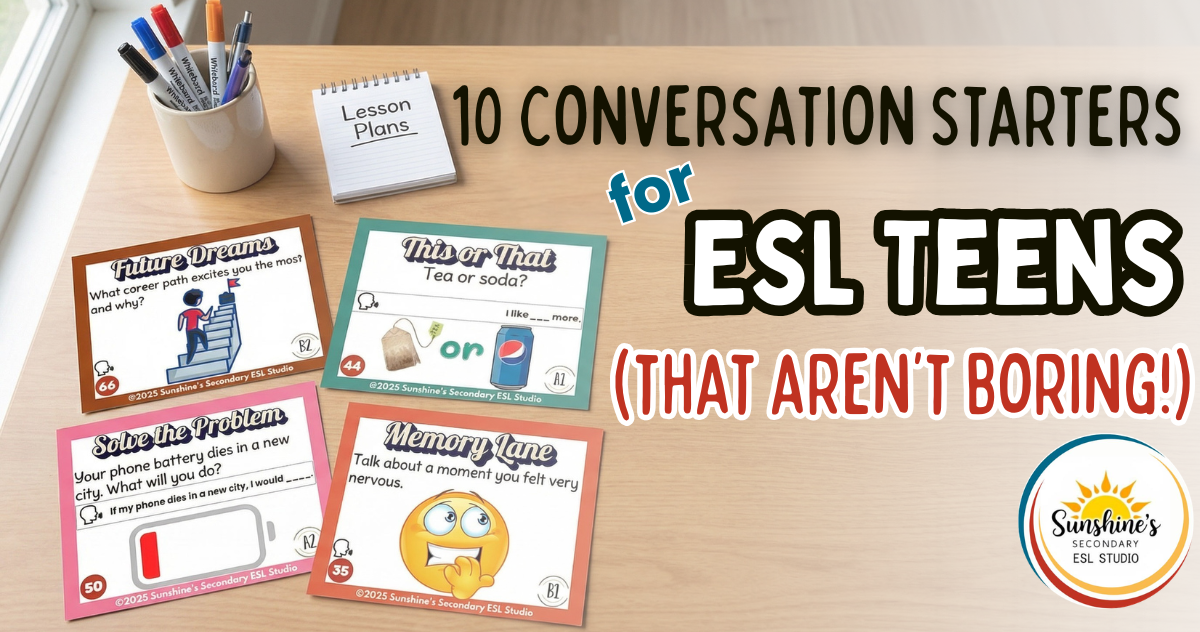
- Conversation Starters for ESL Teens
- ESL Emotion Speaking Prompts
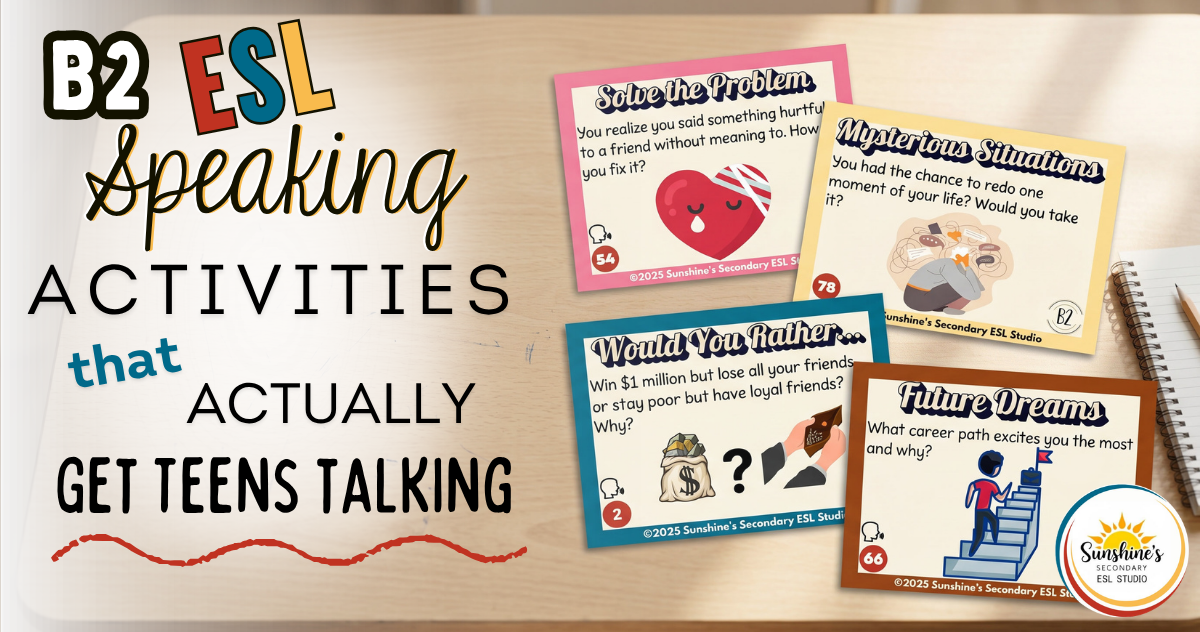
- B2 ESL Speaking Activities for Teens
- A2 ESL Speaking Prompts for Teens
Final Thoughts
Charades has officially become one of my favorite low-prep ESL speaking games for high school students.
It gets students moving, lowers anxiety, encourages teamwork, and creates authentic opportunities for communication. Best of all, students usually forget they’re “practicing English” because they’re too busy having fun.
Speaking fluency is only one piece of language development, though. If you’re also looking for ways to track pronunciation growth without overwhelming students, I share my full system in this post about the ESL Teen Pronunciation Dolch Sight Word Test.