
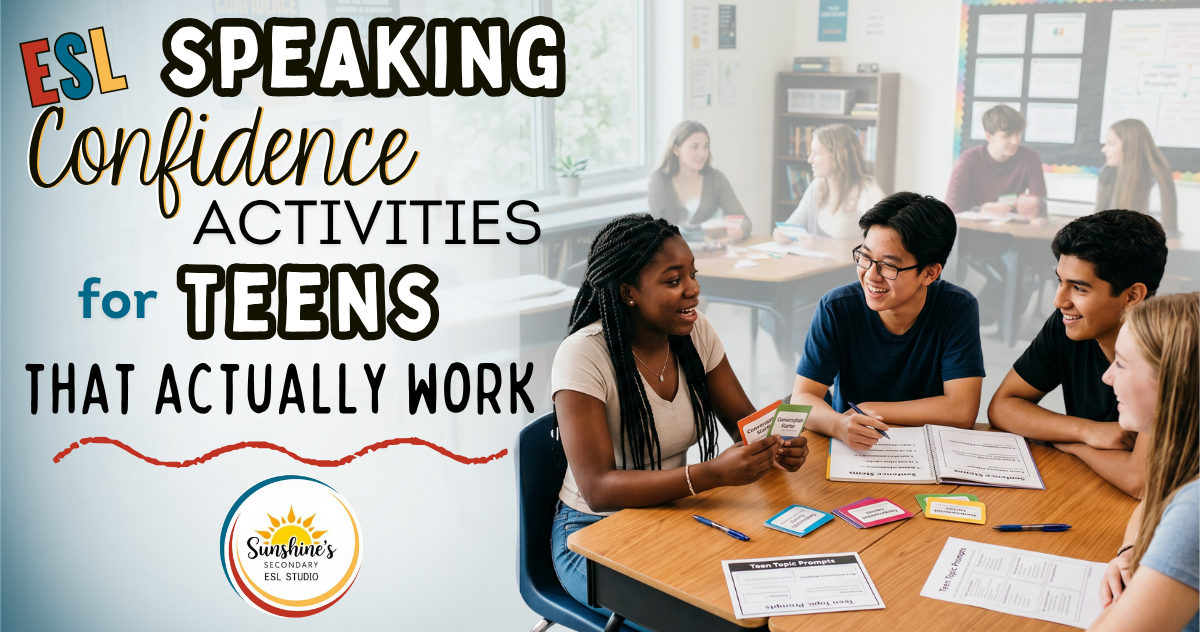
ESL speaking confidence activities can help hesitant English learners move from silence and private rehearsal to successful partner, small-group, and whole-class communication.
You ask a question, wait for an answer, and hear nothing.
Your students may understand the question. They may even know the vocabulary and grammar they need. But when it is time to speak English in front of other students, they freeze.
This is especially common in middle school and high school ESL classrooms. Teenagers are already highly aware of how they sound to their peers. Add pronunciation worries, limited processing time, unfamiliar vocabulary, and fear of making a mistake, and even capable English learners may avoid participating.
The most effective ESL speaking confidence activities for teens do not force students into public speaking before they are ready. Instead, they gradually move students from private rehearsal to partner talk, small-group interaction, and eventually more independent speaking.
The goal is not immediate perfection. The goal is to create enough successful speaking experiences that using English begins to feel safe, manageable, and normal.
What Makes ESL Speaking Confidence Activities Effective?
Strong confidence-building activities usually include four things:
- Time to think or rehearse
- Language support students can see and use
- A low-risk speaking format
- A clear reason to communicate
A helpful progression looks like this:
| Speaking stage | Student task | Risk level | Helpful support |
|---|---|---|---|
| Private rehearsal | Think, write, whisper, or record | Very low | Models, word banks, and sentence stems |
| Partner speaking | Share with one classmate | Low | Assigned roles and short turns |
| Small-group speaking | Discuss with three or four students | Moderate | Question cards and response frames |
| Whole-class speaking | Volunteer or report for a group | Higher | Rehearsal and student choice |
| Independent speaking | Respond more spontaneously | Highest | Familiar routines and supportive feedback |
Not every student needs to reach the final stage during every lesson.
Speaking confidence grows through repeated success, not one high-pressure presentation.
Teachers looking for an easy beginner-friendly starting point can use these free A1 conversation cards for teens for short, choice-based partner conversations.
Why English Learners May Lack Speaking Confidence
Silence does not automatically mean that a student is lazy, unmotivated, or disengaged. English learners may hesitate for several legitimate reasons.
Language Anxiety and Fear of Making Mistakes
Teenagers are particularly sensitive to embarrassment.
A student may be willing to make a mistake privately with a trusted partner but unwilling to take the same risk in front of the entire class. Pronunciation can create an additional layer of anxiety. Some students would rather remain silent than mispronounce a word and risk being corrected or laughed at.
This is why teaching high school ESL pronunciation without stressing teens requires a different approach from interrupting every time a student pronounces something incorrectly.
Students May Need More Processing Time
An English learner may complete several mental steps before responding:
- Understand the question.
- Connect it to prior knowledge.
- Choose vocabulary.
- Organize the sentence.
- Check the grammar.
- Prepare to pronounce the words.
By the time the student is ready, the teacher may have repeated the question, called on someone else, or answered it.
Using stronger wait time strategies for ESL students can sometimes improve participation more than changing the speaking activity.
Newcomers May Be Experiencing the Silent Period
Some newcomers go through a period in which they are listening, observing, and processing much more language than they are producing.
That does not mean teachers should remove all opportunities to communicate. It means participation may begin with pointing, selecting a picture, matching, drawing, repeating a short model, or answering with one word.
Students should be invited into speaking without being publicly pressured before they are ready. Teachers supporting newly arrived students may also find this guide to the first 30 days with a newcomer in high school ESL helpful.
Students May Not Know How to Begin Their Answer
“Turn and talk” sounds simple to a fluent English speaker. For a beginning English learner, it may feel like an enormous task.
Students may understand the topic but still need language such as:
- I think ___ because ___.
- My answer is ___.
- I agree with ___ because ___.
- In the picture, I notice ___.
- I would choose ___ because ___.
- First, ___ happened. Then, ___.
These free ESL sentence starters for teens can give reluctant speakers the structure they need to begin.
12 ESL Speaking Confidence Activities for Teens
The following ESL speaking confidence activities move students gradually from highly supported language production toward more independent communication.
1. Write First, Then Talk
Best for: A1–B2
Risk level: Very low
Time: 5–10 minutes
Give students a question and allow them to write before they speak.
For example:
What is one school rule you would change? Why?
Students can first write keywords, complete a sentence frame, or draft a short response. They then read or explain their answer to a partner.
Possible sentence frames include:
- I would change ___.
- I think this rule is ___ because ___.
- A better rule would be ___.
This activity works because it separates language planning from the pressure of live speaking. Students are not being asked to invent and present an answer at the same time.
For beginners, accept one complete sentence. For stronger students, require a reason and a follow-up question.
2. Use Whisper Rehearsal Before Partner Speaking
Best for: Newcomers and A1–A2 students
Risk level: Very low
Time: 2–5 minutes
Before students share with a partner, allow them to quietly rehearse their answer.
They can whisper the complete sentence, practice only the difficult words, or repeat a teacher model.
A simple routine could be:
- Read the question.
- Circle important words.
- Write a short answer.
- Whisper the answer twice.
- Share it with a partner.
Whisper rehearsal is especially helpful for students who understand the content but worry about pronunciation.
3. Try Would You Rather ESL Speaking Questions
Best for: A1–B2
Risk level: Low
Time: 5–15 minutes
Would You Rather questions work well because students do not need to invent an entire topic. They choose between two clear options.
Teen-friendly examples include:
- Would you rather have no homework or no tests?
- Would you rather give up your phone for a week or wake up at 5:00 a.m. every day?
- Would you rather work alone or with a group?
- Would you rather live in a large city or a small town?
An A1 student might say:
I would rather have no homework.
An A2 student might add:
I would rather have no homework because I need more free time.
A B1 or B2 student can explain a consequence and ask a partner a follow-up question.
This beginner ESL speaking activity using Would You Rather explains how to use the format with beginning English learners.
4. Use Structured ESL Conversation Cards
Best for: A1–B2
Risk level: Low
Time: 10–20 minutes
Conversation cards are most effective when students have defined roles rather than vague instructions to “discuss.”
Try this structure:
- Student A reads the question.
- Student B answers.
- Student A asks one follow-up question.
- Students switch roles.
Begin with concrete, age-appropriate topics such as food, music, school routines, technology, future plans, friendships, and free time.
In secondary ESL, predictable routines usually work better than introducing a completely new speaking format every day. Once students understand the process, they can focus more attention on language and less on figuring out the directions.
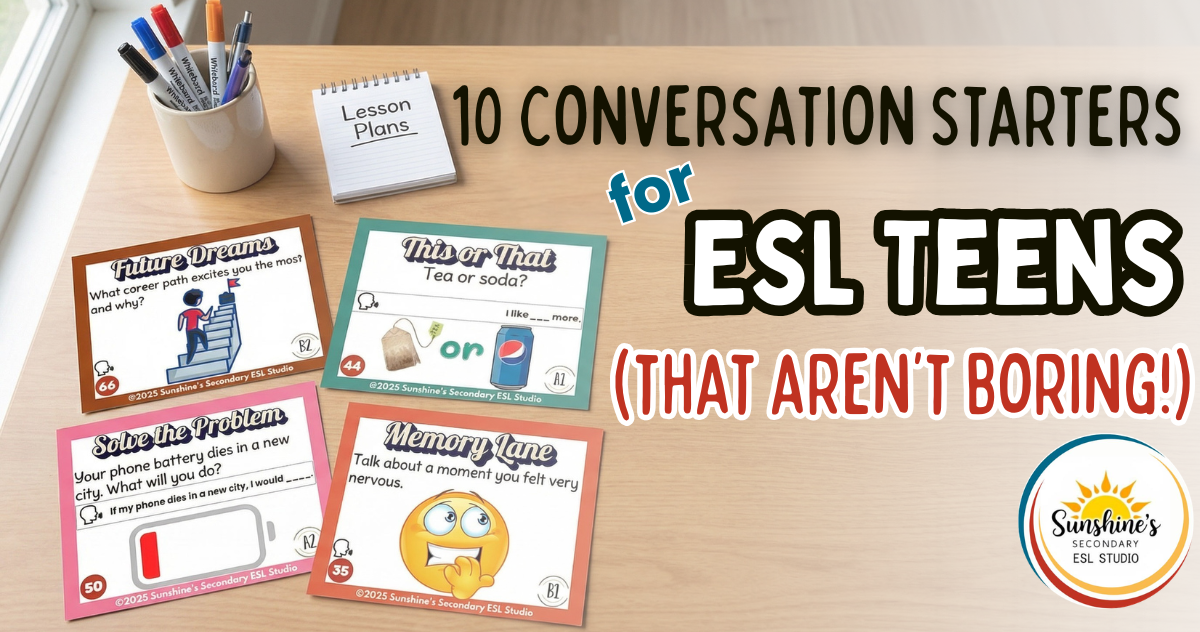
These conversation starters for ESL teens can help teachers choose questions that are engaging without feeling childish.
For regular differentiated practice, the Teen Talk ESL Conversation Starters Bundle for A1–B2 teens provides structured prompts that can be used repeatedly in mixed-level classes.
5. Build Fluency Through Repeated Speed Chats
Best for: A2–B2
Risk level: Low to moderate
Time: 10–20 minutes
Students answer the same question with several different partners.
For example:
What is one skill every teenager should learn?
Students speak with one partner for one minute, rotate, and answer the same question again.
Repetition is the key.
The first response may be hesitant. By the third or fourth partner, students usually speak more smoothly because they have already organized and practiced the language.
For A2 students, display frames such as:
- I think every teenager should learn ___.
- This is important because ___.
- Do you agree?
For B1–B2 students, require a follow-up question, additional detail, or a response to the partner’s idea.
6. Discuss Emotions and Teen-Friendly Opinions
Best for: A2–B2
Risk level: Low to moderate
Time: 10–15 minutes
Students often speak more naturally when the topic connects to familiar emotions or realistic situations.
Possible prompts include:
- What helps students feel calm before a test?
- What makes a classroom feel welcoming?
- When might a teenager feel left out?
- What is a healthy way to handle frustration?
- Why is it sometimes difficult to ask for help?
Students should always have the option to answer generally rather than reveal personal information.
For example:
Some students feel nervous when they speak in front of the class.
This creates meaningful language practice without requiring personal disclosure.
These ESL emotions speaking prompts for teens can support structured discussion and emotional vocabulary.
Speaking confidence is also closely connected to classroom belonging. These strategies for social-emotional learning with ESL teens offer additional support.
7. Use Information-Gap Partner Activities
Best for: A1–B2
Risk level: Low
Time: 10–20 minutes
In an information-gap activity, each partner has information the other student needs.
Students might:
- Compare two schedules.
- Complete a map.
- Identify differences between pictures.
- Ask about missing details in a chart.
- Put events in order.
- Solve a mystery using separate clues.
The communication has a real purpose. Students are not speaking only because the teacher told them to talk.
A1 students can use visible question patterns:
- What time is ___?
- Where is ___?
- Does your picture have ___?
- Who has ___?
Stronger students can practice clarification:
- Are you saying that ___?
- I have different information.
- Can you explain that again?
- Based on my clue, I think ___.
8. Practice Real-World ESL Role Plays
Best for: A2–B2
Risk level: Moderate
Time: 15–30 minutes
Role plays give students realistic speaking practice without requiring them to speak as themselves.
Secondary-friendly scenarios include:
- Asking a teacher for clarification
- Resolving a group-project problem
- Returning an incorrect order
- Explaining an absence
- Requesting help with an assignment
- Discussing a schedule conflict
- Planning an activity with friends
- Making an appointment
Give students role cards, useful phrases, and rehearsal time before they begin.
A useful progression is:
- Read the situation.
- Identify the goal.
- Choose useful phrases.
- Rehearse with a partner.
- Perform for another pair.
- Reflect on the conversation.
Students do not need to perform every role play for the entire class. Pair-to-pair performances create an authentic audience with less pressure.
These real-world ESL speaking activities for teens provide additional classroom ideas.
Teachers looking for prepared scenarios can also use these secondary ESL role-play cards for teens.
9. Provide Audio-Supported Speaking Rehearsal
Best for: Newcomers and A1–B1
Risk level: Very low to low
Time: 5–15 minutes
Allow students to hear a model before they speak.
Students can:
- Listen and repeat.
- Pause after each sentence.
- Practice with headphones.
- Record a private response.
- Rehearse before speaking live.
Audio support is especially helpful when pronunciation anxiety prevents students from participating.
The goal is not to make every student sound exactly like the recording. The purpose is to help students hear the language, notice its rhythm, and enter the conversation with greater confidence.
These ESL speaking role plays with audio provide language models before live partner practice.
10. Expand ESL Charades Into Complete Sentences
Best for: A1–B2
Risk level: Low
Time: 10–20 minutes
Charades can provide a lower-pressure entry point because students communicate first through movement.
However, it becomes more valuable when students expand the guessed word into spoken language.
After guessing, require a level-appropriate response.
A1
He is running.
A2
He is running because he is late.
B1
He might be running because he missed the bus.
B2
He appears to be in a hurry, although we do not know where he is going.
This lets the activity begin with play and movement but end with meaningful language production.
These ESL charades activities for teens can be differentiated by changing the expected sentence length and complexity.
11. Solve Small-Group Advice Scenarios
Best for: A2–B2
Risk level: Moderate
Time: 15–25 minutes
Give each group a realistic problem.
Examples include:
- A student has too much homework.
- Two friends disagree about a group project.
- A new student does not know anyone at school.
- A student is nervous about giving a presentation.
- Someone wants to improve their English outside of class.
- A teenager is spending too much time on a phone.
Students discuss possible solutions and choose the best advice.
Useful sentence frames include:
- I think the person should ___.
- One possible solution is ___.
- I agree with ___ because ___.
- That might not work because ___.
- The best choice is probably ___.
The group can select one student to report its decision. Reporting a shared answer often feels safer than producing an individual answer without support.
12. Establish Daily ESL Speaking Confidence Activities
Best for: A1–B2
Risk level: Low
Time: 5–10 minutes
Confidence grows when speaking becomes a predictable part of class instead of a special performance.
A daily speaking warm-up might ask students to:
- Describe a photograph.
- Answer an opinion question.
- Guess a mystery object.
- Explain a fun fact.
- Discuss an age-appropriate idiom.
- Choose between two options.
- Share an observation with a partner.
Keep the routine consistent:
- Think silently.
- Write keywords.
- Practice with a partner.
- Invite volunteers to share.
Consistency reduces anxiety because students know what to expect.
This is why it is often more effective to build ESL speaking routines than to rely only on occasional large speaking projects.
Teachers who need a consistent source of short warm-ups can use these ESL bell ringers for teens with audio.
How to Adapt ESL Speaking Confidence Activities for A1–B2 Students
The same activity can often work across proficiency levels when the language support and expected output change.
| Level | Helpful support | Reasonable speaking expectation |
| Newcomer or early A1 | Pictures, gestures, choices, word banks, repetition, and first-language planning | Pointing, choosing, repeating, or producing a word or phrase |
| A1 | Sentence frames, modeled questions, and short partner turns | One complete sentence |
| A2 | Sentence starters, vocabulary banks, and rehearsal time | Two or three connected sentences |
| B1 | Follow-up questions, reasons, and comparisons | An explanation with supporting details |
| B2 | Reduced scripting, clarification, disagreement, and problem solving | More sustained and spontaneous interaction |
For more examples of keeping one classroom task while changing the language support, see these strategies for differentiating ESL instruction in A1–B2 mixed-level classes.
ESL Speaking Confidence Activities for Newcomers and A1 Students
Newcomers can participate by:
- Selecting one of two responses
- Matching a sentence to a picture
- Repeating a useful phrase
- Practicing with a trusted partner
- Listening to an audio model
- Using gestures before adding words
- Planning in their first language
- Reading a prepared sentence aloud
The goal is not to keep newcomers silent. It is to provide a safe bridge into spoken English.
A structured newcomer first-weeks ESL bundle can also help students build the survival language and classroom routines they need before longer conversations.
Speaking Support for A2 English Learners
A2 students often understand more than they can produce spontaneously.
Help them by providing:
- Visible sentence starters
- Short preparation time
- A word bank
- A model response
- One required reason
- One predictable follow-up question
These A2 ESL speaking prompts for teens provide an appropriate bridge between beginner responses and more extended discussion.
Increasing the Challenge for B1–B2 Students
Higher proficiency does not always mean higher confidence.
B1 and B2 students may hesitate because they are more aware of their mistakes. Increase challenge by asking them to:
- Defend an opinion
- Compare perspectives
- Ask follow-up questions
- Paraphrase a partner’s answer
- Disagree respectfully
- Solve a problem
- Summarize a group discussion
- Respond without reading a full script
These B2 ESL speaking activities for teens provide options for students ready for more spontaneous communication.
How Feedback Can Build or Damage ESL Speaking Confidence
Speaking practice loses its confidence-building value when every response becomes a public grammar lesson.
During fluency-focused activities:
- Respond to meaning first.
- Avoid interrupting every sentence.
- Record common errors privately.
- Review patterns with the class afterward.
- Correct only errors connected to the lesson objective.
- Allow students to try the sentence again.
- Praise specific communication strategies.
Instead of saying:
No. That verb is wrong.
Try:
I understand what you mean. Try that sentence again using the past tense.
Or:
Good explanation. Let’s adjust one word so the meaning is clearer.
Students need to know that errors will be addressed, but they also need to trust that speaking will not lead to embarrassment.
Common Mistakes When Using ESL Speaking Confidence Activities
Starting With Whole-Class Speaking Too Soon
Whole-class questions create the highest social risk. Begin with thinking, writing, partner talk, or small-group discussion before requesting public responses.
Giving Vague Instructions Such as “Just Talk”
“Talk about the picture” does not provide enough structure for many English learners.
Instead, ask:
- What do you notice?
- Where are the people?
- What may have happened before this?
- How does the person feel?
- What evidence supports your answer?
Correcting Every Mistake During Fluency Practice
If every sentence is interrupted, students may monitor themselves so closely that they stop speaking.
Decide whether the activity is focused primarily on fluency, accuracy, pronunciation, vocabulary, or a particular grammar skill. Do not attempt to assess everything at once.
Calling on Reluctant Students Without Preparation
Randomly calling on students can teach anxious English learners that silence is safer.
Give them warning and rehearsal:
Practice your answer with your partner. In two minutes, I will ask several pairs to share one idea.
Mistaking Silence for Disengagement
Some students are listening carefully but are not ready to produce English publicly.
Look for other signs of participation, including written planning, gestures, partner responses, completed sentence frames, and private rehearsal.
Using Childish Speaking Topics With Teenagers
Teenagers can be beginners in English without being beginners in life.
Use accessible language with age-appropriate topics such as technology, school, jobs, future goals, friendships, independence, entertainment, and real-world decisions.
How to Measure ESL Speaking-Confidence Growth
Speaking confidence is not always reflected by perfect grammar or pronunciation.
Look for smaller changes:
- A student answers with a phrase instead of one word.
- A newcomer repeats a modeled question independently.
- A reluctant student speaks to a partner without teacher prompting.
- A student asks a follow-up question.
- A student volunteers after rehearsing.
- A student continues speaking after making a mistake.
- A student begins using sentence frames independently.
- A student agrees to record a response.
- A student reports an idea for a group.
A short student reflection can also make progress more visible:
- Today I spoke English with ___ people.
- One sentence I used was ___.
- The easiest part was ___.
- One word I practiced was ___.
- Next time, I will try to ___.
Confidence develops through visible, manageable progress.
Frequently Asked Questions About ESL Speaking Confidence Activities
What are the best ESL speaking activities for shy students?
The best activities begin with private rehearsal and short partner turns. Write-then-talk activities, Would You Rather questions, conversation cards, information gaps, and repeated speed chats usually create less pressure than immediate whole-class discussion.
Should teachers force quiet ESL students to speak?
Students need regular opportunities and encouragement to communicate, but forcing public speaking too early can increase anxiety. Participation can begin with pointing, choosing, repeating, reading a prepared sentence, speaking with a partner, or recording privately.
Should speaking mistakes be corrected immediately?
Correct immediately when an error blocks meaning or when the activity is specifically focused on accuracy. During fluency practice, respond to the student’s message first and address common errors afterward.
How often should teachers use ESL speaking confidence activities?
Short, predictable speaking practice several times each week is usually more effective than one large speaking activity every few weeks. Even five minutes of structured partner talk can help when it becomes a consistent routine.
How can teachers support students who worry about pronunciation?
Provide audio models, choral repetition, private rehearsal, and time to practice before speaking live. Focus on understandable communication rather than trying to eliminate a student’s accent.
What works in a mixed-level ESL class?
Keep the central task the same while varying the support and expected output. Beginners can use sentence frames and one-sentence answers, while intermediate students explain, justify, compare, and ask follow-up questions.
Build ESL Speaking Confidence Through Successful Repetition
ESL speaking confidence activities work best when they give students repeated opportunities to communicate successfully without unnecessary embarrassment.
English learners do not become confident speakers because a teacher tells them to be brave. They become more confident after experiencing moments in which they understand the task, have enough support, communicate an idea, and recover from mistakes safely.
Begin with low-risk speaking. Give students useful language. Allow rehearsal. Move gradually from partners to small groups, and treat whole-class speaking as one stage of development rather than the starting point.
For consistent A1–B2 speaking practice, the Teen Talk ESL Conversation Starters Bundle for teens provides structured, teen-friendly prompts for regular classroom use. Teachers can also begin with the free A1 Would You Rather conversation cards.
The most important step is not asking students to speak more loudly or more publicly. It is creating speaking experiences safe enough for them to try again tomorrow.