
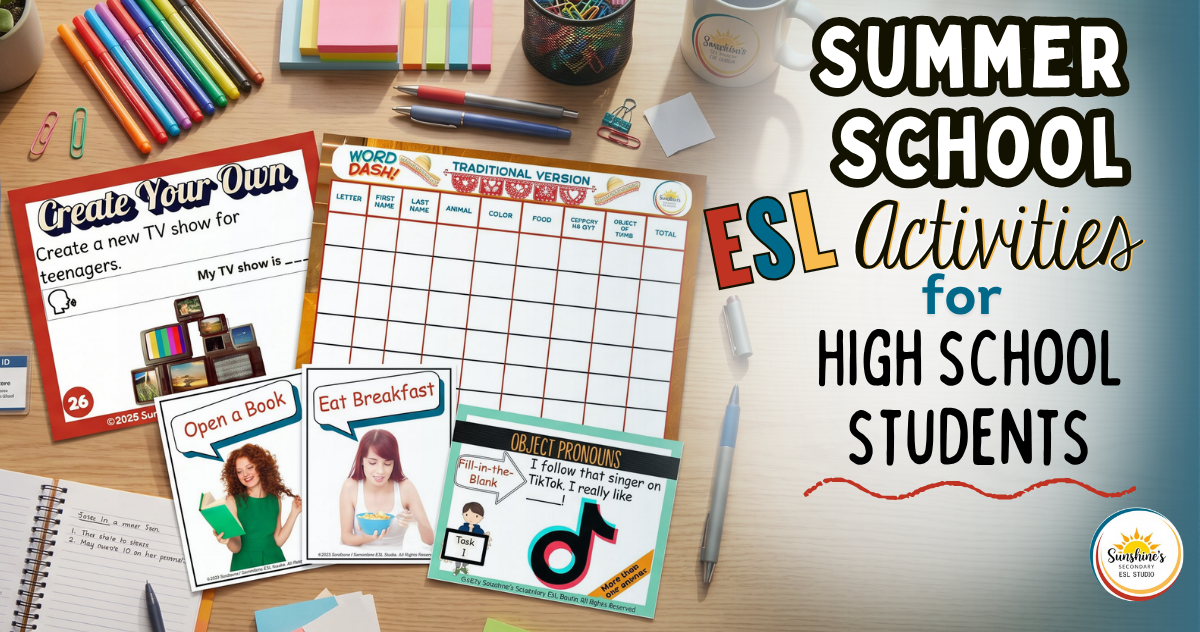
Summer school ESL activities for high school students can look very different from activities used during the regular school year. Last year, I finally had the opportunity to teach ESL summer school after years of usually teaching regular English summer school at my own campus instead. Our ESL students came from different schools across the district, and they committed to attending six hours a day, five days a week, for five straight weeks in order to earn an entire year of credit.
Most of my students were A2-B1 English learners who were trying to stay on track for graduation. They were not students who had failed during the regular school year. Many were juniors and seniors who simply needed the credit and were willing to spend part of their summer working hard to earn it.
By the end of those five weeks, we had built a strong classroom community. We even completed a final project and invited families to attend. It was exhausting at times for both the students and me, but it was also one of the most rewarding teaching experiences I’ve had.
Unfortunately, because of funding issues, there’s a possibility our district may not offer the same ESL summer school program this year. I’m still hopeful something could change at the last minute, but the uncertainty made me reflect on the types of activities that helped make those long summer days successful.
When you spend six hours a day with ESL teens during the summer, students need more than packets and silent work time. They need opportunities to move, collaborate, laugh, speak English naturally, and feel successful.
That’s really the purpose of this post.
If you’re teaching summer school this year, here are some of the summer school ESL activities for high school students that helped me keep students engaged, motivated, and participating during long summer days.
Summer School ESL Activities for High School Students Need Speaking Opportunities
One thing I noticed quickly during summer school was how important speaking activities became. Students spent so many hours together each day that relationship-building naturally became part of the classroom environment.
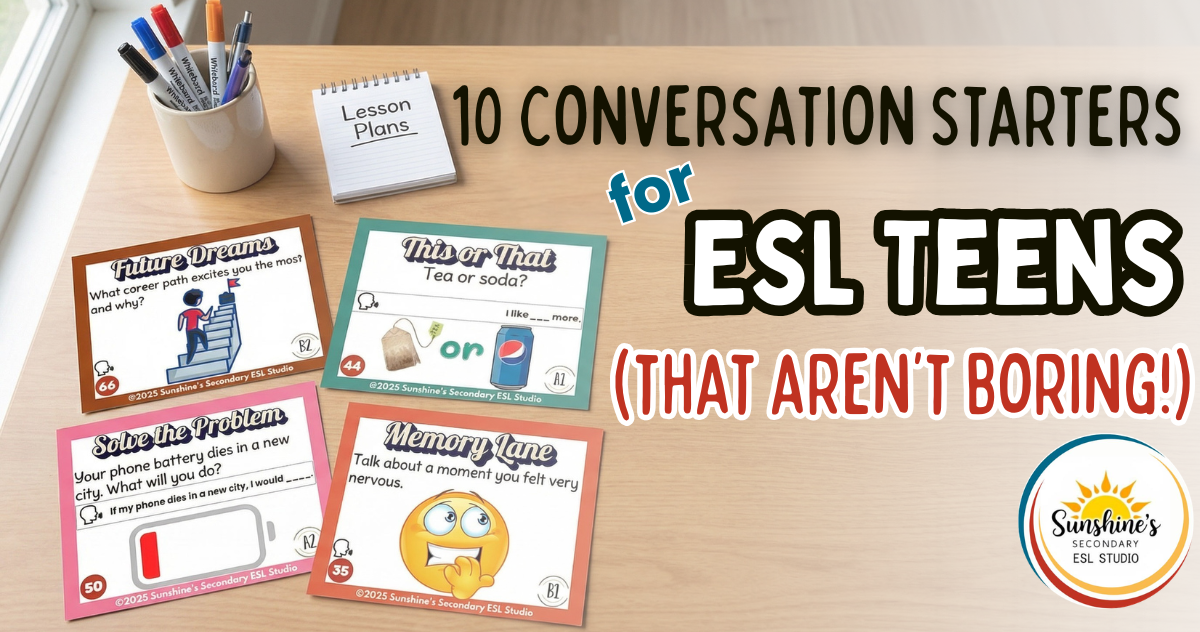
I had the best results with structured conversation activities that still felt relaxed and teen-friendly. Activities with sentence frames, discussion cards, and partner rotations worked especially well because students could practice speaking without feeling overwhelmed.
Some of my favorite discussion topics included:
- future goals
- summer plans
- social media
- jobs and careers
- music and entertainment
- “Would You Rather?” questions
- emotional reactions and opinions
If you need additional ideas for building speaking confidence during long summer days, I highly recommend using structured discussion routines and conversation prompts. I talked more about this in my posts on ESL Teen Speaking Activities, ESL Speaking Confidence Activities, and How to Build ESL Speaking Routines.
I also relied heavily on conversation cards and speaking prompts because they were easy to grab when students’ energy levels started dropping halfway through the day. My Teen Talk ESL Conversation Bundle | 320 Speaking Prompts worked especially well during summer school because students could immediately start talking without needing long instructions or complicated setup.
Low-Prep Summer School ESL Activities for High School Students
When students and teachers are together for six hours a day, every activity cannot require intense prep.
Some of the best summer school ESL activities for high school students were actually the simplest ones.
Games, movement activities, partner tasks, and collaborative challenges often created the highest engagement levels in my classroom.
One activity my students always enjoyed was charades. Teenagers pretend they are too old for games until they start competing and laughing with each other.
I usually focused on vocabulary categories connected to teen life rather than random elementary-style topics. Emotions, school situations, jobs, actions, technology, and daily routines worked especially well.
Interactive vocabulary games became essential during summer school because students simply could not stay engaged with worksheets for six hours a day. Activities that included movement, competition, and humor completely changed the classroom atmosphere.
If you enjoy interactive vocabulary activities, you may also like my posts about Charades Games for ESL High School Students, the Basta ESL Vocabulary Game, and other ESL Vocabulary Activities for High School Students.
My students especially loved using charades during the last hour of the day when everyone was mentally exhausted. I often used my own ESL Charades for Teens | Speaking Game Bundle (A1–B2) because the vocabulary categories felt much more age-appropriate for teenagers than typical elementary charades activities.
Summer School ESL Activities for High School Students Should Include Collaboration
One of the biggest lessons I learned during summer school was that collaboration matters.
Students were together all day long. If the classroom felt too isolated or worksheet-heavy, energy levels dropped quickly.
Collaborative activities helped students stay engaged while also encouraging natural language development.
Some of my favorite collaborative summer school ESL activities included:
- logic puzzles
- gallery walks
- partner speaking rotations
- small-group projects
- team competitions
- classroom discussions
- station activities
Logic puzzles became especially popular because students naturally started negotiating meaning and helping each other communicate. Some of my quieter students became surprisingly competitive once there was a mystery or challenge involved.
I wrote more about this in my post about ESL Logic Puzzles for Teens. These types of collaborative activities also connect really well to my posts on Social Emotional Learning for ESL Teens and Why Rigor in ESL Looks Different because students were practicing communication skills while also building relationships.
I frequently used my own ESL Logic Puzzles for Teens Bundle | School Drama Mysteries | A1–B2 during summer school because students enjoyed solving problems together instead of quietly working independently for long periods of time.
Listening-Based Summer School ESL Activities for High School Students
After several hours of instruction, students often needed activities that felt different from traditional reading and writing tasks.
Short listening activities worked very well during summer school because students could focus on manageable chunks of language.
Some listening activities I used included:
- short audio clips
- cloze listening tasks
- QR code listening stations
- partner listening activities
- music-based lessons
- repeat-and-discuss activities
I found that shorter listening tasks kept students engaged much more effectively than lengthy lectures or long listening passages.
I also noticed that listening activities worked best when students could replay audio independently or discuss answers with partners afterward.
For more listening activity ideas, you can also read my posts about ESL Listening Activities for High School, Cloze Listening Activities for ESL, and ESL Listening Worksheets with QR Codes.
During summer school, I often rotated in my own The Necklace Cloze Listening Activity | A2 ESL | MP3 + Google Slides + PDF because students liked being able to work more independently while still practicing listening skills.
Summer School ESL Activities for High School Students Still Need Rigor
Even though summer school often feels more relaxed than the regular school year, students still need meaningful language practice.
One thing I tried to balance carefully was keeping activities engaging while still maintaining rigor and academic expectations.
Students can absolutely practice grammar, reading, writing, and speaking skills during summer school without every lesson feeling exhausting.
Some ways I balanced rigor with engagement included:
- short grammar review games
- structured speaking tasks
- collaborative reading activities
- visual supports
- sentence stems
- project-based learning
- flexible grouping
At the end of our five-week program, students completed a final project and invited their families to attend. Watching students confidently present in English after spending weeks working together was one of the most rewarding parts of the experience.
If you are looking for additional ways to scaffold rigor for ESL students while still keeping activities manageable during summer school, you may also enjoy my posts about ESL Reading Comprehension for High School, Argumentative Writing for ESL Students, ESL Writing Support Strategies, and Differentiating ESL Instruction in High School.
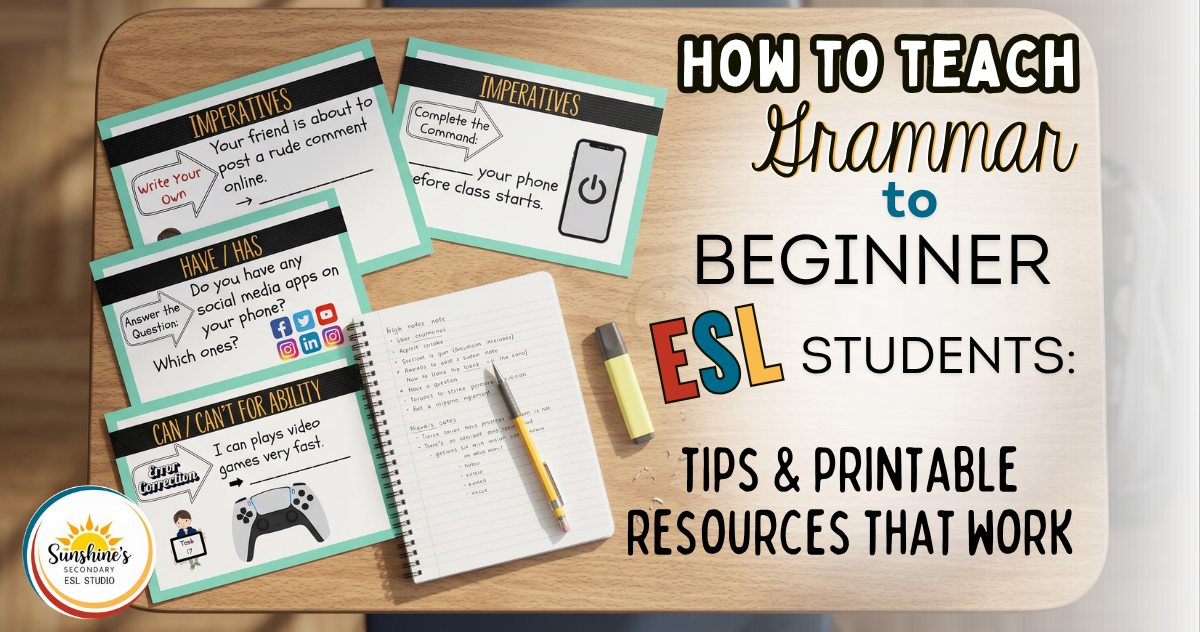
I also regularly incorporated my B1 ESL Grammar Task Card Bundle | 8 Sets of Practice for High School ELLs and Rights, Rules & Responsibility | ESL Argumentative Writing Bundle with Audio because students still needed structured language practice even during a more relaxed summer environment.
Final Thoughts on Summer School ESL Activities for High School Students
Teaching ESL summer school reminded me how important engagement, flexibility, and relationship-building are for language learning.
Six hours a day is a long time for both students and teachers. The activities that worked best were usually the ones that encouraged students to interact, collaborate, and use English naturally rather than simply complete worksheets for hours at a time.
Even though I still don’t know whether our district will be able to offer the program again this year, reflecting on the experience reminded me how meaningful summer school can be for ESL students.
Sometimes the activities students remember most are not the most complicated ones. Sometimes it’s a conversation game, a logic puzzle, a collaborative project, or simply a classroom environment where students feel comfortable enough to participate.
And honestly, after five weeks together, those students really did start to feel like a little summer family.