
If you’re looking for a practical beginning of year ESL assessment for high school English learners, you’re not alone. One of the biggest challenges secondary ESL teachers face is figuring out where students are starting without overwhelming them with lengthy tests or elementary-style activities.
A good beginning of year ESL assessment should help you identify strengths, uncover learning gaps, and guide your instruction for the months ahead. It should also feel age-appropriate for teenagers.
Planning for Back to School ESL? You can also visit my Back to School ESL Resources page for secondary ESL activities, newcomer support, first-week routines, daily warm-ups, and assessment ideas for middle school and high school English learners.
Over the years, I’ve learned that no single assessment tells the whole story. Instead, I prefer collecting several small pieces of information about my students’ language skills. By looking at speaking, pronunciation, grammar, writing, and student self-reflection together, I get a much clearer picture of what my students actually need.
Why I Stopped Looking for Traditional Phonics Assessments
When I first started teaching ESL at the high school level, I was told that my students needed phonics instruction.
That advice made sense at first. After all, pronunciation and decoding skills are important for English learners. However, I quickly realized that many of my students already had some of those sounds in their native languages. Depending on their language background, spending time teaching certain sounds simply wasn’t necessary.
I also discovered another problem.
Most phonics resources were designed for young children.
As soon as I pulled out activities that felt elementary, I got the same reaction many secondary ESL teachers know all too well—eye rolls.
My students were teenagers. They still needed pronunciation support, but they wanted materials that respected their age and maturity.
That’s when I decided to create my own system.
Assessment Idea #1: Pronunciation Screening Through Recorded Word Lists
My favorite beginning of year ESL assessment is a pronunciation screening that helps students identify their own growth areas.
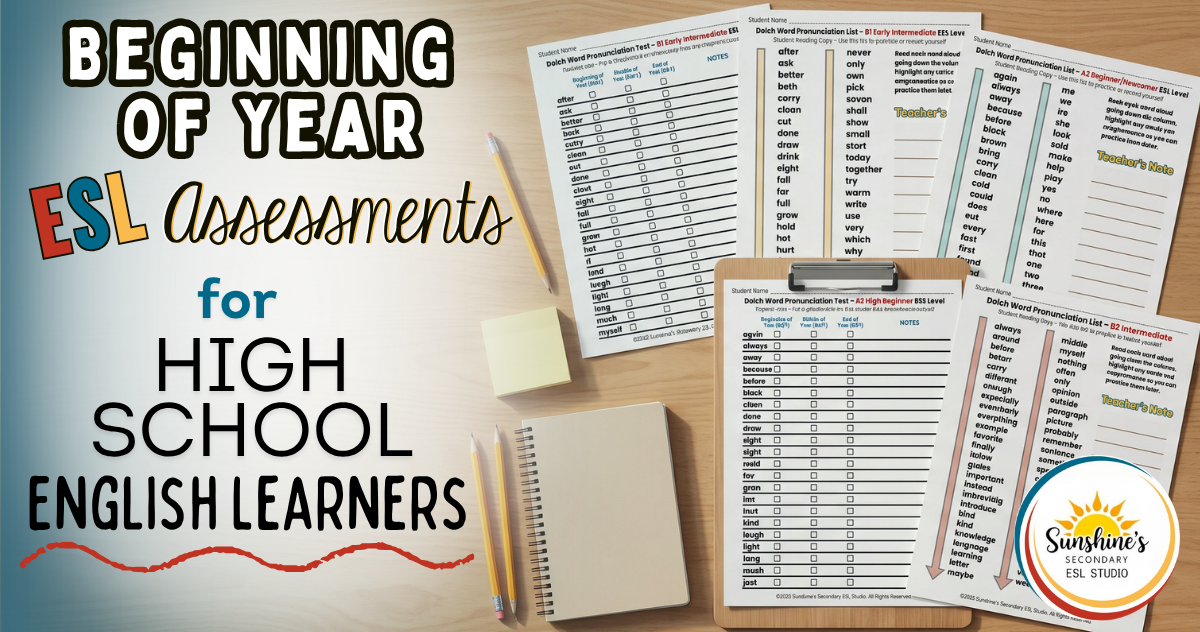
Instead of using phonics worksheets designed for elementary students, I created leveled word lists for English learners at different proficiency levels:
- A1
- A2
- B1
- B2
Each list contains 50 words that are appropriate for that student’s current English level.
At the beginning of the year, students record themselves reading the words aloud.
While this can be done one-on-one, my favorite method is using Vocaroo. Students record themselves independently, which greatly reduces anxiety during those first weeks of school when they are still getting comfortable with a new teacher.
After recording, Vocaroo generates a link and QR code. I save the recording and later review each student’s pronunciation.
During the next class period, I meet with students and discuss their results. Rather than telling students they need phonics practice simply because a curriculum says so, I can point to specific sounds and words that caused difficulty.
Suddenly, pronunciation instruction becomes personal and relevant.
Students understand exactly why they are practicing certain sounds because they can hear their own errors.
The eye rolling disappears.
More importantly, student buy-in increases.
I repeat the same assessment three times throughout the year:
- Beginning of year
- Middle of year
- End of year
Students can hear their own progress over time, making them more accountable for their learning and giving them concrete evidence of growth.
I would also note that for the middle and end of year assessment, I only have them pronounce the words that I have marked for them to practice.
If you want to try this approach with your students, you can start with my FREE ESL Pronunciation Assessment for Teens. It gives you an A1 diagnostic pronunciation test that works well as a low-pressure beginning-of-year screening for secondary English learners.
Students read a short leveled word list, record themselves, and give you a simple starting point for identifying pronunciation patterns without using materials that feel too young.
If you need the full leveled version, my ESL Teen Pronunciation Dolch Word Assessments include A1, A2, B1, and B2 word lists so you can assess students at different English proficiency levels and track growth throughout the year.
For additional pronunciation strategies, check out my article on teaching high school ESL pronunciation.
Assessment Idea #2: Collect a Speaking Sample
Pronunciation is only one piece of the puzzle.
I also like to gather a short speaking sample during the first few weeks of school.
This doesn’t need to be complicated.
Students can:
- Introduce themselves
- Talk about their summer
- Describe a hobby
- Respond to simple discussion prompts
These speaking samples provide valuable information about vocabulary, fluency, confidence, and sentence structure.
If you’re looking for ideas, you might enjoy these ESL teen speaking activities or these conversation starters for ESL teens.
Assessment Idea #3: Use a Quick Grammar Diagnostic
A grammar assessment doesn’t have to be long.
In fact, shorter assessments often provide more useful information.
I focus on a few foundational skills:
- Subject pronouns
- Basic sentence structure
- Present tense verbs
- Question formation
- Common grammar patterns
The goal isn’t to assign a grade.
The goal is to identify what students already know and where they need support.
This information helps me plan future lessons and differentiate instruction throughout the year.
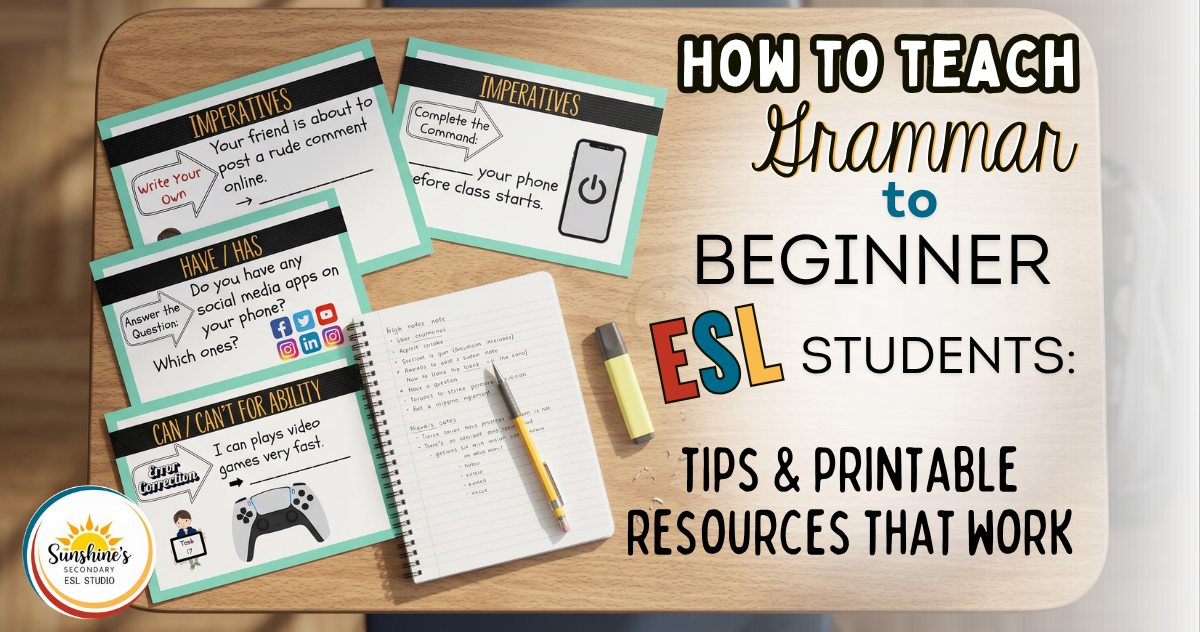
You can read more about my approach in How to Teach Grammar to Beginner ESL Students and ESL Grammar Task Cards.
Assessment Idea #4: Gather a Writing Sample
Writing samples provide another important piece of data.
One of my favorite prompts is simply:
“Tell me about yourself.”
Students can write about:
- Their family
- Interests
- School experiences
- Goals for the future
This allows me to examine:
- Sentence complexity
- Vocabulary usage
- Grammar patterns
- Organization
- Writing stamina
The writing sample often reveals strengths and challenges that don’t appear in speaking assessments.
For additional writing support ideas, see ESL Writing Support Strategies and Argumentative Writing for ESL Students.
Assessment Idea #5: Ask Students to Assess Themselves
One of the most overlooked beginning-of-year assessments is student self-reflection.
Students often know exactly where they struggle.
I like asking questions such as:
- Do you feel confident speaking English?
- Is reading easy or difficult for you?
- What do you want to improve this year?
- When do you feel most successful in English class?
Their answers frequently provide insights that formal assessments miss.
Why Multiple Small Assessments Work Better Than One Big Test
One lesson I’ve learned over the years is that no single assessment tells the whole story.
A student might:
- Read well but struggle to speak.
- Speak confidently but have weak writing skills.
- Understand grammar but struggle with pronunciation.
That’s why I prefer using multiple small assessments rather than one large diagnostic test.
Together, these assessments create a more complete picture of student needs and allow me to provide targeted support from the very beginning of the year.
Need a ready-to-use pronunciation assessment for the beginning of the year?
My ESL Teen Pronunciation Dolch Word Assessments are designed for middle school and high school English learners who need pronunciation support without elementary-style phonics worksheets. The leveled A1–B2 word lists help you collect a quick pronunciation sample, identify patterns, and give students specific sounds or words to practice.
I like this type of assessment because it gives both the teacher and the student clear information. Students can hear their own starting point, practice targeted words, and compare their growth later in the year.
Want to try a simple version first? Grab the free A1 ESL Pronunciation Assessment and use it as a quick beginning-of-year diagnostic with your students. It is a low-stress way to collect a pronunciation sample and see how this type of assessment works before using the full leveled set.
My Favorite Beginning of Year ESL Assessment
If I had to choose just one assessment, I would still choose the pronunciation screening.
It is low-stress, age-appropriate, and provides actionable information that students can immediately understand.
Most importantly, it helps students take ownership of their own learning.
Instead of practicing phonics because the teacher says so, students can hear exactly where they need improvement and track their growth throughout the year.
For many of my high school English learners, that simple shift makes all the difference.
A strong beginning of year ESL assessment does not have to be complicated. It just needs to provide meaningful information that helps both teachers and students understand where they are starting and where they want to go.
If you want to begin with a simple, low-pressure diagnostic, start with the free A1 ESL Pronunciation Assessment for Teens. Then, when you are ready to assess students across multiple proficiency levels, the full ESL Teen Pronunciation Dolch Word Assessments give you A1, A2, B1, and B2 word lists that can be used at the beginning, middle, and end of the school year.
This gives you a practical way to document growth, target pronunciation support, and help secondary English learners hear their own progress over time.