
Nothing is more awkward than asking a question to a group of ESL teens… and getting silence in return.
If you’ve ever experienced that, you’re not alone. The truth is, conversation starters for ESL teens only work when they feel natural, engaging, and safe for students to respond to.
Planning for Back to School ESL? You can also visit my Back to School ESL Resources page for secondary ESL activities, speaking routines, newcomer support, daily warm-ups, and ready-to-use resources for middle school and high school English learners.
If your students still hesitate to speak—even with prompts—you might also want to check out How to Build ESL Speaking Routines to build consistency and reduce speaking anxiety over time.
If you’re working with mixed proficiency levels, you’ll also want strategies that support all learners Differentiating ESL Instruction from A1 to B2
These categories are part of the exact system I use in my classroom to get even my quietest students speaking within minutes.
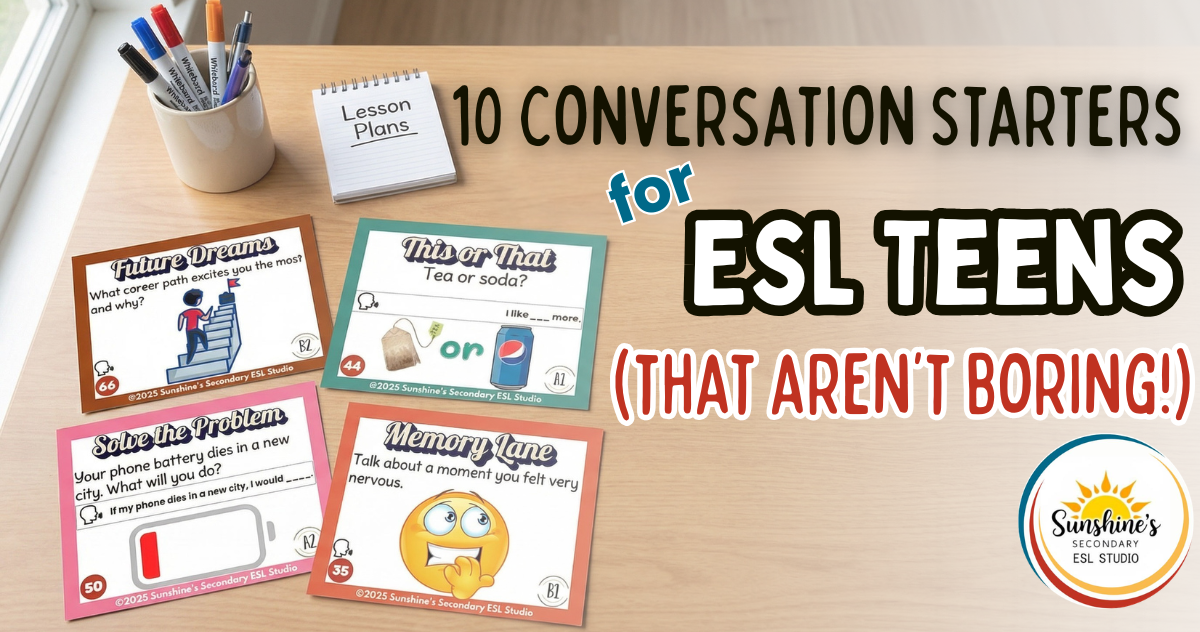
Here are 10 conversation starters for ESL teens that actually work — tested in real classrooms and loved by students.
Want to try a free sample first?
Start with my Free Teen Talk ESL Conversation Starters for A1 students. This free “Would You Rather?” sample gives beginner English learners a low-pressure way to choose, explain, and start speaking without needing long or complicated answers.
It is a simple way to test the format with your students before using the full leveled conversation card sets.
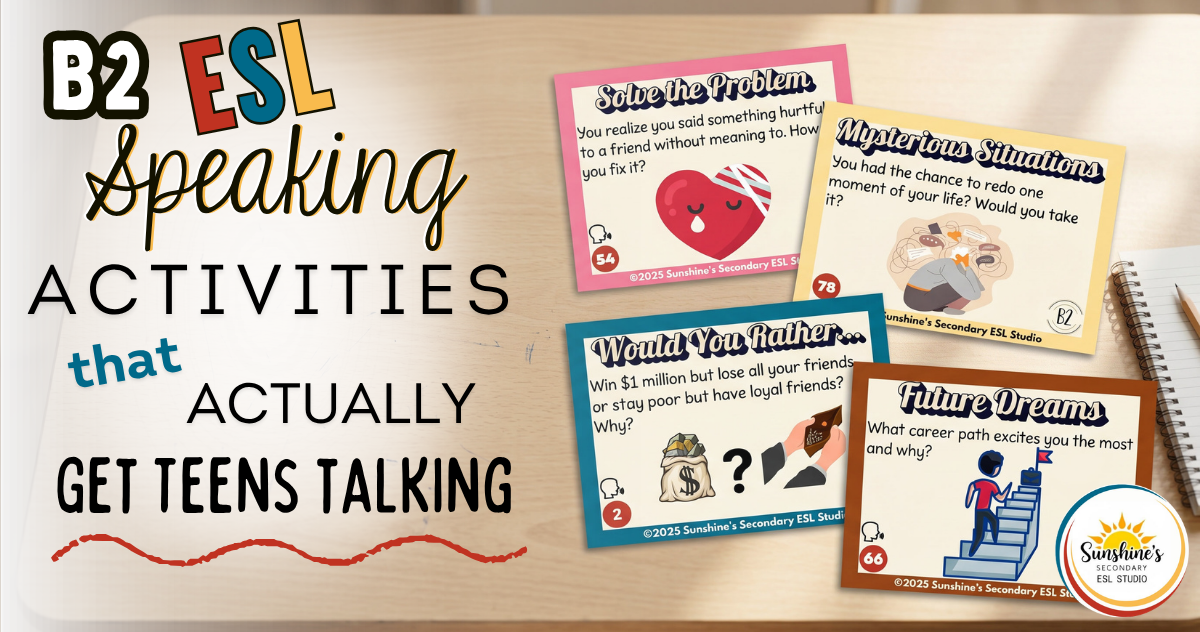
1. Would You Rather…?
This type is always a hit with teens — they love comparing weird situations.
For example: Would you rather be invisible or be able to fly?
For ESL teens, these conversation starters push them to explain why they made their choice.
Use it as: a warm-up, quick poll, or pair discussion.
In my classroom, I group students by similar language levels so they can support each other—but they still debate their answers, which keeps engagement high.
2. What if…?
“What if…?” conversation starters give students imaginative situations while building grammar skills.
These are perfect for practicing modal verbs like would, should, and might.
Sample questions:
- What if you woke up and could speak any language — which one would you choose?
- What if animals could talk — which one would be the funniest?
- What if your phone disappeared for a whole week — what would you do?
Use it as: partner conversations or second conditional practice (I would… if…).
3. Unpopular Opinions
“Unpopular Opinions” spark strong reactions—and teens love them.
Students agree or disagree, explain their thinking, and respond to others.
Sample questions:
- Pineapple belongs on pizza. Do you agree or disagree?
- Homework should be banned forever. What’s your take?
- School uniforms are better than casual clothes. Why or why not?
Use it as: debates, warm-ups, or discussion starters.
This is also a great transition into argumentative writing. If you want to take it further, here’s how I scaffold argumentative writing for ESL students Argumentative Writing for ESL
Students naturally begin using sentence frames like:
- “I disagree because…”
- “I see your point, but…”
4. Create Your Own…
These go beyond quick answers—students invent something new.
They might create:
- a new app
- a new holiday
- a new sport
Sample questions:
- Create your own social media app. What does it do?
- Invent a new holiday. How do people celebrate it?
- Make your own sport. What are the rules?
Use it as: presentations, interviews, or writing extensions.
Support with sentence frames like:
- “It’s called…”
- “The rules are…”
5. Memory Lane
These prompts get students talking about real experiences using past tense.
Sample questions:
- Tell me about a time you felt really proud.
- What was the best birthday you ever had?
- What’s a memory that always makes you laugh?
Use it as: pair interviews or storytelling.
Encourage sentence frames like:
- “One time…”
- “When I was younger…”
These also connect well with social-emotional learning in ESL classrooms Social Emotional Learning for ESL Teens
6. This or That
“This or That” questions are quick, low-pressure choices.
Sample questions:
- Tea or coffee?
- Books or movies?
- Morning or night?
Use it as: a fast warm-up or speed chat.
Unlike “Would You Rather,” these don’t require long explanations—they’re perfect for building confidence quickly.
Need leveled conversation starters for mixed-level ESL classes?
If you teach students at different proficiency levels, my ESL Conversation Cards Mega Bundle gives you 320 teen-friendly prompts across A1, A2, B1, and B2 levels. The cards are designed to help secondary English learners practice speaking without feeling put on the spot.
Each level includes structured prompts, sentence support, and topics that work well for warm-ups, partner talks, speaking stations, small groups, and early-year classroom routines. This makes it easier to get students talking from the beginning of the school year while still respecting their language level.
7. Solve the Problem
These prompts build critical thinking and real-life language use.
Sample questions:
- Your friend is always late. What should they do?
- You forgot your homework. What do you do?
- Your phone dies while you’re lost. What’s your next move?
Use it as: role-plays or group discussions.
Students can use:
- “I think they should…”
- “Maybe they could…”
- “If it were me, I would…”
8. My Top 3
Students rank their favorites and explain their choices.
Sample questions:
- What are your top 3 favorite snacks?
- What are your top 3 songs right now?
- What are your top 3 places you want to visit?
Use it as: speaking or writing practice.
Encourage sentence frames like:
- “My favorite is… because…”
- “In second place, I would choose…”
- “I like ___ more than ___ because…”
9. Future Dreams
These prompts focus on goals and future plans.
Sample questions:
- What is one goal you have this year?
- What job would you like in the future?
- What place do you want to visit someday?
Use it as: writing, speaking, or vision board activities.
Sentence frames:
- “Someday, I want to…”
- “In five years, I hope to…”
- “My dream is to…”
10. Mysterious Situations
These are some of the most engaging prompts.
Students explain strange or unexplained events using speculation.
Sample questions:
- You wake up and your backpack is filled with sand. What happened?
- A pizza appears at your door. Who sent it?
- Your teacher disappears for a week. What’s the story?
Use it as: storytelling or group problem-solving.
Sentence frames:
- “Maybe someone…”
- “I think it could be…”
- “It must have been…”
Why It Matters
Speaking is often one of the last skills ESL teens develop, and it is usually because they do not get enough structured, low-pressure practice.
That is why conversation starters work especially well during Back to School. Students are still learning classroom routines, building trust, and figuring out how much English they feel comfortable using. Short, teen-friendly prompts give them a safe way to participate without needing a perfect answer.
Using conversation starters for ESL teens builds:
- confidence
- vocabulary
- fluency
Sentence starters are another powerful scaffold for reluctant speakers Free ESL Sentence Starters for Teens
When you combine conversation practice with light pronunciation support, students improve even faster.
Ready-to-Go Conversation Starters for ESL Teens
If you want to start small, grab the Free Teen Talk ESL Conversation Starters for A1 students and try the “Would You Rather?” prompts with your class.
Then, when you are ready for a full speaking routine, the ESL Conversation Cards Mega Bundle gives you 320 leveled prompts for A1, A2, B1, and B2 English learners. The prompts are designed for teens, so they feel age-appropriate while still giving students the structure they need to speak with more confidence.
Use them for Back to School speaking routines, warm-ups, partner discussions, speaking stations, early finisher tasks, or mixed-level ESL classes where students need different levels of support.
Low prep, highly reusable, and designed to get your students actually talking from day one.