
If you’ve ever stood in front of a room full of ESL teens and asked an open-ended question, you probably know the awkward silence that follows. Understanding how to build ESL speaking routines can make a huge difference in getting students to participate. Instead of avoiding eye contact or waiting for someone else to answer, students begin to see speaking as a normal part of class.
For a long time, I struggled to get my classes speaking consistently—and even when they did talk, it was usually the same handful of students.
I remember trying to start discussions with questions like “What did you do this weekend?” and getting nothing but shrugs and nervous smiles. My students were capable of speaking—they just needed structure and repetition before speaking English felt safe.
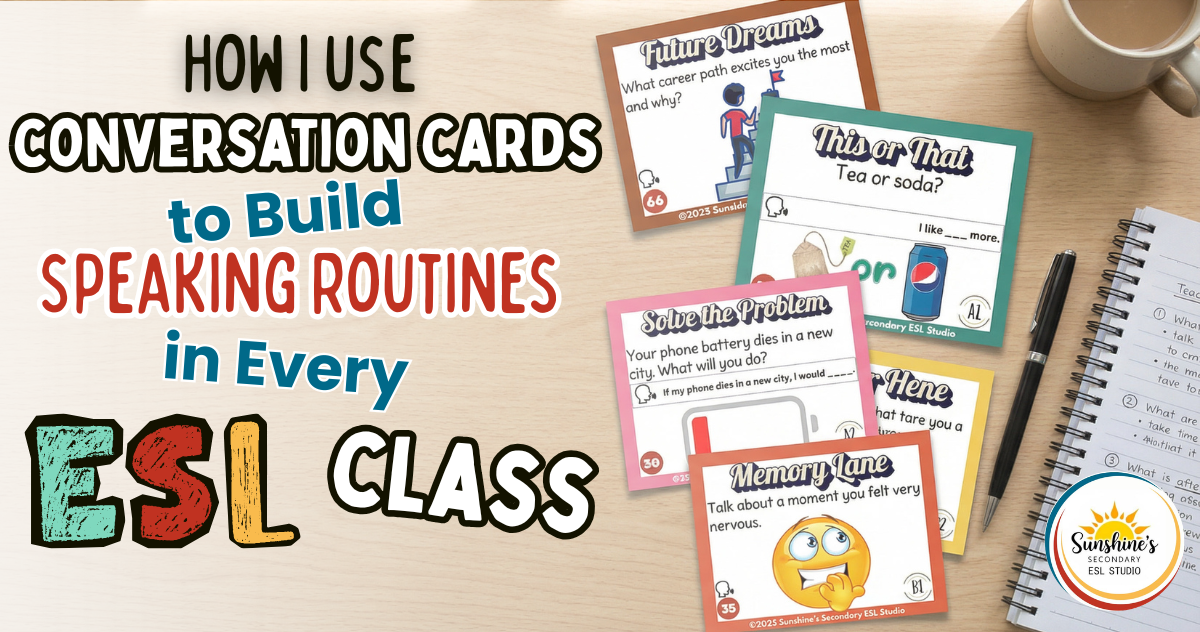
What finally changed things for me was building speaking routines into every class. Instead of treating speaking practice as an occasional activity, I made it part of our daily rhythm. Conversation cards became the simple tool that helped me build those routines and keep students engaged.
If you’re looking for additional ways to structure speaking practice with teenagers, you might also like my post on ESL Teen Speaking Activities.
Affiliate disclosure: This post contains affiliate links. As an Amazon Associate I earn from qualifying purchases at no additional cost to you.
Why Learning How to Build ESL Speaking Routines Matters
When students know what to expect, they relax. Routines take away the pressure of “being put on the spot” and give students a clear structure. In ESL classrooms, speaking routines can offer several benefits:
- Provide repeated practice in a safe format
- Reduce anxiety because students know what’s coming
- Balance participation so everyone gets a chance, not just the confident few
- Build fluency over time through consistent repetition
Once I shifted from random speaking prompts to daily routines, my classroom felt less like pulling teeth and more like guided practice.
Another small strategy that helps these routines work better is allowing students more thinking time before they respond. I share several practical examples in my article on Wait Time Strategies in the ESL Classroom.
How to Build ESL Speaking Routines Using Conversation Cards
Here are a few of my favorite ways to weave conversation cards into the structure of every ESL class.
1. Warm-Ups (2–3 Minutes)
At the start of class, I project or pass out a conversation card. Students turn to a partner and respond before we dive into the lesson. It’s quick, low-stakes, and sets the tone: this is a class where we speak English.
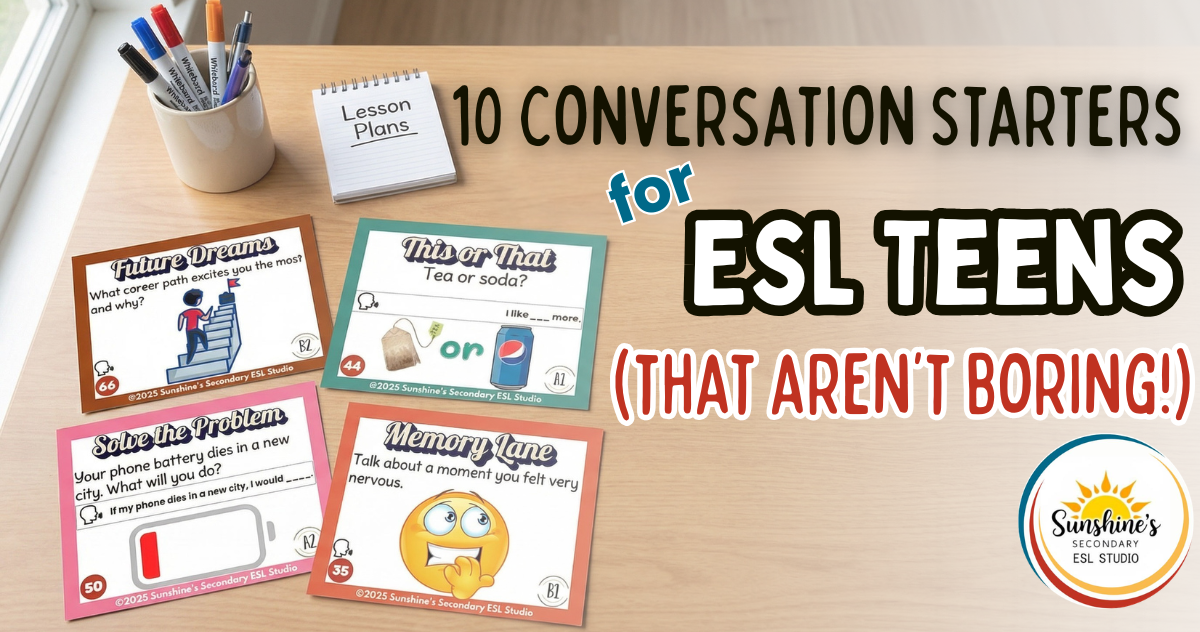
If you’re looking for additional prompt ideas, you can also explore these Conversation Starters for ESL Teens.
For beginner students, pairing speaking prompts with sentence stems can make participation feel much less intimidating. I also use supports like these Free ESL Sentence Starters for Teens to help students respond more confidently.
2. Pair Work Practice
During guided practice, I use cards as a way to scaffold pair or small-group discussions. Instead of telling students, “Talk about this topic,” they get a focused prompt that keeps them from freezing.
These types of structured prompts are especially helpful for multilingual classrooms where students may be at very different proficiency levels. I talk more about strategies like this in my post on Differentiating ESL Instruction from A1 to B2.
In larger classes, these routines also help with classroom management because students always know what they should be doing. Predictable routines reduce off-task behavior and help students transition more smoothly between activities. If you teach larger secondary ESL classes, you may also enjoy my article on ESL Classroom Management in High School.
3. Exit Tickets
Before students leave, I’ll have them answer one last question from a card. It’s a simple check for understanding and a way to end class with speaking instead of silence.
Sometimes the best conversations happen during these quick closing moments because students are more relaxed by the end of class.
4. Fast Finishers
Every teacher has those students who finish an activity early. Instead of sitting idle, they grab a conversation card and practice with a classmate. It keeps everyone engaged and reinforces speaking practice as part of the classroom routine.
Activities that focus on emotions and personal experiences can also work really well here. If you need more ideas, you might enjoy these ESL Emotion Speaking Prompts.
How I Store and Reuse My Conversation Cards
Because I use conversation cards for warm-ups, partner practice, exit tickets, and fast finishers, I need them to hold up throughout the school year. I laminate the cards with Self-Adhesive Laminating Sheets and store the different sets in a photo storage box that can organize these conversation cards so I can quickly find the level or topic I need.
The organizer also keeps loose cards from getting mixed together between classes, while the laminated surface makes the cards easier to reuse.
Classroom supplies: self-adhesive laminating sheets | Conversation-card organizer
Adapting Speaking Routines for Different Levels
One thing I love about conversation cards is how easy they are to adapt for different proficiency levels.
A1/A2 Students
Sentence stems or word banks help scaffold answers. For example:
“My favorite food is ___ because ___.”
Students at beginning levels often want to participate but may not yet have the language to answer independently. Structured supports help lower anxiety while still encouraging real communication. You can find additional ideas in my posts on Beginner ESL Speaking Activities and A2 ESL Speaking Prompts for Teens.
B1/B2 Students
Open-ended prompts encourage more detail and follow-up questions. For example:
“If you could change one rule at school, what would it be and why?”
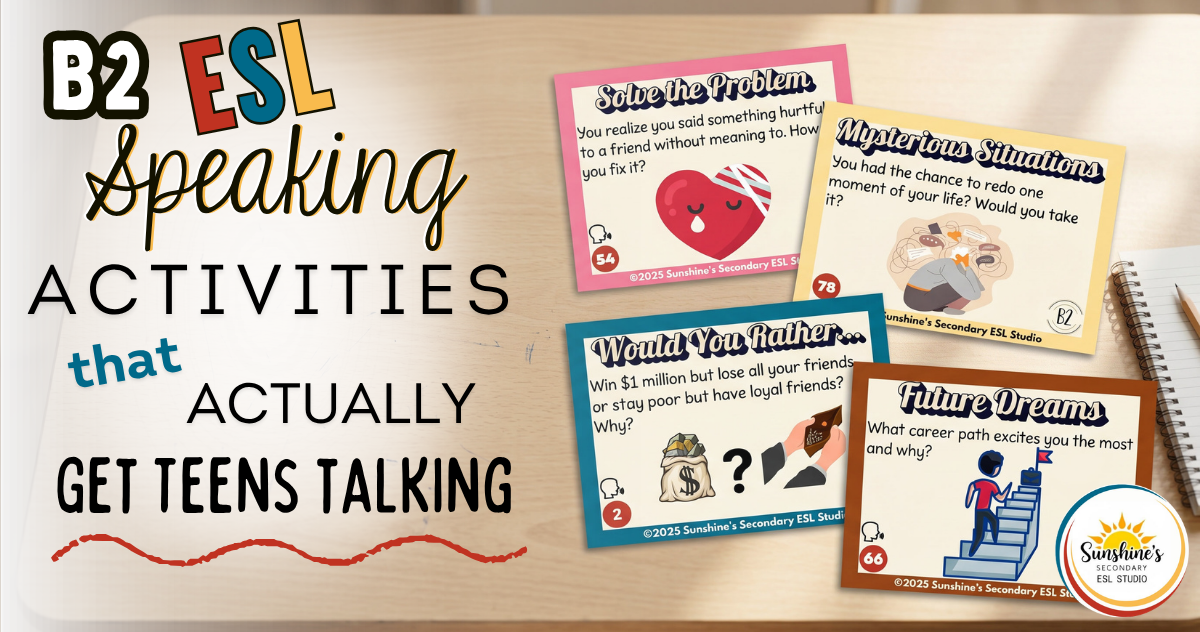
Older ESL students especially appreciate prompts that feel age-appropriate and connected to their real opinions and experiences. For more advanced ideas, you may also enjoy these B2 ESL Speaking Activities for Teens.
Mixed-Level Classes
Pairing stronger speakers with beginners can work really well when the prompt itself provides structure. The conversation card acts as a guide so both students can participate at their own level.
I’ve also found that culturally responsive topics often increase participation because students feel more connected to the discussion itself. I talk more about this in my post on Culturally Responsive Teaching for ESL Teens.
Common Mistakes When Building ESL Speaking Routines
One mistake I made early on was assuming students would automatically know how to participate in conversations just because I asked a question. In reality, many multilingual learners need modeling, structure, and repetition before speaking routines feel comfortable.
Another common mistake is changing routines too often. Students benefit from consistency. When the format stays familiar, students can focus their energy on speaking rather than figuring out new directions every day.
I also think secondary ESL teachers sometimes accidentally choose prompts that feel too childish for teenagers. Even beginner students want to feel respected and age-appropriate activities matter a lot for participation.
Finally, it’s important not to overcorrect students during speaking routines. If every mistake gets interrupted immediately, students can become hesitant to participate at all. Building confidence first often leads to stronger fluency over time.
Building Confidence Through Daily Speaking Practice
The physical layout of your classroom can make speaking activities much easier to manage. Take a look at how I organize my ESL classroom to see how my seating arrangement encourages collaboration and daily conversation practice.
The magic of learning how to build ESL speaking routines isn’t that one question suddenly makes everyone fluent. It’s the accumulation of daily practice.
Over weeks and months, I’ve watched reluctant students go from whispering a few words to carrying on full conversations with peers. Consistent routines lower the pressure and make speaking feel normal instead of intimidating.
If you want additional ideas for helping students become more comfortable speaking, you might also find these ESL Speaking Confidence Activities helpful.
Final Thoughts
Learning how to build ESL speaking routines doesn’t require complicated lesson plans. Often, the most effective strategies are the simplest ones.
With a small set of conversation cards and a consistent structure, you can reduce silence, build student confidence, and make speaking a natural part of your classroom culture.
If you’d like a ready-to-use set, I created a Teen Talk ESL Conversation Cards Mega Bundle with 320 prompts designed specifically for secondary ESL students at levels A1–B2.
Because the prompts are leveled from A1–B2, I can keep the same speaking routines throughout the year while adjusting the complexity of the conversations for different students and classes.
These are the same prompts I use in my own classroom for warm-ups, pair work, speaking practice, fast finishers, and quick daily discussions.
You can explore the full Teen Talk ESL Conversation Cards Mega Bundle on TPT, or start with the FREE sample set of ESL conversation cards for teens to see how the prompts work in your classroom.