
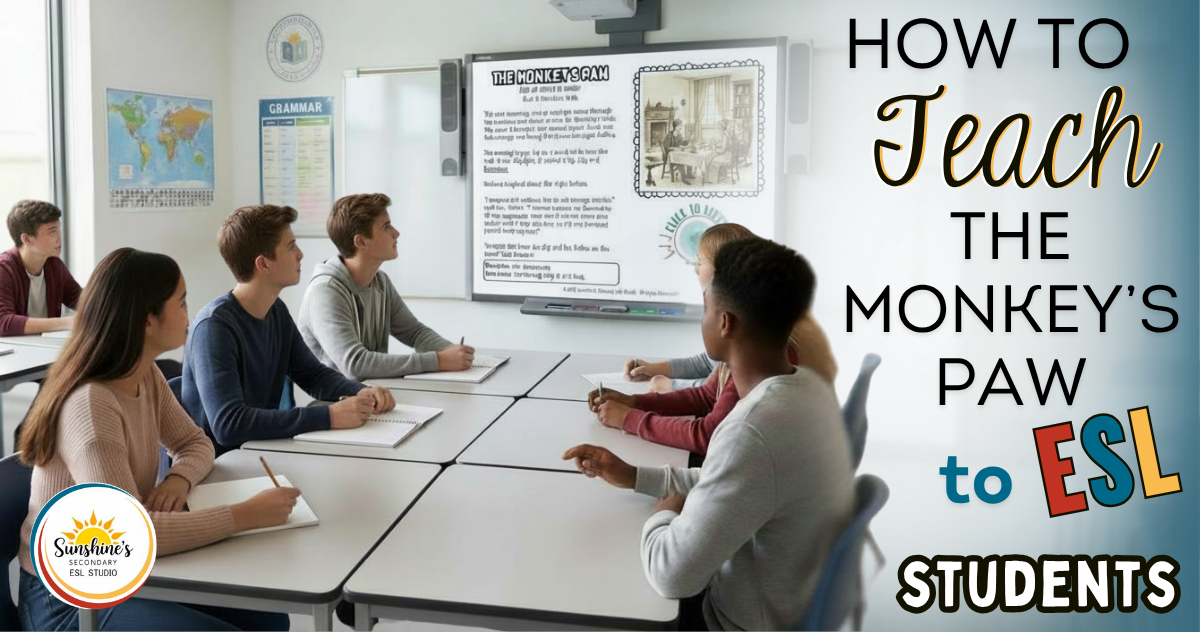
Teaching The Monkey’s Paw ESL lessons can be a little tricky because the story itself is incredibly teachable, but the original language can be a major obstacle for English learners.
The plot has everything you want in a short story for secondary students: suspense, bad decisions, unexpected consequences, foreshadowing, irony, grief, and plenty of opportunities for discussion.
The problem is that students can be perfectly capable of understanding those ideas while still struggling to follow W. W. Jacobs’s language.
That is an important distinction.
A student may be ready to discuss fate, consequences, character motivation, or whether Mr. White is responsible for what happens, even if that same student cannot independently work through every sentence of the original story.
For me, that is where scaffolding comes in.
Making the language more accessible does not mean lowering the level of thinking. In fact, I wrote more about that idea in my post about why rigor in ESL looks different.
With the right support, The Monkey’s Paw can be an excellent short story for secondary English learners.
Want to Try The Monkey’s Paw With Your Students for Free?
Before we get into the teaching ideas, I have a FREE resource you can use if you want to see whether this type of adapted literature works for your students.
My FREE ESL Short Story Sampler | The Tell-Tale Heart & The Monkey’s Paw with Audio includes samples from both stories with adapted text, visuals, and audio.
It gives you a chance to try the format before purchasing a full resource, and it is also an easy way to introduce students to two classic spooky stories during October.
Now, let’s talk about how I would actually teach The Monkey’s Paw in an ESL classroom.
Why The Monkey’s Paw Can Be Difficult for English Learners
W. W. Jacobs published The Monkey’s Paw more than a century ago, so some of the difficulty is not really an ESL problem at all.
Even native English-speaking students may encounter vocabulary, sentence structures, and expressions that feel unfamiliar.
For an English learner, several challenges can pile up at once:
- unfamiliar or older vocabulary
- long or complicated sentence structures
- descriptive passages that require inference
- cultural and historical background knowledge
- dialogue in which the meaning is implied rather than directly stated
- important details students have to remember across the story
- suspense that depends on noticing subtle clues
That can become overwhelming quickly.
And once students stop understanding what is happening, it becomes almost impossible for them to analyze why it matters.
This is one of the reasons I think it is important to separate reading level from thinking ability.
I talk about that more in my post about ESL students reading below grade level. Students can absolutely be capable of grade-level thinking while still needing substantial language support to access the text.
The answer is not to replace age-appropriate literature with material that feels childish.
Secondary English learners still deserve interesting, complex stories.
If you teach teenagers, this balance comes up constantly. I wrote more about that in How to Teach ESL in High School.
Before Reading The Monkey’s Paw: Start With the Idea, Not the Vocabulary List
One of the easiest things about teaching The Monkey’s Paw is that students can understand the central idea before they understand the story.
Start with wishes.
Ask:
If you could have three wishes, what would you wish for?
Then ask the question that makes the discussion much more interesting:
What could go wrong?
Now students are already thinking about consequences before they ever read about the monkey’s paw.
This also makes differentiation fairly simple.
A beginning student might respond with:
I would wish for ______ because ______.
A developing student might use:
I would wish for ______, but one problem could be ______.
A more proficient English learner might respond:
Although ______ seems like a good wish, it could have the unexpected consequence of ______.
Everyone is discussing the same concept.
The amount of language support changes.
That is one of the ideas I use frequently when differentiating ESL instruction from A1 to B2. You do not always have to create completely different lessons for every proficiency level. Sometimes you can keep the thinking the same while changing the support.
Be Selective With Vocabulary
I would not start The Monkey’s Paw by giving students a giant list of unfamiliar vocabulary and asking them to copy definitions.
That can create another difficult reading assignment before they even get to the story.
Instead, I would ask:
Does the student need this word to understand what is happening?
If the answer is yes, teach it.
If students can understand the scene without knowing the exact meaning, or they can reasonably infer the meaning from context, the word may not need to be pre-taught.
For the words that really matter, combine more than a definition.
Try:
word + student-friendly meaning + image + context
Visual vocabulary support can be especially helpful with English learners because students are trying to process new language and unfamiliar context at the same time.
If you want more ideas for that, I have an entire post about ESL vocabulary activities for high school students.
Give Students Enough Background Knowledge—But Not Too Much
Students do not need a 30-minute lecture about W. W. Jacobs before they start reading.
They do need enough information to understand the world of the story.
Depending on your students, I might briefly introduce:
- the general time period
- the British setting
- the idea of a talisman
- the concept of wishes
- the possibility that interfering with fate may have consequences
Then I would get into the story.
Background knowledge should make the text easier to understand, not become another obstacle students have to get through before reading.
A simple KWL chart for ESL students could also work well here if you want students to activate what they already know about wishes, superstitions, fate, or supernatural objects before reading.
During Reading: Make The Monkey’s Paw Accessible Without Removing the Suspense
During Reading: Protect the Suspense
This is where The Monkey’s Paw can fall apart for English learners if the reading is not scaffolded.
Suspense only works when students understand enough of the story to wonder what will happen next.
If students are confused, they are no longer thinking:
What is going to happen?
They are thinking:
What is happening?
That is a very different experience.
Chunk the Story
Instead of assigning the entire story at once, break it into meaningful sections.
After each section, students should be able to answer one basic question:
What just happened?
A simple reading routine could be:
Read or listen → check understanding → clarify → predict → continue
For example:
- Read or listen to a short section.
- Ask students to identify the most important event.
- Clarify one confusing detail if necessary.
- Ask students what they think will happen next.
- Continue reading.
Prediction is especially useful with The Monkey’s Paw because students naturally begin looking for clues.
And once they start noticing clues, you have already opened the door to teaching foreshadowing.
For more general strategies like this, I also have a post about ESL reading comprehension in high school.
When an Adapted Version Makes More Sense
There is nothing particularly rigorous about watching students struggle through a text they cannot access.
The better question is:
What am I actually trying to teach?
If your objective is for students to analyze Jacobs’s original syntax, diction, or word choice, then of course they need to spend time with the original language.
But if your goal is for students to understand and analyze:
- plot
- consequences
- suspense
- foreshadowing
- characterization
- irony
- mood
- theme
then an adapted text can give them access to those concepts.
A strong adaptation should not reduce the entire story to a summary.
It should preserve the events and ideas students need in order to actually analyze the literature.
For The Monkey’s Paw, that means keeping:
- the wishes and consequences
- character motivations
- the increasingly uneasy atmosphere
- important clues
- the ambiguity around the supernatural
- the emotional impact of the ending
You can also combine an adapted version with selected passages from the original.
Students can first understand the full story in accessible language, then return to important original passages when you want them to examine Jacobs’s language more closely.
I use a similar philosophy when thinking about how to support ESL students during novel studies and when teaching other difficult classics such as Julius Caesar to ESL students.
A Ready-to-Use Adapted Version of The Monkey’s Paw
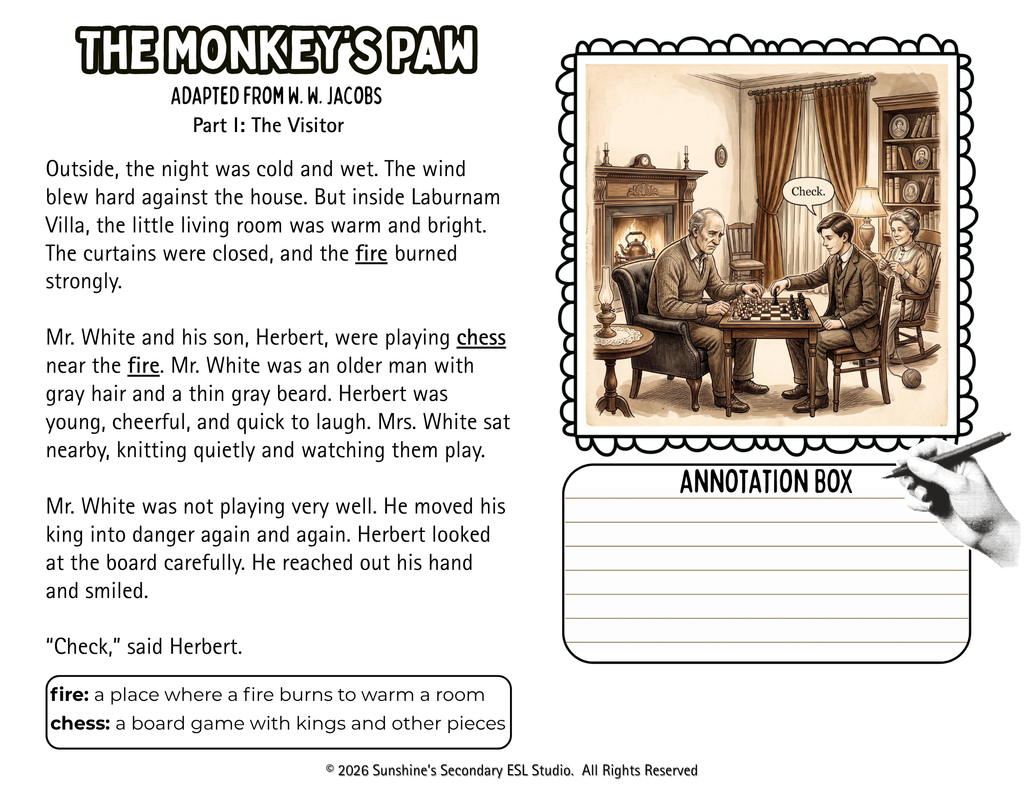
If you do not want to adapt the entire story yourself, I created The Monkey’s Paw Adapted Reading for ESL | Simplified Short Story with Visuals specifically for secondary English learners.
It uses accessible language while preserving the important events, characters, suspense, and literary ideas of the original story.
It also includes visual supports, vocabulary support, chunked reading, comprehension and discussion opportunities, and before-reading activities.
The goal is still to teach The Monkey’s Paw.
The supports simply help students get there.
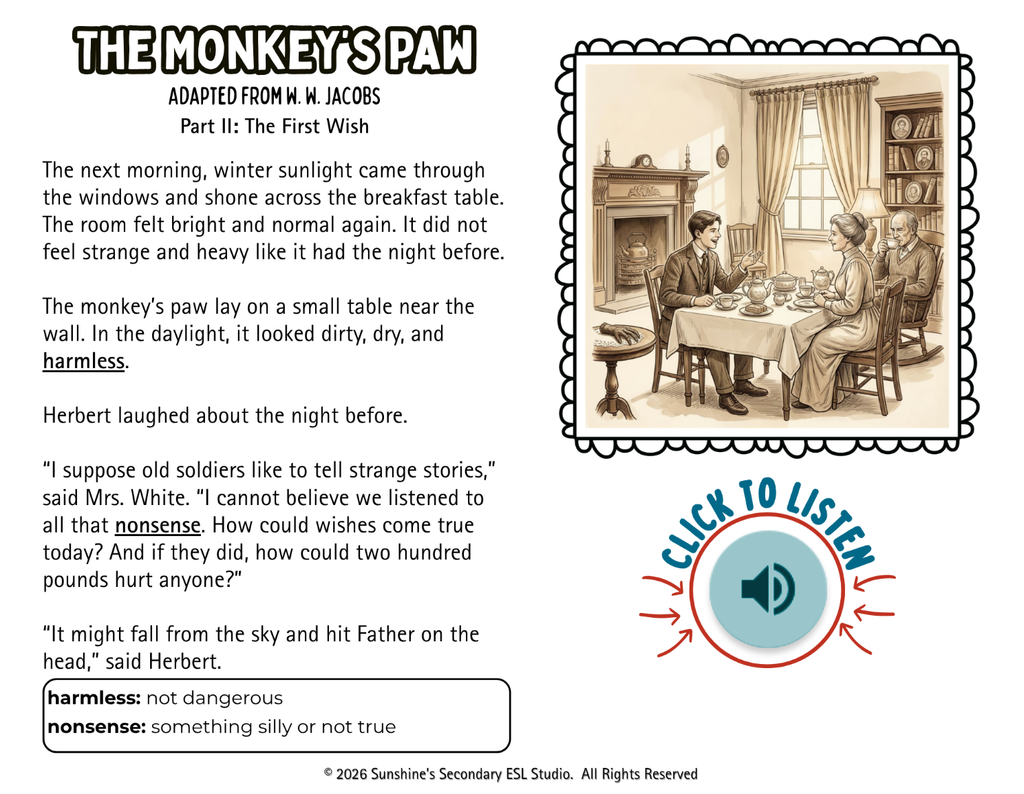
Use Visuals to Support Meaning
For English learners, visuals should do more than make the lesson look attractive.
A useful visual can help students understand:
- where a scene takes place
- what an unfamiliar object looks like
- what a character is doing
- what an important moment in the plot looks like
- the emotional atmosphere of a scene
Sometimes students understand the individual words in a sentence but still cannot create a mental picture of what is happening.
A meaningful visual can fill in that gap.
That leaves students with more mental energy for actually understanding the story.
Use Audio as More Than a Read-Aloud
Audio can be incredibly useful with English learners, especially when students listen while following along with the text.
They are getting multiple forms of language input at once:
- pronunciation
- phrasing
- intonation
- emotion
- written language
- spoken language
I talk more about the benefits of this kind of practice in my post on ESL listening activities for high school.
With The Monkey’s Paw, though, audio can do more than help students understand the words.
First Listening: Understand What Happened
During the first listen, focus on comprehension.
Pause occasionally and ask:
- What happened?
- Who did what?
- What changed?
- What do you think will happen next?
The purpose is simply to understand the story.
Second Listening: Notice Suspense and Mood
Once students understand the plot, return to an important section.
This time, ask them to notice:
- tone of voice
- pauses
- character emotion
- sound
- mood
- rising tension
Students are no longer using all of their attention to figure out what is happening.
Now they can pay attention to how the story feels.
Standard and Dramatic Audio Options
I created The Monkey’s Paw Audio Reading Slides | ESL Read Aloud with Visuals & Discussion for exactly this kind of repeated listening.
The resource includes both:
- a standard character-voice version
- a dramatic version with character voices, atmospheric audio, and sound effects
One option is to use the standard audio during the first reading when students are primarily concentrating on comprehension.
Later, revisit a scene with the dramatic version and ask students to focus on suspense, mood, and emotion.
That turns listening into part of the literary analysis.
If you already use cloze listening in your classroom, The Monkey’s Paw also works well with that approach. I have more ideas in Cloze Listening Activities for ESL.
Check Comprehension Before Asking for Analysis
This sounds obvious, but it is an easy step to skip.
Before students can explain why Jacobs made a particular choice, they have to understand what happened.
I like to think of the questions as a staircase.
Start with:
What happened after Mr. White made his wish?
Then:
Why is that consequence important?
Then move into:
Why does Jacobs make the first wish seem relatively ordinary before revealing the consequence?
Each question asks students to move a little further into analysis.
That progression is especially helpful for students who are still developing academic English.
Teaching Literary Analysis Without Lowering the Rigor
Once students understand the story, there is no reason they cannot work with literary analysis.
They may just need language support.
Sentence frames can help with that.
Foreshadowing
Instead of only asking:
What is an example of foreshadowing?
Try:
The detail ______ may foreshadow ______ because ______.
Students still have to identify the detail, connect it to a later event, and explain their reasoning.
Suspense
Try:
The author creates suspense when ______ because the reader expects ______.
Or:
This moment becomes more suspenseful because ______.
Characterization
Students might use:
Mr. White’s decision to ______ suggests that he is ______ because ______.
Now they are moving beyond identifying an action and making an inference about character.
Irony
A simple organizer can make the contrast visible:
| Expectation | What Actually Happens | Why It Matters |
|---|---|---|
| The wish will improve the family’s life. | ______ | ______ |
| The paw will solve a problem. | ______ | ______ |
This is where graphic organizers for ESL literature can be particularly useful. Sometimes students understand the literary idea before they have enough English to explain it in a full paragraph.
Give them a way to organize the thinking first.
Then work on the language.
Fate, Choice, and Theme
At the end of the story, return to the same idea you introduced before reading.
Originally, students considered:
If you could have three wishes, what could go wrong?
Now ask:
What do you think The Monkey’s Paw says about wishes, fate, or human choices?
A developing writer might use:
At first I thought ______. After reading the story, I think ______ because ______.
More proficient students can move into a short evidence-based response.
If your students need more support turning ideas into written responses, I also have a post about ESL writing support strategies.
Ready-to-Use The Monkey’s Paw ESL Activities
Reading the story is only the beginning.
Students should have opportunities to use what they understood through discussion, literary analysis, listening, evidence, and writing.
That is why I created The Monkey’s Paw Activities for ESL | Comprehension, Literary Analysis & Writing.
The activities are designed to move students from basic comprehension into deeper literary thinking.
I think that progression is important.
English learners should not spend an entire literature unit doing nothing but vocabulary matching and literal comprehension questions.
Those supports can help students enter the story.
They just should not be the final destination.
Differentiating The Monkey’s Paw ESL Lessons
If you teach a mixed-level ESL class, you probably already know that one version of a lesson will not work equally well for every student.
But that does not mean you have to create five completely different lessons.
You can keep the same literary objective and adjust how students access the story and how much language support they receive.
| Support | Newcomer/Beginning | Intermediate/Developing |
|---|---|---|
| Reading | Adapted chunks + visuals | Adapted text and selected original excerpts |
| Vocabulary | Image + word/phrase + simple meaning | Context + student-friendly definition |
| Listening | Read and listen simultaneously | Listen, then analyze delivery and mood |
| Comprehension | Choice, sequencing, short response | Short constructed response with evidence |
| Speaking | Fixed sentence frame + partner rehearsal | Expandable frame + follow-up questions |
| Literary analysis | Identify, match, predict | Explain, infer, support with evidence |
| Writing | Sentence frames + word bank | Paragraph frame or evidence organizer |
Newcomers do not need to be excluded from literature simply because they are still developing English.
If you are teaching students at very early proficiency levels, my post about beginner ESL in high school has more ideas for keeping instruction age-appropriate while providing substantial language support.
After Reading: Give Students Something Worth Talking About
You do not need a giant list of extension activities.
A few meaningful ones are enough.
1. Wish and Consequence Discussion
Students create a wish and predict an unintended consequence.
They might use:
If ______ happened, then ______ could happen because ______.
2. Write an Alternate Ending
Ask students to change one decision made by a character.
Then have them explain how that choice would change the rest of the story.
This gives you a nice combination of creative writing and cause-and-effect thinking.
3. Debate Fate Versus Choice
Ask:
Were the Whites victims of fate, or did their own choices create the tragedy?
Students might begin with:
I believe ______ was more responsible because ______.
More proficient students can support their answer with multiple pieces of evidence.
For students who hesitate to speak in front of the class, partner rehearsal can help tremendously. I discuss that kind of language support more in ESL speaking confidence activities.
Is The Monkey’s Paw a Good Halloween Story for ESL Students?
Definitely.
The supernatural elements, dark atmosphere, suspense, and disturbing ending make The Monkey’s Paw an easy choice for October.
But I would not teach it only because it is spooky.
There is a lot to work with:
- consequences
- greed and desire
- fate versus free will
- family
- grief
- suspense
- foreshadowing
- irony
- symbolism
- mood
- character motivation
That makes it a good seasonal story without making it a throwaway Halloween activity.
If you are planning more October lessons, you may also like my Halloween vs. Día de los Muertos ESL lesson.
Frequently Asked Questions About The Monkey’s Paw ESL Lessons
Is The Monkey’s Paw appropriate for ESL students?
Yes. The story works well with many secondary English learners, but the original language may require significant scaffolding.
Adapted text, visuals, vocabulary support, audio, chunking, and sentence frames can make the story much more accessible.
Should English learners read the original or an adapted version of The Monkey’s Paw?
It depends on the students and the purpose of the lesson.
If your goal is to analyze the story’s plot, suspense, characterization, irony, or theme, an adapted version can give students access to those ideas.
You can always return to selected passages from the original text for closer language analysis.
How can I simplify The Monkey’s Paw without lowering the rigor?
Simplify the language demands, not the thinking.
Students can work with accessible text while still identifying evidence, making inferences, analyzing foreshadowing, discussing theme, and writing about literature.
How can audio help English learners understand The Monkey’s Paw?
Audio helps students connect written language with pronunciation, phrasing, intonation, and emotion.
It can also be used more than once. The first listening can focus on comprehension, while later listening can focus on mood, suspense, and characterization.
What literary elements work well with The Monkey’s Paw?
The story works especially well for:
fate versus free will
foreshadowing
suspense
irony
mood
symbolism
characterization
theme
cause and effect
Want the Complete The Monkey’s Paw ESL Unit?
If you would rather have the reading, audio, and activities ready to use together, the The Monkey’s Paw ESL Bundle | Adapted Reading, Audio Read Aloud & Activities includes the complete set.
The bundle brings together:
- the adapted reading
- visual and vocabulary support
- before-reading activities
- audio-supported reading slides
- standard character-voice audio
- dramatic audio with sound effects
- comprehension activities
- literary analysis
- speaking and listening
- evidence-based responses
- writing activities
If you only need one piece, you can also choose the individual resources:
The Monkey’s Paw Adapted Reading for ESL | Simplified Short Story with Visuals
The Monkey’s Paw Audio Reading Slides | ESL Read Aloud with Visuals & Discussion
The Monkey’s Paw Activities for ESL | Comprehension, Literary Analysis & Writing
And if you want to try the approach first, start with the FREE ESL Short Story Sampler | The Tell-Tale Heart & The Monkey’s Paw with Audio.
English Learners Can Handle Complex Literature
Teaching The Monkey’s Paw to ESL students does not have to mean choosing between an inaccessible original text and a lesson that has been simplified so much that the interesting parts disappear.
There is a middle ground.
We can support students with adapted language, visuals, audio, vocabulary, chunked reading, sentence frames, and differentiated writing while still asking them to think about real literature.
The goal is not to remove the complexity from The Monkey’s Paw.
The goal is to give students a way into it.
And once they understand the story, English learners can absolutely discuss consequences, debate character choices, analyze foreshadowing, explain irony, and write about theme.
They should not have to wait until their English is “good enough” before they get to participate in meaningful literature.