
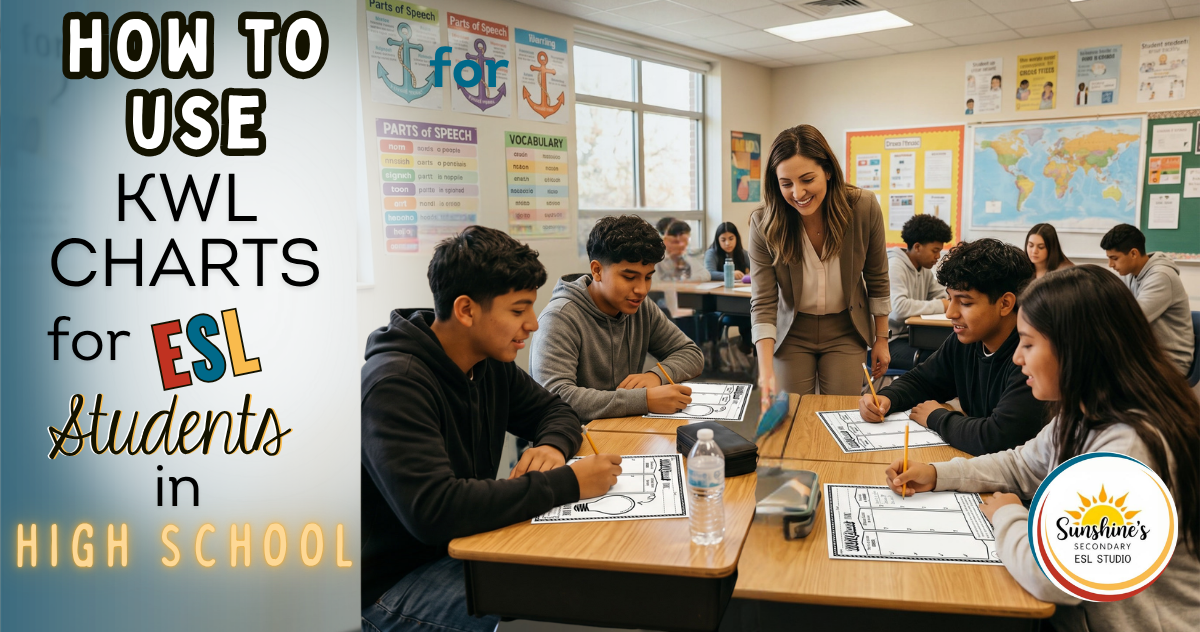
KWL charts for ESL students are one of the simplest—and most powerful—ways to build comprehension, activate prior knowledge, and guide meaningful learning in your classroom.
If you’re teaching ESL at the high school level, you already know your students come in with a wide range of language abilities. Some are ready to discuss ideas, while others are still building basic vocabulary. That’s exactly why strategies like KWL charts work so well—they meet students where they are.
This is especially important if you’re working with mixed proficiency levels like I talk about in Differentiating ESL Instruction A1–B2.
What Is a KWL Chart?
A KWL chart stands for:
- Know
- Wonder
- Learned
It’s a simple three-column graphic organizer that helps students:
✔ activate prior knowledge
✔ set a purpose for learning
✔ reflect on what they learned
You can use KWL charts:
- before reading a nonfiction text
- when introducing a new topic
- during research
- as a pre-writing strategy
If you use graphic organizers often, this pairs well with ESL Graphic Organizers for Literature.
Why KWL Charts Work So Well for ESL Students
KWL charts for ESL students do more than organize thinking—they reduce overwhelm.
Instead of jumping straight into reading or writing, students get time to:
- process ideas
- connect to what they already know
- build confidence before engaging with new content
This connects directly to comprehension strategies I explain in ESL Reading Comprehension High School.
Should ESL Students Use Their Native Language?
Let’s talk about something important.
Many teachers feel like everything has to be “English-only.” But here’s the reality:
Your students don’t think in English yet.
They think, process, and make meaning in their native language first.
Allowing students—especially beginners—to complete KWL charts in their native language:
✔ deepens understanding
✔ increases participation
✔ lowers anxiety
✔ builds stronger connections
This idea aligns closely with strategies in Translanguaging in the Secondary ESL Classroom.
Types of KWL Charts You Can Use
KWL charts have evolved over time, and that’s a good thing—especially for ESL learners.
Some variations include:
- Traditional KWL
- Visual KWL (great for beginners)
- KWLQ (adds questions)
- KWLS (adds search/research)
Visual supports are especially helpful for newcomers, which I talk more about in Beginner ESL High School.
How I Use KWL Charts in My ESL Classroom
In my classroom, KWL charts are part of a full learning cycle—not just a quick activity.
Here’s what it looks like:
Before the lesson:
Students complete the K and W sections (often in their native language)
During the lesson:
We revisit their questions and look for answers
After the lesson:
Students complete the L section using structured support
This works especially well when paired with writing scaffolds like Free ESL Sentence Starters for Teens.
Want a Ready-to-Use KWL Chart?
If you want something already scaffolded for your students:
Download my free KWL charts here
These include:
- visual supports
- beginner-friendly layouts
- multiple formats
If you’re building routines like this, tools like ESL Desk Mats for Back to School also help students stay independent during activities like KWL work.
Final Thoughts
KWL charts for ESL students are simple—but incredibly effective.
They give students structure.
They give students confidence.
And most importantly, they give students a way to take ownership of their learning.
If you’re building strong classroom routines overall, you might also like ESL Classroom Management Strategies for High School.