

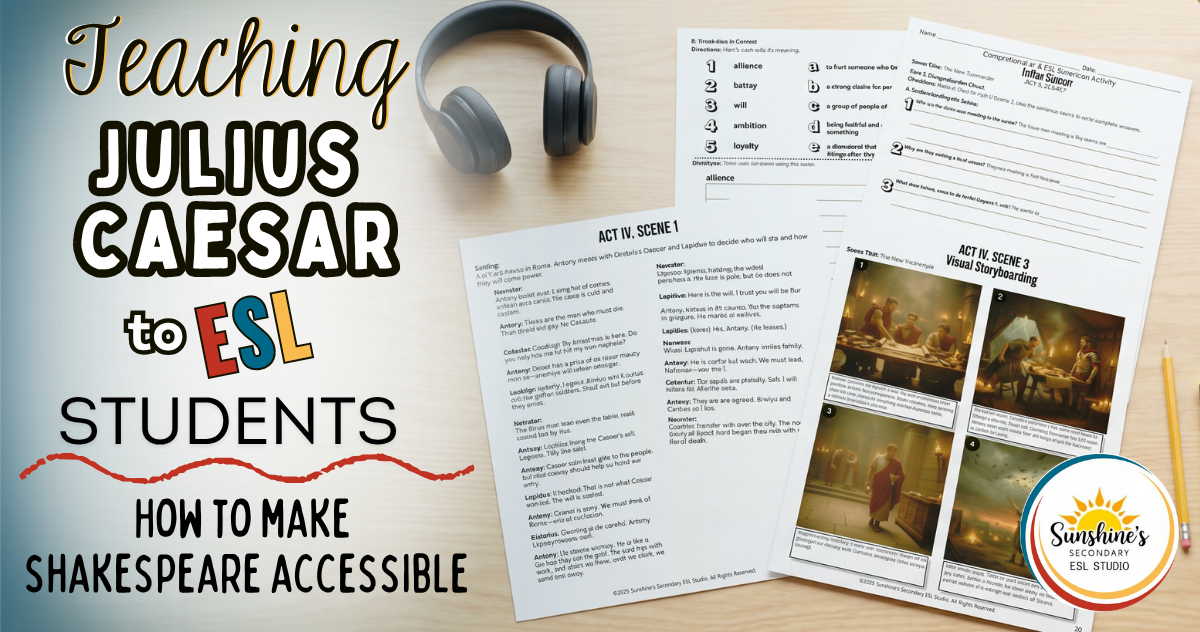
When I first told English teachers who don’t teach ESL that I would be teaching Julius Caesar to my ESL students, they could not quite wrap their heads around it.
“But Shakespeare’s language is so hard.”
“How will they understand any of it?”
“Are you using the original version?”
And honestly, I understood the concern. Shakespeare can feel intimidating even for native English speakers. For multilingual learners, the language, sentence structure, historical references, and figurative meaning can feel like a lot all at once.
But here is what I have learned: teaching Shakespeare to ESL students is not impossible. It just cannot look exactly the same as it does in a mainstream English classroom.
When we think carefully about how to teach Julius Caesar to ESL students, we have to focus on access first. That does not mean lowering the rigor. It means giving students the language supports, visuals, audio, background knowledge, and speaking opportunities they need so they can actually engage with the story.
And once they do? They understand far more than people expect.
Why Julius Caesar Still Belongs in the ESL Classroom
There is a reason Julius Caesar continues to show up in high school English classes. The play is packed with themes that teenagers understand: power, loyalty, betrayal, friendship, persuasion, fear, and ambition.
Students may not immediately understand Shakespearean language, but they do understand social pressure. They understand rumors. They understand wanting influence. They understand what it feels like when someone is trusted, manipulated, admired, or betrayed.
That is where the connection begins.
The problem is not that ESL students cannot understand the ideas in Julius Caesar. The problem is that the original language often blocks them from getting to those ideas in the first place.
That is why I approach Shakespeare the same way I approach many challenging texts in my ESL classroom: I scaffold the language so students can access the thinking. I still want them analyzing characters, making predictions, discussing themes, and writing about evidence. I just do not want archaic syntax to be the reason they shut down before we even begin.
If you are teaching other challenging texts with multilingual learners, you may also like my post on how to support ESL students during novel studies. A lot of the same principles apply here, especially when students need help managing longer texts, unfamiliar language, and abstract themes.
Start with the Story Before the Language
Before my students read any part of Julius Caesar, I want them to understand the world of the play.
Who is Caesar?
Why do some people love him?
Why are others afraid of him?
What does it mean when one person becomes too powerful?
I do not start with a long lecture. I start with visuals, discussion, and simple context. Students look at images of ancient Rome, crowds celebrating Caesar, worried senators, storms, warnings, and secret conversations.
This gives students something concrete to hold onto before they meet the text.
Instead of asking them to decode Shakespeare cold, I invite them into the conflict first. They can describe what they notice, make predictions, and start using language connected to the story.
Simple sentence frames help a lot:
I notice ___.
I think Caesar is ___ because ___.
Maybe the people feel ___.
This person looks worried because ___.
These small speaking moments matter. They help students build confidence before reading, and they make the play feel like a story instead of a wall of unfamiliar words.
This is also one reason I use so many visuals and organizers when teaching literature. For more ideas, you can read my post on ESL graphic organizers for literature, especially if your students need help tracking characters, conflict, and theme across a longer text.
Use Audio Before Reading
One of the biggest shifts I made when teaching Julius Caesar to ESL students was moving from “read first” to “listen first.”
Before students read a scene, I let them hear it.
The audio does not need to be long. In fact, shorter is better. I like using clearly voiced recordings in manageable chunks so students can focus on tone, emotion, and meaning without trying to decode every word at once.
After listening, I ask quick questions:
Who is speaking?
What emotion do you hear?
Does this character sound calm, angry, worried, or confident?
What do you think might happen next?
Then, when students finally see the adapted text, the language already feels familiar. They recognize the scene. They remember the voices. They have a sense of the conflict.
That small bit of recognition builds confidence.
Audio is especially helpful for ESL students because it supports listening comprehension, pronunciation, pacing, and fluency all at once. It also helps students hear drama as drama, not just words on a page.
If you use listening support often, my post on ESL listening activities for high school has more ideas for building listening practice into everyday lessons.
Use Modern English Adaptations Without Losing the Meaning
This is where adapted text makes a huge difference.
I know some teachers worry that using modern English takes something away from Shakespeare. I see it differently. For ESL students, a strong adaptation can be the bridge that finally allows them to access the story, the characters, and the themes.
The goal is not to erase Shakespeare. The goal is to help students understand him.
For example, in Act I, Cassius says:
“These growing feathers pluck’d from Caesar’s wing / Will make him fly an ordinary pitch.”
That line is powerful, but most A2–B1 ESL students are not going to understand it without major support.
A modern English adaptation might say:
“If we take away Caesar’s power now, he won’t rise above the rest of us later.”
Now students can actually discuss the metaphor. They can understand Cassius’s jealousy. They can talk about ambition, fear, and manipulation. They can begin to analyze the character instead of getting stuck on every unfamiliar word.
That is why I created my FREE Julius Caesar Adapted Text Sample with Audio for Act 1 Scene 1. It gives teachers a starting point if they want to see what Shakespeare can look like when it is adapted specifically for ESL students.
For the full first act, I also have the Julius Caesar Modern English Adaptations with Audio | Act 1 Bundle, which follows Caesar’s return to Rome, the Soothsayer’s warning, Cassius’s manipulation of Brutus, and the strange omens that foreshadow the conspiracy.
Keep the Text in Small Chunks
When teaching Julius Caesar to ESL students, chunking is everything.
A whole act is too much. A long scene can also be too much. But a short section with a clear purpose? That is manageable.
I like to break each scene into smaller parts and give students a focus for each one. They might read to find out:
Who wants power?
Who is afraid?
Who is trying to persuade someone?
What warning does Caesar ignore?
What does Brutus believe?
What does Cassius want?
This helps students read with a purpose. They are not just trying to “understand everything.” They are looking for specific meaning.
Chunking also makes it easier to stop and discuss. After each section, students can summarize what happened, act out a short exchange, complete a quick comprehension question, or respond to a sentence frame.
This is one of the biggest reasons I believe rigor in ESL has to look different. Students can absolutely do rigorous thinking, but they need the text broken into pieces that allow them to process language and meaning. I wrote more about that in my post on why rigor in ESL looks different.
Add Speaking Through Mini Drama
Shakespeare was meant to be performed, and that is actually a gift for ESL students.
After reading a short section, I like to have students act out small parts of the scene. This does not have to be a big performance. It can be as simple as two students reading a few lines with expression or a small group acting out the conflict using the adapted script.
When students perform, they have to think about meaning.
Is Cassius being friendly or manipulative?
Is Caesar confident or arrogant?
Is Brutus calm or conflicted?
Is the Soothsayer warning him gently or urgently?
These choices push students beyond basic comprehension. They start interpreting tone, motivation, and character relationships.
Mini drama also gives students a real reason to practice speaking. They are not just answering a question for the teacher. They are using English to bring the scene to life.
This connects well with speaking routines, too. If your students need more structured speaking practice before jumping into drama, you may find my post on how to build ESL speaking routines helpful.
Use Sentence Stems for Analysis
After students listen, read, and perform, I want them to write. But I do not want writing to become a guessing game.
Sentence stems help students move from comprehension to analysis without staring at a blank page.
For example:
Cassius wants Brutus to ___ because ___.
Caesar ignores the warning because ___.
The storm represents ___.
Brutus feels torn between ___ and ___.
One theme in this scene is ___ because ___.
These stems still require thinking. Students have to understand the scene, choose evidence, and explain their reasoning. The support simply gives them a structure for expressing those ideas in English.
Over time, students need fewer stems. At first, they may complete one sentence with a word bank. Later, they may write a full paragraph explaining how Cassius persuades Brutus or why Caesar ignores the warning.
That gradual release is where real growth happens.
If writing is one of the harder parts of your ESL classroom, you may also like my post on ESL writing support strategies.
What Act I Looks Like in My ESL Classroom
Act I is where students meet the major conflict, so I want it to feel clear and dramatic from the beginning.
In my classroom, Act I usually centers around three main moments:
The Celebration and the Scolding
Students learn that Caesar has returned to Rome and that not everyone is happy about it. The common people celebrate him, while the tribunes worry that the crowd is too quick to give Caesar power.
The Warning and the Ambition
Students hear the famous warning, “Beware the Ides of March,” and begin to see how Cassius uses fear, jealousy, and persuasion to influence Brutus.
The Night of Omens
Students explore the storm, strange signs, and growing sense of danger as the conspiracy begins to take shape.
By the end of Act I, students can usually explain the basic conflict: Caesar is becoming powerful, some Romans are afraid, and Cassius wants Brutus to join a plan against him.
Even better, they can talk about the bigger question:
Should one person have that much power?
That question leads to some of the best discussions. Students may not know every historical reference, but they understand power. They understand loyalty. They understand fear. They understand the pressure to choose sides.
That is where Shakespeare starts to feel alive.
Moving Beyond Act I
Once students understand the routine, the rest of the play becomes much more approachable.
I use the same basic structure across the acts:
Visual preview
Audio support
Adapted modern English text
Short reading chunks
Speaking or performance
Comprehension questions
Reflection or writing
This consistency helps students feel safe. They know what to expect, so they can focus more energy on meaning.
The later acts also give students rich opportunities to discuss character choices and consequences.
In Act 2, students watch Brutus wrestle with loyalty, fear, and the decision to join the conspiracy.
In Act 3, students experience the assassination and compare Brutus’s and Antony’s speeches in accessible language.
In Act 4, students see the consequences of betrayal, conflict, and civil unrest.
In Act 5, students follow the final battle and reflect on honor, regret, and Antony’s tribute to Brutus.
Each act builds on the last, and students begin to see how one choice leads to another.
Scaffolds That Help ESL Students Understand Julius Caesar
If you are wondering how to teach Julius Caesar to ESL students without overwhelming them, these are the supports I would start with:
Chunk the play into short, manageable scenes.
Preview characters, setting, and conflict with visuals.
Use audio before reading so students hear tone and emotion first.
Provide modern English adaptations for A2–B1 learners.
Use sentence stems for discussion and writing.
Let students act out short scenes instead of only reading silently.
Connect every scene back to universal themes like power, loyalty, ambition, persuasion, and betrayal.
Use graphic organizers to track character motivation and conflict.
These supports work especially well because they do not remove the thinking. They remove unnecessary language barriers so students can actually do the thinking.
That distinction matters.
Why Modern English Versions Do Not “Water Down” Shakespeare
I understand why some teachers feel protective of Shakespeare’s original language. The language matters. The rhythm matters. The imagery matters.
But students cannot appreciate language they cannot access.
For ESL students, a modern English version can actually make Shakespeare more meaningful because it allows them to understand the story first. Once they understand what is happening, they are in a better position to notice important original lines, compare versions, discuss figurative language, and analyze character choices.
A strong adaptation does not replace Shakespeare. It opens the door.
And for many multilingual learners, that door is the difference between feeling excluded from classic literature and realizing they can understand it after all.
Resources for Teaching Julius Caesar to ESL Students
If you want to try this approach without creating everything from scratch, I have a complete set of Julius Caesar ESL adapted texts with audio.
You can start with the FREE Julius Caesar Adapted Text Sample with Audio | Act 1 Scene 1 to see how the format works.
The full collection includes modern English adaptations, audio support, printable and digital formats, comprehension tasks, and speaking opportunities for ESL students.
You can browse each act individually:
Julius Caesar Modern English Adaptations with Audio | Act 1 Bundle
Julius Caesar Modern English Adaptations with Audio | Act 2 Bundle
Julius Caesar Modern English Adaptations with Audio | Act 3 Bundle
Julius Caesar Modern English Adaptations with Audio | Act 4 Bundle
Julius Caesar Modern English Adaptations with Audio | Act 5 Bundle
Or, if you want the full play in one place, you can explore the Julius Caesar ESL Adapted Play with Audio | Modern English Complete Bundle.
Final Thoughts
Teaching Julius Caesar to ESL students is not about making Shakespeare easy. It is about making Shakespeare possible.
When students can hear the story, see the conflict, read the language in an accessible way, perform the scenes, and write with support, they begin to understand that classic literature is not only for native English speakers.
It belongs to them, too.
And that is the part that makes this kind of teaching worth it.