

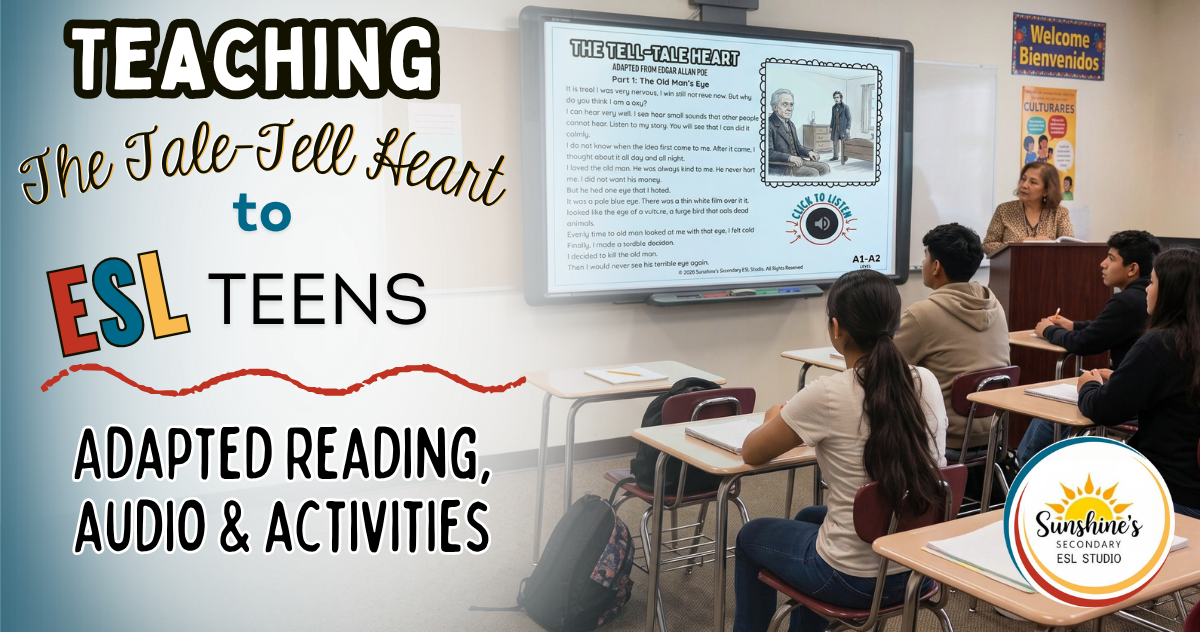
Teaching Edgar Allan Poe’s The Tell-Tale Heart can be a fantastic way to introduce suspense, mood, point of view, and the unreliable narrator. But if you teach secondary English learners, there is an obvious problem: students cannot analyze a story they cannot understand.
Poe’s language can be difficult even for native English speakers. Long sentences, unfamiliar vocabulary, figurative language, unusual syntax, and the narrator’s frantic voice can make the original text overwhelming for beginning and intermediate English learners.
That does not mean your ESL students need to skip Poe—or that you have to replace meaningful literary analysis with an oversimplified worksheet.
The goal is to adapt the language, not the thinking.
With the right scaffolds, beginning and intermediate English learners can read The Tell-Tale Heart, discuss what is happening, identify evidence, analyze suspense and mood, examine the narrator’s point of view, and write about the story.
And they can often do it in the same classroom.
The Tell-Tale Heart ESL Lesson at a Glance
Best for: Secondary ESL, middle school, and high school English learners
Levels: A1–B2
Skills: Reading, listening, speaking, comprehension, literary analysis, and writing
Literary focus: Suspense, mood, narrator, point of view, text evidence
Helpful supports: Adapted text, audio/read-along support, visuals, sentence frames, and differentiated questions
If you want to see what an adapted classic can look like before planning the full story, start with my FREE ESL Short Story Sampler | The Tell-Tale Heart & The Monkey’s Paw with Audio.
It gives you a chance to try adapted classic literature and audio support with your students before committing to a complete unit.
Why The Tell-Tale Heart Is Challenging for English Learners
One of the biggest mistakes we can make with English learners is assuming that difficulty equals rigor.
Giving a student a text filled with language they cannot decode does not automatically make the lesson rigorous. Sometimes it simply prevents the student from reaching the thinking we actually want them to do.
This is especially important with Poe.
Before students can explain how the narrator creates suspense or whether he can be trusted, they first need to understand basic questions such as:
- Who is telling the story?
- What does the narrator want?
- What happens to the old man?
- Why does the narrator become increasingly nervous?
- What does he believe he hears?
- Why does he finally confess?
Once students understand the story, we can move into the deeper questions.
That progression matters in any ESL reading lesson. I talk more about this in ESL Reading Comprehension for High School and What to Do When ESL Students Are Reading Below Grade Level.
The goal is not to remove challenging ideas.
It is to give students enough language access to engage with them.
Choose the Right Adapted Reading: A1–A2 or B1–B2
A mixed-level ESL class does not necessarily need completely different literature lessons.
Students can study the same story and the same literary concepts while receiving different levels of language support.
For The Tell-Tale Heart, I like dividing that support into two pathways.
A1–A2 English Learners
Beginning and high-beginning students may need:
- shorter sentences
- more direct vocabulary
- visual vocabulary support
- clearly chunked sections
- audio while reading
- comprehension checks after small portions of text
- evidence choices
- sentence frames for discussion and writing
A student might respond to an unreliable-narrator question with:
I think the narrator is unreliable because ______.
That is still literary analysis. The language demand has simply been scaffolded.
B1–B2 English Learners
Intermediate students can work with:
- more complex sentence structures
- richer vocabulary
- more independent reading
- open-ended comprehension questions
- independently selected text evidence
- more developed literary analysis
- claim-evidence-explanation writing
A B1–B2 student might take the same idea further by explaining how the narrator’s words conflict with his actions.
The students are still participating in a shared lesson about narrator reliability. The expected language output changes.
That is one reason I created The Tell-Tale Heart Differentiated Reading & Audio | ESL English Learners A1–B2 with separate A1–A2 and B1–B2 adaptations.
If you regularly teach several proficiency levels in one secondary ESL classroom, you may also find my post on Differentiating ESL Instruction from A1–B2 helpful.
Before Reading: Build Vocabulary and Get ESL Teens Talking
Students do not need a lengthy lecture about Poe before beginning the story.
A few carefully chosen supports are usually more valuable.
Start with the vocabulary students genuinely need in order to understand the action. Whenever possible, pair new vocabulary with visuals, simple definitions, examples, or gestures.
Then give students a reason to talk.
You might ask:
- What kinds of sounds make people nervous?
- Can fear make someone imagine things?
- Why might someone feel guilty after doing something wrong?
- Can a person tell a story and still not be trustworthy?
- What makes a story suspenseful?
Beginning students can use sentence frames:
I feel nervous when ______.
A scary sound is ______.
I think a narrator can/cannot be trusted because ______.
More proficient students can expand their reasoning.
This kind of prereading discussion builds background knowledge while also giving students an opportunity to rehearse language they will encounter again during the story.
If you want more ways to build structured student talk, see How to Build ESL Speaking Routines.
Optional: Introduce Edgar Allan Poe First
Some classes benefit from learning a little about the author before reading.
Poe’s life, his influence on Gothic literature, and the recurring themes in his writing can give students useful context without turning the lesson into a long biography unit.
For an ESL-friendly option, I created an Edgar Allan Poe ESL Biography Reading with Audio & Activities that can be used before beginning the story.
Read and Listen: Use Audio Support for Comprehension
Audio should do more than play in the background while students follow along.
For English learners, audio can become part of the comprehension process.
One routine I like is:
Listen → Read Along → Pause → Check Understanding → Replay → Discuss
On the first listen, students can focus on the overall meaning.
On the second, they can follow the written text.
Then pause after a manageable section and ask one or two comprehension questions.
Later, replay a particularly suspenseful section and shift the focus from comprehension to analysis.
Now students can listen for:
- repetition
- changes in pacing
- the narrator’s emotions
- important sounds
- moments when tension increases
The same piece of audio can support reading comprehension, listening comprehension, pronunciation awareness, and literary analysis.
That is much more purposeful than simply telling students, “Here is the audiobook.”
You can find more ideas for using audio with teens in ESL Listening Activities for High School and Cloze Listening Activities for ESL.
Move From Reading Comprehension to Literary Analysis
One of the most important parts of teaching literature to English learners is building a visible bridge between understanding the story and analyzing it.
I think of the process like this:
Understand → Sequence → Identify → Find Evidence → Explain → Discuss → Write
Students should not be expected to jump directly from decoding Poe to writing a literary-analysis paragraph.
Start with literal comprehension.
What happened?
What did the narrator do?
What happened next?
Then begin moving into interpretation.
Why is that detail important?
What does it reveal about the narrator?
How does it affect the reader?
What evidence supports your answer?
This gradual progression keeps rigor intact without expecting students to perform several difficult language and thinking tasks at once.
Teach Suspense and Mood With Text Evidence
The Tell-Tale Heart is especially useful for teaching suspense because students can usually feel the tension before they have the academic English to explain how Poe creates it.
Use that.
Ask students to identify a moment when they felt nervous or expected something bad to happen.
Then move from reaction to evidence.
Beginning students might complete:
Poe creates suspense when ______.
The sound of ______ makes the scene feel ______.
Students ready for more complex analysis might use:
The repetition of ______ creates suspense because ______.
Poe increases tension by ______, which makes the reader ______.
Now students are moving from personal reaction to literary analysis.
And importantly, they are using evidence rather than simply saying, “It was scary.”
Teach Point of View and the Unreliable Narrator
The narrator is one of the best reasons to teach The Tell-Tale Heart.
Students quickly realize something is wrong with the way he tells his story.
He insists that he is rational.
But should we believe him?
This makes the story a natural text for teaching first-person point of view and narrator reliability.
Try separating the narrator’s claims from his actions.
| What the narrator says | What the narrator does |
|---|---|
| He insists that he is sane. | He secretly watches the old man night after night. |
| He believes his senses are unusually sharp. | He becomes obsessed with sounds around him. |
| He believes he has planned everything perfectly. | His behavior eventually leads to his confession. |
Even beginning English learners can notice contradictions when the language is made accessible.
Then differentiate the response.
An A1–A2 student might choose evidence and complete:
The narrator says ______, but he ______. I think he is/is not reliable.
A B1–B2 student can explain how the contradiction between the narrator’s statements and behavior affects our interpretation of the story.
That is a much stronger form of differentiation than simply giving one group fewer questions.
Before They Write, Let English Learners Rehearse Their Analysis Aloud
Speaking can be the bridge between understanding an idea and successfully writing it.
Before asking students to write about suspense, mood, or narrator reliability, give them a chance to say their answer to a partner.
Try frames such as:
I think the narrator is ______ because ______.
One piece of evidence is ______.
This evidence shows ______.
More advanced students might use:
The narrator appears unreliable because ______. The evidence ______ suggests that ______.
Students are rehearsing the structure of analytical writing before they have to produce it independently.
This is especially useful for students who understand the story but freeze when faced with a blank page.
I use the same idea in broader writing instruction, which I discuss in ESL Writing Support Strategies.
Move Into Evidence-Based Literary Analysis Writing
Once students have read, listened, discussed, and located evidence, writing becomes much less intimidating.
A simple short constructed response can ask:
How does Poe create suspense in The Tell-Tale Heart? Use evidence from the story to support your answer.
Or:
Is the narrator reliable? Use evidence from the story to explain your answer.
Beginning students can work from a structured claim-and-evidence frame.
Intermediate students can move toward:
Claim → Evidence → Explanation
The important part is that students are still doing authentic literary analysis.
They are not being removed from the core skill because they are learning English.
The scaffolding gives them a way into it.
The Tell-Tale Heart ESL Activities for a Complete Unit
If you already have a version of the story you plan to use but need the instructional pieces around it, my The Tell-Tale Heart Differentiated ESL Activities | Reading Comprehension includes differentiated activities designed to move students beyond simple comprehension.
The activities address reading comprehension and literary analysis while incorporating listening, speaking, evidence, and writing.
If you want the adapted readings, audio, and activities together, the The Tell-Tale Heart Differentiated ESL Unit | Adapted Text, Audio & Activities combines the complete instructional sequence in one resource.
Teaching The Tell-Tale Heart in a Mixed-Level ESL Class
Mixed-proficiency classes can make literature especially challenging.
You may have one student who needs strong language support sitting beside another who is ready for much more independent analysis.
They do not necessarily need separate lessons.
A mixed-level lesson might look like this:
Everyone: Participate in the same prereading question or visual discussion.
A1–A2: Read the more supported adaptation with audio and complete scaffolded comprehension.
B1–B2: Read the more complex adaptation and respond to extension questions.
Everyone: Discuss the narrator, suspense, or mood as a class.
A1–A2: Complete a sentence-supported evidence response.
B1–B2: Write an expanded claim-evidence-explanation response.
Same story.
Same essential literary concept.
Different linguistic access.
That is the kind of differentiation I want for secondary English learners.
A Quick Teacher Note About the Story
The Tell-Tale Heart includes murder, disturbing behavior, and Poe’s repeated use of language about madness.
Before teaching it, consider the age, maturity, and experiences of your students.
It is also worth distinguishing literary analysis of the narrator’s behavior from attempting to diagnose him with a mental-health condition. English learners may take unfamiliar language particularly literally, so phrases and concepts may need a little contextual explanation.
Try a Free Tell-Tale Heart ESL Sample
If you are not sure which level will work best with your students—or you simply want to try adapted classic literature before planning a complete unit—you can start with my FREE ESL Short Story Sampler | The Tell-Tale Heart & The Monkey’s Paw with Audio.
It includes samples from both classic short stories and gives you a chance to see how adapted reading and audio support can help English learners access literature that might otherwise be out of reach.
And if your students enjoy Poe, you might follow The Tell-Tale Heart with another suspenseful classic. I recently wrote about Teaching The Monkey’s Paw to ESL Students, which makes a natural companion text.
Frequently Asked Questions About The Tell-Tale Heart for ESL Students
Is The Tell-Tale Heart appropriate for ESL students?
Yes, especially when the language and instructional supports match students’ English proficiency. Beginning learners may need an adapted version, vocabulary support, audio, and sentence frames, while intermediate students can work toward increasingly independent literary analysis.
Can beginner English learners read The Tell-Tale Heart?
The original text will be difficult for many beginners, but an adapted A1–A2 version can make the plot and major literary concepts accessible without eliminating the central ideas of the story.
What point of view is The Tell-Tale Heart written in?
The story uses first-person point of view. Because readers experience events entirely through the narrator’s account, the story is particularly useful for teaching narrator reliability.
Why is the narrator considered unreliable?
The narrator repeatedly insists that he is rational, but his actions and perceptions cause readers to question his account. Students can compare what he says about himself with what he actually does.
How does Poe create suspense in The Tell-Tale Heart?
Students can examine repetition, pacing, sound, the narrator’s increasingly anxious voice, and the delay before key events. These techniques provide excellent opportunities for evidence-based literary analysis.
How can I teach The Tell-Tale Heart to mixed-level English learners?
Keep the literary objective shared while differentiating the language students use to access and respond to the text. Beginning students may use adapted text, audio, evidence choices, and sentence frames, while more proficient students work with more complex language and increasingly independent analysis.
Final Thoughts
Classic literature does not have to be reserved for the students who already have the English proficiency to read it independently.
When we provide adapted language, audio support, explicit comprehension scaffolds, opportunities to speak, and a clear path toward evidence-based writing, English learners can participate in the same meaningful literary conversations as their peers.
That is the goal when I teach literature to ESL teens:
Adapt the language, not the thinking.