
Fall can be such a fun time to teach cultural reading lessons, but I always want those lessons to be more than cute seasonal activities. A strong Halloween and Día de los Muertos ESL lesson can help students build background knowledge, practice academic vocabulary, compare two cultural traditions, and write about what they learned.
For ESL teens, this type of lesson works especially well because both holidays are visual, memorable, and connected to big ideas like tradition, remembrance, fear, family, and culture. Students are not just reading about holidays. They are learning how to compare and contrast two celebrations with different histories, symbols, and meanings.
That is why I like using Halloween and Día de los Muertos together as a paired-text reading activity. It gives students a clear purpose for reading, and it naturally leads into discussion, vocabulary practice, and short constructed response writing.
Why Teach Halloween and Día de los Muertos Together?
Halloween and Día de los Muertos are often mentioned around the same time of year, but they are not the same holiday. That difference is actually what makes them so useful for ESL instruction.
When students compare the two, they can explore questions like:
- What traditions are connected to each holiday?
- How do people use symbols, food, clothing, and decorations?
- What do these holidays show about culture and beliefs?
- How are the holidays similar?
- How are they different?
This kind of comparison helps students move beyond basic comprehension. They have to notice details, explain ideas, and use evidence from both texts.
It also supports the type of academic thinking students need in English class. If you are working on reading comprehension with multilingual learners, this connects well with broader strategies for ESL reading comprehension in high school.
Why Cultural Reading Lessons Work So Well for ESL Teens
Cultural topics can be especially powerful in secondary ESL classrooms because students often bring their own experiences, languages, and traditions into the conversation. Some students may already know a lot about Día de los Muertos. Others may be more familiar with Halloween. Some may celebrate completely different holidays.
That mix creates natural opportunities for discussion.
A culturally meaningful reading lesson can help students:
- build background knowledge
- learn academic and cultural vocabulary
- connect new information to their own experiences
- practice respectful discussion
- strengthen reading and writing skills
This is also why I try to include culturally relevant lessons throughout the year, not only during holidays. I wrote more about that in my post on culturally responsive teaching for ESL teens.
Start with Background Knowledge
Before students read, I like to begin with a simple warm-up or anticipation guide. This gives students a reason to think before they start the passage.
You might use statements like:
- Halloween and Día de los Muertos are the same thing.
- Holidays can teach us what a culture values.
- Some traditions help people remember loved ones.
- Symbols can have different meanings in different cultures.
Students can agree, disagree, and explain their thinking. For lower-level students, they can simply choose agree or disagree first. Then you can provide sentence frames such as:
- I agree because ___.
- I disagree because ___.
- I think this means ___.
- In my culture, ___.
This gives students a low-pressure way to enter the topic before reading.
If your students need more structured warm-ups, this type of activity also pairs well with KWL charts for ESL students. A KWL chart can help students organize what they already know, what they wonder, and what they learn after reading.
Use Accessible Informational Texts
The heart of this lesson is the reading. Students need texts that are clear, respectful, and accessible without feeling babyish.
For a strong Halloween and Día de los Muertos ESL lesson, I recommend using two short informational texts: one about Halloween and one about Día de los Muertos. This allows students to read each holiday separately before comparing them.
When choosing or creating the texts, I look for:
- clear headings
- student-friendly definitions
- cultural vocabulary in context
- enough detail for comparison
- language that matches my students’ proficiency levels
- visuals or audio support when possible
This is where differentiation matters. A newcomer and an advanced ESL student should not always be expected to read the exact same version of a text without support. You can read more about that in my post on differentiating ESL instruction from A1 to B2.
In my own classroom resources, I like to include leveled readings so students can work with the same topic at an appropriate level. That way, everyone can participate in the same class conversation, even if they are reading different versions of the passage.
Teach Vocabulary Before and During Reading
A lesson like this gives students a great chance to learn both cultural and academic vocabulary.
Some useful words might include:
- tradition
- symbol
- remembrance
- ancestors
- altar
- costume
- superstition
- celebration
- compare
- contrast
Instead of giving students a long vocabulary list and moving on, I like to connect the words to the reading. Students can match words to pictures, complete sentence frames, or sort words by holiday.
For example:
- An altar is connected to ___.
- A costume is often connected to ___.
- Remembrance means ___.
- Both holidays include ___, but only ___ includes ___.
This gives students more than word recognition. They start using the vocabulary to explain ideas.
For more vocabulary support ideas, you might also like my post on ESL vocabulary activities for high school.
Add Audio Support for Listening Practice
One thing that helps ESL students a lot is hearing the text while they read. Audio gives students another way to access the passage, especially if they are still developing confidence with English pronunciation and fluency.
You can use audio in a few different ways:
- Students listen once without writing.
- Students listen and follow along with the text.
- Students highlight key vocabulary as they hear it.
- Students replay the audio independently during station work.
- Students answer comprehension questions after listening and reading.
This turns the lesson into both a reading and listening activity. It also supports students who may understand more when they hear the rhythm and pronunciation of the language.
If you use audio often, I also have a post on ESL listening activities for high school with more ideas for making listening practice feel purposeful instead of random.
Guide Students Through Compare and Contrast Thinking
After students read both passages, they need a structured way to compare the holidays. A Venn diagram or T-chart works well because students can visually organize similarities and differences before writing.
You might have students look for:
- dates
- symbols
- clothing
- food
- decorations
- purpose
- mood or tone
- family traditions
- cultural meaning
Students can begin with simple notes:
- Halloween is celebrated on October 31.
- Día de los Muertos is celebrated on November 1 and 2.
- Both holidays include decorations.
- Halloween often focuses on fear and costumes.
- Día de los Muertos focuses on remembering loved ones.
Then they can turn those notes into stronger sentences:
- Both Halloween and Día de los Muertos happen in the fall, but they have different meanings.
- Halloween is often connected to costumes and scary traditions, while Día de los Muertos is connected to remembrance and family.
- Both holidays use symbols, but the symbols represent different ideas.
This step is important because many ESL students understand the content but need help turning their ideas into academic language.
Move into Short Constructed Response Writing
Once students have compared the holidays, they can write a short constructed response.
A strong prompt might be:
Compare and contrast Halloween and Día de los Muertos. How are the two holidays similar, and how are they different? Use details from both texts in your response.
Before students write, I like to give them a simple organizer. They can plan:
- one similarity
- one difference
- evidence from the Halloween text
- evidence from the Día de los Muertos text
- a concluding sentence
Sentence frames can also help:
- Halloween and Día de los Muertos are similar because ___.
- One important difference is ___.
- In the Halloween text, I learned ___.
- In the Día de los Muertos text, I learned ___.
- These holidays show ___.
This keeps the writing focused without taking away the thinking. Students still have to compare, explain, and use text evidence.
If writing is an area where your students need more support, I have a full post on ESL writing support strategies that connects well with this kind of lesson.
Add Speaking Without Making It Stressful
After students finish their organizers or written responses, I like to give them a chance to talk through their ideas. This does not have to be a big presentation.
Students can share with a partner:
- one thing they learned about Halloween
- one thing they learned about Día de los Muertos
- one similarity between the holidays
- one difference between the holidays
- one tradition from their own culture or family
This gives students speaking practice that is connected to something they already read and wrote about. That structure helps reduce the pressure.
For more ways to build student talk into lessons, you may want to read my post on ESL teen speaking activities.
Supporting Cultural Understanding
Many ESL teachers may have students who celebrate Día de los Muertos or have family connections to the tradition. Because of this, it can be helpful to approach the topic as a cultural learning opportunity rather than simply a holiday comparison.
When discussing Día de los Muertos, encourage students to share what they know if they feel comfortable, while recognizing that experiences and traditions can vary from family to family and region to region.
Using paired texts allows students to explore similarities and differences between Halloween and Día de los Muertos while building reading, vocabulary, and critical thinking skills. It also helps students understand that each celebration has its own history, purpose, and traditions.
A Ready-to-Use Halloween and Día de los Muertos ESL Lesson
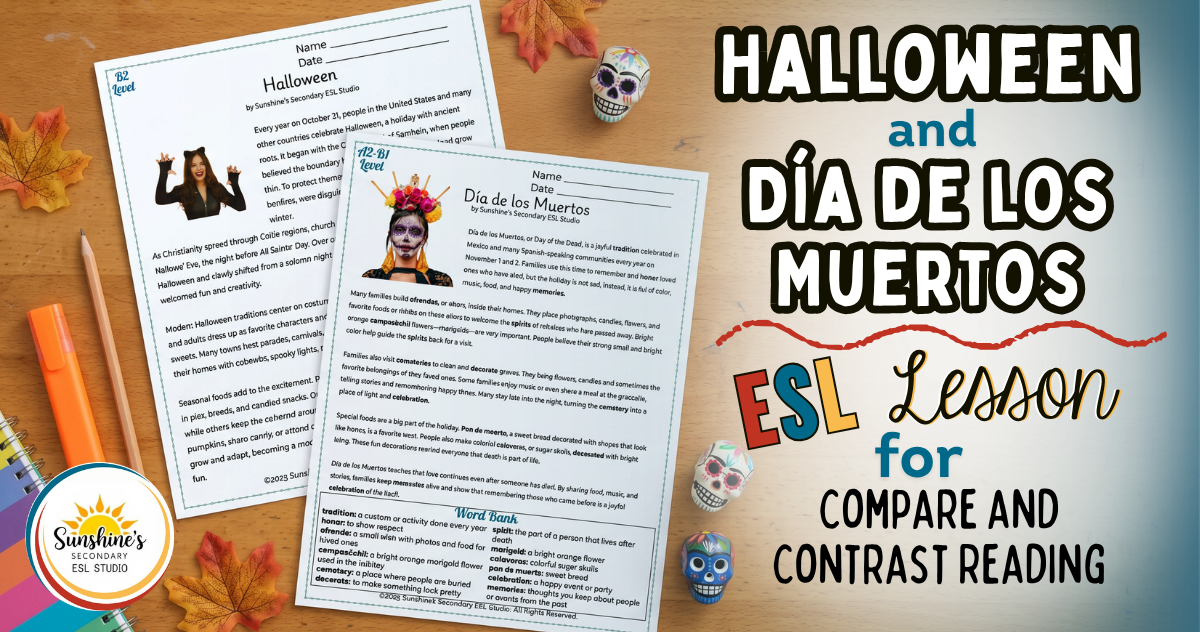
If you want this lesson ready to go, I created a Halloween + Día de los Muertos ESL Informational Texts with Audio resource for secondary ESL students.
It includes:
- Halloween informational reading passages
- Día de los Muertos informational reading passages
- two reading levels for differentiation
- audio support
- comprehension questions
- vocabulary practice
- context clues activities
- short constructed response organizers
- final draft writing pages
- a paired-text compare and contrast activity
The goal is to make the lesson academic, accessible, and engaging without requiring you to build everything from scratch during one of the busiest parts of the school year.
You can use the readings separately, or you can teach them together as a compare and contrast lesson.
Final Thoughts
A Halloween and Día de los Muertos ESL lesson can be much more than a seasonal activity. With the right structure, students can practice reading comprehension, vocabulary, listening, speaking, and short constructed response writing.
More importantly, they can learn how to compare cultural traditions respectfully and thoughtfully.
For ESL teens, that combination matters. They need lessons that are accessible, but they also deserve lessons that are meaningful and rigorous. Paired cultural readings give them a way to build language while thinking deeply about the world around them.