
If you’ve ever taught a novel or short story to English learners, you’ve probably seen it happen—students reading the words, but not really understanding what’s going on.
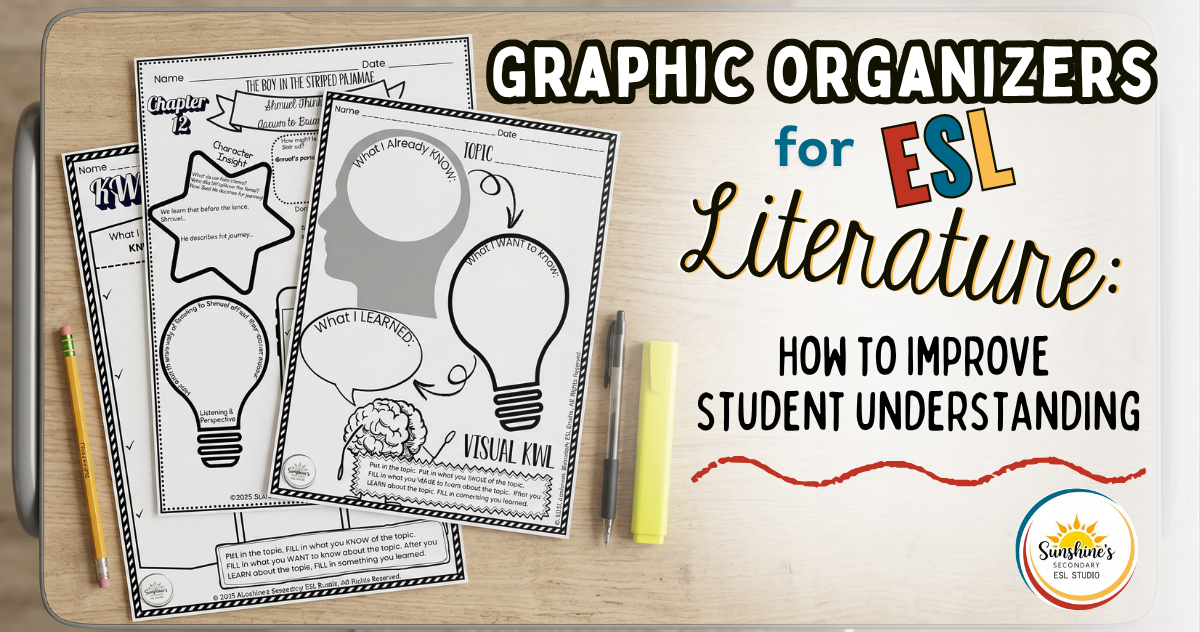
That’s exactly why graphic organizers for ESL literature have become one of the most important tools in my classroom.
They don’t just “help”—they completely change how students process, organize, and respond to what they read.
And once I started using them consistently, I saw a huge shift in comprehension, participation, and confidence.
If you’re already working on building stronger reading routines, this pairs really well with strategies from: ESL Reading Comprehension for High School
1. Graphic Organizers for ESL Literature Make Complex Texts Manageable
Reading in a second language isn’t just about vocabulary—it’s about holding multiple ideas at once:
- characters
- setting
- conflict
- theme
That’s where graphic organizers come in.
Instead of expecting students to keep everything in their heads, I give them a structure that helps them track their thinking as they read.
My go-to setups include:
- character charts with visuals
- chapter summary boxes
- quote + response sections (with sentence frames)
For students who need extra support, pairing this with: Free ESL Sentence Starters for Teens
makes a huge difference in getting complete responses.
2. They Turn Silence into Structured Discussion
Asking open-ended questions like “What does this text mean?” rarely works with ESL students.
But when students first organize their thinking, everything changes.
With a graphic organizer, students come to discussions already prepared with:
- ideas
- examples
- language support
That’s when you start seeing real participation.
If you’re working on getting students to speak more confidently, this connects really well with: ESL Speaking Confidence Activities
3. They Make Differentiation Actually Manageable
One of the hardest parts of teaching ESL literature is handling multiple levels at once.
Graphic organizers solve that.
Instead of creating completely different lessons, I just adjust the support:
A1–A2:
- visuals
- word banks
- sentence starters
B1–B2:
- open responses
- quote analysis
- theme tracking
If differentiation is something you’re constantly juggling, this strategy aligns closely with: Differentiating ESL Instruction for A1 to B2
4. They Improve Writing Without Extra Work
Here’s something I didn’t expect:
When students use graphic organizers consistently, their writing improves automatically.
Why?
Because they already have:
- organized ideas
- text evidence
- partial sentence structures
So when it’s time to write, they’re not starting from zero.
If you’re trying to build stronger writing alongside reading, you might also find this helpful: ESL Writing Support Strategies
5. They Make Assessment Clear (and Faster)
Graphic organizers also make it much easier to see what students actually understand.
Instead of guessing, you can quickly identify:
- who understands the text
- who is missing key ideas
- who needs reteaching
This connects directly to how you monitor progress during a unit—and even how you approach grading: Grading ESL Students in High School
Final Thoughts: Why Graphic Organizers for ESL Literature Work
Using graphic organizers for ESL literature isn’t about giving students more work—it’s about giving them the structure they need to succeed.
They:
- reduce overwhelm
- support comprehension
- improve discussion
- strengthen writing
And most importantly—they help students actually understand what they’re reading.
If you’re looking for ready-to-use tools, I’ve created graphic organizers designed specifically for ESL literature units—leveled, student-friendly, and easy to use with any text.