
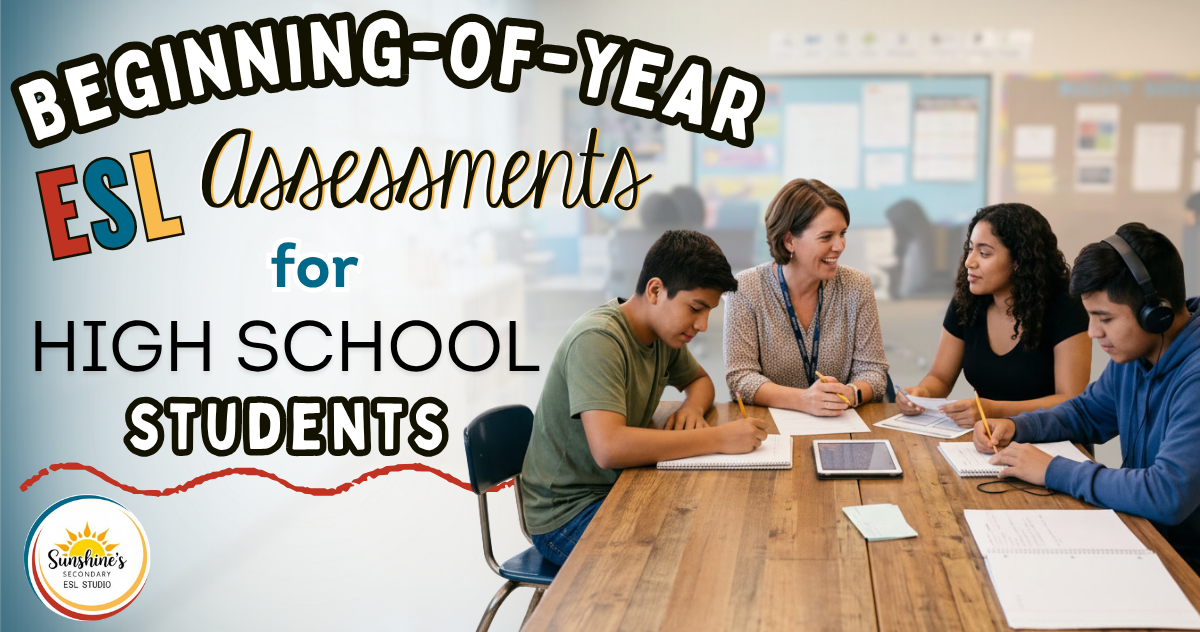
Beginning of year ESL assessments high school teachers use should reveal what students can do in speaking, listening, reading, and writing without turning the first week into a testing marathon.
At the start of the school year, secondary ESL teachers often have a class full of students whose files tell only part of the story. One student may speak confidently with classmates but struggle to write a paragraph. Another may read grade-level text in a first language but be brand new to English. A third may understand much more than they are ready to say during the first week of school.
That is why I do not rely on one long placement test or one grammar worksheet. I prefer several short, age-appropriate diagnostic tasks spread across multiple class periods. Together, those small pieces of evidence help me identify strengths, plan instruction, form temporary groups, and set useful language goals.
The purpose is not to catch students making mistakes. It is to answer a much more helpful question:
What can this student already do, what support makes success possible, and what should we teach next?
If students are still learning the room, the schedule, and basic classroom expectations, begin with low-pressure first-day activities for ELL students before asking them to complete formal-looking tasks. For brand-new English learners, my first 30 days with a newcomer in high school ESL offers a slower, survival-language-focused starting point.
Beginning of Year ESL Assessments High School Teachers Can Use: What You Need to Learn
A useful beginning-of-year diagnostic should give you information you can act on. You do not need a perfect proficiency label by Friday. You need enough evidence to make better instructional decisions on Monday.
By the end of the assessment process, I want to know:
- Can the student understand familiar classroom directions?
- Can the student communicate basic needs, experiences, and ideas?
- Is the student’s speech understandable, even when grammar is still developing?
- Can the student read an age-appropriate text and explain the central meaning?
- Can the student write words, sentences, or connected paragraphs independently?
- Which visuals, sentence frames, audio supports, word banks, or first-language resources help?
- How confident and independent does the student feel in each language domain?
Notice that these questions do not produce one simple label. A student can be stronger in listening than speaking, stronger in reading than writing, or conversationally fluent while still needing substantial academic-language support.
That uneven profile is normal. It is also the reason multiple small assessments are more useful than one large test.
Keep classroom diagnostics separate from official placement procedures
An informal classroom baseline can guide your teaching, but it should not replace any district-required identification, placement, language-proficiency, special education, or accommodation process. Use official records and required assessments when they are available. Then add classroom evidence to understand how the student uses English during real secondary tasks.
Gather Context Before You Test English
Before I interpret a student’s performance, I try to learn about the student behind the paper.
A short student profile, conversation, or family questionnaire can help you learn:
- Languages the student speaks, reads, and writes
- Length and continuity of prior schooling
- Previous experience learning English
- Favorite and most difficult school subjects
- Access to glasses, hearing support, technology, or other accommodations
- Interests, goals, and preferred ways to participate
- Whether the student feels more comfortable responding orally, in writing, through visuals, or in a first language
This context matters. A student who has had interrupted schooling may need a different kind of support from a student who completed rigorous coursework in another country. A newcomer who remains silent during the first week may be processing language, observing routines, or protecting themselves socially. Silence alone is not evidence that the student knows nothing.
I also allow students to use their full linguistic resources when I am trying to understand what they know. A quick first-language explanation, labeled drawing, bilingual word list, or translated response can help separate a language barrier from a content gap. My posts on translanguaging in the secondary ESL classroom and native-language use in the ESL classroom explain why strategic first-language support can give teachers clearer information rather than less rigorous information.
A Five-Day Plan for Beginning of Year ESL Assessments High School Teachers Can Use
You can spread the following plan across one week, two weeks, or short portions of several class periods. The exact schedule matters less than keeping each task brief and giving students more than one way to show what they can do.
| Day | Main evidence to collect | Low-pressure task ideas |
|---|---|---|
| Day 1 | Student background, classroom independence, comfort level | Student profile, name activity, visuals, informal conversation, routine observation |
| Day 2 | Listening, speaking, and pronunciation | Follow directions, listen and select, short interview, picture description, recorded word list |
| Day 3 | Reading | Leveled passage, oral reading sample if appropriate, comprehension questions, short retell |
| Day 4 | Writing, grammar, and vocabulary | Independent writing sample, supported response, short grammar and vocabulary check |
| Day 5 | Clarification, self-assessment, and goals | Brief conference, second-chance task, student reflection, first language-learning goal |
Day 1: Make Beginning of Year ESL Assessments High School Students Can Enter Successfully
The first day should not feel like an interrogation. I begin by observing how students enter the room, locate materials, respond to visuals, follow modeled directions, and ask for help.
A student information activity can provide useful evidence without announcing, “This is a test.” Students might write or select their name, languages, interests, favorite subject, and one hope for the year. Newcomers can point, circle, draw, copy, or respond in a first language.
The free ESL Newcomer First Day Mini Kit can support this kind of low-pressure entry task. The goal on Day 1 is not to determine a final level. It is to build enough safety that later samples are more representative.
Day 2: Collect listening, speaking, and pronunciation evidence
Use short tasks instead of one extended interview. Ask students to follow a few classroom directions, listen to a brief message, answer familiar questions, and describe a visual. If students are anxious speaking live, let them rehearse with a partner or record a response privately.
A separate pronunciation check can help you identify specific sounds or word patterns without confusing accent with overall language ability. More on that distinction appears below.
Day 3: Observe the reading process
Give students a short, age-respectful text. Include a title or visual, a few literal questions, and at least one question that requires students to explain meaning. If the first text is clearly too difficult or too easy, move to a shorter or more complex version rather than making the student struggle through the entire task.
Day 4: Gather two writing samples
I like to collect one independent sample and one supported sample. The independent sample shows what students can produce without help. The supported sample shows what becomes possible with a word bank, sentence starters, a model, or a short discussion first.
That difference is valuable. It tells you not only where the student is now, but also which scaffolds may help the student participate in upcoming lessons.
Day 5: Clarify, reflect, and choose a goal
Use the final day to revisit anything that did not make sense. A student may have misunderstood the directions, frozen during an interview, or rushed through a writing task. A brief conference or second attempt can prevent one difficult moment from defining the student’s baseline.
Then invite the student into the process. Ask which task felt easiest, which felt hardest, and what they would most like to improve. My guide to ELL goal setting in high school can help turn that reflection into one specific, student-friendly goal.
How to Assess Listening Without Turning It Into a Memory Test
Listening is often the least visible language domain. Students may appear to understand because they are watching classmates, following a routine, or copying what others do. A short listening check helps you see what they understand from spoken English itself.
Try three types of listening tasks:
- Listen and do. Give one-step directions such as “Circle the date” or “Put the paper under your notebook.” Later, try a two-step direction.
- Listen and select. Read or play a short statement while students choose a matching picture, word, or answer.
- Listen for meaning. Share a brief, age-appropriate message and ask for the main idea, one detail, or the correct sequence.
Record more than right or wrong answers. Notice whether the student:
- Understands after one presentation or needs repetition
- Uses visuals, gestures, or context effectively
- Recognizes familiar classroom vocabulary
- Understands the main idea but misses details
- Follows one-step directions but loses part of a two-step direction
- Needs slower speech or simply more processing time
Do not accidentally turn a listening assessment into a reading test. Keep written answer choices short, read them aloud when appropriate, and avoid directions filled with unfamiliar academic vocabulary.
For a practical newcomer listening sample, the ESL Classroom Directions with Audio slides let students respond to language they will actually hear in school. The free newcomer vocabulary and listening audio slides provide another low-risk way to observe how beginners respond to audio, visuals, and familiar school vocabulary.
For additional lesson ideas after you identify a need, see these ESL listening activities for high school.
How to Assess Speaking: Separate Confidence, Fluency, and Pronunciation
A speaking sample should tell you how a student communicates, not how comfortable the student feels performing in front of a new teacher.
Begin with familiar, optional topics:
- Tell me about something you enjoy.
- Describe your school day.
- What is one thing you are good at?
- What is one goal you have this year?
- What do you notice in this picture?
Then add one follow-up question. Follow-up questions show whether students can extend an idea, clarify meaning, and participate in an exchange rather than deliver a memorized sentence.
When I listen, I separate several features:
- Comprehensibility: Can I understand the central message?
- Response length: Does the student respond with a gesture, word, phrase, sentence, or connected ideas?
- Vocabulary: Can the student select words that communicate the intended meaning?
- Sentence control: What patterns are already stable, and which break down during spontaneous speech?
- Interaction: Can the student take turns, ask for clarification, or respond to a follow-up?
- Confidence: Does performance improve with rehearsal, a partner, a visual, or private recording?
This distinction matters. A quiet student may have stronger language than a first interview reveals. A socially confident student may sound fluent in casual conversation while still needing support with academic explanation.
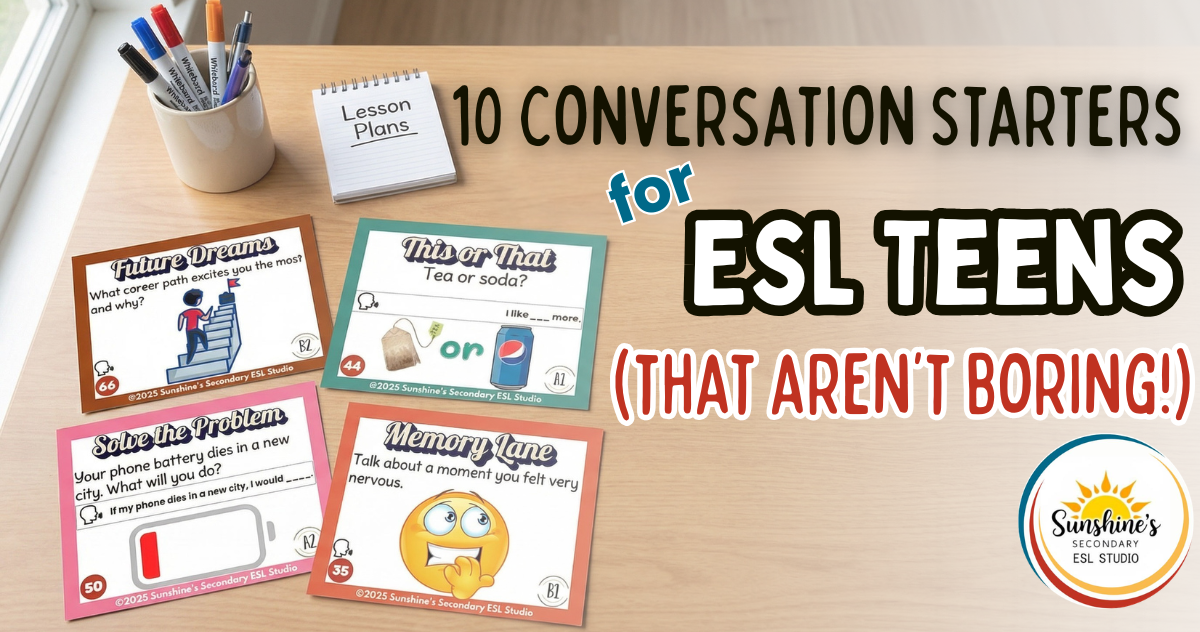
If students need structure, use conversation starters for ESL teens or a few tasks from the ESL Speaking Activities for Teens bundle. Choose only a small sample for diagnosis; save the rest for instruction. These posts on building ESL speaking routines and ESL speaking-confidence activities can help you continue collecting more authentic evidence after the first week.
Use a separate pronunciation screening
Pronunciation affects comprehensibility, but pronunciation is not the same as speaking proficiency. A student may communicate complex ideas while having difficulty with a few English sounds. Another student may pronounce a memorized word list clearly but struggle to create an original response.
I still like a recorded pronunciation screening because it is brief, repeatable, and concrete. Students can record themselves privately, and I can listen later without placing every student in a one-on-one testing line.
The free A1 ESL Pronunciation Assessment for Teens provides a simple place to begin. For mixed-level classes, the A1–B2 ESL Diagnostic Assessment Bundle lets teachers use leveled pronunciation checks and revisit them later to document growth.
Use the results to identify a limited number of patterns that affect understanding. Do not try to remove a student’s accent or turn every difference into an error. My post on teaching ESL pronunciation in high school explains how to keep pronunciation instruction targeted and respectful.
How to Assess Reading: Look Beyond Oral Fluency
A student who reads aloud smoothly does not necessarily understand the text. A student who reads slowly in English may still make strong inferences once vocabulary barriers are reduced. Reading assessment should therefore include decoding or fluency information and meaning.
Use a short passage with a mature topic and ask students to:
- Preview the title, image, or heading and make a prediction.
- Read independently.
- Identify the central idea or most important event.
- Answer one or two literal questions.
- Explain an inference, connection, or vocabulary word in context.
- Point to or highlight evidence in the text.
- Give a brief oral or written retell.
When appropriate, ask the student to read a short portion aloud. Use that sample to observe word recognition, phrasing, and pronunciation, but do not make oral reading the entire reading assessment.
Record the conditions under which the student succeeds. Can the student understand the text with audio? With a bilingual glossary? With a shorter chunk? After a quick vocabulary preview? With extra time?
Those supports are not side notes. They are instructional data.
If your class includes several proficiency levels, use texts that share the same central topic but vary in language complexity. My guide to differentiating ESL instruction for A1–B2 students shows how to keep the thinking age-appropriate while adjusting text length, vocabulary, syntax, audio, and expected response. You may also find these strategies for ESL reading comprehension in high school and supporting ESL students who read below grade level helpful after the diagnostic.
How to Assess Writing: Collect an Independent and a Supported Sample
One writing prompt rarely tells the whole story. Students may know what they want to say but lack the English to begin. Others can fill sentence frames successfully but struggle to organize ideas independently.
That is why I recommend two short samples.
Sample 1: Independent writing
Use a familiar, teen-appropriate prompt such as:
Describe something that is important to you. Explain why it matters.
or
What is one goal you have for this school year? What could help you reach it?
Give students a manageable amount of time and do not correct while they write. This sample can reveal writing stamina, idea development, spelling patterns, sentence boundaries, vocabulary, organization, and grammar students control independently.
Sample 2: Supported writing
Use a related prompt, but add one or more supports:
- A visual
- A word bank
- Sentence starters
- A model response
- A brief partner discussion
- A planning organizer
- The option to brainstorm in a first language
Compare the two samples. If a student’s writing improves dramatically with a word bank and sentence frames, you have identified tools that may increase access right away. If the student has strong ideas but limited English sentence control, the instructional need is different from a student who writes accurate sentences but needs help developing and organizing ideas.
The free ESL identity name-poem template can provide a supported, age-respectful sample for A2–B1 students. For broader classroom scaffolds, see my ESL writing-support strategies and free ESL sentence starters for teens.
What to look for in beginning-of-year writing
Score the sample lightly. I usually record evidence in several separate categories rather than giving one overall grade:
- Meaning and clarity
- Amount of independent language
- Organization and sequence
- Sentence completeness and variety
- Vocabulary precision
- Verb and grammar patterns
- Spelling and conventions
- Use of available supports
- Writing stamina
A diagnostic is not the time to cover the page in corrections. Choose patterns that will influence instruction, and preserve the original sample so you can compare it with later writing.
Use Grammar and Vocabulary Checks as Clues, Not the Whole Assessment
Grammar and vocabulary matter, but they should not stand in for language proficiency.
A student can select the correct verb on a worksheet and still struggle to use that form while speaking. Another student may communicate clearly despite making several grammatical errors. A beginning-of-year grammar check is most useful when it confirms patterns you also notice in speaking and writing.
Keep the check short. You might include:
- Subject pronouns and basic sentence structure
- Forms of be
- Simple present and present progressive
- Question formation
- Common past-tense forms
- High-frequency academic and classroom vocabulary
- One brief editing or sentence-building task
Include both recognition and production. Matching a word to a picture measures something different from using the word in a sentence. Multiple-choice grammar measures something different from creating an original sentence.
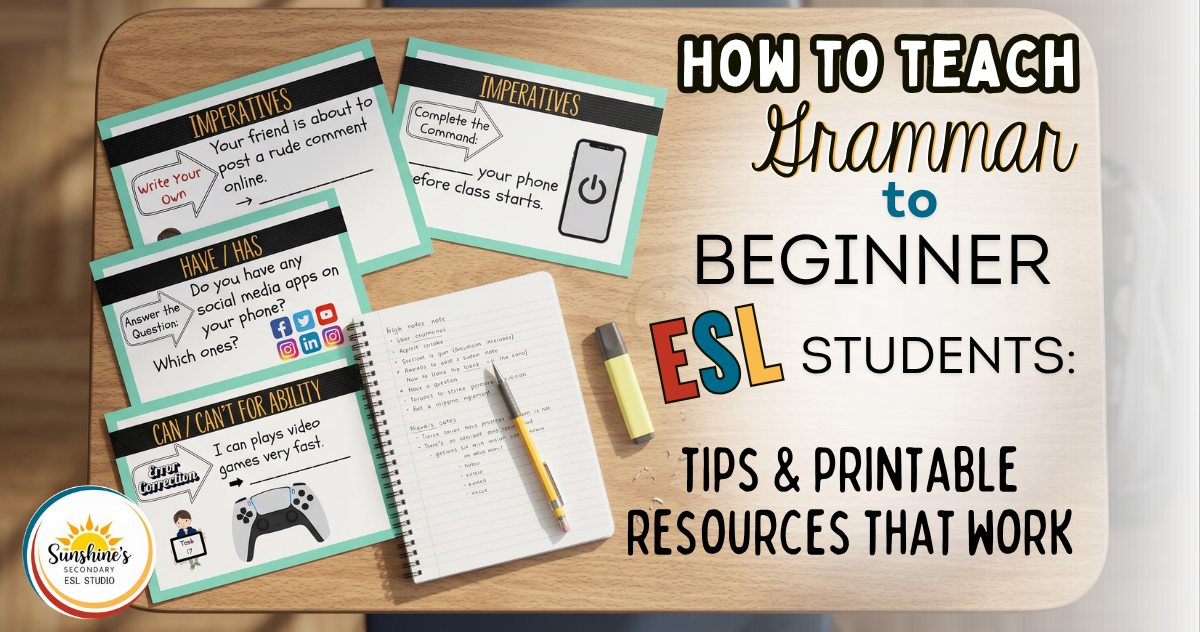
For beginner classes, my post on how to teach grammar to beginner ESL students can help you turn diagnostic patterns into a manageable sequence. These ESL vocabulary activities for high school offer follow-up options that go beyond memorizing definitions.
What If a Newcomer Cannot Complete the Assessment?
When a newcomer cannot yet respond to a task in English, record the conditions—not simply a zero.
Try changing one variable at a time:
- Model the task.
- Add a visual.
- Reduce the number of choices.
- Allow pointing, matching, drawing, or acting.
- Read the directions aloud.
- Offer a first-language explanation.
- Let the student respond in a first language.
- Ask for one word instead of a sentence.
- Return to the task after several days of routines and survival English.
You may discover that the student understands the concept but not the English directions. You may also discover that the student needs support with literacy, school routines, or the task format itself. Those are different needs and should lead to different next steps.
Do not force a brand-new student to speak publicly to prove participation. Small responses count. Pointing to the correct picture, following a direction, repeating a useful phrase, or completing a sentence frame can all provide meaningful evidence.
For additional support, see beginner ESL in high school and revisit the newcomer first-30-days plan linked earlier in this post.
A Simple Baseline Recording Sheet
You do not need a complicated spreadsheet to use beginning-of-year data. A one-page class tracker can help you see patterns without reducing students to one score.
| Area | Evidence to record | Possible next step |
|---|---|---|
| Listening | Follows one-step or two-step directions; understands gist or details; supports needed | Teach classroom commands, listening for key words, or note-taking |
| Speaking | Gesture, word, phrase, sentence, or extended response; comprehensibility; interaction | Add rehearsal, sentence frames, follow-up questions, or fluency practice |
| Pronunciation | Specific patterns that affect understanding | Select a small number of high-impact words or sounds for practice |
| Reading | Text complexity, accuracy, comprehension, retell, evidence use, supports needed | Group for decoding, vocabulary, comprehension, or text-evidence practice |
| Writing | Independent output, organization, sentence control, vocabulary, stamina | Model sentences, paragraph structure, revision, or extended response |
| Independence | Uses visuals, tools, first-language resources, and help-seeking language | Teach routines and gradually remove unnecessary supports |
| Student goal | One skill the student wants to improve | Create a specific short-term practice goal and review date |
You can also use a simple four-point classroom scale for each task:
- Not yet observed or requires full modeling and support
- Responds with visuals, choices, words, or substantial support
- Completes a familiar task with moderate support
- Completes a familiar task independently and can extend the response
This is a classroom tracking tool, not an official proficiency designation. Always keep a brief note or work sample beside the number so you remember what the student actually did.
Turn Assessment Results Into Instruction
The most important part of an assessment is what happens next.
After reviewing the evidence, I use a simple process.
1. Identify a strength in every domain
Start with what the student can do. For example:
- Understands the main idea of short audio with visuals
- Communicates clearly in familiar conversations
- Locates explicit evidence in a short text
- Writes organized ideas with sentence starters
Strengths tell you which resources students can already use to access harder work.
2. Choose one or two high-leverage needs
Do not turn every error into a goal. Look for patterns that appear across tasks or prevent the student from participating.
Repeatedly misunderstanding classroom directions may indicate a need for survival listening before a detailed grammar sequence. Strong oral ideas paired with very short writing may point to a need for sentence expansion and paragraph organization. Meanwhile, students who understand a text but cannot explain an inference may benefit from academic discussion frames and evidence language.
3. Form flexible, skill-specific groups
Group students by the need you are teaching—not by one permanent ESL label.
A student might join a pronunciation group on Monday, a reading-vocabulary group on Wednesday, and an advanced discussion group on Friday. Another student may need beginner speaking support but stronger reading work.
The purpose of the task should determine the group. The mixed-level differentiation guide linked earlier includes more examples of flexible grouping and shared objectives.
4. Write a clear language objective
Assessment data becomes useful when it changes what students will practice.
Instead of writing, “Students will improve speaking,” try:
Students will answer a familiar question with a complete sentence and one supporting detail.
Instead of, “Students will improve reading,” try:
Students will identify the central idea of a short informational text and highlight one supporting detail.
My guide to language objectives for high school ESL includes examples across proficiency levels and content areas.
5. Set one student-friendly goal
A student does not need six goals at once. Choose one next step the student can understand and practice.
Examples include:
- I will ask for clarification when I do not understand a direction.
- I will add one reason or example when I answer a speaking question.
- I will use evidence from the text in one reading response each week.
- I will write a topic sentence and three connected details.
For an age-appropriate lesson that introduces the process, the Goal Setting for ESL Teens informational text with audio can help students connect reflection, planning, reading, listening, and writing.
Reassess Without Giving Another Big Test
A baseline is only useful if you return to it.
Review the student’s first goal after two to four weeks. Whenever possible, use a parallel task rather than an identical memorized task. Pronunciation growth can be checked by intentionally repeating the same selected words so students can hear the change. Writing progress is better measured with a new prompt that has similar demands. Listening can be reassessed by using the same type of direction or note-taking task with new content.
Ongoing evidence can come from:
- Short audio responses
- ESL bell ringers and daily warm-ups
- Exit tickets
- Reading annotations
- Partner conversations
- Recorded speaking samples
- Paragraphs and constructed responses
- Student self-ratings
- Brief teacher conferences
The goal is not constant testing. It is noticing growth during normal instruction.
Common Beginning-of-Year ESL Assessment Mistakes
Trying to assess everything in one day
Fatigue, anxiety, unfamiliar routines, and misunderstood directions can distort the results. Spread tasks out and allow students to settle in.
Using only a grammar test
Grammar knowledge is one part of language. It does not show how students understand speech, negotiate meaning, comprehend text, or organize ideas.
Treating oral reading as complete reading evidence
Oral fluency can reveal useful patterns, but comprehension requires additional questions, retelling, inference, and evidence use.
Assuming silence means low proficiency
Students may be shy, processing, unfamiliar with the teacher, or more comfortable responding in another format. Offer rehearsal, recording, visuals, and time.
Using materials that feel elementary
High school students may need beginner language without childish topics or designs. Simplify the language, not the student’s age, experience, or ability to think.
Grading the diagnostic harshly
A baseline should inform instruction. If students believe every error will lower a grade, they are less likely to take risks and show what they can actually do.
Creating permanent groups from one week of data
Language performance changes by domain, topic, task, and support. Use groups temporarily and update them as new evidence appears.
Frequently Asked Questions About Beginning of Year ESL Assessments High School Teachers Use
What should a beginning-of-year ESL assessment include?
Include manageable evidence from listening, speaking, reading, and writing. Add a short student profile, self-reflection, and optional pronunciation, grammar, or vocabulary checks. No single task should determine the student’s entire instructional plan.
How long should beginning-of-year ESL assessments take?
Individual tasks can often take 5–20 minutes. Spread them across several days rather than giving one long test. Students should still have time to learn routines, build relationships, and participate in meaningful class activities.
Should a beginning-of-year diagnostic be graded?
I recommend treating it as ungraded baseline evidence. Students are more likely to take productive risks when they understand that the purpose is to help the teacher plan support, not punish them for what they have not learned yet.
How do I assess a newcomer with almost no English?
Use visuals, modeling, gestures, pointing, matching, drawing, first-language responses, and familiar school vocabulary. Observe how the student responds to routines and supports. Revisit tasks after the student has had time to learn survival English.
Can I use one assessment to place students into groups?
Use several pieces of evidence and group by the specific skill you are teaching. A student’s listening, speaking, reading, and writing strengths may not match, so one permanent level group can hide important differences.
How often should I reassess students?
Use short checks throughout instruction, review an initial goal after two to four weeks, and collect more formal comparison samples around the middle and end of the year. The schedule should be frequent enough to guide teaching without making students feel constantly tested.
What should I do when official scores and classroom performance do not match?
Treat the difference as a reason to gather more information. Review the date and conditions of the official assessment, observe the student across tasks, consult relevant staff, and document specific classroom evidence. One score and one classroom moment can both be incomplete.
Final Thoughts
The best beginning-of-year assessment is not the longest one. It is the one that gives you clear, usable information while allowing students to feel capable and respected.
I still value a recorded pronunciation screening because it is concrete, private, and easy to repeat. However, I would never let that sample stand alone. Listening, speaking, reading, writing, classroom observation, student background, and self-reflection all add important pieces to the picture.
Use beginning of year ESL assessments high school students can complete in short, age-appropriate steps. Look for strengths before deficits. Record the supports that make success possible. Form temporary groups around real needs. Then turn the evidence into one clear instructional priority and one goal the student can understand.
That is enough to begin.