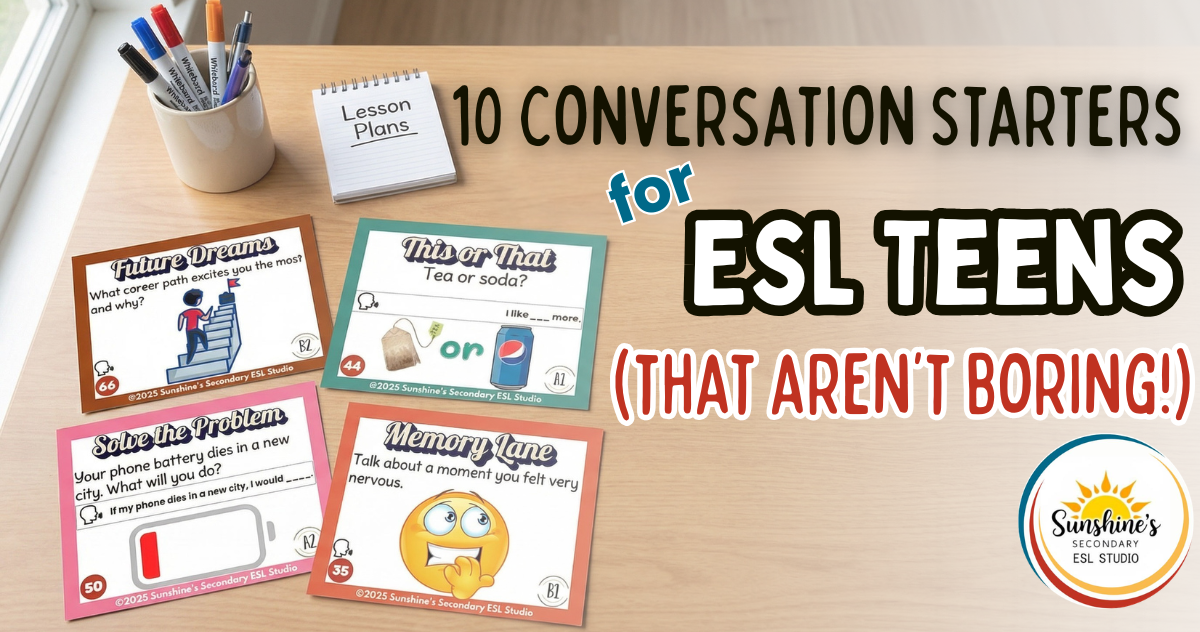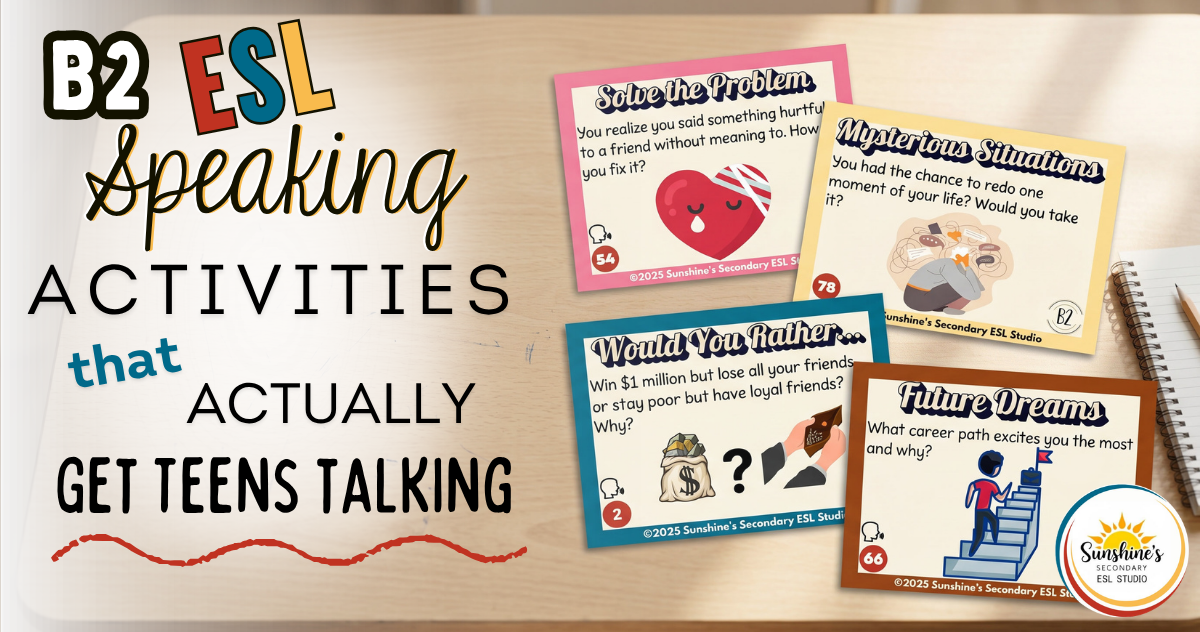

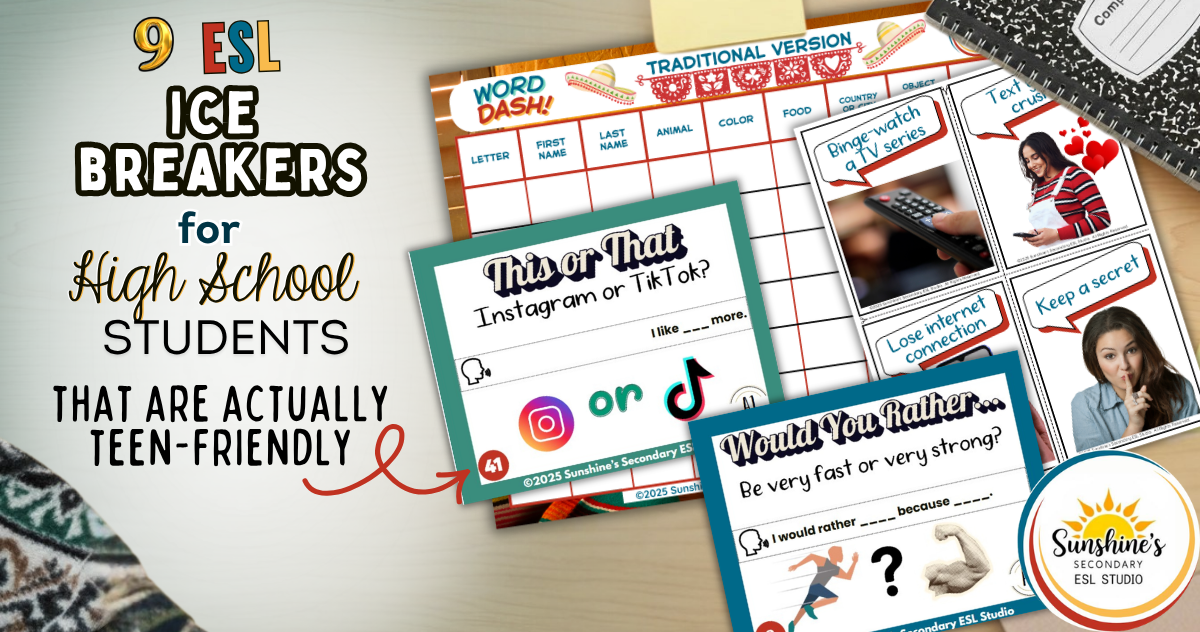
Finding ESL icebreakers for high school students can be surprisingly difficult.
Many activities require students to give long answers before they have the English to do that. Others ask teenagers to share personal information with classmates they just met. And some look so elementary that students decide they hate the activity before it even begins.
Teenagers can tell when a worksheet was designed for younger children and simply relabeled for high school.
Beginner English does not mean beginner thinking. An A1 student may need a one-sentence response, a picture, or a choice between two options, but the activity can still feel mature and respectful.
This post is intentionally narrower than my broader guide to first day activities for ELL students. The activities below are specifically designed to help middle and high school English learners interact without:
- requiring advanced English
- forcing students to speak in front of the whole class
- asking for private family or immigration information
- putting shy newcomers on the spot
- using materials that feel babyish
Each activity also includes simple modifications for A1, A2, B1, and B2 students.
Affiliate disclosure: This post contains affiliate links. As an Amazon Associate I earn from qualifying purchases at no additional cost to you.
What Makes ESL Icebreakers for High School Students Teen-Friendly?
A teen-friendly icebreaker is not simply an elementary activity with questions about phones or music added to it.
It is an activity that protects students’ dignity.
High school students are extremely aware of how they look and sound in front of their peers. An activity can have a fun topic and still create too much social risk if students must perform alone, reveal private information, or speak before they have time to prepare.
That is why the best icebreakers give students:
- a clear choice
- visible language support
- time to think
- a partner or small group
- permission to pass
- more than one way to participate
I discuss this gradual movement from private rehearsal to partner and group interaction in my post about ESL speaking confidence activities.
Age-appropriate support matters too. As I explain in my guide to teaching beginner ESL in high school, simple language and mature content can exist in the same lesson.
Establish One Privacy Rule Before You Begin
Before using any getting-to-know-you activity, tell students:
You may pass, choose a different question, or answer for a fictional person.
Avoid requiring students to discuss:
- why they moved
- immigration experiences
- family structure
- religion
- finances
- relationships
- trauma
- living arrangements
- political beliefs
- a home country or home language
Well-designed ESL icebreakers for high school students let learners pass, choose another prompt, or answer for a fictional person without being singled out.
Students may volunteer some of that information later, but an icebreaker should never make disclosure the price of participation.
The nine ESL icebreakers for high school students below use mature topics, visible language support, and low-pressure ways to participate.
1. Four Corners with Teen-Relevant Choices
Four Corners works well with English learners because students can participate before producing a full sentence.
Place one answer choice in each corner of the room. Read or project a question, and have students move to the corner that represents their answer.
For a mobility-friendly or lower-visibility version, students can remain seated and hold up an A, B, C, or D card instead.
Try questions such as:
- What helps you learn a new word: seeing it, hearing it, using it, or writing it?
- Which would improve school most: a later start, longer breaks, shorter classes, or fewer assignments?
- How do you prefer to work: independently, with a partner, in a small group, or it depends?
- Which activity sounds best: creating something, solving something, competing, or relaxing?
Once students choose, give them 15–20 seconds to rehearse. Then they explain their choice to one person in the same corner.
A1–B2 scaffold:
A1: “I choose ___.”
A2: “I choose ___ because it is ___.”
B1: Students explain one advantage of their choice.
B2: Students compare their choice with another option and acknowledge a possible disadvantage.
Low-pressure version: Do not ask every corner to report publicly. Invite one volunteer or collect anonymous responses instead.
2. Would You Rather Discussion Lines
“Would You Rather?” is one of the safest ESL icebreakers because students respond to a hypothetical choice instead of revealing personal history.
Label one side of the room Option A and the other side Option B. Students stand closer to the option they prefer. The middle of the room can represent “undecided” or “it depends.”
Use choices that feel relevant without assuming students own certain devices, play certain games, or have particular experiences.
Try prompts such as:
- Would you rather start school later and end later or start earlier and end earlier?
- Would you rather complete one long assignment or three short assignments?
- Would you rather study with music or in complete silence?
- Would you rather work with a partner or work independently?
- Would you rather have more time or more help?
Students talk to the person standing nearest to them and explain their choice. They do not have to defend it in front of the class.
My beginner ESL speaking activity using Would You Rather explains why this format works especially well with students who do not yet generate answers independently.
Teachers who need a ready-made starting point can also use my free A1 Would You Rather conversation cards. The prompts include built-in sentence support for beginner speakers.
A1–B2 scaffold:
A1: Choose an option and read a sentence frame.
A2: Add one simple reason using because.
B1: Ask a partner, “Why did you choose that?”
B2: Explain a trade-off: “I would choose ___, although ___.”
Low-pressure version: Students may stay in the middle, point to an option from their seats, or answer for a fictional student.
3. Silent Ranking Challenges
Silent ranking is one of my favorite choices for shy newcomers because students begin by communicating without speaking.
Give each group four to six cards. Students must place the cards in order without talking. They can move cards, point, gesture, and reconsider the order as a group.
Possible ranking topics include:
- the most useful strategies for learning vocabulary
- the most important qualities of a good group member
- the best ways to prepare for a test
- the most helpful items for a new student
- the best features of an ideal classroom
- the most useful English skills outside school
After the silent round, each student explains one card placement.
For example:
We put asking questions first because students need help.
The nonverbal first stage gives newcomers time to study the words, observe their group, and form an idea before speaking.
A1–B2 scaffold:
A1: Number picture cards and say, “Number one is ___.”
A2: Add a short reason.
B1: Explain why two cards should change positions.
B2: Negotiate a final group ranking and summarize the group’s reasoning.
Low-pressure version: Let students point to the card they agree with while a partner reads the group sentence.
4. Visual Identity Cards Without the Forced Autobiography
Traditional “All About Me” pages often ask for a hometown, family details, favorite everything, and a long personal introduction.
A visual identity card can be much safer.
Give students a selection of neutral icons representing interests, learning preferences, strengths, and goals. Students choose three or four icons and decide what each one represents.
Possible icons might include:
- a speech bubble
- a book
- headphones
- a camera
- a puzzle
- a paintbrush
- a soccer ball
- a keyboard
- a lightbulb
- a group of people
Students might say:
- “The puzzle represents problem-solving.”
- “The headphones represent music.”
- “The speech bubble represents my goal to speak more English.”
The student controls what goes on the card. Do not require information about family, nationality, or personal history.
A1–B2 scaffold:
A1: Draw, select, and label three icons.
A2: Complete “This represents ___.”
B1: Explain why one symbol is important.
B2: Connect two symbols to a personal strength or future goal.
Low-pressure version: Students share only one symbol with one partner. They may also create a visual card for a fictional student.
After students have built more trust, this can lead naturally into a longer ESL identity poem writing activity.
5. The Common-Ground Challenge
The Common-Ground Challenge helps students connect without placing one student at the center of attention.
Put students in groups of three or four. Their task is to find four things everyone in the group agrees with.
Set clear boundaries first:
- Do not use physical characteristics.
- Do not use family information.
- Do not use nationality or language background.
- Do not ask questions another student does not want to answer.
Give groups safe topic categories such as:
- learning preferences
- school routines
- entertainment
- weather
- free-time activities
- classroom expectations
- food choices
- future skills
Possible group statements include:
- “We all prefer seeing an example first.”
- “We all think students need breaks.”
- “We all like at least one kind of music.”
- “We all prefer working in a quiet room.”
- “We all want clear directions.”
This feels more mature than a traditional name game because students are solving a small communication challenge together.
A1–B2 scaffold:
A1: Use a picture choice board and yes-or-no questions.
A2: Complete “We all like ___.”
B1: Ask follow-up questions until the group finds four agreements.
B2: Find one area of agreement and one respectful disagreement.
Low-pressure version: One student can serve as the recorder while another points to options. No one must share an individual answer with the class.
Activities like this can support belonging without forced disclosure, which is also an important part of social-emotional learning for ESL teens.
6. Find Someone Who for Secondary ESL Students
“Find Someone Who” can work with teenagers, but the prompts need an upgrade.
Statements such as “has a pet,” “has blue shoes,” or “has two brothers” can feel elementary or unnecessarily personal. Use opinions, learning preferences, and low-risk interests instead.
Try prompts such as:
- Find someone who prefers working with a partner.
- Find someone who learns well from visuals.
- Find someone who would choose a later school start.
- Find someone who can recommend something to watch, read, or listen to.
- Find someone who enjoys solving problems.
- Find someone who thinks group projects need clear roles.
- Find someone who prefers examples before directions.
- Find someone who wants more speaking practice.
Students ask a classmate one question, record the person’s name, and move on.
Limit the number of times one student can sign a paper so that the most outgoing students do not complete the entire activity together.
A1–B2 scaffold:
A1: “Do you like ___?” or “Do you prefer ___?”
A2: Ask the question and record a short answer.
B1: Add one follow-up question.
B2: Use the results to describe a class trend or compare answers.
Low-pressure version: Let shy newcomers move with a buddy, complete only three boxes, or remain seated while classmates visit them.
7. Speed Interviews with Sentence Frames
Speed interviews can give every student several short speaking turns without requiring anyone to present to the class.
Choose two or three safe questions and display them where students can see them. Partners have 60–90 seconds to ask and answer before rotating.
Use opinion-based questions rather than personal biography questions.
For example:
- What helps students feel comfortable in a new class?
- What makes group work successful?
- Which helps you learn more: visuals, examples, practice, or discussion?
- What is one classroom rule that makes sense?
- Which English skill is easiest to practice with a partner?
- What makes a class discussion interesting?
Keep the same questions for several rounds. Repetition is not a weakness here. It allows students to improve the same answer each time instead of starting from zero with every new partner.
For more prompt categories, see my conversation starters for ESL teens.
Mixed-level classes can also use the Teen Talk A1–B2 Conversation Cards Bundle so students discuss similar themes with language support appropriate to their level.
A1–B2 scaffold:
A1: Choose from pictured answers and read a frame.
A2: Give an answer plus one reason.
B1: Ask and answer one follow-up question.
B2: Paraphrase the partner’s answer or ask for clarification.
Low-pressure version: Students may read directly from the question card. Do not end by requiring everyone to introduce a partner to the whole class.
8. Conversation-Circle Rotations
Conversation circles work especially well after students have already completed one or two lower-pressure activities.
Create an inside and outside circle, or arrange students in two facing lines. Display one prompt and give students a short period to think or write.
During the first round, students give a basic answer. During the next rotation, they repeat the answer with one added detail. In the final round, they ask or answer a follow-up question.
Good prompts include:
- A good group member should ___.
- One school rule that helps students is ___.
- The most useful way to learn vocabulary is ___.
- A comfortable classroom needs ___.
- Students participate more when ___.
- One quality of a good teacher is ___.
Repeating the same response with several partners reduces the language load. By the third rotation, many students sound more fluent because they have already practiced the vocabulary and sentence structure.
This same principle is central to building ESL speaking routines: familiarity and repetition make speaking feel more normal and less risky.
A1–B2 scaffold:
A1: Repeat one modeled sentence with each partner.
A2: Add one detail or example.
B1: Ask a related follow-up question.
B2: Restate the partner’s idea before responding.
Low-pressure version: Use seated partners or a rotation chart instead of standing circles. Students may also complete the first round as listeners before speaking in the second round.
9. Two True, One Invented
Two Truths and a Lie is common, but the traditional version can pressure students to reveal personal experiences.
A safer version is Two True, One Invented.
Students create three statements within a teacher-selected category. Two reflect their real preferences or opinions, and one is invented.
Safe categories include:
- school preferences
- hypothetical choices
- entertainment opinions
- learning habits
- favorite types of activities
- opinions about everyday topics
Students might write:
- “I prefer working in the morning.”
- “I like learning with videos.”
- “I would choose a three-hour group project.”
Classmates ask one question and guess which statement is invented.
Students may also create all three statements for a fictional teenager. That version still practices asking questions, listening, and making inferences without requiring any personal disclosure.
A1–B2 scaffold:
A1: Select three prepared statement cards.
A2: Write three short sentences using a model.
B1: Explain or support each statement with one detail.
B2: Answer follow-up questions while maintaining the invented statement.
Low-pressure version: Use pairs or groups of four rather than the entire class. Students should always have the option to use a fictional profile.
This activity has the highest social risk on the list, so I would save it until students have already completed several choice-based and partner activities.
How to Differentiate ESL Icebreakers for High School Students from A1 to B2
You do not need four completely different icebreakers for four proficiency levels.
Keep the topic and activity structure the same. Change the amount of language students are expected to produce.
A simple progression looks like this:
A1 students: Choose, point, match, repeat, or complete a short frame.
I choose ___.
I like ___.
Yes, I do.
A2 students: Give a complete answer and one reason.
I prefer ___ because ___.
B1 students: Explain, give an example, and ask one follow-up question.
I prefer ___ because ___. What about you?
B2 students: Compare options, qualify an opinion, paraphrase, or respond to another perspective.
I would probably choose ___, although ___ might be better when ___.
The activity remains age-appropriate for everyone. Only the language demand changes.
That is the same principle I use when differentiating ESL instruction from A1 to B2: students can engage with the same meaningful topic while receiving different levels of language support.
What to Do After the Ice Is Broken
After students complete a few ESL icebreakers for high school students, carry the same choice, rehearsal, and partner structures into your regular speaking routines.
An icebreaker should not be the only time students speak to classmates.
Once students are comfortable choosing an answer and talking to one partner, use a simple progression:
- Students choose or respond privately.
- Students rehearse with one trusted partner.
- Students repeat the response with a second partner.
- Students participate in a small group.
- Volunteers share with the class.
After students have built some comfort, a physical guessing game such as this charades game for ESL high school students can increase energy without requiring long answers.
For a faster team challenge, try Word Dash, my ESL vocabulary game inspired by ¡Basta!. Students contribute words to a team, so the attention stays on the challenge rather than on one student’s English.
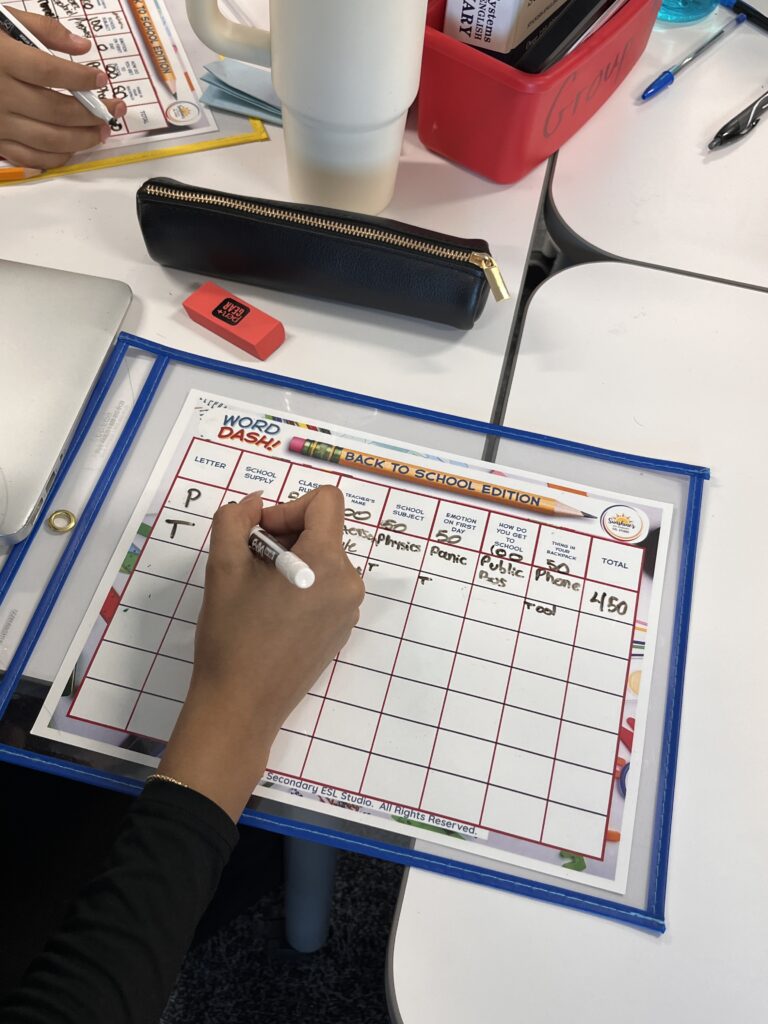
The reusable supplies shown in the photo make it easy to play again. I use dry-erase sleeves and Expo fine-tip dry-erase markers so students can write clearly and the activity pages can be reused.
The ready-made ESL Icebreaker and Vocabulary Games Bundle for Teens provides an easy way to use this format during the first weeks of school. It works especially well after students have completed one of the lower-pressure partner activities above and are ready for a more energetic team challenge.
These activities work even better when students already understand the basic classroom routines. My guide to First Week ESL Slides explains how I use a simple slideshow to make expectations, participation, and classroom language more predictable.
For teachers building a complete first-week system, the Back to School ESL Bundle combines first-week activities with classroom routines, procedures, visual supports, and community-building resources designed for secondary English learners.
Final Thoughts on ESL Icebreakers for High School Students
The best ESL icebreakers for high school students do not require dramatic performances, advanced vocabulary, or deeply personal introductions.
They give students something clear to choose, enough language to respond, time to rehearse, and permission to protect their privacy.
Start with silent or choice-based participation. Move into partner talk. Add rotations and small groups only after students have experienced some success.
Most importantly, remember that beginner language can still be paired with mature ideas.
A high school newcomer may need to point to a picture or complete a three-word sentence frame. That does not mean the student needs an activity designed for a small child. Teen-friendly ESL icebreakers respect both the student’s current English level and the student’s age.
Frequently Asked Questions
What is a good icebreaker for ESL high school students?
Four Corners and Would You Rather are strong starting points because students can participate by choosing an option before explaining it. Both activities can work with one-word answers, sentence frames, or extended discussion.
Which ESL Icebreakers for High School Students Work Best for Shy Newcomers?
Silent ranking challenges, visual identity cards, and seated Four Corners are especially useful. They allow students to observe, point, draw, or choose before speaking. Partner interaction is usually safer than whole-class reporting.
How can I adapt an icebreaker for A1–B2 students?
Keep the same topic but change the expected response. A1 students can choose and complete a frame. A2 students can add a reason. B1 students can ask a follow-up question. B2 students can compare perspectives or paraphrase a partner.
Should ESL icebreakers ask students about their backgrounds?
Students should control how much personal information they share. Avoid requiring information about immigration, family, religion, finances, trauma, or living situations. Provide a pass option and allow students to answer for a fictional person.