
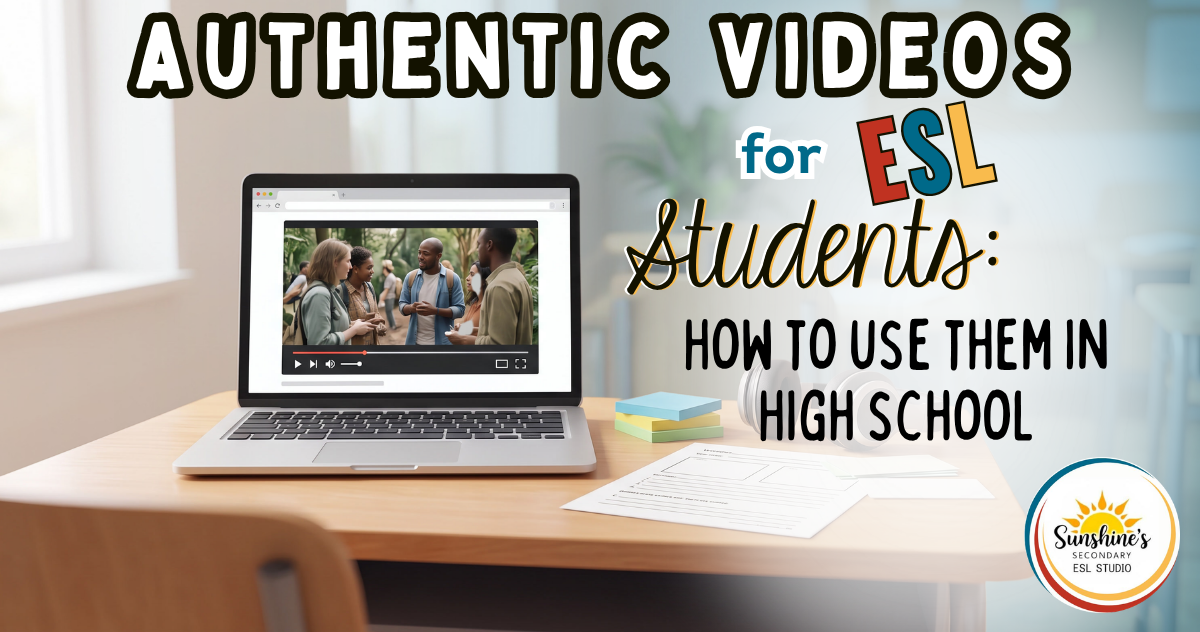
Authentic videos for ESL students can be powerful in high school classrooms, but they can also become overwhelming very quickly. A short video clip may include fast speech, background noise, unfamiliar vocabulary, slang, humor, cultural references, captions, music, and visual information all at once.
That does not mean teachers should avoid authentic videos. It means students need support before, during, and after they watch.
When used carefully, authentic videos for ESL students can help secondary English learners practice real-world listening, build vocabulary, discuss meaningful topics, and connect classroom language to the world outside the textbook. The key is choosing short, purposeful clips and turning them into structured listening, speaking, reading, or writing tasks.
For high school ESL students, authentic videos work best when they are teen-friendly, scaffolded, and connected to a clear language goal.
Why Authentic Videos for ESL Students Work in High School
Authentic videos give English learners something that worksheets alone cannot always provide: real language in context.
Students can hear tone of voice, see facial expressions, notice gestures, and use visual clues to support comprehension. This is especially helpful for newcomers and mixed-level ESL classes because students do not have to understand every word to understand the main idea.
Authentic videos can also help high school English learners practice skills they need outside the ESL classroom, including listening for the main idea, identifying important details, noticing vocabulary in context, making inferences, explaining opinions, asking questions, and discussing real-world topics.
This is why authentic videos connect so naturally to ESL listening activities for high school, media literacy activities for ESL teens, and ESL speaking activities for teens. Students are not just watching a video. They are learning how to listen, think, respond, and communicate.
Choose Short Authentic Videos for ESL Students
One of the biggest mistakes teachers make is choosing videos that are too long.
For high school English learners, especially A1, A2, and B1 students, a two-minute clip can be more useful than a twenty-minute video. Shorter clips allow students to watch more than once, focus on specific language, and build confidence instead of shutting down.
A good authentic video for ESL students usually has clear visuals, a focused topic, school-appropriate content, enough context to understand the main idea, and a purpose that connects to your lesson.
The video does not need to be perfect. In fact, authentic videos often include imperfect speech, background noise, or fast pacing. That is part of what makes them authentic. The teacher’s job is not to remove every challenge. The teacher’s job is to make the challenge manageable.
For example, a short video clip might be used to introduce a topic, build background knowledge, support a reading passage, start a discussion, or practice listening for details.
Preview Authentic Videos for ESL Students Before Watching
Before using authentic videos with high school English learners, preview the clip carefully.
Do not just check whether the content is appropriate. Watch for language demands. Ask yourself:
What vocabulary will students need?
What background knowledge might they be missing?
Is the speaker too fast?
Are captions accurate?
Are there idioms, slang, jokes, or cultural references?
What do I actually want students to listen for?
This step matters because authentic videos can look simple but carry a heavy language load. A short news clip, commercial, interview, movie scene, or social media-style video may include language that native speakers process automatically but English learners may not.
This is also where differentiation becomes important. A newcomer may need visuals and word banks, while a B1 or B2 student may be ready to explain the speaker’s opinion or evaluate the message. For more support with mixed levels, you can connect this strategy to how to differentiate ESL instruction in high school or differentiating ESL instruction from A1 to B2.
Give ESL Students a Purpose Before Watching Authentic Videos
Students should never be told to “just watch.”
That is too vague, especially for English learners. Before playing the video, give students a specific listening purpose.
For example, students can listen for the main idea, three important words, one problem and one solution, the speaker’s opinion, something surprising, or evidence that supports a claim.
This turns the video from passive viewing into active listening.
For beginner students, the purpose may be very simple. They might circle words they hear, match pictures to ideas, or choose the best main idea from three options. For intermediate students, the purpose can become more analytical. They can identify the speaker’s message, explain the tone, compare ideas, or respond with an opinion.
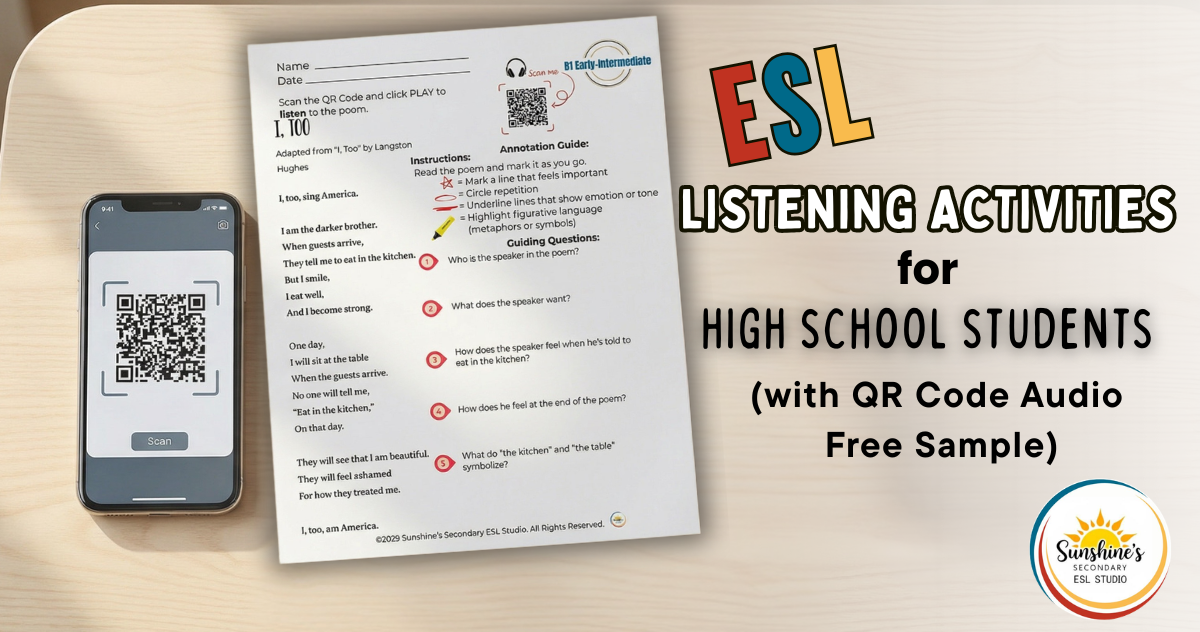
This is the same idea behind strong cloze listening activities for ESL students and QR code listening worksheets. Students need a reason to listen, not just an audio or video clip in front of them.
Pre-Teach Only the Most Important Vocabulary
It can be tempting to pre-teach every word students might not know. That usually makes the lesson too long and too teacher-heavy.
Instead, choose the vocabulary that students truly need in order to understand the main idea. For most short videos, five to eight words may be enough.
You can pre-teach vocabulary with pictures, simple definitions, examples, gestures, quick matching activities, sentence stems, or prediction questions.
For example, before watching a short video about school rules, students might learn words like rule, consequence, opinion, fair, unfair, agree, and disagree. They do not need every word in the video. They need enough language to participate.
This connects well with ESL vocabulary activities for high school because vocabulary should help students do something with the video, not just memorize isolated words.
Use Authentic Videos for ESL Students More Than Once
One watch is usually not enough.
Native speakers often process video quickly because they understand the language, the cultural context, and the visual clues at the same time. English learners may need repeated exposure.
A simple structure is:
First watch: main idea
Second watch: details
Third watch: discussion, writing, or analysis
During the first watch, students might answer: What is this mostly about?
During the second watch, students might listen for details, examples, vocabulary, or evidence.
During the third watch, students might prepare to speak, write, debate, summarize, or connect the video to another text.
This structure helps students feel more successful because they are not expected to understand everything immediately. It also gives teachers a natural way to support mixed-level classes.
A1 students can focus on visuals, words, and basic meaning. A2 students can answer simple questions and complete sentence frames. B1 students can summarize and explain opinions. B2 students can evaluate the message, compare perspectives, or discuss media choices.
Add Speaking After Authentic Videos
Authentic videos are especially useful when they lead into speaking.
After watching, students can respond with sentence stems such as:
I noticed that…
I think the main idea is…
One important detail is…
I agree with… because…
I disagree with… because…
This reminds me of…
In my opinion…
The speaker wants us to understand that…
These stems help students move from listening comprehension into academic conversation. They also make the activity safer for students who understand more than they can comfortably say.
For high school English learners, speaking after video does not need to be complicated. A quick partner discussion, four-corners opinion activity, sentence stem response, or small-group question can be enough.
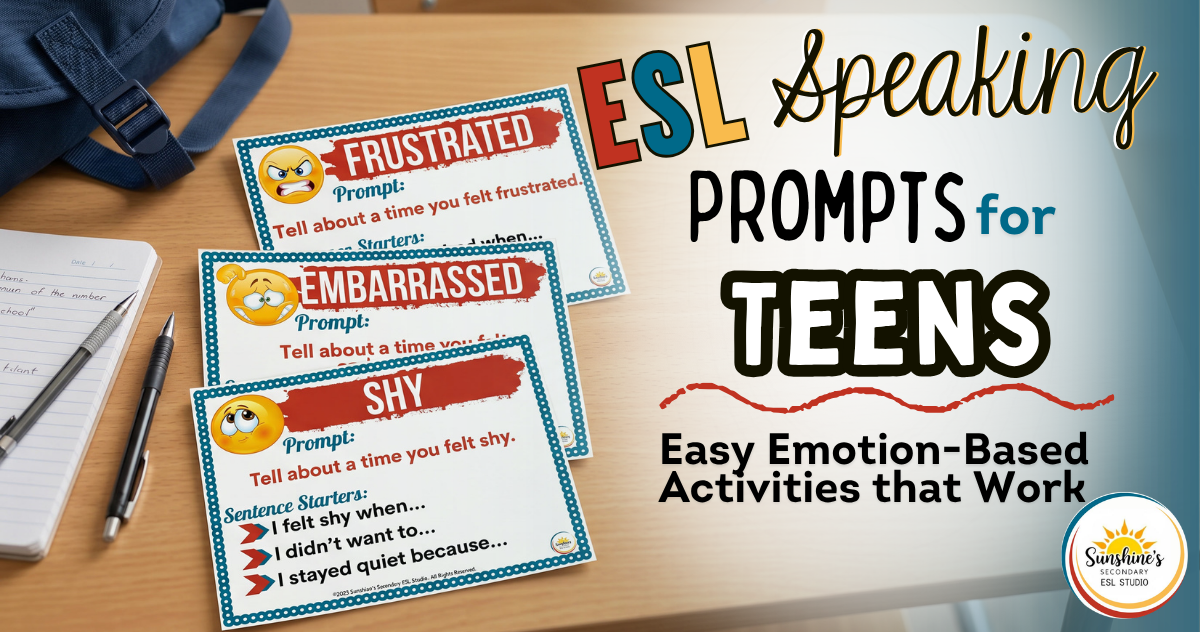
If your students need more support with post-video discussion, structured speaking prompts can help them respond without freezing. Conversation cards, role-plays, and sentence stems give students language they can actually use after watching.
This connects to conversation starters for ESL teens, how to build ESL speaking routines, and ESL speaking confidence activities.
Turn Authentic Videos Into ESL Bell Ringers
Authentic videos do not always need to become full lessons. Sometimes they work best as short warm-ups.
A short video clip, image-based prompt, audio clip, mystery photo, fun fact, or discussion question can help students settle into class and begin using English right away.
For example, students might watch a 30-second clip and answer:
What do you see?
What do you hear?
What is happening?
What do you think will happen next?
What is one word that describes the video?
What question do you have?
This kind of routine is especially useful in secondary ESL classrooms because it creates structure. Students know what to do when they enter the room, and the teacher can begin class with listening, speaking, and vocabulary practice.
This connects naturally to ESL bell ringers and daily warm-ups. Bell ringers with audio, mystery photos, fun facts, idioms, and teen-friendly discussion prompts can help students practice many of the same skills they need for authentic video comprehension.
For teachers who want a ready-to-use routine, my ESL Bell Ringers Mega Bundle includes teen-friendly daily warm-ups with audio, discussion prompts, mystery photos, fun facts, idioms, and slang practice. These work well as a bridge before students move into longer authentic videos.
Use Captions Strategically With Authentic Videos
Captions can be helpful, but they should be used with purpose.
For some students, captions lower anxiety and make the video more accessible. For others, captions can become a crutch if students only read and stop listening.
One helpful approach is to vary how captions are used:
First watch: without captions for gist
Second watch: with captions for details
Third watch: with pauses for vocabulary or discussion
For beginners, captions may be necessary from the start. For intermediate students, you may want them to listen first, then use captions to confirm what they heard.
Captions can also support reading, pronunciation, and vocabulary. Students can notice how words sound in connected speech, how phrases are used naturally, and how spoken English differs from textbook English.
Connect Authentic Videos to Content-Area ESL
Authentic videos are also useful for content-area ESL because they can build background knowledge before students read, write, or discuss academic topics.
A short video can introduce science, history, current events, literature, social issues, biographies, or cultural topics. This is especially helpful when English learners are expected to participate in grade-level content but need more context before reading complex texts.
For example, before reading an informational passage, students might watch a short video to preview the topic. Before discussing a historical speech, students might watch a clip that introduces the time period. Before writing an opinion paragraph, students might watch two short clips with different perspectives.
This makes authentic video a bridge between listening, reading, speaking, and writing.
It can also support posts such as teaching U.S. history to high school ESL students, ESL biography reading passages, and ESL reading comprehension for high school.
Keep Authentic Videos Teen-Friendly
High school English learners need materials that feel respectful and age-appropriate. Authentic videos can help with this because they often feel more connected to real life than simplified textbook passages.
However, teen-friendly does not mean anything goes.
Choose videos that are appropriate for school, useful for discussion, and connected to a language or content goal. Avoid clips that rely too heavily on sarcasm, inappropriate humor, cultural references students may not understand, or controversial topics that are not necessary for the lesson.
Teen-friendly authentic videos might include short informational clips, interviews, public service announcements, movie trailers, school-related videos, career videos, cultural videos, short speeches, news explainers, commercials, or educational shorts.
The goal is not entertainment by itself. The goal is meaningful language practice.
A Simple Authentic Video Lesson Structure
Here is a simple structure you can use with high school ESL students:
Before watching:
Introduce the topic, pre-teach key vocabulary, and ask a prediction question.
First watch:
Students listen for the main idea.
Second watch:
Students listen for details, examples, or vocabulary.
Partner talk:
Students use sentence stems to discuss what they understood.
Follow-up task:
Students write a summary, complete a cloze activity, answer comprehension questions, give an opinion, or connect the video to a reading.
This structure works because it does not assume students will understand everything the first time. It gives them repeated exposure, language support, and a reason to communicate.
Need More Listening and Speaking Support for ESL Teens?
Students often need practice with shorter, more structured listening tasks before they are ready for longer authentic videos. Audio-supported warm-ups, QR listening activities, cloze listening worksheets, and speaking routines can help students build the same skills they need for authentic video comprehension.
My ESL listening and speaking resources are designed for middle and high school English learners who need teen-friendly practice with vocabulary, listening, discussion, and real-world language. These activities work well before or after authentic videos because they help students practice listening for meaning, responding with sentence stems, and discussing ideas with support.
You might also find it helpful to explore audio-supported bell ringers, mystery photo warm-ups, fun fact discussion prompts, cloze listening activities, QR listening worksheets, and teen speaking activities as part of your ESL listening routine.
Final Thoughts on Authentic Videos for ESL Students
Authentic videos for ESL students can be one of the most engaging ways to support high school English learners, but they work best when they are scaffolded.
Students need short clips, clear listening goals, vocabulary support, repeated exposure, captions used strategically, and structured speaking or writing tasks after they watch.
When teachers use authentic videos with purpose, students get more than listening practice. They build confidence, vocabulary, discussion skills, media awareness, and real-world comprehension.
For secondary ESL teachers, authentic videos can become part of bell ringers, QR listening tasks, cloze listening activities, speaking routines, content-area lessons, and future video-based ESL lessons. The key is to keep the activity focused, teen-friendly, and accessible for the English learners in front of you.
Looking for Teen-Friendly ESL Resources?
If you teach middle or high school English learners, I create ESL resources designed specifically for teens, newcomers, mixed-level classes, and secondary ESL classrooms. Many of my resources include audio support, sentence stems, visual scaffolds, Google Slides, PowerPoint, printable PDFs, teacher guides, and differentiated levels.
You can browse my Sunshine’s Secondary ESL Studio TPT store for listening activities, bell ringers, speaking tasks, reading passages, grammar practice, newcomer supports, and other teen-friendly ESL resources.