Language objectives for high school ESL do not have to be complicated, overly formal, or filled with educational jargon. A strong language objective simply identifies how students will use language to demonstrate what they are learning.
That sounds simple now. However, it took me several years to understand it.
Affiliate disclosure: This post contains affiliate links. As an Amazon Associate I earn from qualifying purchases at no additional cost to you.
My Honest Experience Writing Language Objectives for High School ESL
During my first few years as a high school ESL teacher, I believed that writing a language objective required me to study every standard, choose the perfect academic verb, and create wording that sounded polished enough for an administrator.
In my mind, the objective had to be flawless.
As a result, I made the process so complicated that I eventually gave up on doing it consistently. I prioritized planning and teaching the actual lesson. Meanwhile, the same content and language objectives stayed untouched on my dry-erase board for months.
They were technically posted, but they were not guiding my instruction. In addition, they were not connected to what my students were doing that day, and they were not helping students understand how they were expected to use English.
Eventually, I changed my thinking.
Instead of asking:
How do I write the perfect language objective?
I started asking:
What do my students need to do, and how am I going to help them get there linguistically?
That shift made language objectives more practical and far less intimidating. Rather than treating them as a compliance task, I began using them as a tool for deciding what language support my students would need.
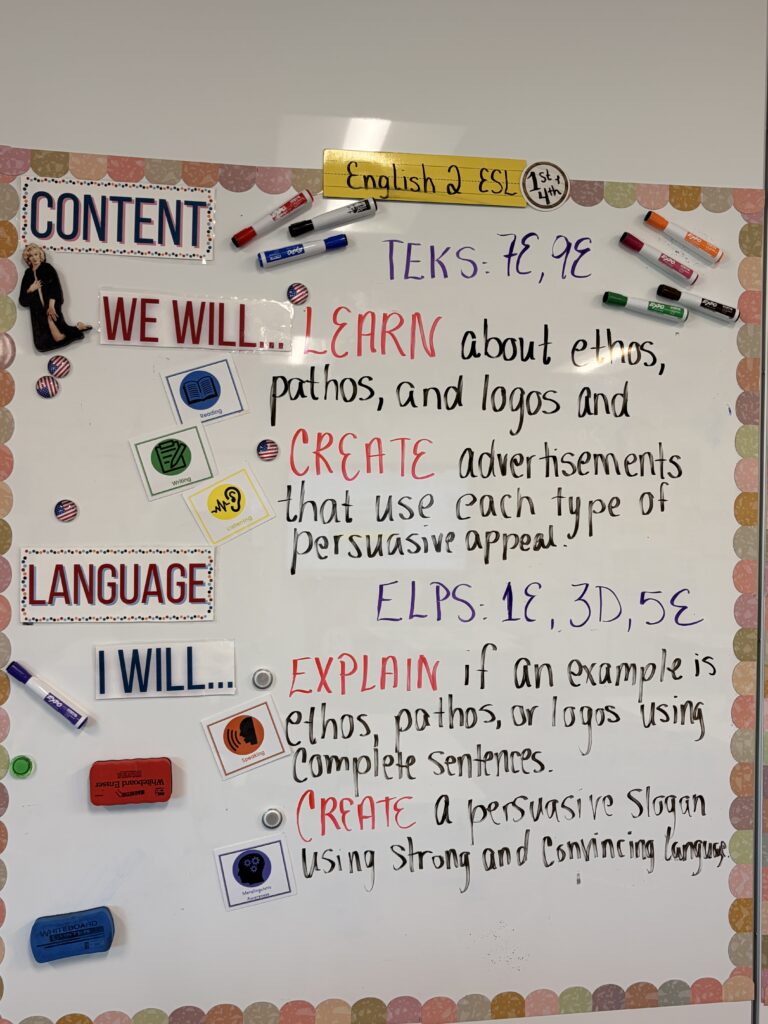
My classroom content and language objective board reminds me to connect what students are learning with the language they need to demonstrate that learning.
Classroom tools I use: I keep my content and language objectives visible on the dry-erase board throughout the lesson. Magnetic dry-erase markers and magnetic board erasers stay attached to the board, so they are easy to reach when I need to update or revise an objective.
A language objective identifies the language students will need to understand or produce during a lesson.
In other words, it explains how students will use one or more of the four language domains:
Listening
Speaking
Reading
Writing
A content objective focuses on what students will learn.
By contrast, a language objective focuses on how students will use language to demonstrate that learning.
For example, imagine that students are studying the causes of the American Revolution.
Content objective:
Students will identify three causes of the American Revolution.
Language objective:
Students will orally explain one cause of the American Revolution using the sentence frame, “One cause of the American Revolution was ___ because ___.”
The content objective identifies the knowledge students need to develop. The language objective identifies the language they will use to express that knowledge.
Why Language Objectives for High School ESL Matter
High school English learners are often expected to complete the same academic tasks as their English-proficient classmates.
For instance, they may be asked to:
Explain a scientific process
Compare historical events
Defend a claim with evidence
Summarize a complex text
Participate in an academic discussion
Write a constructed response
Present information to the class
However, students may understand the content without yet having the English needed to demonstrate that understanding independently.
For this reason, language objectives for high school ESL can be especially valuable.
A language objective helps teachers identify the linguistic bridge between what students know and what they need to produce. Therefore, teachers can maintain meaningful academic expectations while adjusting the language support students receive.
That distinction is central to differentiating ESL instruction in high school. Differentiation should not automatically mean giving English learners easier content. Instead, it often means helping them complete meaningful content through stronger modeling, vocabulary support, sentence frames, visuals, and structured opportunities to speak and write.
Language objectives can help teachers plan supports such as:
Sentence frames
Word banks
Discussion stems
Visuals
Models
Partner rehearsal
Graphic organizers
Academic vocabulary
Transition words
The goal is not to lower the academic expectation.
Rather, the goal is to make the language pathway visible.
A Simple Formula for Language Objectives for High School ESL
You do not need an elaborate template to write a useful language objective.
First, ask three questions:
What will students do?
Which language domain will they use?
What language structure or support will help them succeed?
Next, turn those answers into this simple formula:
Students will + language action + content + language support or structure.
For example:
Students will orally compare two characters using comparative language and the sentence frame, “___ is more ___ than ___ because ___.”
In this objective:
The language action is compare.
The content is two characters.
The language support is comparative language and a sentence frame.
Useful language actions include:
Describe
Explain
Compare
Contrast
Summarize
Sequence
Ask
Respond
Defend
Justify
Retell
Discuss
Write
Present
Analyze
Most importantly, the verb should match what students are actually going to do during the lesson.
For instance, if students are only circling answers on a worksheet, the objective should not claim that they will orally explain or discuss the content. Likewise, if the objective says students will write an evidence-based response, the lesson should actually include writing and evidence.
The language objective should reflect the real student task.
Sentence frames can make this connection much clearer for students. My free ESL sentence starters for teens include practical language supports that can be adapted for discussion, written responses, explanations, and classroom participation.
Teachers who need additional structured speaking practice may also find the Free Teen Talk ESL Conversation Starters | A1 Conversation Cards for Teens helpful. These cards give beginning English learners accessible opportunities to respond in complete sentences while building speaking confidence.
Language Objectives for High School ESL: Content-Area Examples
These language objectives for high school ESL show how teachers can connect academic content with speaking, listening, reading, and writing tasks.
The easiest way to understand language objectives is to see them paired with content objectives. Therefore, the following examples show how the same basic formula can work across several subject areas.
English Language Arts Example
Content objective:
Students will identify the central idea of an informational text.
Language objective:
Students will write a one-sentence central idea statement using the frame, “The central idea of the text is ___ because ___.”
Science Example
Content objective:
Students will explain the stages of the water cycle.
Language objective:
Students will orally sequence the stages of the water cycle using the transition words first, next, then, and finally.
Social Studies Example
Content objective:
Students will compare the governments of two ancient civilizations.
Language objective:
Students will write three comparison sentences using the words both, however, and unlike.
Math Example
Content objective:
Students will solve multi-step equations.
Language objective:
Students will explain the steps used to solve an equation using sequence words and the sentence frame, “First, I ___. Next, I ___. Finally, I ___.”
ESL Grammar Example
Content objective:
Students will distinguish between the simple past and past progressive.
Language objective:
Students will describe an interrupted action using the frame, “I was ___ when ___ happened.”
Reading Example
Content objective:
Students will identify how a character changes throughout a story.
Language objective:
Students will explain the character’s change using evidence from the text and the frame, “At the beginning, the character ___. By the end, the character ___ because ___.”
Speaking Example
Content objective:
Students will evaluate possible solutions to a school-related problem.
Language objective:
Students will participate in a partner discussion using the phrases “I agree because,” “I disagree because,” and “Another possible solution is.”
Students become more independent with this kind of academic language when they use it repeatedly. My post about building ESL speaking routines in high school explains how consistent discussion structures can make speaking feel safer and more predictable.
Students will evaluate whether a school policy is fair.
Language objective:
Students will write a claim and support it with one reason and one piece of evidence using the frame, “I believe ___ because ___. One example is ___.”
Students who need additional support organizing claims and evidence can use a visual writing structure. The ESL Argumentative Essay Outline & Example | Bilingual Writing Resource provides a free model that helps English learners organize a claim, reasons, evidence, and explanation.
Language Objective Examples for Listening, Speaking, Reading, and Writing
If you’d like to see how I organize and display my content and language objectives in a real classroom, take a tour of my high school ESL classroom. You’ll see the whiteboard setup, visual supports, and organization systems I use every day with multilingual learners.
Language objectives do not always have to focus on writing.
In fact, a balanced secondary ESL lesson may involve more than one language domain. However, it is usually best to identify the most important language task instead of trying to include everything in one objective.
Listening Objective Examples
After listening to a short explanation, students will identify three key details.
Using a sequence of oral directions, students will complete a classroom task.
During partner work, students will listen to an opinion and record one supporting reason.
After hearing an audio passage, students will place four events in the correct order.
Speaking Objective Examples
During partner work, students will describe a photograph using complete sentences and at least three descriptive adjectives.
Next, students will ask and answer questions about daily routines using the simple present tense.
In a small-group discussion, students will defend an opinion using a claim and at least one supporting reason.
When responding to a classmate, students will use “I agree because,” “I disagree because,” or “I would like to add.”
Reading Objective Examples
After reading an informational passage, students will highlight words that show cause and effect.
Using a leveled text, students will identify the main idea and two supporting details.
While reading, students will use context clues to determine the meaning of five unfamiliar words.
With a graphic organizer, students will compare information from two short texts.
Writing Objective Examples
Using a planning organizer, students will write a paragraph with a topic sentence, supporting details, and a concluding sentence.
After reading about two traditions, students will compare them using both, unlike, and however.
In three to five sentences, students will summarize a text without including personal opinions.
Using one quotation or detail, students will support a written claim.
For additional ways to scaffold written responses without completing the work for students, see my post on ESL writing support strategies.
Language Objective Examples for Different English Proficiency Levels
Students at different proficiency levels may work toward the same content goal while receiving different levels of language support.
For example, imagine that students are explaining why a character made an important decision.
Newcomer or A1 Language Objective
Using a picture choice and sentence frame, students will identify the character’s decision: “The character decided to ___.”
Possible supports include:
Picture choices
A word bank
A model sentence
Partner support
Gestures
A bilingual glossary
A2 Language Objective
With a sentence frame, students will explain the character’s decision: “The character decided to ___ because ___.”
At this level, students may use:
Sentence frames
Key vocabulary
A partially completed organizer
Partner rehearsal
B1 Language Objective
Using one detail from the text, students will explain the character’s decision.
Helpful supports might include:
Discussion stems
An evidence organizer
Academic vocabulary
A model response
B2 Language Objective
After analyzing the character’s actions, students will defend whether the decision was justified using evidence from the text.
Students may use:
A claim-evidence-reasoning structure
Transition words
An academic discussion guide
A checklist
Although the content remains connected across proficiency levels, the language demand and amount of support change. As a result, students can work toward the same academic goal without being expected to produce the same amount or complexity of English.
This approach is especially useful in mixed-level secondary ESL classrooms. My post on ESL teaching strategies for teens includes additional ways to maintain age-appropriate rigor while providing accessible language support.
For recently arrived students, the objective may first need to focus on functional school language before moving into longer academic responses. My guide to a newcomer’s first 30 days in high school ESL explains how teachers can establish essential routines and survival language during those first weeks.
Some objectives sound academic but do not provide enough information to guide instruction.
Weak Objective
Students will understand the water cycle.
The word understand is difficult to observe or measure. In addition, it does not explain how students will use language.
Stronger Objective
Students will orally explain the four stages of the water cycle using sequence words.
This version tells us:
What students will do
What content they will discuss
Which language domain they will use
Which language feature they will practice
Weak Objective
Students will learn vocabulary.
Similarly, this objective does not identify which vocabulary students will learn or how they will use it.
Stronger Objective
Using five academic vocabulary words, students will write a summary of the passage.
Weak Objective
Students will discuss the story.
Again, this is too broad.
Stronger Objective
During a partner discussion, students will explain the main character’s decision using the stems “I think the character ___ because ___” and “The text shows ___.”
Weak Objective
Students will know the causes of the Civil War.
The word know does not describe a visible language task.
Stronger Objective
Using cause-and-effect language, students will orally explain two causes of the Civil War.
Strong language objectives do not need to be long. Instead, they need to be specific enough to influence the lesson.
How to Write Language Objectives Without Overcomplicating Them
When I write language objectives now, I begin with the student task rather than the standards document.
First, I ask:
What are students actually going to say, read, listen to, or write today?
Then I consider the language they will need.
For example, if students are comparing two texts, they may need:
Comparative language
Transition words
Complete sentences
Evidence-based discussion stems
On the other hand, if students are explaining a process, they may need:
Sequence words
Present-tense verbs
Cause-and-effect language
Content-specific vocabulary
Likewise, if students are defending an opinion, they may need:
A clear claim
Supporting reasons
Evidence
Agreement and disagreement stems
The standards still matter. Nevertheless, they do not have to make the process intimidating.
The language objective should support the lesson you are actually teaching. It should not become a separate assignment for the teacher.
A Quick Process for Planning High School ESL Language Objectives
Before writing the language objective, look at the final student task.
Suppose students will read a short article and write a response explaining the author’s claim.
First, identify the content goal:
Content goal: Identify the author’s claim and supporting evidence.
Next, determine the language task:
Language task: Write an explanation.
Finally, decide what language support students will need:
Language students need: Claim-and-evidence vocabulary, complete sentences, and a sentence frame.
The final language objective might be:
Students will write an explanation of the author’s claim using one piece of evidence and the frame, “The author claims ___, and the text supports this by stating ___.”
Once this becomes a habit, the process can take less than a minute.
This same task-first thinking can also improve beginning-of-year ESL assessments. What students can explain, write, read, and discuss often gives us more useful information than whether they can recognize the correct answer on a multiple-choice worksheet.
Once teachers begin using this task-first approach, writing language objectives for high school ESL becomes much faster and more practical.
Should Language Objectives Be Posted for Students?
Posting language objectives can be useful, but only when students can understand them and connect them to the lesson.
For example, an objective written entirely for administrators may not help students.
Consider this objective:
Students will utilize discipline-specific academic discourse to synthesize information from multiple sources.
It may sound formal. However, many students will not understand what they are expected to do.
A student-friendly version might be:
I can combine information from two texts and explain my answer using academic vocabulary.
You can still use professional language in your lesson plans while displaying a clearer version for students.
Ultimately, the posted objective should help students answer this question:
What kind of language will I use today?
How to Use Language Objectives During the Lesson
Posting the objective is only the beginning.
A language objective becomes meaningful when it appears throughout the lesson.
At the beginning of class, briefly explain the objective.
You might say:
“Today, you are going to compare two characters. You will use the words both, however, and unlike to explain your ideas.”
During the lesson, point students back to the language they need.
For example, you might ask:
“Which comparison word could you use here?”
Before students begin independent work, model the expected response.
Finally, return to the objective at the end of the lesson.
You might ask:
“Were you able to compare the characters using all three transition words?”
This makes the objective part of the learning process rather than a sentence that remains untouched on the board.
One common mistake is trying to include too much in one objective.
For example:
Students will read, annotate, discuss, compare, analyze, write, revise, and present information about two historical events.
That is an entire unit, not one language objective.
Instead, choose the most important language task for that lesson.
Another mistake is relying on vague verbs such as:
Know
Learn
Understand
Become familiar with
These words do not explain how students will demonstrate their learning.
A third mistake is writing an objective that does not match the assignment.
If the objective says students will speak, they should have a meaningful opportunity to speak. Likewise, if the objective says students will write an evidence-based response, the lesson should include instruction and support for writing with evidence.
Finally, teachers sometimes post the objective but never refer to it again. Students should see the connection between the objective, the modeled language, the activity, and the final response.
A Bank of Language Objectives for High School ESL
The following examples can be adapted for secondary ESL and content-area classes.
Describing
Using at least three descriptive adjectives, students will describe a person, place, object, or event.
Comparing
After examining two ideas, students will compare them using both, however, and unlike.
Explaining
Using first, next, then, and finally, students will orally explain a process.
Summarizing
In three sentences, students will summarize the main idea and two key details.
Justifying
Using the frame “I believe ___ because the text states ___,” students will defend an answer.
Asking Questions
During partner work, students will ask three relevant questions using who, what, when, where, why, or how.
Discussing
In a class discussion, students will respond using “I agree because,” “I disagree because,” or “I would like to add.”
Sequencing
After placing five events in order, students will retell them using sequence words.
Presenting
During a one-minute presentation, students will use complete sentences and appropriate transition words.
Analyzing
Using one claim and two pieces of textual evidence, students will analyze the author’s purpose.
Cause and Effect
With the words because, therefore, and as a result, students will explain one cause and one effect.
Making Inferences
Using the frame “I can infer ___ because the text says ___,” students will make and support an inference.
Expressing an Opinion
With two supporting reasons, students will state an opinion using “I believe ___ because ___.”
Language Objectives Can Make Instruction More Intentional
Writing language objectives for high school ESL became easier for me when I stopped trying to make them perfect.
Now, I no longer begin by asking how complicated or official the objective should sound.
Instead, I begin with my students.
First, I identify the learning goal.
Next, I determine the task students will complete.
Finally, I choose the language they will need to succeed.
That is the heart of an effective language objective.
A language objective does not need to impress anyone. Rather, it needs to help the teacher plan purposeful language support and help students understand how they will use English during the lesson.
The objective should change when the lesson changes. In addition, it should connect to the task students are completing and influence the scaffolds we provide.
Most importantly, it should not sit untouched on a dry-erase board for months.
It should live inside the lesson.
For more classroom-tested ideas for teaching middle and high school English learners, visit my secondary ESL teacher blog.
Ready-to-Use Support for High School ESL Language Objectives
Writing the objective is only the first step. Students also need repeated opportunities to practice the language named in that objective.
Ultimately, these resources work best when they are connected to a specific language goal. The objective identifies the language students need, and the activity gives them a meaningful reason to use it.