
If you have been looking for media literacy activities for ESL teens, you already know how important this topic feels right now. Our students are constantly surrounded by headlines, social media posts, videos, screenshots, AI-generated content, and online claims. They need more than vocabulary practice. They need chances to pause, think critically, ask questions, and talk through what they see. That is why media literacy has become such a meaningful part of my secondary ESL teaching. If you also enjoy using structured speaking tasks in class, you might like my posts on conversation starters for ESL teens and ESL teen speaking activities.
For English learners, media literacy can be especially powerful because it blends real-world language with real-world decision-making. Students are not just practicing English for the sake of a worksheet. They are using English to evaluate information, question what they hear, and explain their thinking. That makes discussion more purposeful and much more engaging.
The good news is that media literacy does not have to feel intimidating or overly academic. It can be taught through short, structured speaking activities that help students build confidence while exploring questions that actually matter to them.
Why Media Literacy Activities for ESL Teens Matter
When I think about media literacy activities for ESL teens, I do not just think about “fake news.” I think about helping students learn how to slow down and ask smart questions.
Is this real?
Who posted it?
What is the source?
Is this a fact, an opinion, or just a claim?
Is this headline trying to inform me or manipulate me?
Could this image, audio clip, or video be misleading?
Those are important questions for all students, but they are especially valuable in secondary ESL. Teen English learners are still building language, but they are also old enough to think deeply about the world around them. They deserve activities that respect that maturity, which is one reason I believe rigor in ESL looks different.
Media literacy also creates natural opportunities for:
- speaking and listening practice
- vocabulary development
- critical thinking
- collaborative discussion
- writing extensions
- real-life relevance
That combination is one reason I think these kinds of activities work so well in middle school and high school ESL classrooms.
What Good Media Literacy Activities for ESL Teens Look Like
The best media literacy activities for ESL teens are not overloaded with text or packed with abstract explanations. They should be clear, structured, and discussion-friendly.
I like activities that ask students to respond to short, realistic scenarios. For example:
- a suspicious giveaway post
- a dramatic headline
- a fake voice message
- an AI-generated image
- a rumor spreading in a group chat
- a health claim with no real source
These kinds of prompts are accessible, but they still lead to meaningful conversation.
Good media literacy tasks for English learners should also include support. That might mean sentence frames, key vocabulary, audio support, structured response sheets, partner discussion time, and visual cues. If you teach mixed-level classes, this kind of scaffolding fits closely with differentiating ESL instruction from A1 to B2. And if you want simple language supports students can use right away, my free ESL sentence starters for teens are another helpful option.
That support might include:
- sentence frames
- key vocabulary
- audio support
- structured response sheets
- partner discussion time
- visual cues
When students have those supports, they are much more willing to participate. Instead of shutting down because the topic feels too big, they can focus on expressing ideas, asking questions, and practicing language.
Easy Ways to Use Media Literacy Activities for ESL Teens in Class
One thing I love about this topic is how flexible it is. You do not need an entire unit every time you want to bring media literacy into your classroom. In fact, these prompts fit especially well if you are already working on how to build ESL speaking routines or looking for ways to strengthen ESL speaking confidence activities.
Here are a few easy ways to use media literacy activities for ESL teens:
Bell ringers
Start class with one short scenario and one discussion question. Students can think quietly, turn and talk, or write a quick response.
Partner or small-group discussions
Give students one card and a response sheet. Let them talk through the scenario, listen to each other, and write a final answer.
Stations
Set up different categories around the room such as fact vs. opinion, source check, clickbait, and AI. Students rotate and discuss one card at each station.
Listening and speaking practice
Use audio support so students can hear the scenario and questions before discussing. This is especially helpful for mixed-level groups.
Writing extensions
After students discuss a prompt, have them write a short paragraph about what they think and why.
This is one reason I enjoy using media literacy so much in ESL. The same set of discussion prompts can work as a speaking activity, a listening task, a warm-up, or a short writing assignment.
Topics That Work Especially Well for Secondary ESL
Not every media literacy topic feels equally engaging for teens. The best ones usually connect to things students already see in everyday life.
Some of my favorite discussion topics include:
- fact, opinion, or claim
- real or fake content
- source credibility
- clickbait and headlines
- AI and digital media
These categories feel current without becoming too overwhelming. They also give students a lot to say.
For example, students often have strong opinions about whether AI can be helpful for school, whether people should trust viral screenshots, or how digital tools should be used in class. Those conversations connect naturally to topics like AI in the ESL secondary classroom and even questions about Google Translate in the ESL classroom. That makes discussion feel more natural.
My Free Sample and Full Media Literacy Resource
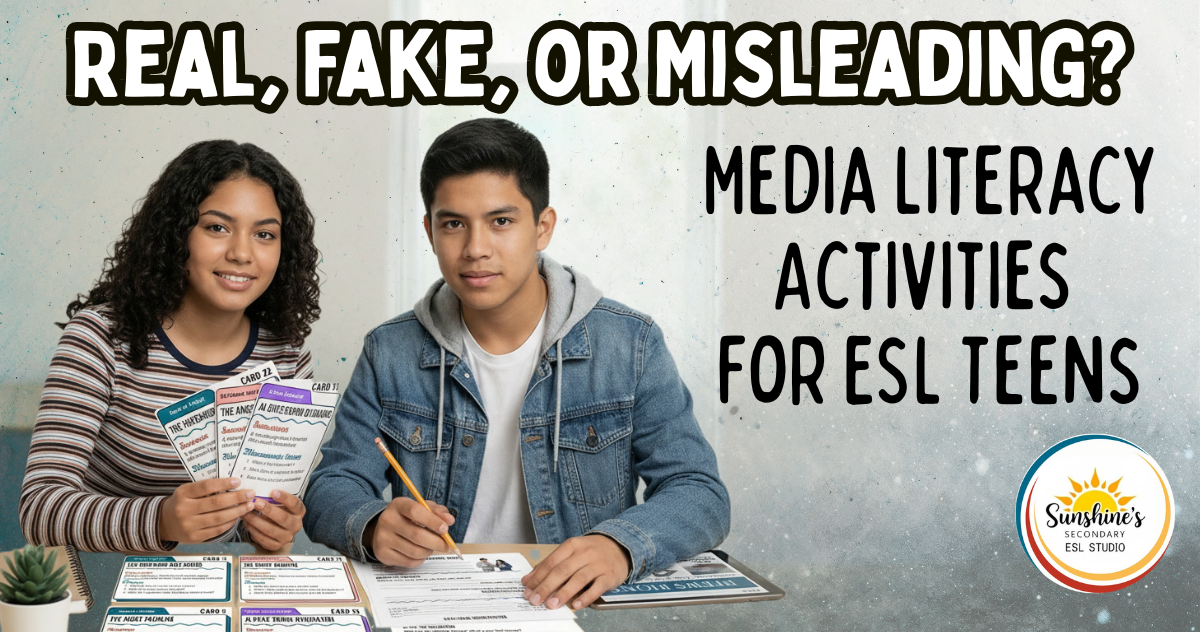
Because I wanted a practical way to bring these ideas into the classroom, I created Media Literacy Cards for ESL Teens in both a free sample and a full paid version.
The free sample includes a small set of printable and digital discussion cards with audio, along with support materials that let teachers try the format in an easy, low-pressure way. It is a nice way to see how media literacy discussion can work with English learners before jumping into the full set.
The full paid resource includes a larger collection of media literacy discussion cards with audio support, printable and digital formats, sentence frame supports, vocabulary supports, and student response pages. I designed it to work well for secondary ESL, ELD, and mixed-level English learner classrooms.
What I especially like about this resource is that it gives students structured language support while still letting them talk about topics that feel current and relevant. The audio also helps students who benefit from hearing the scenario and questions before responding.
I wanted these cards to feel useful, flexible, and age-appropriate — not childish and not overly complicated.
Why Audio Support Matters
One of the features I am most excited about in this resource is the audio.
For many students, especially multilingual learners, hearing the prompt can make a big difference. Audio support can help with:
- comprehension
- pronunciation
- confidence
- independent work
- station use
- accessibility for mixed-level classes
Sometimes a student understands much more once they hear the question aloud. That is one reason I think digital audio support can make media literacy activities for ESL teens even more effective.
Final Thoughts on Teaching Media Literacy in ESL
Media literacy is not just another trend. It is a real need in our classrooms, and it fits beautifully into secondary ESL instruction.
When students learn to question a headline, verify a source, or discuss whether something is real, fake, or misleading, they are doing much more than practicing English. They are building the habits of thoughtful readers, listeners, and communicators.
And honestly, that is one reason I keep coming back to media literacy activities for ESL teens. They feel relevant. They feel meaningful. And they give students a real reason to use language in ways that matter beyond the classroom.
If you want to try this with your students, you can start with my free Media Literacy Cards for ESL Teens sample and then explore the full Media Literacy Cards for ESL Teens resource with audio for even more discussion prompts and supports.
Teaching The Tell-Tale Heart to ESL Teens: Adapted Reading, Audio & Activities
The Monkey’s Paw ESL: How to Teach the Classic Short Story to English Learners
Beginning-of-Year ESL Assessments for High School Students