
It would be an understatement to say that getting high-intermediate students to speak is easy. Even when they have the vocabulary and grammar knowledge, many teens hesitate to participate.
That’s why B2 ESL speaking activities are so important—they give students structured opportunities to express ideas, opinions, and personal experiences in real time.
Without regular speaking practice, students risk becoming learners who can write well but struggle to speak confidently.
In this post, I’m sharing some of my favorite B2 ESL speaking activities that actually work with teens in real classrooms.
If you’re looking for ideas across proficiency levels, you might also enjoy ESL Teen Speaking Activities.
Why B2 ESL Speaking Activities Need to Be Intentional
Simply asking students to “talk” in English is rarely enough.
Many B2 learners can write thoughtful responses, but reading those aloud doesn’t build real fluency.
What students truly need are on-the-spot speaking opportunities.
These moments push them to:
- organize thoughts quickly
- negotiate meaning
- communicate without a script
Strong B2 ESL speaking activities go beyond surface-level conversation. They help students develop academic language and confidence.
One of the most effective ways to support this is by building predictable routines: How to Build ESL Speaking Activities
And if you’re teaching mixed-level classes, differentiation becomes essential: Differentiating ESL Instruction for A1 to B2
B2 ESL Speaking Activities That Work in Real Classrooms
1. Problem-Solving Prompts
These give students real-world situations that require critical thinking.
Example:
“What would you do if your friend broke your phone?”
Why it works: Students practice conditionals, modals, and transitions.
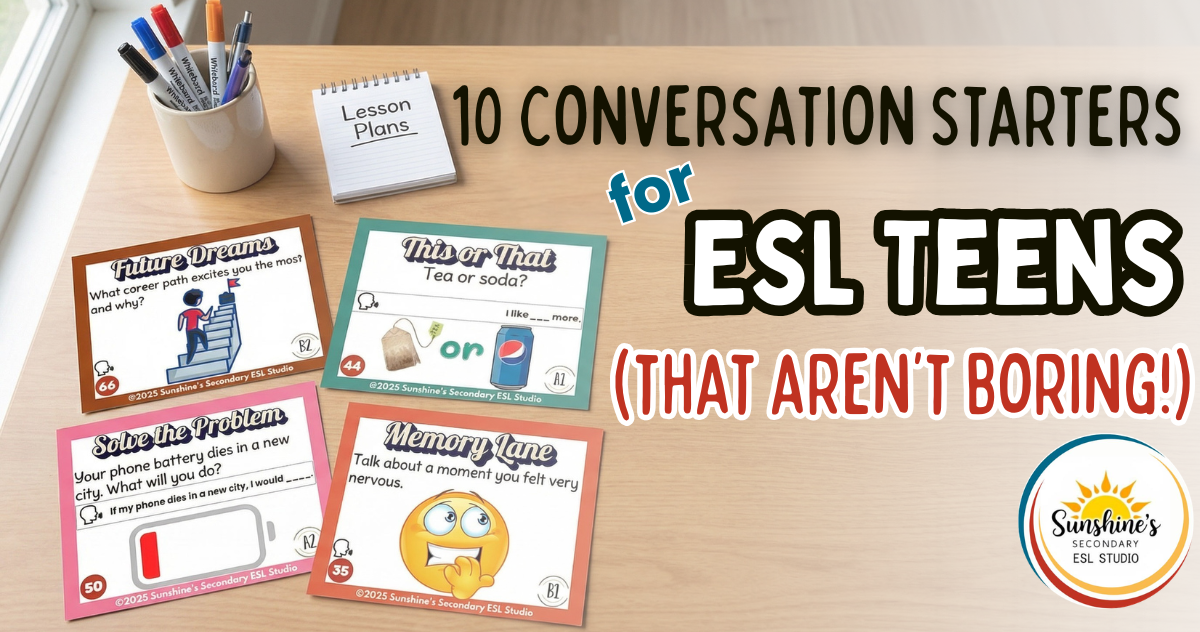
This is one of the core categories in my B2 ESL Conversation Starter Cards.
2. Memory-Based Storytelling
Students recount real or imagined past experiences.
Example:
“Describe a time you felt angry with a friend.”
Tip: Pair with sentence frames for support.
These also connect well with social-emotional learning: Social Emotional Learning for ESL Teens
3. Speed-Dating Style Speaking Circles
Students rotate partners and repeat conversations.
Why it works:
- reduces whole-class pressure
- builds fluency through repetition
- increases speaking stamina
If you need structured prompts, students can quickly start with conversation cards.
4. Roleplay with Real-Life Scenarios
Students practice real-world communication:
- asking for help
- making complaints
- ordering food
These B2 ESL speaking activities prepare students for real-life situations.
If you want a simple entry point, try this free role-play activity: Beginner ESL Speaking Activity
5. Fast-Paced Word Games
Sometimes fluency comes from lowering the pressure.
One of my favorites is Word Dash!—an ESL-friendly version of ¡Basta!
Students race to fill categories with words starting with the same letter. It becomes energetic, competitive, and highly engaging.
👉 Try it here: FREE Word Dash! Traditional Vocabulary Game for ESL | Inspired by the Game Basta
Tips to Make B2 ESL Speaking Activities More Effective
Use sentence stems and question stems: Free ESL Sentence Starters for Teens
Provide a word bank before speaking activities so students feel prepared.
Encourage low-stakes speaking. Overcorrecting shuts students down quickly.
Give students wait time so they can process and respond more thoughtfully: Wait Time Strategies in the ESL Classroom
Why It Matters
Speaking is often the last skill ESL teens develop—and it’s usually due to lack of practice.
Using consistent B2 ESL speaking activities helps students build:
- confidence
- fluency
- real communication skills
If your students still hesitate, confidence-building strategies can make a big difference: ESL Speaking Confidence Activities
Ready-to-Go B2 ESL Speaking Activities
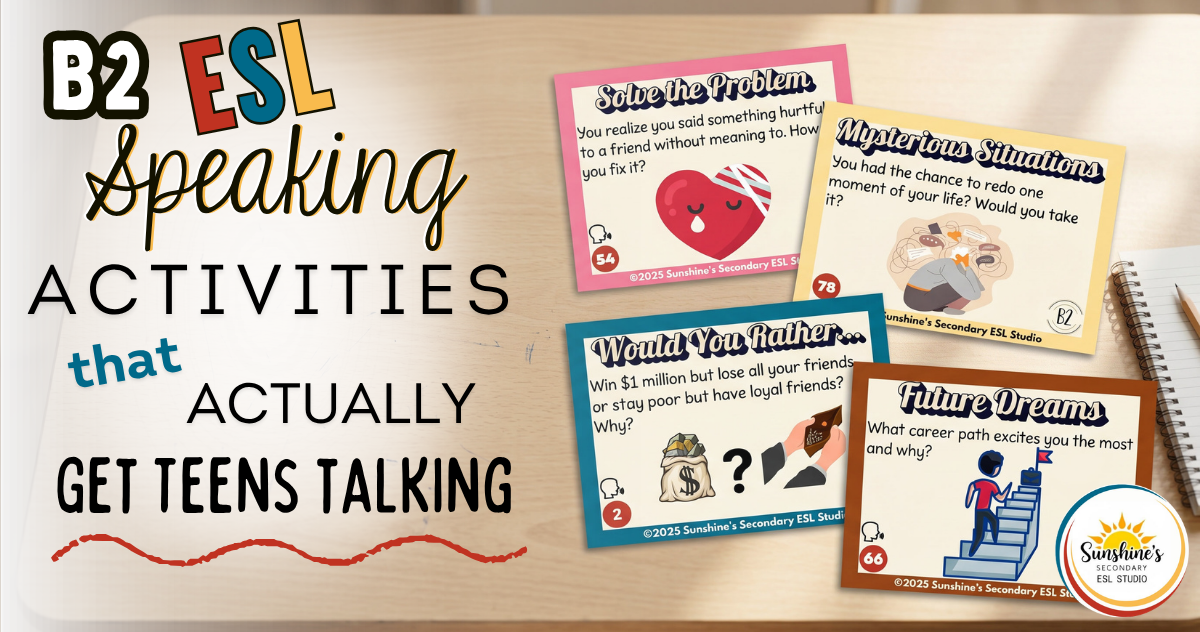
If you’re looking for structured, reusable speaking activities, my B2 ESL Conversation Starter Cards were designed for exactly this.
With 80 prompts across 10 categories, they help students move beyond scripted responses and actually start talking.
👉 Grab them here: Teen Talk ESL Conversation Cards | B2 Level
Track Speaking Growth Without Killing Confidence
If you also want a simple way to track speaking progress without making it feel babyish, I share that here: ESL Teen Pronunciation Dolch Sight Words Test