
Let’s be real—no two ESL students walk into your room with the same needs. If you’re trying to provide effective ESL grammar supports for high school students, you’ve probably realized pretty quickly that one-size-fits-all just doesn’t work.
Some students are brand-new to English and still figuring out classroom routines. Others can chat about TikToks all day but panic when it’s time to write a paragraph. And then you’ve got your silent observers—students who understand way more than they’re willing to say aloud.
If you’re teaching a mix like this, you’ll also find a lot of overlap with strategies used in Culturally Responsive Teaching ESL Teens—because meeting students where they are is everything.
In a perfect world, we’d have time to sit beside each student and offer the exact grammar support they need, exactly when they need it. But we all know how that goes—bell rings, announcements start, and someone needs to go to the nurse before you’ve even finished taking attendance.
That’s where consistent, visible grammar supports come in.
What Are ESL Grammar Support Tools (and Why They Work)
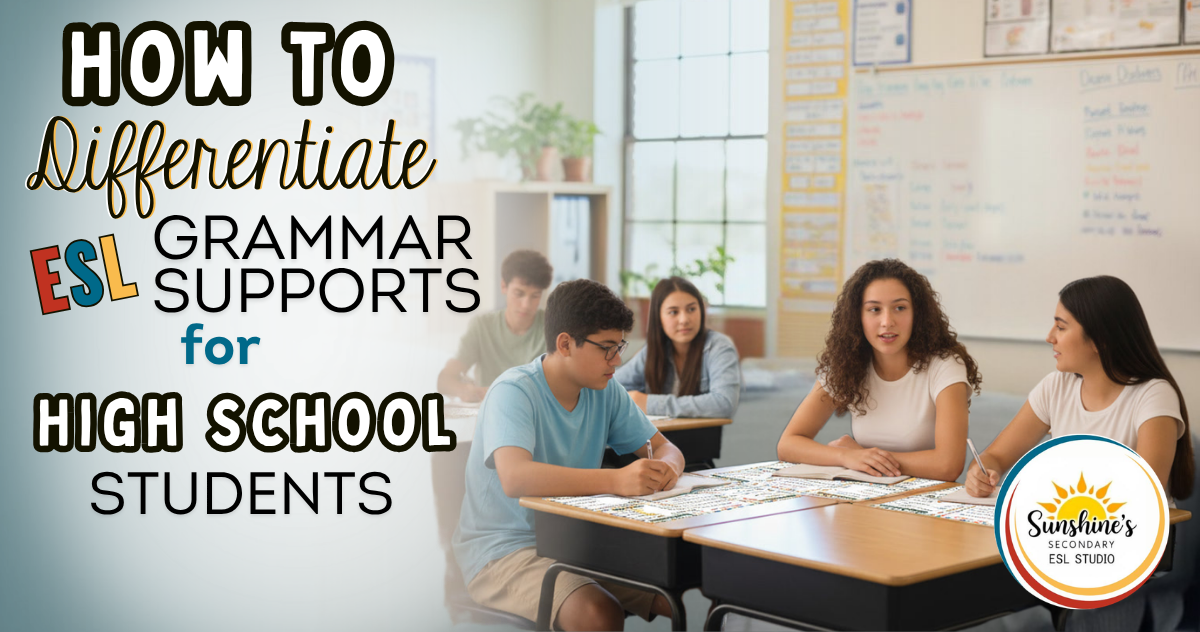
If you’ve never used desk mats before, imagine a grammar anchor chart shrunk down to fit right on a student’s desk. These are reference tools with visuals, sentence frames, reminders, and examples—all laid out in a clear, student-friendly way.
They’re especially powerful for multilingual learners because they remove barriers:
- No flipping through notebooks
- No waiting for help
- No shutting down mid-sentence
Students can glance down, double-check their sentence, and keep going.
Honestly, they function a lot like the sentence scaffolds you might already use—like the ones I share in Free ESL Sentence Starters for Teens—but in a more permanent, always-available format.
Why Differentiation Matters in ESL Grammar Support
The reality is, ESL scaffolding strategies only work when they match student level.
Here’s what that actually looks like in a high school classroom:
- A1 learners need survival-level language:
sentence starters, visuals, basic vocabulary
“I like ___.” “This is a ___.” - A2 learners are expanding:
questions, past tense, descriptive language - B1 learners are communicating but inconsistent:
verb tense confusion, missing articles, irregular verbs - B2 learners are refining accuracy:
transitions, complex sentences, academic tone
If everyone gets the same support, it breaks down fast.
This is something I go deeper into in Differentiating ESL Instruction A1–B2—because differentiation isn’t extra work, it’s what makes everything else actually work.
A Simple Way to Differentiate Without Creating 4 Lessons
One of the easiest ways I’ve found to support multiple levels at once is by using leveled grammar reference tools that stay consistent across activities.
Instead of rewriting assignments, I adjust the support.
That’s why I started using leveled ESL desk mats in my classroom. Each version (A1–B2) aligns to what students are realistically producing—so they’re not overwhelmed or under-supported.
👉 If you want something ready to go, this is exactly how I use my
Survival English Desk Mats (A1–B2 levels) from my TPT store.
They’re designed to:
- match proficiency levels
- provide sentence frames students actually use
- stay on desks as a daily support tool
And if you prefer flexibility, I also use editable desk mats so I can adjust wording, add translations, or align with whatever we’re working on that week.
How I Use ESL Grammar Supports Daily
Here’s where this really starts to pay off—because these supports become part of your routine.
During warm-ups
Students use them to build complete sentences during bell ringers or quick writes.
During speaking activities
They double as scaffolds for partner conversations—especially for hesitant speakers. (This pairs really well with structured speaking routines like the ones in Conversation Starters for ESL Teens.)
During writing
Instead of getting stuck, students keep going.
During assessments
They reduce anxiety and help students actually show what they know.
Over time, you’ll notice fewer repeated grammar questions—and more independent work.
Want to Try It Without Committing? (Free Option)
If you’re curious but not ready to jump into a full system, start small.
You can grab a free version here:
👉 Free ESL Progressive Tense Desk Mat
It’s simple, focused, and gives students immediate support with am / is / are + -ing, which is one of those areas that always comes up.
Final Thoughts
When it comes to ESL grammar supports for high school, the goal isn’t to create more work—it’s to create smarter systems.
You don’t need four versions of every lesson.
You just need the right scaffolds in the right places.
And when students have consistent support in front of them:
- they write more
- they speak more
- and they build confidence faster
If you want to explore more strategies like this, you can always head back to my main hub here:
👉 ESL Teacher Blog