

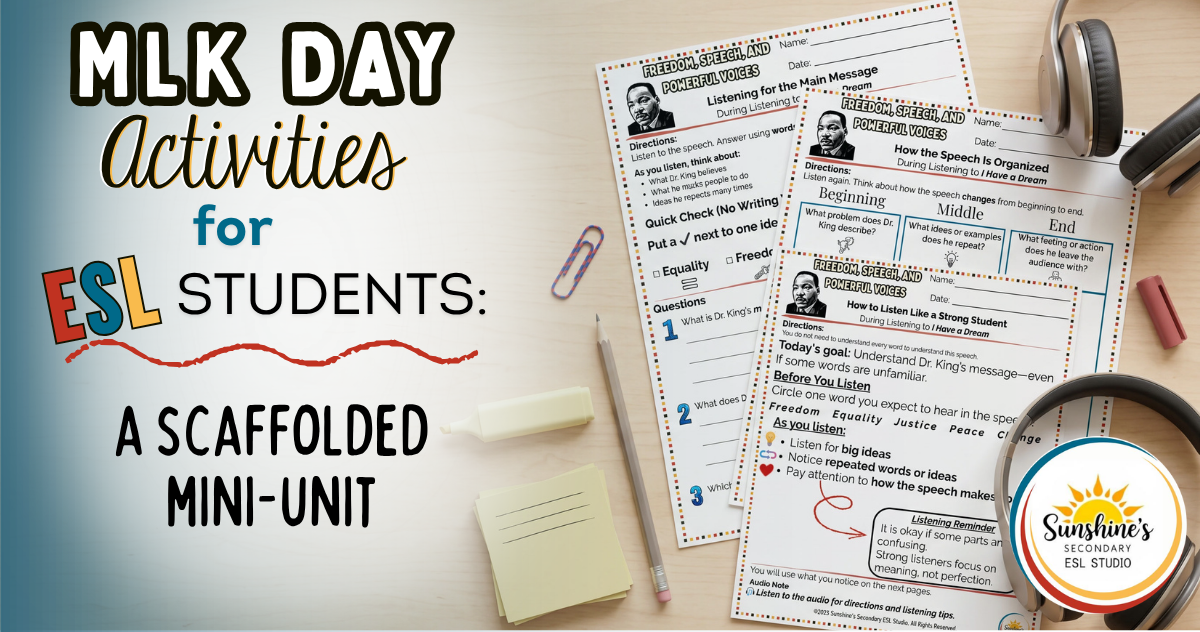
Finding meaningful MLK Day activities for ESL students can be difficult because many lessons assume students already understand the civil rights movement and the language used in Martin Luther King Jr.’s speeches. English learners may recognize ideas such as fairness and freedom, yet unfamiliar historical context and abstract vocabulary can still make full participation challenging.
This lesson sequence is designed for middle and high school English learners, including newcomers, mixed-level classes, and students working across approximately CEFR A1–B2. You can use the activities during one class period or combine them into a short Martin Luther King Jr. Day mini-unit.
Throughout the lesson, students build background knowledge, develop vocabulary, read an accessible informational text, listen to part of the “I Have a Dream” speech, discuss important ideas, and complete a short written response. Most importantly, each activity includes language support so students can engage with the topic without lowering the level of thinking.
Why MLK Day Activities for ESL Students Need Scaffolding
Martin Luther King Jr. Day gives students an opportunity to study an important period in United States history while exploring larger ideas such as justice, equality, opportunity, and peaceful change.
However, several barriers may affect comprehension.
Some students have limited background knowledge about segregation, the civil rights movement, or the March on Washington. Others may recognize Martin Luther King Jr.’s name without understanding why his speeches are still studied.
In addition, the “I Have a Dream” speech includes figurative language, repetition, historical references, and abstract vocabulary. Even students with strong conversational English may struggle to explain words such as equality, injustice, and discrimination.
Rather than avoiding the speech or simplifying the ideas too much, teachers can provide better entry points. Visuals, background information, repeated listening, structured discussion, and sentence frames help students participate more successfully.
MLK Day Activities for ESL Students
The activities below move from background knowledge to vocabulary, reading, listening, speaking, and writing. Teachers can follow the complete sequence or select the parts that best match their students and available class time.
1. Build Background Knowledge for an MLK Day ESL Lesson
Begin by showing three to five photographs connected to Martin Luther King Jr. and the civil rights movement. Useful images might include King speaking at the Lincoln Memorial, people participating in a peaceful march, segregated public spaces, or diverse groups gathering together.
Before giving students historical information, ask them to observe the photographs closely.
Possible questions include:
- What do you notice?
- Who do you see?
- What emotions do you notice?
- What do you think is happening?
- What questions do you have?
To support emerging speakers, provide simple language frames:
- I notice ______.
- I see ______.
- The people look ______.
- I think they are ______ because ______.
- I wonder why ______.
After students examine the images, introduce a short timeline. Include only the information students need for the lesson rather than overwhelming them with too many dates and names.
A simple sequence might include:
- segregation in the United States
- nonviolent protests
- the March on Washington
- the “I Have a Dream” speech
- the continuing recognition of King’s work
At this stage, a KWL chart for ESL students can help students organize their thinking. They can record what they already know, what they want to learn, and what they discover during the lesson.
For newcomers, brief discussion in a home language may also support comprehension. Strategic translanguaging in the secondary ESL classroom allows students to connect difficult ideas to language they already understand before expressing those ideas in English.
2. Preteach Vocabulary for MLK Day ESL Activities
Once students understand the basic context, introduce a small group of essential words. Six to eight terms are usually enough.
Possible vocabulary includes:
- equality
- freedom
- rights
- justice
- segregation
- discrimination
- protest
- dream
Teach each word with a student-friendly definition, an image, a gesture, a synonym, or a brief example. Translation can also be useful, especially when a word is abstract and difficult to demonstrate visually.
For example:
Equality: People have the same rights and opportunities.
Segregation: People are separated because of their race or another part of their identity.
Protest: People publicly show that they disagree with something and want it to change.
The word dream deserves special attention. Students may first think of images or stories experienced while sleeping. Therefore, explain that a dream can also mean a strong hope for the future.
Next, ask students to complete a quick matching, sorting, or example-and-nonexample activity. This additional practice helps them recognize the words before they encounter them in a reading or speech.
For more ideas, see these vocabulary-building strategies for high school ESL students.
During the lesson, students can use frames such as:
- Freedom means ______.
- Equality is important because ______.
- One right people should have is ______.
- King’s dream was that ______.
3. Use an MLK Day Anticipation Guide
An anticipation guide encourages students to think about the major themes before reading or listening.
Create three to five agree-or-disagree statements connected to fairness, opportunity, peaceful protest, and social change.
For example:
- Everyone should have the same opportunities.
- Peaceful protest can change society.
- Words can change people’s minds.
- One person can influence an entire country.
- A law can be legal but still be unfair.
First, students respond independently. This quiet thinking time allows them to form an opinion without being influenced by the group.
Afterward, partners compare one or two responses. To make the conversation more accessible, provide sentence starters and frames for ESL students.
Useful frames include:
- I agree because ______.
- I disagree because ______.
- One example is ______.
- I understand your idea, but ______.
- My opinion changed because ______.
Rather than discussing every statement, choose one or two for a brief whole-class conversation. Later, students can return to the guide and decide whether any of their opinions changed.
A prepared option is available through this free “I Have a Dream” anticipation guide with audio. It can be used before reading or listening and gives students structured language support.
4. Add an Accessible MLK Reading Activity
A short reading gives students important context before they listen to King’s speech.
Choose a brief adapted biography, timeline, or informational passage about Martin Luther King Jr. and the civil rights movement. The text should explain who King was, what problems he wanted to change, how he used nonviolent action, and why the “I Have a Dream” speech became significant.
Start with the topic
Ask students to preview the title, headings, photographs, captions, and bold words. Then give them one broad question:
What is this text mostly about?
Beginners may choose from two or three possible answers. More proficient students can write their own main-idea statement.
Read again for important details
During the second reading, students answer a few focused questions:
- Who was Martin Luther King Jr.?
- What unfair conditions did he want to change?
- What methods did he support?
- What was one important message he shared?
- Why do people continue to study his words?
Four or five strong questions are usually more helpful than a full page of details.
Connect the information
Finally, ask students to complete a short response:
- King believed that ______.
- One problem he wanted to change was ______.
- His message is still important because ______.
For more support with adapting text and questions, explore these strategies for ESL reading comprehension in high school.
5. Listen to a Short “I Have a Dream” Excerpt
Students do not need to hear the entire speech during one lesson. Instead, choose a one- or two-minute excerpt that includes clear repetition or an important central idea.
Repeated listening works best when each round has a different purpose.
Listen for the general idea
During the first listen, play the excerpt without stopping. Ask students to focus on the speaker’s overall message and emotional tone.
Possible questions include:
- Does King sound hopeful, angry, serious, or determined?
- What general idea do you hear?
- Which word or phrase do you recognize?
At this point, students should not be expected to understand every word.
Listen again with support
For the second listen, add English subtitles or a short printed transcript. Pause after important sections so students have time to process the language.
Ask learners to underline repeated words or phrases and circle familiar vocabulary from the earlier activity.
Possible questions include:
- What phrase does King repeat?
- What does he hope will happen?
- Which words connect to freedom or equality?
- Who does he include in his dream?
Focus on one language feature
During the final listen, give students one specific feature to notice.
Beginners might listen for a repeated phrase. Intermediate learners can identify details or examples. More advanced students may examine repetition, metaphor, tone, or emotional appeal.
Because repeated listening allows students to focus on meaning before details, it reduces the pressure to understand everything immediately. These ESL listening comprehension strategies for high school can help you adapt other authentic audio and video clips in the same way.
6. Use Structured Partner Discussion
After students build background knowledge and listen to the excerpt, give them time to discuss the ideas with a partner or small group.
Broad questions such as “What do you think about the speech?” can be difficult for English learners. More focused prompts lead to stronger responses.
Try questions such as:
- What does the word dream mean in the speech?
- Why does King repeat the phrase “I have a dream”?
- What change does King want to see?
- Which part of his message is still relevant today?
- Can peaceful words and actions create change?
- What would equality look like in a school?
To support academic discussion, provide frames:
- King’s main message is ______.
- King repeats ______ to emphasize ______.
- I believe this message is still relevant because ______.
- One example from the speech is ______.
- I agree with ______ because ______.
- I would like to add that ______.
Another option is the claim-reason-example structure:
- Claim: I believe ______.
- Reason: This is important because ______.
- Example: One example is ______.
Before asking students to speak, give them time to write a few notes. That short preparation period often leads to more complete answers.
In addition, predictable routines can reduce anxiety. These ESL speaking confidence activities offer more ways to make discussion manageable for reluctant speakers.
7. Assign a Short Written Response
A brief written response allows students to organize ideas developed during reading, listening, and discussion.
Choose one focused prompt instead of asking students to summarize the entire speech.
Possible prompts include:
- Explain one important message in the “I Have a Dream” speech.
- Explain why King’s message was important.
- Describe one way King strengthens his message.
- Explain why part of King’s message is still relevant today.
Support beginning writers
A1–A2 students may use a word bank and sentence frames:
- King wants ______.
- He believes ______.
- This is important because ______.
- One example is ______.
A three- or four-sentence response can still demonstrate meaningful comprehension and language growth.
Guide intermediate writers
A2–B1 learners can use a claim-reason-example structure:
King’s message is that ______. This is important because ______. One example from the speech is ______. This example shows ______.
Extend the task for proficient writers
B1–B2 students can analyze repetition, figurative language, tone, or emotional appeal. Ask them to include a specific example from the excerpt and explain how it strengthens the message.
Graphic organizers, models, word banks, and sentence frames should support students without completing the work for them. These ESL writing support strategies can help students move from oral rehearsal to an organized paragraph.
8. End with an Exit Ticket
Finish the lesson with a brief reflection that students can complete in one or two minutes.
Possible prompts include:
- One important idea I learned today is ______.
- One word that connects to King’s message is ______ because ______.
- King’s message is still important because ______.
- One question I still have is ______.
- I have a dream that ______.
An exit ticket does not need to be a formal assessment. Its purpose is to check whether students can express one clear idea from the lesson.
The responses can also guide future instruction. For instance, if many students identify vocabulary but cannot explain the main message, the next lesson may need additional discussion or writing support.
How to Differentiate MLK Day Activities for ESL Students
The central ideas can remain the same for everyone, even when students need different levels of language support.
Support A1 learners and newcomers
Use photographs, a brief visual timeline, and four to six essential vocabulary words. In addition, limit the listening excerpt to a short segment.
Responses may include matching, labeling, short phrases, or complete sentence frames. Bilingual dictionaries, translated keywords, and home-language discussion can also help students access the content.
Build independence with A2 learners
Provide an adapted reading, a short transcript excerpt, literal comprehension questions, and sentence frames. Before whole-class sharing, allow students to rehearse answers with a partner.
Written responses may consist of three to five connected sentences supported by a word bank.
Increase analysis for B1 learners
Ask students to identify the main idea, supporting details, tone, and repeated language. They can also participate in claim-reason-example discussions and write a structured paragraph using evidence.
Extend learning for B2 students
Challenge proficient learners to analyze repetition, metaphor, word choice, emotional appeal, audience, or purpose.
As an extension, they might compare King’s message with another speech, text, or current issue connected to equality and peaceful change.
For more ideas, see how to differentiate ESL instruction for A1–B2 learners.
One-Day MLK Day Activities for ESL Students
Teachers with one class period can use a shortened version of the sequence.
- 10 minutes: Examine images and establish historical background
- 10 minutes: Preteach essential vocabulary
- 10 minutes: Complete an anticipation guide
- 15 minutes: Listen to a short speech excerpt twice
- 10 minutes: Discuss one question with a partner
- 5 minutes: Complete an exit ticket
For a 90-minute block, add the short reading and written response.
These MLK Day activities for ESL students can also be expanded when you have more than one class period.
A Two- or Three-Day MLK Mini-Unit
A longer mini-unit allows students to spend more time on each language skill.
Begin with Background and Reading
- Analyze historical photographs
- Complete a KWL chart
- Learn essential vocabulary
- Read an adapted biography or historical passage
- Revisit the anticipation guide
Move into Listening and Speaking
- Preview the speech excerpt
- Listen for the main idea
- Listen again with subtitles or a transcript
- Identify repetition and important vocabulary
- Participate in structured partner discussions
Finish with Writing and Reflection
- Review the central ideas
- Analyze one language or rhetorical feature
- Plan and write a short constructed response
- Share selected responses
- Complete an exit ticket or final reflection
Optional Ready-to-Use MLK Resources
The activities in this post can be created with materials you already have. However, teachers who prefer a prepared sequence can explore the MLK ESL Mega Bundle.
The bundle brings together reading, listening, speaking, writing, speech analysis, and assessment activities designed for secondary English learners. It provides an optional way to follow the same scaffolded progression without preparing each component separately.
Frequently Asked Questions About MLK Day ESL Lessons
How do I teach MLK Day to beginner ESL students?
Start with photographs, a visual timeline, and a small set of essential vocabulary words. Then use a short reading and only a brief speech excerpt. Matching activities, word banks, and sentence frames help beginners demonstrate understanding before they produce longer responses.
How can I simplify the “I Have a Dream” speech for English learners?
Choose a short excerpt instead of playing the entire speech. Before listening, teach the most important vocabulary. During a second listen, add subtitles or a short transcript. Each listening round should have one clear purpose.
What can advanced ESL students analyze in the speech?
B1–B2 students can examine repetition, metaphor, tone, word choice, emotional appeal, audience, and purpose. They can also explain how a particular technique strengthens King’s message.
How can I teach this lesson in a mixed-level ESL class?
Keep the same topic and essential question while changing the response demands. Beginners may label images or complete sentence frames. Intermediate students can write a paragraph, while advanced learners analyze rhetoric or develop a longer evidence-based response.
How long should an MLK Day ESL lesson take?
A shortened version can fit into one class period. By contrast, the full sequence works well as a two- or three-day mini-unit.
Final Thoughts
These MLK Day activities for ESL students give secondary English learners several ways to understand and respond to Martin Luther King Jr.’s life and message.
By building background knowledge first, teachers create a stronger foundation for vocabulary, reading, listening, speaking, and writing. As a result, students can engage with an important historical topic without reducing the level of thinking.
You do not need to use every activity. Instead, select the components that match your students’ English proficiency, course goals, and available time.
Newcomers may need visuals, bilingual support, and complete sentence frames. Meanwhile, more proficient learners can examine repetition, metaphor, tone, and persuasive techniques.
Ultimately, the goal is not simply for students to recognize a famous speech. The deeper goal is for them to understand its central ideas, discuss those ideas with others, and use English to express a thoughtful response.