
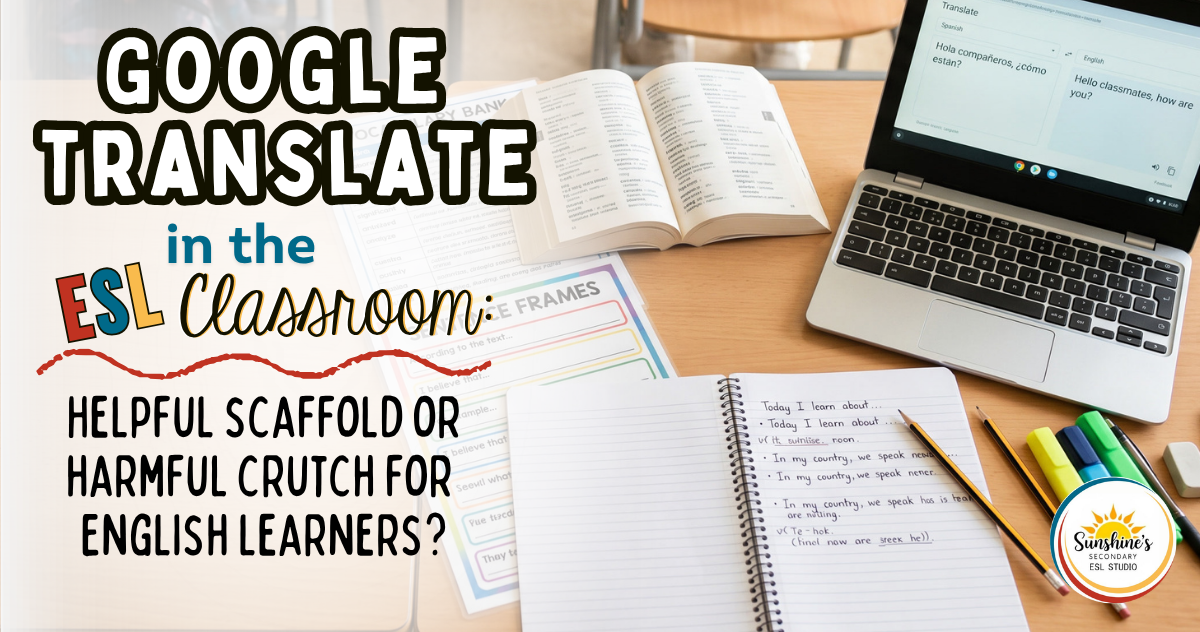
The role of Google Translate in ESL classroom instruction sparks ongoing debate among teachers. Some educators see it as a quick scaffold for comprehension, while others worry it may slow authentic language development.
As a high school ESL teacher, I’ve watched both sides play out in real classrooms. When used thoughtfully, translation tools can help students access challenging content. But without clear guidance, Google Translate can quietly replace the thinking and language practice students actually need in order to grow.
Understanding how to manage Google Translate in the ESL classroom is key to helping multilingual learners build independence while still receiving the support they need.
Why Teachers and Students Like Google Translate
Many students—and even some teachers—view Google Translate as a quick way to stay afloat in a challenging academic environment.
Translation apps provide almost instant comprehension, helping learners decode unfamiliar vocabulary and keep lessons moving. For students who are still building confidence in English, this quick support can reduce frustration and allow them to participate more actively in class.
Google Translate can also expose students to multiple vocabulary options or grammatical structures. When learners carefully review and revise translation output, they may broaden their vocabulary and improve accuracy.
However, translation should never replace authentic communication. This is why I focus heavily on structured speaking opportunities like ESL Teen Speaking Activities and Conversation Starters for ESL Teens, which encourage students to practice real language rather than relying on translation tools.
Used sparingly and strategically, Google Translate can act as a scaffold—but it should never become the main structure holding language learning up.
Where the Cracks Show With Google Translate in the ESL Classroom
Despite its convenience, there are several reasons teachers should approach Google Translate in the ESL classroom with caution.
Accuracy and nuance problems
Idioms, figurative language, and even simple sentence structures can confuse machine translation. Students may unknowingly submit writing that sounds unnatural or incorrect in English.
Over-reliance
When students automatically translate every sentence, they skip the productive struggle of forming language themselves—the process that actually builds proficiency.
Fossilized errors
If incorrect translations go unchecked, students may internalize mistakes that later become difficult to correct.
Reduced cognitive processing
Language learning thrives on experimentation, self-correction, and reflection. Instant translations can short-circuit those important moments of growth.
Many researchers describe this as the “crutch effect”—a tool designed to support learning ends up replacing the thinking learners need to do.
This is why strategies like Wait Time Strategies in the ESL Classroom are so powerful. Giving students a few extra seconds to process language often reduces the impulse to immediately translate everything.
State Testing Reality Check
There’s also a practical reason to limit Google Translate use: standardized testing.
On exams such as STAAR and many other U.S. state assessments, English learners may be allowed bilingual dictionaries—but Google Translate is not permitted.
If students rely exclusively on Google Translate, they may never develop the skill or confidence to navigate a bilingual dictionary efficiently.
Teaching dictionary use as a classroom routine helps students build independence long before testing day arrives. In fact, these routines are often part of larger language-support strategies like Differentiating ESL Instruction A1–B2, where students gradually take on more responsibility for their own language development.
When Google Translate Might Be Necessary
It often takes considerable effort for teachers to secure hard-copy bilingual dictionaries in every language represented in their classrooms.
Until those resources are available, limited Google Translate use can be a temporary lifeline for newcomers—especially for quick vocabulary checks or emergency comprehension support.
However, this should remain a short-term support, not a permanent solution.
As students develop stronger reading and vocabulary skills—especially those who may initially be ESL Students Reading Below Grade Level—they gradually rely less on translation tools and more on their developing English proficiency.
Support Students With Word Banks and Sentence Frames
One of the most effective ways to reduce dependence on translators is to strategically teach the vocabulary students will actually need.
Providing word banks for key topics and sentence frames for common classroom tasks reduces the pressure to “find every word” independently.
For example, a science lab might include vocabulary such as:
measure
observe
record
Students might also receive sentence frames like:
“I observed that ___ changed when ___.”
These scaffolds allow students to focus on communication rather than constant translation.
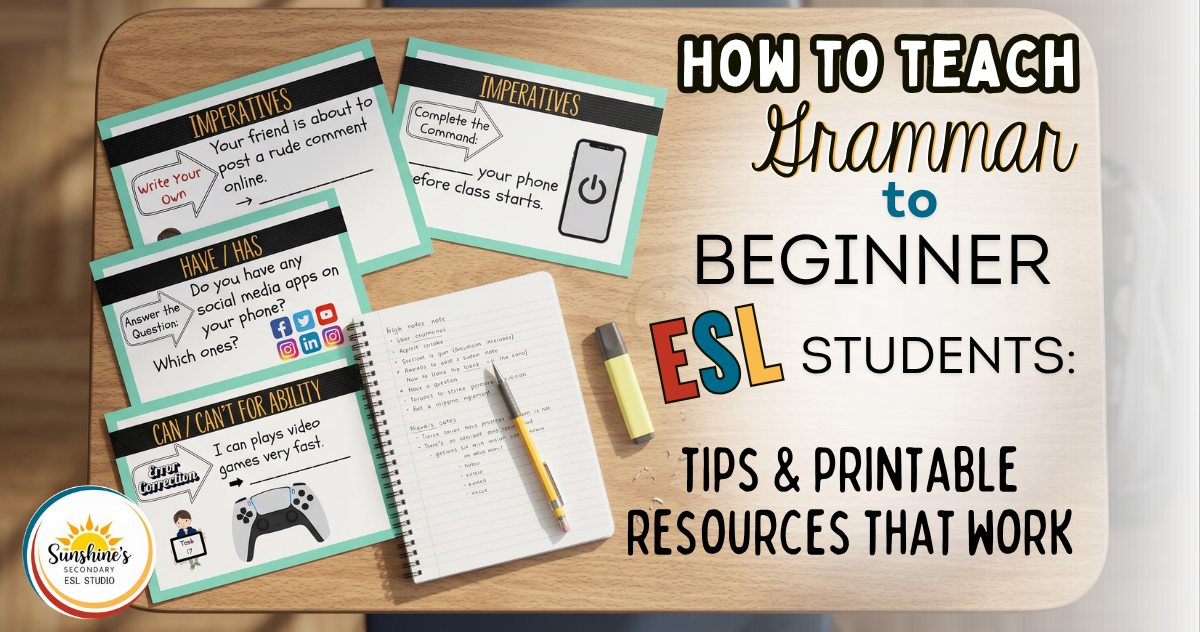
Many teachers build these supports into activities such as ESL Grammar Task Cards, ESL Writing Support Strategies, or structured listening activities like Cloze Listening Activities for ESL Students so students always have language tools available.
A Middle Ground: Responsible Use of Google Translate in the ESL Classroom
Outright banning Google Translate can backfire. Instead, thoughtful guidelines help students use it responsibly.
Set clear boundaries
Allow Google Translate for single-word lookups or brief phrases—not full sentences or essays.
Teach post-editing
Model how to review translation output and correct unnatural phrasing.
Gradually wean students off it
As proficiency improves, reduce the situations where translation tools are allowed.
Provide strong language supports
Word banks, sentence frames, bilingual glossaries, and structured speaking activities should always be available.
These strategies shift Google Translate from an all-purpose translator to an occasional support tool.
They also pair well with approaches like Translanguaging in the Secondary ESL Classroom, where students strategically use both languages to strengthen understanding.
Classroom Management Matters
Managing Google Translate in the ESL classroom is not only about technology—it’s also about classroom expectations.
Include guidelines for translation tools in your syllabus. Model appropriate use during lessons. You might even ask students to note when they relied on translation tools while completing an assignment.
Treat Google Translate the same way you would treat any powerful classroom technology: provide boundaries while guiding students toward independence.
Key Takeaways for ESL Teachers
Balance, not bans
Structure and guidance are more effective than outright prohibition.
Build metacognition
Teach students to question and revise Google Translate output.
Prepare for testing
Help students practice bilingual dictionary skills early.
Provide language supports
Word banks and sentence frames reduce the need for translation.
Encourage authentic communication
Activities such as ESL Speaking Confidence Activities help students practice thinking and responding directly in English.
Final Thoughts
The debate over Google Translate in ESL classroom settings isn’t really about whether the tool is good or bad. The real question is how teachers guide students to use it responsibly while continuing to develop their English skills.
By combining strategic vocabulary instruction, structured language supports, and clear expectations, teachers can help students transition from relying on translation tools to communicating independently in English.
And ultimately, that confidence and independence are the goals of every ESL classroom.
If you’re looking for classroom-ready activities that help students build real language skills without relying on translation tools, you can explore my resources here:
👉 ESL Resources for High School Students
Many teachers use my grammar task cards, reading bundles, and speaking activities to provide the word banks and sentence frames students need to work independently.
You can browse my most popular resources in my store, Sunshine’s Secondary ESL Studio, on Teachers Pay Teachers.