
There are some poems I’ve always loved as an English teacher but hesitated to bring into my high school ESL classroom. Some felt too abstract, too symbolic, or simply too difficult for multilingual learners who were still building foundational English skills.
Emily Dickinson was one of those poets.
For years, I assumed poems like Hope is the Thing with Feathers would overwhelm my ESL students. Phrases like “perches in the soul” and Dickinson’s unusual writing style can already feel intimidating to native English speakers, so I worried my English learners would disconnect from the poem immediately.
But this year, I decided to approach poetry differently.
Instead of expecting students to adapt to the text, I adapted the support around the text.
That shift completely changed the experience for my students.
Teaching poetry to ESL students became far more successful once I started focusing on scaffolds, visuals, leveled texts, audio support, and emotional connection instead of simply “covering” a poem.
And honestly? It worked even better than I expected.
If you teach secondary ESL, you may also enjoy my posts about supporting ESL students during novel studies and why rigor looks different in ESL classrooms.
Why Poetry Matters in the ESL Classroom
Poetry can feel intimidating in high school ESL classrooms, especially for newcomer and beginner-level students. Many teachers worry that figurative language, symbolism, and abstract themes will overwhelm multilingual learners.
But I’ve actually found the opposite can happen when poetry is scaffolded carefully.
Short poems often work beautifully for ESL students because they:
- expose students to rich vocabulary
- encourage emotional connection
- support repeated reading
- build speaking confidence
- create opportunities for discussion
- help students analyze language in manageable chunks
Poetry also gives students space to respond personally, even when their English is still developing.
That emotional connection matters.
Some of the best classroom conversations I’ve had with ESL teens started with short poems that allowed students to reflect on identity, hope, fear, belonging, and resilience.
If you enjoy using emotionally meaningful texts with multilingual learners, you might also like my posts about social emotional learning for ESL teens and building speaking confidence in ESL classrooms.
Why I Chose “Hope is the Thing with Feathers”
Hope is the Thing with Feathers is short, powerful, and packed with meaning. Even though it’s only a few stanzas long, the poem introduces students to metaphor, symbolism, imagery, and emotional interpretation.
At the same time, it’s deceptively difficult.
For many ESL students, even understanding the title requires support. Words like feathers, perches, and soul are not everyday vocabulary for beginner English learners.
Still, I kept coming back to the poem because the central idea of hope feels incredibly universal.
My students immediately connected to the idea that hope continues during difficult times. Once the language barriers were reduced, students had genuinely thoughtful reactions to the poem.
That’s when I realized teaching poetry to ESL students is absolutely possible — but the scaffolding has to be intentional.
What Scaffolding Looked Like in My ESL Classroom
For this lesson, scaffolding meant much more than simplifying vocabulary words.
I wanted students to actually experience the poem emotionally instead of just translating line by line.
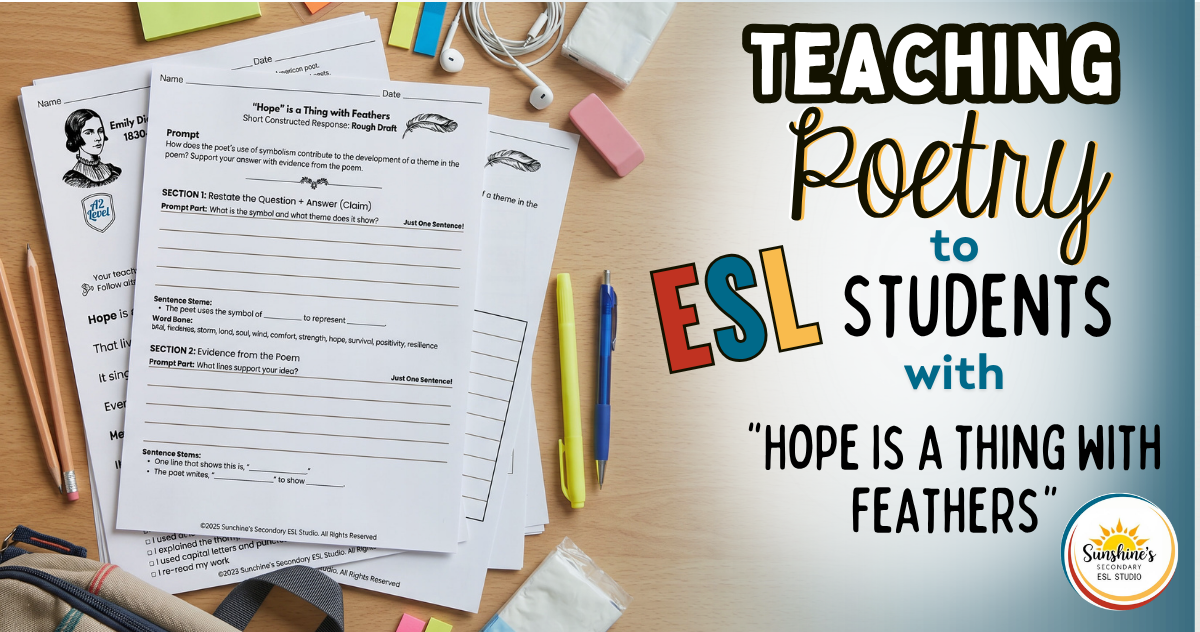
To make that possible, I created four leveled versions of the poem:
- A1
- A2
- B1
- B2
Each version was carefully adapted to match what students at that proficiency level could realistically process independently.
For my beginner and newcomer students, that included:
- shorter sentences
- simplified wording
- visual vocabulary support
- beginner-friendly definitions
- cleaner formatting
- listening support through MP3 audio
For higher-level students, I kept more of Dickinson’s original language while adding supports like:
- vocabulary guidance
- comprehension scaffolds
- discussion prompts
- analysis support
I also created:
- student-friendly Emily Dickinson biographies
- printable PDFs
- Google Slides versions
- PowerPoint versions with embedded audio
Keeping everything visual and organized made a huge difference for my ESL teens.
If you teach multi-level classes, you may also enjoy my posts about differentiating ESL instruction from A1-B2 and supporting ESL students reading below grade level.
Teaching Poetry in Multi-Level ESL Classrooms
One of the biggest challenges in secondary ESL is teaching students with completely different English proficiency levels in the same room.
That’s one reason I love leveled poetry resources.
Instead of giving every student the exact same text and hoping for the best, students can interact with the same themes and ideas at a level they can actually understand.
My newcomer students focus on:
- key vocabulary
- basic comprehension
- listening support
- visual understanding
Meanwhile, my higher-level students can analyze:
- metaphor
- symbolism
- tone
- figurative language
- emotional meaning
Everyone participates in the same lesson — just with different levels of support.
That’s incredibly powerful in high school ESL classrooms because students still feel included in a shared learning experience.
This approach also works well with other literature activities like The Necklace ESL activities, The Boy in the Striped Pajamas ESL guide, and teaching Julius Caesar to ESL students.
Want to Try the A1 Version for Free?
If you’re curious how this works in practice, I created a FREE A1-level version of Hope is the Thing with Feathers for beginner ESL students.
The free resource includes:
- the adapted poem
- a simplified Emily Dickinson biography
- beginner-friendly vocabulary definitions
- MP3 listening support
- Google Slides and PowerPoint versions with embedded audio
It works well for:
- newcomers
- beginner ESL students
- listening stations
- sheltered English classes
- mixed-level classrooms
The lesson is short, accessible, and designed specifically for multilingual teens.
You can grab the free A1 poetry resource here:
Hope is the Thing with Feathers – A1 ESL Poetry Freebie with Audio
If you use listening activities frequently, you may also enjoy my posts about ESL listening activities for high school and cloze listening activities for ESL students.
Ready for All Four Levels?
The full resource includes A1, A2, B1, and B2 versions of the poem along with:
- printable PDFs
- leveled vocabulary support
- MP3 audio
- Google Slides
- PowerPoint files with embedded audio
- listening and reading scaffolds for every level
It’s designed specifically for secondary ESL teachers who want to make poetry more accessible without removing the emotional depth of the original text.
You can find the complete resource here:
Hope is the Thing with Feathers – Leveled ESL Poetry Bundle with Audio (A1–B2)
You may also enjoy these related poetry and literature posts:
- Langston Hughes “I, Too” ESL activities
- ESL graphic organizers for literature
- ESL reading comprehension strategies for high school
Teaching Poetry to ESL Students Really Can Work
If you’ve ever felt nervous about introducing poetry to your ESL students, especially newcomers or beginner English learners, I completely understand.
But with the right scaffolds, even complex poetry can become accessible, emotional, and meaningful for multilingual students.
This lesson quickly became one of my favorite ways to build:
- vocabulary
- listening confidence
- discussion skills
- emotional connection
- literary analysis skills
Most importantly, it reminded me that ESL students deserve access to rich, meaningful literature too.
Sometimes they just need the right supports to get there.