
The Boy in the Striped Pajamas is often taught in middle schools, but I’ve found it to be a powerful choice for high school ESL students as well.
The novel is written from a child’s point of view, which naturally supports inferencing. Its accessible language, emotional themes, and historical context make The Boy in the Striped Pajamas for ESL students a strong option in my classroom.
In my ESL classes, I don’t believe in watering down literature. I still expect students to complete one or two full novels each year. But let’s be honest—many classic texts are packed with difficult vocabulary and heavy cultural references, which can overwhelm language learners.
Choosing a novel students can both understand and connect with is key to building confidence, fluency, and reading stamina. That’s exactly why The Boy in the Striped Pajamas for ESL students works so well.
If you’re teaching a full novel with ESL learners, you might also find these strategies helpful: How to Support ESL Students during Novel Studies
Why This Novel Works for ESL Teens
So why does The Boy in the Striped Pajamas work so well for ESL students?
The answer is simple—students connect with it.
Bruno, the main character, is innocent and unaware of the world around him. This creates a natural opportunity for ESL students to practice inferencing. Many students understand what’s happening before Bruno does, and their reactions show it.
Older ESL teens also begin to notice deeper plotlines. These moments open the door to discussions about symbolism, relationships, and historical context.
Most importantly, the novel allows students to process complex historical events through accessible storytelling—making The Boy in the Striped Pajamas for ESL students both meaningful and manageable.
This kind of connection is especially important when using culturally responsive teaching practices: Culturally Responsive Teaching for ESL Teens
The Challenges ESL Students Faced
Even at higher levels, ESL students often struggle with:
- limited vocabulary
- reading stamina
- background knowledge
That’s why choosing the right novel matters.
The Boy in the Striped Pajamas offers manageable language while still addressing powerful historical themes. When paired with the right supports, it becomes an ideal text for building both comprehension and empathy.
If your students are reading below grade level, you’ll likely see similar challenges: ESL Students Reading Below Grade Level
My Step-by-Step Scaffolded Approach
A. Pre-Reading Activities
Before reading, ESL students need background knowledge and vocabulary support.
- Provide simplified context about the Holocaust and WWII
- Pre-teach only essential vocabulary (not every unknown word)
- Use visuals to support predictions and comprehension
Visuals and structured supports help students stay engaged even when language is challenging.
KWL charts are also a great way to activate prior knowledge: KWL Charts for ESL Students
B. During-Reading Supports
This is where the real scaffolding happens.
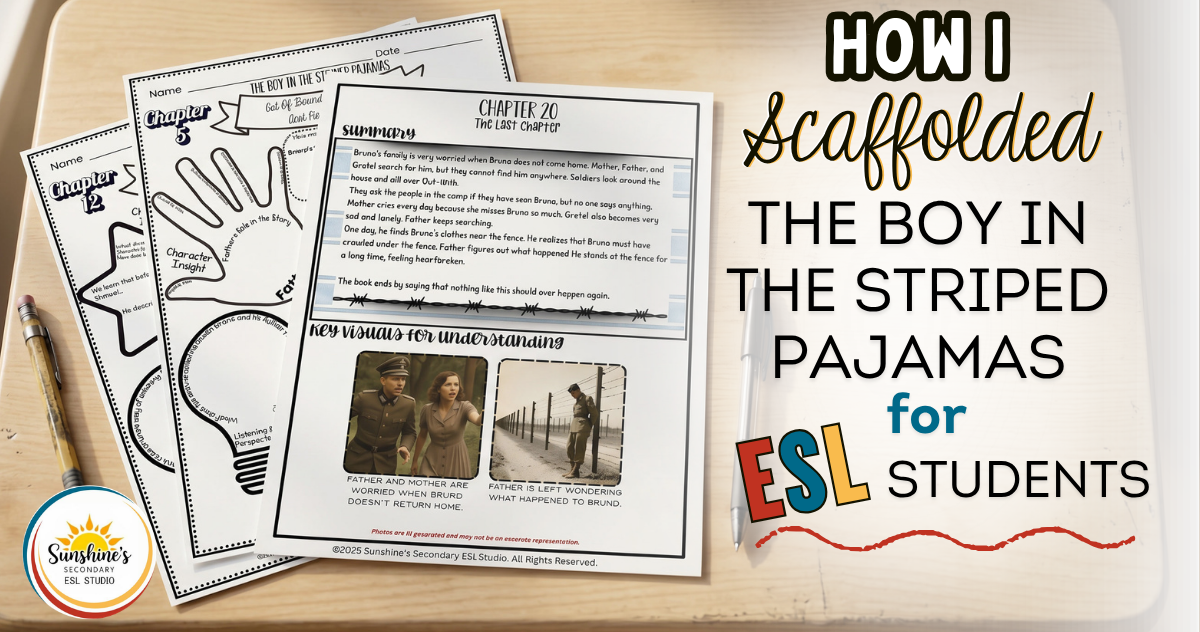
- Simplified chapter summaries before reading
- Visual aids (timelines, character maps, setting visuals)
- Graphic organizers to track key ideas
- Sentence stems for written responses
These supports allow students to focus on meaning instead of getting lost in the language.
Graphic organizers can make a huge difference in comprehension: ESL Graphic Organizers for Literature
If you are interested in my chapter summaries and graphic organizers for The Boy in the Striped Pajamas, you can check them out here 👉 The Boy in the Striped Pajamas Chapter Summaries & Graphic Organizers Bundle
C. Post-Reading Discussions & Writing
After reading, students need opportunities to process and respond.
- Open-ended questions (instead of multiple choice)
- Sentence frames to support responses
- Writing prompts with word banks
- Personal and cultural connections
Sentence frames are especially helpful for building confidence: Free ESL Sentence Starters for Teens
You can also extend this into structured writing activities: ESL Writing Support Strategies
How These Supports Transformed My Classroom
I’ve seen firsthand how scaffolding The Boy in the Striped Pajamas doesn’t take away from the story—it actually deepens it.
One student once said:
“I can’t believe Bruno doesn’t see what is really happening. Maybe kids today are just more aware.”
That moment stuck with me.
It showed that my students weren’t just reading—they were thinking critically, making connections, and engaging with the text on a deeper level.
With the right supports, ESL students:
- build confidence
- improve comprehension
- express complex ideas in English
Want These Scaffolds for Your Classroom?
I created these resources because I couldn’t find what I needed for my own students.
They include:
- Simplified chapter summaries
- Visual supports (characters, setting, plot)
- Designed for A2–B1 learners and mixed-level classes
👉 Check out the full resource here:
The Boy in the Striped Pajamas: ESL Chapter Summaries & Visuals
These are designed to save you time while giving your students the support they need to succeed.
Final Thoughts for ESL Teachers
Our ESL students are more capable than they’re often given credit for.
With the right scaffolds, even complex literature becomes accessible, meaningful, and powerful.
We don’t need to simplify great literature—we just need to support our learners strategically.
When we give students the right tools, they don’t just read…
They think, question, and grow.