
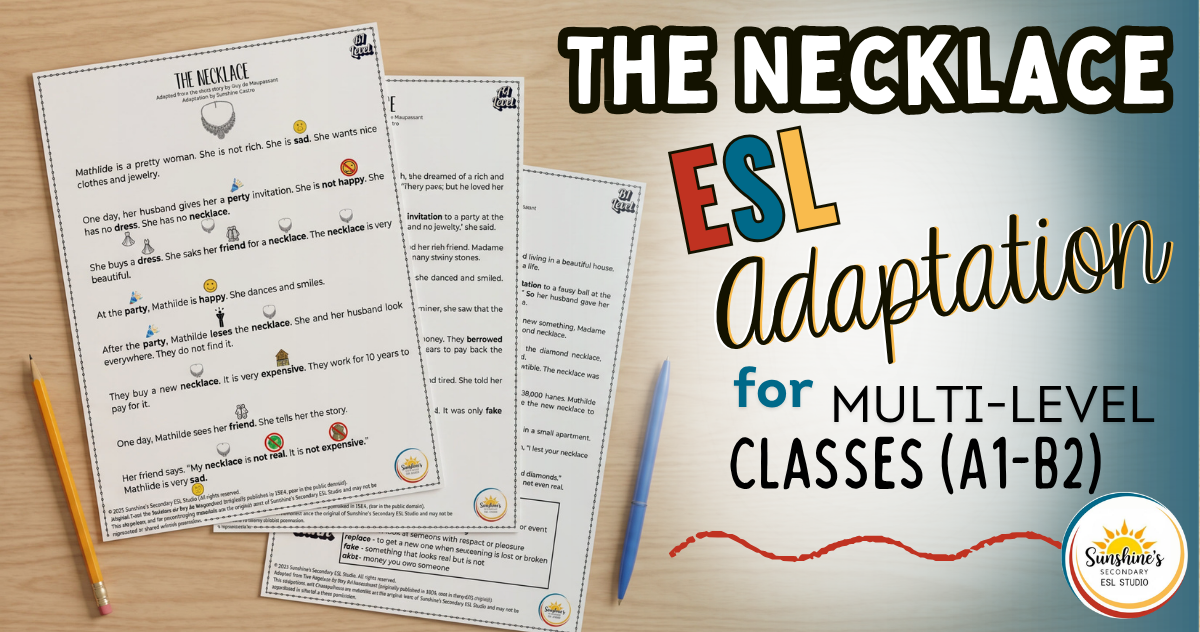
If you’ve ever tried teaching The Necklace by Guy de Maupassant and watched your ESL students completely check out, you’re not alone. That’s exactly why I created my own version of The Necklace ESL adaptation—because the original text simply isn’t accessible for most language learners.
Between 19th-century sentence structure and vocabulary like dowry and exorbitant, even intermediate students can struggle. And when you’re teaching a mixed-level class, it can feel almost impossible to meet everyone’s needs.
If you’re working with a range of proficiency levels, this approach connects closely with how I handle differentiation in my classroom here: Differentiating ESL Instruction for A1 to B2
Step 1: Chunk The Necklace by Events (Not Paragraphs)
One of the biggest shifts I made when building my The Necklace ESL adaptation was organizing the story by key events instead of paragraphs.
Instead of long, overwhelming sections of text, I focused on:
- the invitation
- the borrowed necklace
- the loss
- the years of hardship
- the twist ending
This helped students follow the story without getting lost in language they weren’t ready for.
If your students struggle with longer texts, you might also find this helpful: ESL Students Reading Below Grade Level
Step 2: Add Scaffolding That Builds Independence
Each level of my The Necklace ESL adaptation (A1–B2) includes targeted supports like:
- Vocabulary previews with visuals
- Sentence stems for summarizing and retelling
- Quick comprehension checks after each section
- A mix of multiple choice and open-ended questions
- Graphic organizers for character and theme tracking
These supports don’t just “help”—they allow students to access the text independently, which is where real growth happens.
If you need simple ways to support student responses, you can also use these free sentence starters: Free ESL Sentence Starters for Teens
🎁 Free A1 Version of The Necklace (Try It First)
If you want to see what a The Necklace ESL adaptation looks like in practice, I’ve put together a free A1-level version you can use with your students.
Step 3: Turn The Necklace Into a Speaking Activity
Once students understand the story, that’s when engagement really takes off.
I have students discuss questions like:
- Who was really at fault?
- Was Mathilde justified in her choices?
- What would you have done differently?
Even A2 students have strong opinions when they’re given the right structure and support.
If you’re looking to build more speaking confidence alongside literature, this pairs well with: ESL Speaking Confidence Activities
Why This The Necklace ESL Adaptation Works for Mixed Levels
Here’s what I’ve consistently seen:
When students can understand the story, they:
- participate more
- take risks with language
- engage in deeper thinking
This is exactly what I mean when I talk about rigor in ESL classrooms: Why Rigor in ESL Looks Different
Adapting the text doesn’t lower expectations—it makes meaningful learning possible.
Looking for a Ready-to-Use The Necklace ESL Adaptation?
If you’re looking for The Necklace ESL adaptation across A1–B2 levels, I’ve created a full resource that includes:
- leveled readings
- comprehension questions
- speaking activities
- writing prompts
- print + digital formats
👉 You can explore the full resource here: The Necklace ESL Reading Passages A1–B2 | Differentiated & Editable Resource
Final Thoughts
Classic literature doesn’t have to be off-limits for ESL learners.
With the right supports in place, even a challenging story like The Necklace can become:
- accessible
- engaging
- and meaningful
And once students feel successful reading, everything else—speaking, writing, and confidence—starts to grow from there.
Teaching The Tell-Tale Heart to ESL Teens: Adapted Reading, Audio & Activities
The Monkey’s Paw ESL: How to Teach the Classic Short Story to English Learners
Beginning-of-Year ESL Assessments for High School Students