
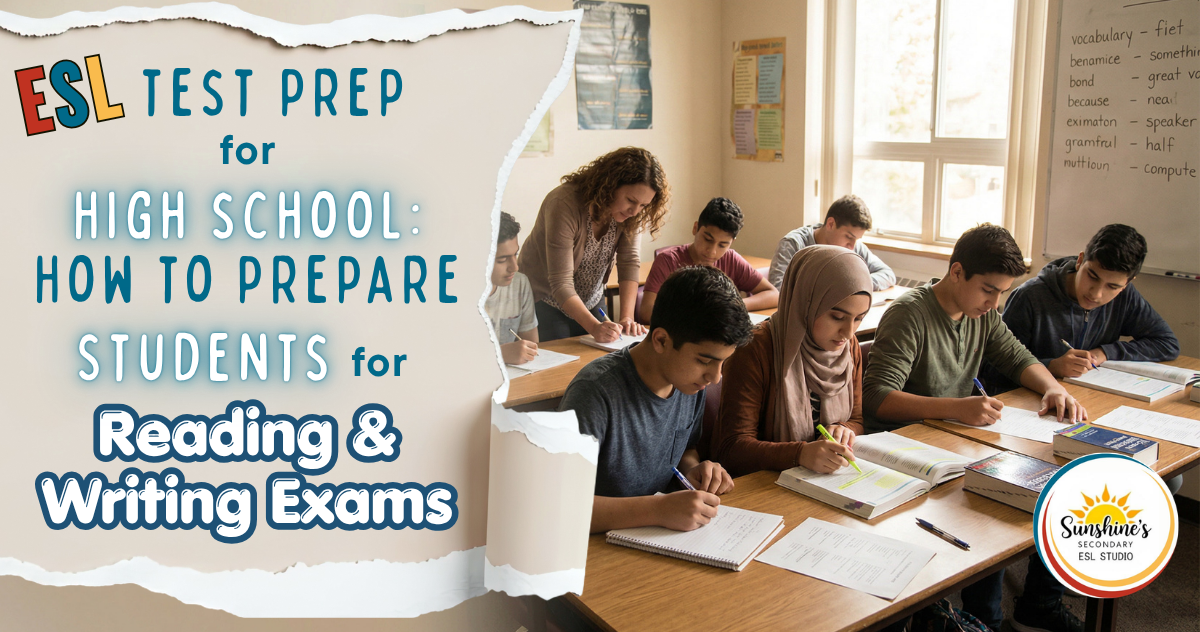
If you teach secondary ESL, then you already know—ESL test prep high school isn’t just about test-taking strategies. It’s about confidence, language development, and helping students access content that often feels just out of reach.
And let’s be honest… traditional test prep can feel overwhelming—for you and your students.
The good news? It doesn’t have to.
With the right approach, you can prepare your students for reading and writing exams without turning your classroom into a stressful test factory.
If you’ve ever worked with students who are still developing reading skills while preparing for exams, you’ll recognize this challenge right away—especially when students are reading below grade level in high school.
Why ESL Test Prep in High School Feels So Challenging
When we think about ESL test prep high school, we’re not just preparing students for a test—we’re supporting:
- Language acquisition
- Academic vocabulary
- Reading stamina
- Writing structure
- Confidence under pressure
That’s a lot.
Many of our students are expected to analyze grade-level texts while still developing basic English skills. So when test prep looks like “read this passage and answer questions,” it often leads to frustration instead of growth.
This is also why rigor in ESL classrooms doesn’t always look the way people expect—it often requires more scaffolding, not less (you can read more about that in why rigor in ESL looks different).
That’s why the key shift is this:
👉 Test prep should feel like skill-building, not test-taking.
Step 1: Build Reading Skills Through Routine (Not Random Practice)
One of the biggest mistakes in ESL reading test prep is inconsistency.
Instead of doing random passages here and there, create a predictable routine your students can rely on.
For example:
- Day 1: Vocabulary preview + discussion
- Day 2: Read + annotate
- Day 3: Comprehension questions
- Day 4: Short written response
This kind of structure is much easier to maintain when you have ready-to-use passages and activities. I often use structured reading resources like my ESL reading comprehension materials to keep this routine consistent without extra prep.
This kind of structure helps students feel safe—and when students feel safe, they take more risks with language.
You’re not just preparing them for a test—you’re training their brain to approach texts with confidence.
This is also why I rely heavily on structured, leveled reading resources in my own classroom. Having passages that already include comprehension questions and built-in writing practice makes it so much easier to stay consistent—especially during ESL test prep high school when time is limited.
Step 2: Teach Students How to Read Test Passages
A lot of ESL students don’t struggle because they can’t read—they struggle because they don’t know how to approach academic texts.
So instead of saying:
“Read and answer the questions…”
Try explicitly modeling strategies like:
- Annotating for key ideas
- Underlining unfamiliar words
- Identifying the main idea after each paragraph
- Asking: What is this mostly about?
If you need structured ways to guide this, using tools like graphic organizers or KWL charts can really support comprehension (I’ve used strategies like these in my KWL charts for ESL students post).
Even something as simple as chunking a passage can completely change comprehension levels.
👉 This is where ESL reading test strategies really start to make a difference.
Step 3: Make Writing Practice Feel Doable
Writing is usually where students shut down the fastest during ESL test prep high school.
So instead of jumping straight into full essays, scaffold the process.
Start with:
- Sentence frames
- Paragraph outlines
- Guided responses
If you don’t already have sentence frames ready, you can grab free ones here: free ESL sentence starters for teens. These make a huge difference in helping students actually get started.
Then slowly release responsibility.
For example:
- Week 1: Fill-in-the-blank responses
- Week 2: Structured paragraph with sentence starters
- Week 3: Independent paragraph
This gradual build helps students feel successful instead of overwhelmed.
I’ve found that using structured writing resources here (especially ones that break down responses step-by-step) can completely change how students approach writing during test prep.
Step 4: Focus on One Skill at a Time
When test prep feels chaotic, it’s usually because too many skills are being taught at once.
Instead, narrow your focus:
- One week = main idea
- One week = context clues
- One week = text evidence
- One week = short constructed response
This makes your instruction clearer—and your students will actually retain what they’re learning.
👉 This is a game changer for ESL exam preparation.
This is especially helpful when preparing for structured assessments like TELPAS or STAAR, where students are expected to demonstrate specific skills in isolation (you can see how I approach this in TELPAS writing practice grades 9–12).
Step 5: Use Speaking as a Bridge to Writing
Before students write, they should talk.
If your students struggle to generate ideas, building speaking routines first can completely change their writing. I’ve seen this work really well using structured activities like conversation starters for ESL teens and simple routines like the ones I share in how to build ESL speaking routines.
This is one of the most underused strategies in ESL writing test prep.
Try this:
- Give students a prompt
- Let them discuss in pairs
- Provide sentence stems
- Then move into writing
When students say their ideas out loud first, their writing becomes stronger and more organized.
And bonus—this also builds confidence for testing situations.
Even simple conversation prompts or role-play activities can give students the language they need before they ever pick up a pencil.
Step 6: Normalize Struggle (and Build Confidence Anyway)
Test prep can easily turn into a cycle of:
“I don’t get it” → shut down → avoid → no growth
Instead, normalize the process:
- Celebrate effort, not just correct answers
- Show model responses
- Let students revise
Confidence plays a huge role in testing success—especially for multilingual learners.
This is also where social-emotional support matters more than we sometimes realize—especially for multilingual learners navigating testing pressure (I talk more about this in social emotional learning for ESL teens).
Step 7: Simulate the Test… But Don’t Live There
Yes, students need exposure to test-like conditions.
But they don’t need it every day.
Try:
- One timed practice per week
- Occasional full-length passages
- Practice bubbling answers or typing responses
The rest of the time?
Focus on skill-building.
That balance is what actually leads to growth in ESL test prep high school.
And if you want to keep students engaged while still building critical thinking skills, even low-pressure activities like logic puzzles or structured games can help reinforce those same skills in a less stressful way (like these ESL logic puzzles for teens).
What ESL Test Prep Should Really Look Like
At the end of the day, strong ESL test prep doesn’t feel like:
❌ Endless worksheets
❌ Silent classrooms
❌ Constant pressure
It should feel like:
✔ Structured routines
✔ Scaffolded support
✔ Opportunities to talk, read, and write daily
✔ Small wins that build confidence over time
Because when students feel capable, their test performance follows.
Final Thoughts
If you’ve ever felt like ESL test prep high school is overwhelming, you’re not alone.
But when you shift from “test prep mode” to “skill-building mode,” everything changes.
Your students become more confident.
Your lessons feel more purposeful.
And test day? It becomes just another day to show what they already know.
If you’re looking for ready-to-use resources to support your ESL test prep high school routines, I’ve created a collection of reading, writing, and speaking activities designed specifically for secondary ESL students. These are the same types of scaffolded tools I use in my own classroom to prepare students for exams without overwhelming them.
Teaching The Tell-Tale Heart to ESL Teens: Adapted Reading, Audio & Activities
The Monkey’s Paw ESL: How to Teach the Classic Short Story to English Learners
Beginning-of-Year ESL Assessments for High School Students